

The New Opium War: Fentanyl, China and the Case for Criminal Accountability

More than a century and a half ago, China learned a brutal lesson about the strategic power of narcotics.
During the nineteenth-century Opium Wars, British commercial interests, backed ultimately by military power, exploited China’s enormous market for opium. Addiction weakened communities, drained wealth and contributed to political instability. The wars and the unequal treaties that followed became embedded in Chinese historical memory as part of what Beijing still calls its “century of humiliation.”
Today, North America should ask whether we are witnessing a twenty-first-century inversion of the Opium Wars—this time with fentanyl, and with the supply chain running in the opposite direction.
The evidence does not establish that the Chinese government has deliberately ordered a campaign to poison North Americans. But substantial evidence shows that China-based chemical manufacturers have become a critical upstream source of the precursor chemicals used to manufacture illicit fentanyl.
The U.S. Department of Justice has described how Chinese chemical companies manufacture and distribute fentanyl precursors and other synthetic opioids, shipping them internationally, including to Mexico, where cartels manufacture finished fentanyl for the North American market. American authorities have indicted numerous China-based companies and individuals for alleged precursor trafficking and related offences.
The U.S. Treasury has gone further, stating that China-based chemical manufacturers remain the primary source of fentanyl precursor chemicals feeding the illicit American market.
This does not prove state-directed chemical warfare. But national-security threats are not limited to conventional warfare. States can be weakened through economic coercion, cyberattacks, disinformation, organized crime, corruption and the exploitation of social vulnerabilities. A narcotic capable of killing tens of thousands of working-age citizens annually deserves to be examined through that same strategic lens.
The death toll is staggering.
The United States experienced three successive waves of the opioid epidemic: prescription opioids beginning in the 1990s, heroin beginning around 2010, and synthetic opioids—particularly illicit fentanyl—beginning around 2013. Between 1999 and 2023, approximately 806,000 Americans died from opioid overdoses.
By 2023, synthetic opioids, primarily fentanyl, were associated with an estimated 74,702 American overdose deaths in a single year.
The trend finally began to improve in 2024. CDC provisional estimates recorded approximately 80,391 total U.S. drug-overdose deaths in 2024, down nearly 27 per cent from 2023, with opioid-involved deaths falling substantially as well.
But a decline from catastrophic levels should not be confused with victory.
Between January 2016 and December 2025, Canada recorded 56,631 apparent opioid-toxicity deaths. In 2025 alone, 5,630 deaths were reported, 96 per cent of them accidental. Fentanyl was involved in 56 per cent of apparent opioid-toxicity deaths and fentanyl analogues in 60 per cent; because substances can overlap, those percentages cannot simply be added together.
The crisis escalated rapidly. Canada recorded 2,832 opioid-toxicity deaths in 2016. The number climbed to 6,429 in 2020, 7,949 in 2021 and 8,606 in 2023 before declining to 7,146 in 2024.
The 2024 provincial breakdown shows a nationwide crisis with stark regional concentrations:
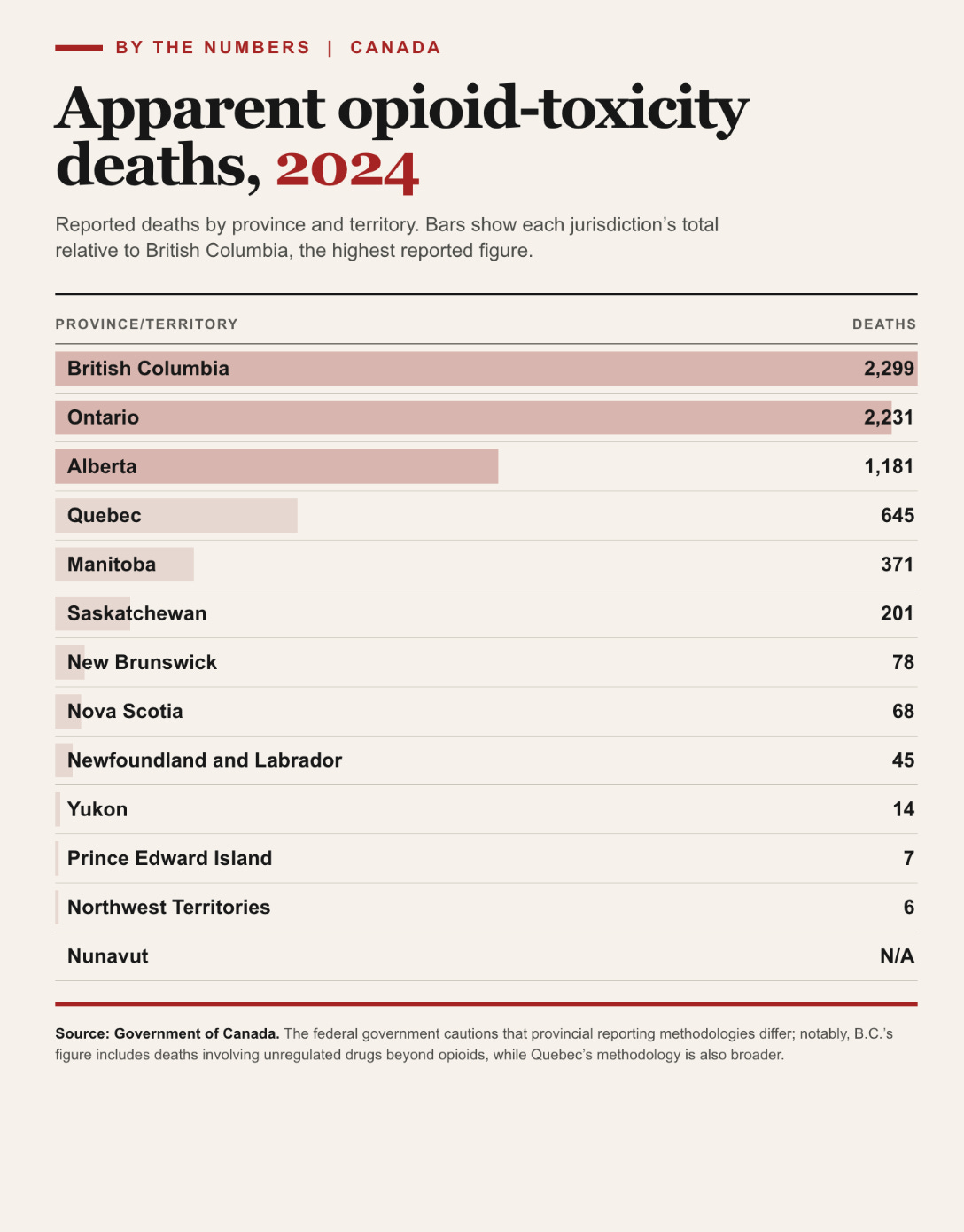
In less than a decade, Canada has lost the population of a small city to opioid toxicity.
Statistics can make the catastrophe seem remote. In Huron County, it has a name: Joey Scrimgeour.
Joey was the son of Brent and Janet Scrimgeour. He died on September 13, 2023, only a few months after his 19th birthday. His obituary remembers a young man who loved the outdoors, drawing, cars, Rubik’s Cubes and geology, and whose family described him as having a genuine heart. Brent has told me that Joey died from an overdose. That loss is one reason Brent reached out and asked me to speak in Exeter on September 17 about the fentanyl and opioid crisis.
For families in rural Ontario, this is no longer a distant threat.
A nineteen-year-old does not have to live on Vancouver’s Downtown Eastside or in a major American city to encounter a lethal illicit drug supply. Fentanyl has reached small towns, farms and communities that once imagined this was somebody else’s problem.
Every annual death total represents parents who will never again hear a son’s voice, siblings who lose a brother, employers who lose a worker, and communities that lose a young person who should have had decades ahead of him.
The human cost comes first, but the economic damage shows how widely the crisis reaches.
Health Canada’s evaluation of the Canadian Drugs and Substances Strategy cites estimates that opioid use cost Canada approximately $7.07 billion, including about $5.26 billion in lost productivity, $1.18 billion in criminal-justice costs, and $519 million in health-care costs.
No estimate can capture a parent’s loss. These figures do show that opioid addiction is draining Canada’s productive capacity and public resources.
The U.S. toll is higher still. The U.S. Congress Joint Economic Committee estimated that the opioid epidemic imposed a cost of nearly US$1.5 trillion in 2020 alone, up 37 per cent from 2017. The methodology incorporates health care, treatment, criminal justice, lost productivity, reduced quality of life and the economic value associated with lives lost.
An epidemic that removes people from the workforce, consumes health-care and policing resources, burdens courts and corrections, damages neighbourhoods and kills citizens in their most productive years is not simply a drug-policy failure. It is an economic-security problem as well as a public-health and national-security threat.
From public-health crisis to criminal accountability
Governments rightly describe fentanyl as a public-health emergency, but that description is no longer enough.
Fentanyl is extraordinarily potent, compact, inexpensive to manufacture and easy to conceal. Unlike agricultural narcotics such as heroin or cocaine, synthetic opioids do not require vast fields of poppies or coca. Production depends upon chemistry, precursor supply chains, laboratories, international logistics and money laundering.
Because a relatively small quantity of precursor chemicals can produce an enormous number of potentially lethal doses, the infrastructure required to destabilize communities is dramatically smaller than that associated with traditional narcotics.
The damage extends far beyond overdose deaths.
I have written about this crisis before, including in my earlier OpEd, “Canada’s Fentanyl Crisis: Why We Must Rethink Our Approach to Illicit Drugs.” My concern has only deepened. Repeating policies because they are politically fashionable, while refusing to examine their unintended consequences, is not compassion. It is avoidance.
The Bureau has documented a fierce and necessary debate over Canada’s ideologically driven approach to drug policy, including allegations from addiction physicians, frontline workers and investigators that diversion from so-called “safer supply” programs can feed black markets and create additional harms.
In writing previously about what I regard as the damaging consequences of “woke” thinking in public policy, I argued against a culture in which uncomfortable evidence can become secondary to approved narratives. The fentanyl crisis is an especially dangerous place for that instinct. When the consequences are measured in dead teenagers, grieving families and billions of dollars of social loss, governments cannot select only the evidence that fits their worldview.
We cannot wish away diversion, trafficking, money laundering or foreign precursor networks. And we should not stigmatize or silence physicians, police officers, addiction workers, families or recovered users who report outcomes that challenge prevailing policy.
Treatment, evidence-based harm reduction and aggressive enforcement against traffickers can coexist.
What, then, is Beijing’s role in the death and devastation fentanyl has inflicted across North America?
Publicly available evidence does not conclusively establish that Beijing deliberately engineered this outcome.
Congressional investigations have found, however, that the Chinese government offered tax rebates to manufacturers of fentanyl precursors on the condition that the products be sold abroad.
As The Bureau has reported, U.S. investigators have also uncovered fentanyl production in Chinese prisons and identified senior CCP members holding “golden shares” in companies linked to fentanyl-precursor supply chains.
But intent is not the only issue.
If companies operating from China knowingly sell precursor chemicals to criminal organizations, disguise shipments, falsify invoices, employ deceptive packaging or facilitate laundering while understanding the destination of those chemicals, North American governments are entitled to treat those activities as something far more serious than ordinary commerce diverted by criminals.
Indeed, U.S. prosecutors have alleged precisely these kinds of concealment techniques by China-based chemical suppliers.
Beijing should recognize the historical irony: China knows better than almost any country what happens when foreign commercial networks profit from addiction while another society bears the human cost.
Canada must also confront the conduct of those who sell the final dose.
Why do we continue to treat the commercial distribution of fentanyl primarily as drug trafficking when the foreseeable consequence of that trafficking is death?
Canada’s Criminal Code already provides an intriguing legal framework.
Section 219 says a person is criminally negligent when, by doing something—or failing to perform a legal duty—the person demonstrates a “wanton or reckless disregard for the lives or safety of other persons.”
Section 220 provides that a person who causes another person’s death through criminal negligence commits an indictable offence punishable, in the ordinary case, by up to life imprisonment.
A fentanyl trafficker today cannot credibly claim ignorance of the drug’s lethality. Dealers know—or ought to know—that illicit powders and counterfeit tablets may contain unpredictable concentrations. They know customers routinely have no reliable means of determining dosage. They know fentanyl is responsible for thousands of deaths every year. And they nevertheless introduce that substance into the marketplace for profit.
That conduct may cross the line from trafficking into wanton and reckless disregard for human life.
This does not mean every dealer should automatically be convicted whenever a customer overdoses.
Canadian criminal law still requires proof beyond a reasonable doubt. Prosecutors would have to establish the elements of the offence, including criminal negligence and causation linking the accused’s conduct to the death. Those requirements matter, particularly in a toxic illicit market where multiple substances and multiple suppliers may be involved.
A difficult prosecution is not necessarily an impossible or illegitimate one.
Where investigators can establish that a trafficker supplied the fentanyl that caused a particular death—and especially where the accused knew the substance contained fentanyl, understood its extreme toxicity, misrepresented its contents, continued selling following previous overdoses, or otherwise demonstrated reckless disregard for customers’ lives—criminal negligence causing death should be seriously considered alongside conventional trafficking charges.
If you knowingly sell an inherently lethal and unpredictably dosed substance for profit, the death of your customer cannot always be dismissed as merely an unfortunate side effect of the narcotics trade.
Sometimes it may be a homicide.
Accountability should extend across the supply chain.
Law enforcement has traditionally concentrated on the visible end of the narcotics economy: street dealers, gangs and cartel importers.
Fentanyl demands a different model.
Investigations should move simultaneously upstream and downstream: from the street dealer to the wholesaler, from the wholesaler to the transnational criminal organization, from the laboratory to precursor brokers, chemical manufacturers, freight forwarders, cryptocurrency networks and professional money launderers.
Financial intelligence may be as important as drug seizures.
A kilogram intercepted at the border removes one shipment. A financial investigation capable of identifying the organizations financing dozens of shipments can dismantle infrastructure.
And where foreign companies knowingly supply precursor chemicals to criminal organizations, Canada should use every instrument available: criminal indictments where jurisdiction permits, sanctions, asset freezes, immigration restrictions, corporate designations, international arrest warrants and coordinated action with allies.
The lesson of the Opium Wars is that narcotics can become more than commodities. When their distribution reaches sufficient scale, they can weaken societies, enrich predatory networks, corrupt institutions and alter relations between states.
China has not forgotten that history. North America should heed it.
https://www.thebureau.news/p/the-new-opium-war-fentanyl-china?utm_source=post-email-title&publication_id=1444443&post_id=212841377&utm_campaign=email-post-title&isFreemail=false&r=rd3ao&triedRedirect=true&utm_medium=email


Post a Comment