

Trump Declassifies Election Documents: Here's What We Know So Far
A large number of declassified documents were released following President Donald Trump’s national address on elections on Thursday night.
While there are plenty of documents to sift through, there are a handful of declassified memorandums from the federal government that circulated warnings on the potential for foreign interference.
One of the key memorandums, from the National Intelligence Council in January 2020, disclosed that “we assess that vote tabulation systems would be difficult to manipulate on a wide enough scale to compromise election results.”
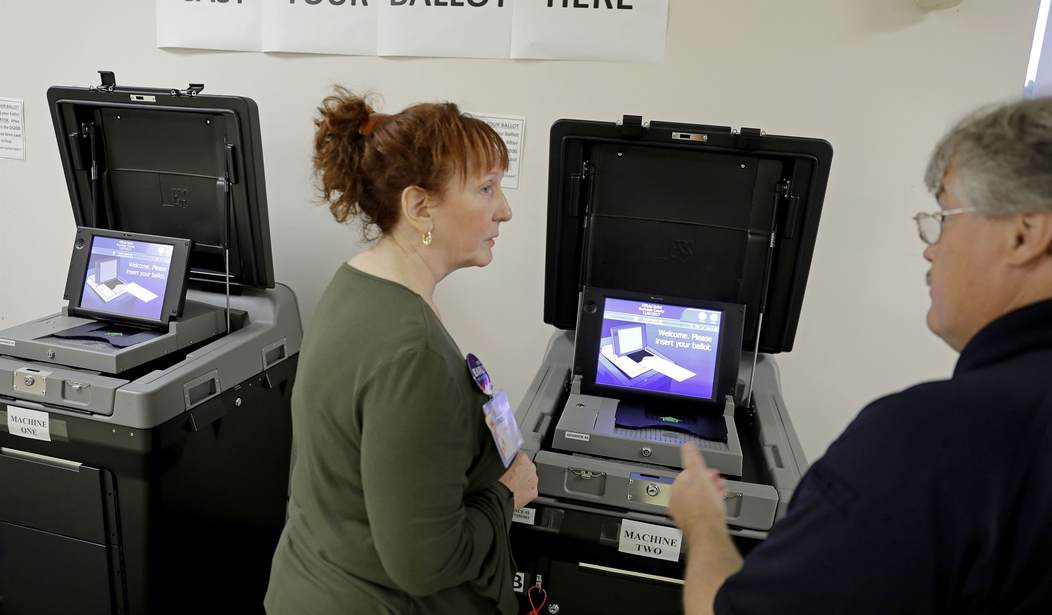
“The systems in each voting location are not connected to the Internet or to each other, and many methods for exploiting them rely on physical proximity,” the memorandum stated.
“Although an adversary could manipulate voting results across multiple jurisdictions and enough states to influence a presidential election, we judge that conducting such a campaign would be difficult and that post-election audits and paper trails very likely would uncover such an effort,” it added.
The same memorandum titled “Vulnerabilities in US 2020 Election Infrastructure” said that the council notes “that US adversaries, including at a minimum Russia, China, Iran, and North Korea, as well as nonstate groups, have the capability to compromise US election infrastructure for the 2020 presidential election.”
“Adversaries gaining access to US election-related systems could disrupt the voting process, steal sensitive data, or undermine confidence in the election results, but we do not know whether any of them have specific plans to manipulate election-related systems,” the memorandum continued.
On China, one declassified document from an unnamed “sensitive government agency” stated that “ahead of the 2020 Presidential Elections, China had extensive plans to utilize potential [redacted] and cyber operations to sway public opinion against the Trump Administration and international opinion against the U.S. Government.”
“The China plans were designed to exploit U.S. societal fissures and vulnerabilities. to influence U.S and other audiences, and by extension U.S. government decision-making. The plans addressed several scenarios, including military conflict between the U.S. and China, as well as other potential crises,” the summarizing document added.
Meanwhile, an August 2020 assessment from the aforementioned intelligence council said that “we assess that China prefers that the President--whom Beijing sees as unpredictable and tough on China-does not win reelection.”
“We assess that hostile actors could also manipulate systems that count or tabulate votes such as voting machines-on a localized basis, but it probably would be difficult to coordinate a campaign to alter voting results on a wide scale,” the August assessment noted.
“Post-election audits and paper trails also most likely would uncover such efforts in the nearly all US states. Similarly, foreign actors would have difficulty coordinating a large scale campaign to manipulate mail-in voting, and robust postal tracking probably would detect any large-scale effort,” the assessment continued.
On the president’s statements regarding noncitizens on voter rolls, a Department of Homeland Security document released in the dump on Thursday night claims that “over 250,000 non-citizens are illegally registered to vote in just the four states for which public data files have been reviewed.”
This does not necessarily mean those individuals registered actually voted in an election, but DHS argues that “states that have adopted alien-first policies instead of American-first policies have a disproportionate number of non-citizens on their voter rolls.”
Following initial publication, Townhall also noticed that many of the documents regarding China are heavily redacted. However, a declassified CIA Note with the subject "Senitive PRC Reporting from 2018-2020" points out that "in mid-2019, the Chinese Government's strategy against the United States was focused on undermining domestic confidence in the U.S. President.
"The strategy included efforts to use Chinese contracts with big U.S. companies to influence U.S. business leaders to turn against the U.S. President," the note stated. "The Chinese Government sought to identify U.S. journalists who had reported negatively on the U.S. President and pay them to write more negative articles about him. The Chinese Government wanted the U.S. President to lose the next election."


Post a Comment