

Trump Administration Announces Section 338 Tariffs at Rate of 50% Across Wide Range of Canadian Goods and Imports
It is very obvious from the construct and details of this announcement that U.S. Trade Representative Jamieson Greer has completed a comprehensive review of the retaliatory action by Canada that followed the U.S. Section 232 tariffs on Steel and Aluminum. {FACT SHEET HERE}
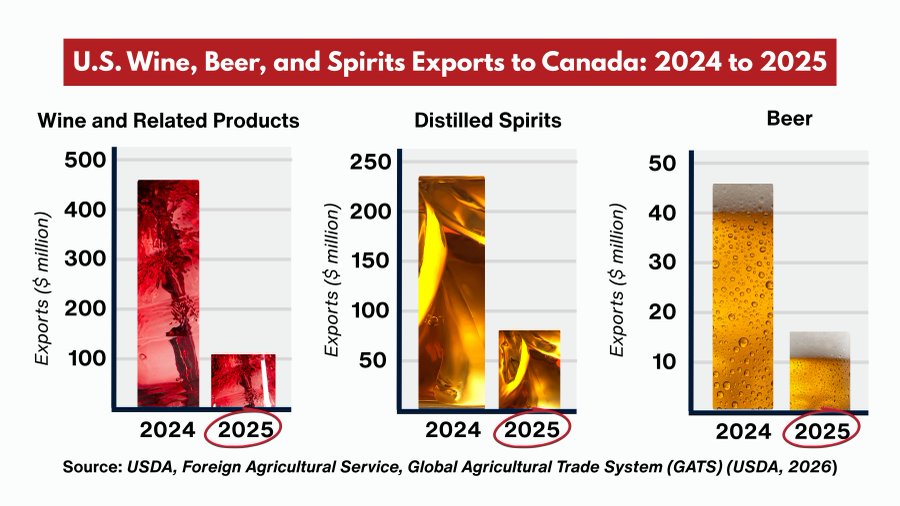
 Last year two countries retaliated against the U.S. for the 232 (steel and aluminum) tariffs, China and Canada. The USTR office has now quantified the tariff and non-tariff barriers triggered by Canada in 2025 and provided President Trump with a financial quantification of the trade impact.
The three Canadian retaliatory sectors highlighted include: (1) Alcoholic Beverages, (2) Motor Vehicles, (3) Dairy Products. These are the three segments quantified by USTR Greer that form the baseline for the U.S. to retaliate with countervailing duties.
Effective 30 days from now, August 16, 2026, President Trump has established a 50% tariff rate against a wide variety of Canadian imports. Essentially three major Annexes: {LIST 1 – LIST 2 – LIST 3} under the authority of Section 338.
♦ Section 338 authorizes the President, if he determines it will serve the public interest, to offset any burden or disadvantage placed on the commerce of the United States by an unequal imposition or discrimination by a foreign country by specifying and declaring additional duties not to exceed 50 percent ad valorem (or its equivalent) and not to take effect earlier than 30 days after the President’s proclamation finding that a foreign country imposes an unreasonable charge, exaction, regulation, or limitation that is not equally enforced on the like articles of every foreign country, or discriminates in fact against U.S. commerce in a way that places the commerce of the United States at a disadvantage compared to the commerce of any foreign country.
Section 338 also authorizes the President to suspend, revoke, supplement, or amend any proclamation under section 338 whenever the President deems that the public interests require such action. Further, section 338 authorizes the President to exclude products of the foreign country if the foreign country maintains or increases the discrimination against the commerce of the United States and the President deems the exclusion to be consistent with the public interests and the interests of the United States. (more)
The 50% tariffs apply to food, alcohol, beer, clothing, chemicals, electronics, flowers, fragrance oils, chemical raw materials and importantly wood products.
The wood products are a big hit to the Canadian export sector. This includes paper goods, cardboard, plywood and fabricated pulp wood derivatives like particle board (MDF). This is a huge export sector for Canada that will now trigger a 50% tariff rate.
Essentially, the list is very long and includes almost every assembled component part created by Canadian manufacturing.
FACT SHEET HERE – {LIST 1 – LIST 2 – LIST 3}
We can surmise the baseline is part of the non-negotiable trade calculation done by President Trump and USTR Greer, that will carry forward into any further trade agreement inside or outside the USMCA construct.
Meaning if the trilateral agreement holds (USMCA), these valuation targets will be part of the expectation from the USA side of the discussion toward Canada. However, in the more likely scenario a bilateral trade agreement is preferred, this now quantifies the tariff reciprocity anticipated by the USA, in addition to the elimination of non-tariff barriers.


Post a Comment