

Banana Republic by Mail: Why We Probably Won't Know Outcomes of CA's Crucial Primaries for Days
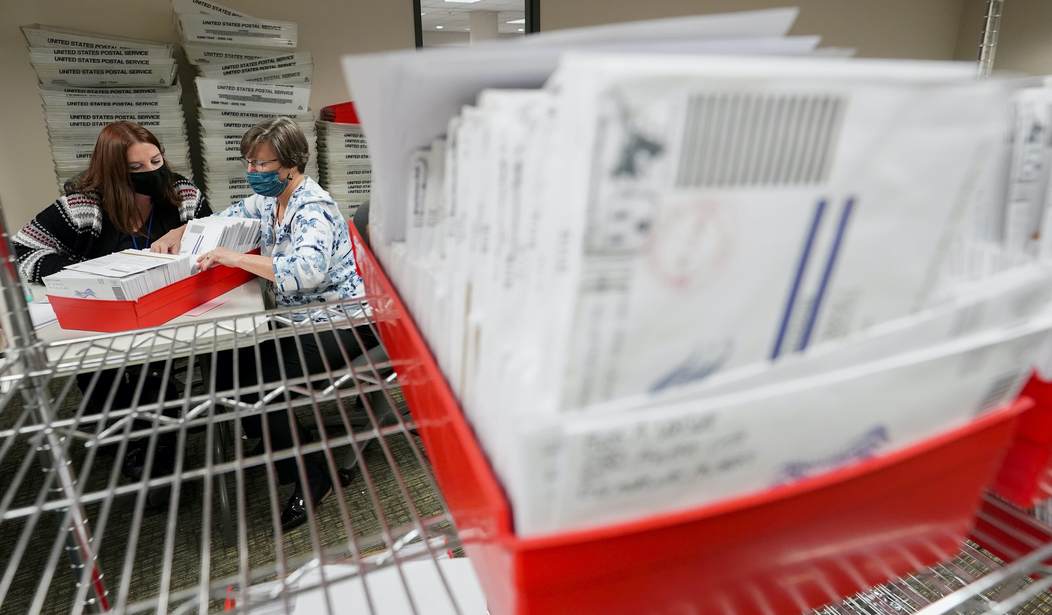
In California, the term “Election Day” is really a misnomer — it’s election month, at least. Ballots were sent out for Tuesday’s primary on May 4 to every eligible voter, which amounts to over 23 million people. Folks have been voting ever since.
So Tuesday marks the end of a seemingly never-ending period that ends this evening; it’s hardly election day.
Well, perhaps we’ll know the winners and the losers by the end of the evening, you might argue, so we can still call it "election night." Oh no, no, no, this is the Left Coast, and things get strange out here. It can take weeks to get final results, sometimes even months.
It shouldn’t be this way:
On multiple occasions, the presumed outcome changed days or even weeks later — and wouldn’t you know it, the revisions usually benefit Democrats. In 2018, for instance, Republican Young Kim was leading her opponent for the race for California's 39th Congressional District and appeared to beat Democrat Gil Cisneros. She even went to Washington, D.C., to attend freshman-member orientation. Weeks later, the count was revised, and her win was ripped from her hands. (Kim eventually got to the House and is now running for reelection. She faces another Republican in Tuesday’s primary, Rep. Ken Calvert, due to redistricting.)
Does this sound like banana republic shenanigans, or is it just me? Believe it or not, the convoluted process is not an accident; it’s by design. State lawmakers wanted to improve so-called “access,” but mostly just ended up appearing to the rest of the nation as stupid and inefficient. Not only does voting go on for a ridiculous period, but the counting is almost guaranteed to go on for eons as well:
By state law, the process of voting and tabulating ballots stretches far beyond the traditional single day of in-person polling. With universal mail-in ballots sent out to every registered voter up to 29 days before Election Day, and early in-person voting available at designated voting centers starting as early as the weekend before the election, voting in the Golden State is effectively a multi-week affair.
Didn’t get your vote in by “election day?” Don’t worry — California Dems got your back:
Vote-by-mail ballots can be postmarked by Election Day but received and counted up to seven days later.
Hey, we don’t need results immediately following the vote. Let’s draw this process out for up to a month:
California’s vote count often stretches beyond Election Day because officials must verify signatures, process millions of vote-by-mail ballots, and conduct required audits before certifying results.
State law gives county election officials up to 30 days after an election to complete the official canvass, count every valid ballot, and perform post-election checks to ensure accuracy.
Frankly, this third-world idiocy is a national embarrassment. Since California is rarely a factor in the presidential race — it’s virtually a lock to go Democrat in modern times — it’s never come into play on a national level. But what if in the future the outcome in the Golden State could decide who’s president? Would the nation have to live in a dangerous limbo for 30 days?
There’s probably no need to stay up wanting to see if Steve Hilton gets through to the general election for governor, or if Spencer Pratt can do the same in the LA mayoral race. Sanity in the California vote count would be a little too much to ask for.


Post a Comment