

President Trump Notes Extended Conversation with Russian Federation President Vladimir Putin
As you are aware, CTH is watching the small details closely on the U.S-Russia alignment against the backdrop of friction with the European Union, the U.K and NATO on issues surrounding Iran. In the past several days there have been several smaller moments lost amid media chatter of bigger news items, this is one such example today in the Oval Office.
During a press availability with the Artemis II astronauts, President Trump was asked for an update on the Ukraine conflict and seemingly stalled negotiations between U.S. intermediaries and Russia. At 04:12 of the video below, President Trump notes he spoke at length with Russian Federation President Vladimir Putin today on issues related to the Ukraine conflict, and {{{thoughtful-pause}}} Iran. WATCH:
President Vladimir Putin is in no hurry to ceasefire in Ukraine, and the U.S. military operation in Iran is not against his interests.
On April 12, 2026, Treasury Secretary Scott Bessent quietly extended the sanction relief for Russia, permitting oil/gas sales loaded on vessels by 4/17/26 for transit and sale through 5/16/26. This permits Russia to push oil to Asia, specifically China, India and ASEAN countries where it is needed, while simultaneously the UAE and Saudi Arabia increase oil pumping avoiding the issues with the Strait of Hormuz.
This is happening while the U.S. is providing large oil and LNG supply increases to South/Central America, Europe and Japan to offset any global shortages.
Russia supplies China, India and Southeast Asia; the U.S. supplies Europe and Japan; the UAE supplies India and Australia; while Saudi Arabia supplies Africa and Europe. Global markets stable, Iran then faces operation financial fury led by Treasury Secretary Scott Bessent. {Go Deep}
Analysis from Gen Jack Keane's ISW think tank:
Ukrainian long-range strikes also continue to have outsized impacts on Russian oil exports, with Ukrainian President Volodymyr Zelensky stating on April 29 that Ukrainian strikes have left the port of Primorsk, Leningrad Oblast, operating at 13 percent below capacity; the port of Novorossiysk, Krasnodar Krai, at 38 percent below capacity; and the port of Ust-Luga, Leningrad Oblast, at 43 percent below capacity.
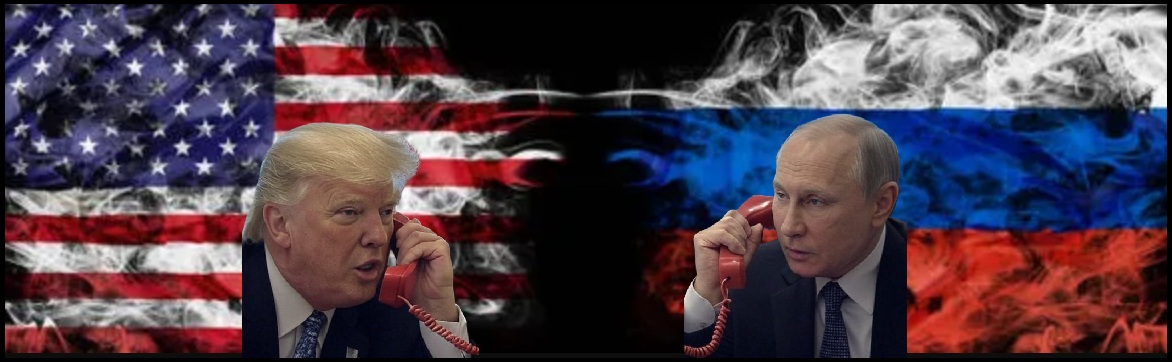
So, we can reasonably see the general tone of the conversation between Donald Trump and Vladimir Putin.
Analysis from Gen Jack Keane's ISW think tank:
Russian Presidential Aide Yuriy Ushakov claimed on April 29 that the Trump-Putin call lasted for 1.5 hours and that Putin briefed Trump on the current state of the war in Ukraine, claiming that Russia holds the strategic initiative and is “pushing back” Ukrainian positions and that Russia will achieve its war goals “in any case” but would prefer to achieve these goals diplomatically. Putin and other Kremlin officials have consistently attempted to portray Ukraine as the intransigent party in peace negotiations for refusing to capitulate to Putin’s demands, despite Russia’s failure to offer meaningful concessions in return, and Putin again reiterated this point to Trump on April 29. Putin again asserted that Russia is performing well on the battlefield in order to justify his demand for Ukrainian capitulation. The premise of Putin’s claim remains false, however. Ukrainian forces continue to deny Russian significant advances in several sectors of the frontline, including in Russia’s priority objective of Donetsk Oblast, and are imposing increasing costs and casualties on Russian forces for these continued offensive operations. Ukraine has conducted significant counterattacks in southern Ukraine since January 2026 that have generated operational-level effects across the theater. Russians are increasingly feeling the costs of the war as Russia’s economy continues to face significant challenges, casualties continue to mount, and recruitment becomes more difficult. The Kremlin is very likely attempting to mitigate some of these costs by attempting to convince Trump and the West to push Ukraine to capitulate in a way that Russia’s full-scale invasion has failed to do and is obfuscating its own military and economic failures as part of this effort.
Well, after this press briefing, President Trump sent the following message on Truth Social.
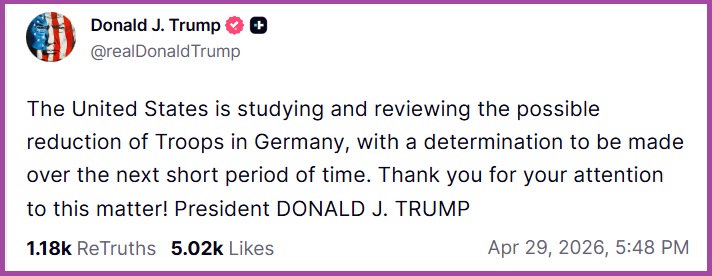
During the press briefing President Trump noted, yet again, his profound disappointment with Europe, the U.K and NATO allies. Trump delivered praise for King Charles as a statesman but separated the political policy aspects of the U.K from his impression of the monarch.
These remarks about drawing down U.S. troop levels in Germany comes against the backdrop of German Chancellor Fredrich Merz being highly critical of President Trump’s intention to incapacitate Iran from gaining a nuclear weapon. Chancellor Merz is looking for any distraction he can come up with to avoid the issue of a severely contracting German economy.
Most Americans do not fully appreciate how the German national identity is defined by their industrial economy. The traditional people of Germany have a self-image that is -in large measure- the result of their economic condition. Everything centers around industriousness. Weaken that a little bit and the hardcore German people get visibly angered.
Commissar and European Commission President, Ursula von der Leyen, is also not happy. “In just 60 days of conflict, our bill for fossil fuel imports has increased by over €27 billion, without a single molecule of additional energy,” she told the European Parliament in Strasbourg.” {CITATION}
For all reasonable intents and purposes President Trump has withdrawn (moral) support for Ukraine. At the same time President Trump has openly been questioning NATO General Secretary Mark Rutte about the seemingly irrelevant purpose of the alliance.
Now, we might think this is just some transitional matters that have been visited before in various peaks and valleys of the geopolitical relationship. However, that is not the case this time.
How do we know this time it is something far more significant?
Well, the EU is debating dropping their climate goals.
BRUSSELS — Energy companies will be able to break the EU’s pollution limits and get away with it, under measures being considered by the European Commission ahead of a gathering of EU leaders in June.
The EU executive is considering a “zero-penalty” option that would allow national authorities not to fine companies that break strict rules governing methane emissions scheduled to come into force next year, according to two people familiar with the matter who were granted anonymity to discuss the sensitive discussions. (link)


Post a Comment