History reminds us who we are and how we came to be. It is for these reasons that the woke left, seeking to craft a narrative that demonizes America by reducing it to simplicity, so often omits the very things that make the nation distinctive—and its history worth reading. Educators who divide and dilute the American story into warring identity groups lie as much through silence and omission as they do through demonization. You won’t find stories of patriotic American diversity in works like The 1619 Project, or even in most mainstream textbooks on the American Founding. What is omitted is not only unity, but complexity—including the men and women who worked in secrecy rather than on the battlefield. Patriot spies of the American founding are too often eclipsed by the era’s battles and its most celebrated statesmen. Figures such as George Washington, Thomas Jefferson, and John Adams dominate the story for their leadership in war and words, while those who shaped events from the shadows remained overlooked for generations. Even Washington’s intelligence network was not firmly documented by historians until the 20th century , and Nathan Hale’s sacrifice was formally commemorated only decades ago . For America’s 250th anniversary (read The Road to the American Revolution
When exactly James Armistead Lafayette was born is unknown. The best historians can do is disagree by twelve years, dating his birth to either 1748 or 1760 . Born into the Armistead family, a prominent Virginia family that included later figures like the Confederate General Lewis Armistead. James was educated and learned how to read and write both English and French alongside his master, William Armistead Jr.
A quarter of a millennium can give the impression that America’s Founding and success were inevitable. It was not. When James entered the Patriot cause, the end of the Revolution was anything but certain. The year 1780 was a disaster. In May that year, the Siege of Charleston led to the surrender of over 5,000 American soldiers to the British, virtually wiping out the Continental Army’s southern command that had been tasked with defending the entirety of Virginia, the Carolinas, and Georgia. Many of the American troops taken at Charleston died on British prison ships. Three signers of the Declaration of Independence, Thomas Heyward Jr., Arthur Middleton, and Edmund Rutledge, were also captured . That same month in South Carolina, the Battle of Waxhaws ended with a British massacre of surrendered Patriot prisoners. In August, despite being outnumbered nearly two-to-one, the British smashed the reconstituted Continental Army again at the Battle of Camden . Weeks later, Continental Army general Benedict Arnold defected .
The threat of oblivion has a way of breeding courage, and British successes in 1780 provoked an American resistance in the South that was as unorthodox as it was innovative. The British actions at the Battle of Waxhaws helped catalyze Francis Marion’s American irregular warfare campaign, known as the “Swamp Fox.” Seeing the situation as dire, the French nobleman, diplomat, and Continental Army Major-General, the Marquis de Lafayette, turned his personal attention to bolstering intelligence operations against the British. While the Patriot cause disintegrated farther south, James and William Armistead Jr. moved from Williamsburg to Virginia’s new capital of Richmond. It was there that James asked for permission to join the Continental Army.
The position of black Americans during the Revolution defies refinement to a simple narrative. A condemnation of slavery was originally included in Thomas Jefferson’s early draft of the Declaration of Independence. This was removed to help ensure the Continental Congress approved independence. Black Americans were part of the Patriot cause from the beginning. Crispus Attucks , an escaped slave-turned sailor, was one of the Americans killed in the Boston Massacre. Attucks, along with the other Massacre victims, were buried together in a common grave despite racial differences. At the end of their lives, Sam Adams, Paul Revere, and John Hancock were buried in the same cemetery . Around 150 black and Native American Patriots fought against the British at Bunker Hill. Nearly four percent of Continental Army veterans were black.
Initially, the Continental Army restricted black enlistment , and multiple states, including Virginia, barred slaves from fighting. In January 1776, Washington began expanding opportunities for blacks in the military. In 1778, the 1st Rhode Island Regiment, which was segregated, fought so ferociously against the British at the Battle of Newport that one Hessian officer resigned to avoid fighting them again. Some served to secure their personal freedom, such as Continental Army surgeon Cuffee Wells. In a variety of circumstances and roles, thousands of black Americans fought for the Patriot cause. The Marquis de Lafayette was one of the most ardent advocates for including black Americans in the Continental Army; indeed, he advocated for its abolition until he died in 1834.
When James enlisted under the Marquis in Virginia, he entered a war in which the Patriot cause was already riddled with betrayal. While Benjamin Franklin served as America’s chief ambassador to France, his personal secretary, Edward Bancroft, was secretly a British agent, passing information under the guise of letters to a mistress. Benedict Arnold’s defection further poisoned the intelligence environment.
Marquis immediately recognized an opportunity in the young James. Fluent in French and intimately familiar with Virginia’s terrain, James was assigned the cover of a runaway slave and sent into British lines. He successfully infiltrated the command of Lt. Gen. Charles Cornwallis, convincing British officers of his loyalty. In reality, James fed Cornwallis false information and carefully recorded conversations for Lafayette’s benefit. Once embedded, he was even assigned to work under the now-thoroughly British Benedict Arnold. James had become a double agent.
As a spy, James’s work helped shift the landscape of the war.
Perhaps karmically, Arnold viewed James as an incredible asset and tasked him with guiding British soldiers through the Virginia backwoods. Eventually, Gen. Cornwallis took James onto his own personal staff at British headquarters, where he unsuspectedly eavesdropped on officers planning strategy and troop movements. When Washington asked the Marquis for an intelligence report of Cornwallis’s plans, the Marquis delivered James’s reports. Marquis, in turn, delivered to James a fake order addressed to General Daniel Morgan about troop movements. The counterfeit order , torn and damaged, was given to t he British, claiming an inability to read, and stated that he personally saw no changes in the countryside and had simply found the note by the roadside. James’s intelligence work proved so valuable that Continental troops successfully blocked the British from reinforcing Yorktown by land while the Patriots awaited the arrival of the French navy. After the British surrender, when Cornwallis met Marquis in person, he personally saw that James had been on Marquis’s staff and understood the betrayal firsthand.
As a spy, James was exempted from the law that emancipated slaves who served in the Revolutionary War in 1783, and returned to his life as a slave. In 1787, Marquis learned of James’s situation, wrote openly to Congress, and successfully petitioned for his release. James took the name Lafayette as his own and retired to a 40-acre farm in New Kent County, Virginia, where he raised a family and lived free the rest of his life. In 1824, the then-elderly James and Marquis reunited at a commemoration of the victory in Yorktown and openly hugged in public. An October 1824 article from the Richmond Compiler described as: “A black man even, who had rendered him services by way of information as a spy, for which he was liberated by the State, was recognized by him in the crowd, called to him by name, and taken in his embrace.”
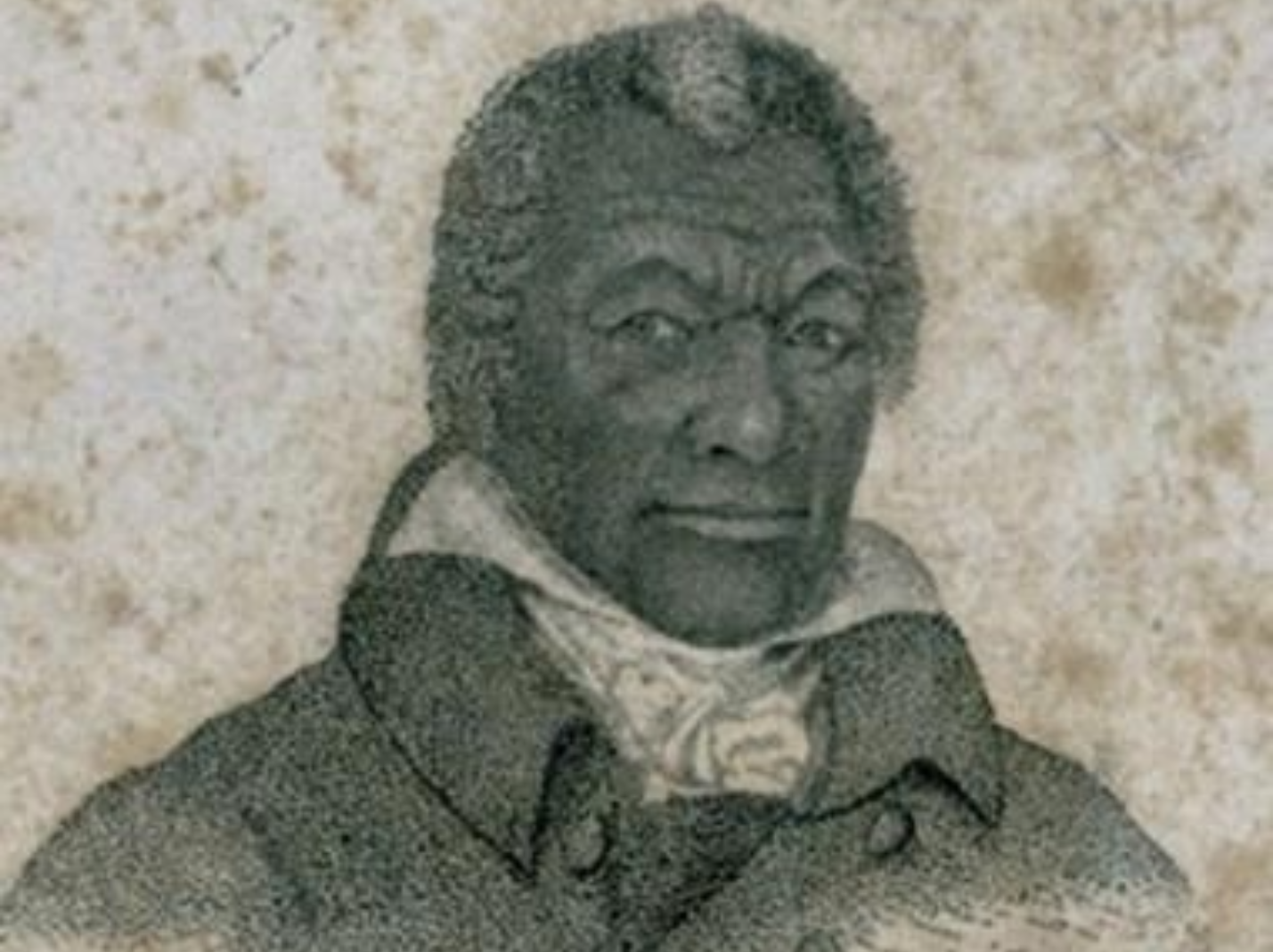
A portrait of James was commissioned shortly after this, as well as a play.
Two takeaways are to be had from James Lafayette’s story. The first is that real spies rely on intrigue and intuition in history far more often than on gadgets and gunfights in fiction. It is partly the work of spies like James, who ensured that the American Revolution was our singular starting point rather than simply a footnote in European history.
The second reason is deeper. While Americans spend the year celebrating the country’s 250th birthday, the Constitution’s freedoms, the country’s history, and our military, it is worth remembering what James’s story represents. History defies narrative just as much as America itself defies the norms of world history. James’s history defies the revisionism and identity politics of the woke left as much as it reveals the gritty rawness of the American story.
As we look back on 250 years, it is precisely this kind of rawness that made us possible.
“Engraved portrait of James Armistead Lafayette (c. 1759-1830). After the painting by John B. Martin, ca. 1824.” on Wikipedia: https://en.wikipedia.org/wiki/James_Armistead_Lafayette#/media/File:James_Armistead_Lafayette.jpg


Post a Comment