Friday, May 22, 2026

Party of Lies and Murder

Party of Lies and Murder

85% of Democrats don’t believe the Democrat attempts to murder Trump were real.

After the nation and the world watched an assassin’s bullet clip President Trump’s ear in Butler, Pennsylvania, 42% or nearly 1 out of 2 Democrats believe the assassination was staged.

Now after the latest assassination attempt by a liberal armed with a shotgun, a handgun and a knife at the White House Correspondents’ Dinner, whose manifesto was posted online, 34% or 1 out of 3 Democrats believe that assassination attempt was also staged. As new social media conspiracy theories circulate, those numbers will grow just as they did after Butler, PA when enough liberals watched Facebook conspiracy videos and freeze frames of Trump’s ear.

Another 26% or 1 out of 4 Democrats believes that another assassination attempt at a golf course was staged. 21% or 1 out of 5 Democrats believe that all three were staged.

The numbers are actually worse than this because Newsguard, a liberal ‘fact checker, claims that less than half of Americans believe that each assassination attempt was real, with the rest being made up of those ‘unsure’, but did not break down this group by partisan lean.

However, only 15% of Democrats admitted that all three assassination attempts were real. That means 85% of Democrats don’t believe or are ‘unsure’ the assassination attempts were real.

Despite photo and video evidence, manifestos and admissions in court, the vast majority of Democrats deny that President Trump has faced systematic assassination attempts from their side. The various conspiracy theories circulating on BlueSky, TikTok, and X are not their reasons for denying it, they’re pretexts for covering up how violently insane their side has become. It’s not about the state of Trump’s ear, but the state of their hearts and minds.

Democrats lie about President Trump’s assassination attempts for the same reason Muslims claim that they don’t believe that Al Qaeda carried out the attacks of September 11 and at the same time celebrate and take pride in those very same attacks. They want the end result, but they also want to evade the blame for it and claim that the attacks were made up by the victims.

Do Democrats really have trouble believing that one of their own would want to kill a man that they routinely describe as a tyrant, a traitor and the next Hitler? Merchandise calling for President Trump’s death is so popular that it appears as an Amazon search listing on Google.

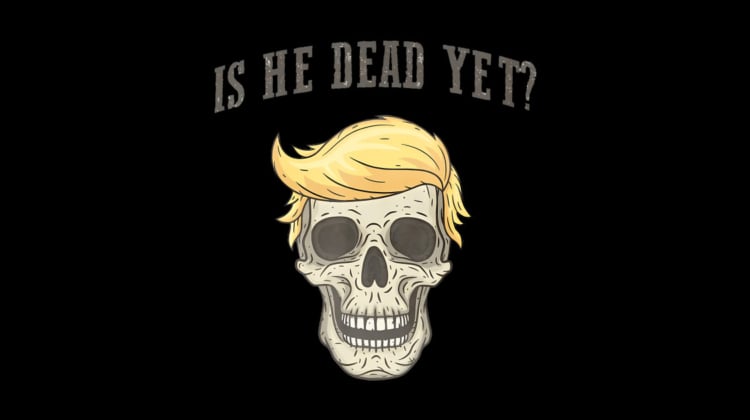
Who exactly is buying t-shirts and lawn signs reading “Is He Dead Yet?” Or merchandise featuring Trump’s tombstone?, “RIP Trump postcards” with a dead Trump with X’s over his eyes in clown makeup. “It won’t solve everything when he exits this mortal stage, but it will feel f*cking great,” one description reads. An ‘Anti-Trump’ wine label features a skull and the motto “open drink, dance on grave.” There are stickers with an orange toupee on a skull, a “we’ll be grateful when he’s dead” sticker of dancing skeletons, and a scented soy wax candle titled “Smells like his funeral”. Is this the kind of thing a movement that doesn’t want someone dead puts up on its lawns and wears to ‘No Kings’ rallies that happen to turn into minor riots?

The same people tagging their social media with ‘8647’ as they fume from their Northern Virginia bedroom communities over federal government reforms can hardly claim that they don’t want Trump dead. It’s as implausible as their companion claim that Iran’s chant of ‘Death to America’ is a metaphor for geopolitical change and not a call for war and destruction. They’d like us to believe that they want Trump dead badly enough to buy a $12.95 ‘Made in China’ sign wishing for that happy outcome, but that they don’t actually want to see it happen.

They’re not denying the three official Trump assassination attempts by their own faction (not counting the Iranian ones) because they don’t want Trump dead, but because they don’t want their side to suffer the political fallout and they don’t want Trump to pick up political sympathy.

It’s not the murder they object to, it’s taking the blame for it, and the victim becoming a martyr.

Some of the same lefties playing this loathsome game with the Trump assassinations also simultaneously deny that Luigi Mangione did anything wrong and cheer for him. But if he really didn’t kill anyone, why are they so enthusiastic about him? What did he do to merit the fan club?

The Democrats play this game because they’ve become a party of lies and murder. Terrorist groups have a violent arm that carries out attacks and a political arm that covers up for them. Democrats increasingly act as the political arm of a terrorist movement, offering excuses, engaging in distractions and cover-ups of Marxist, BLM, Islamist and other violence coming out of their camp. The Trump assassinations are only the most overt symptom of their party’s descent into terrorism. And that was inevitable once leftists took control of the Democrats.

The Left believes in taking over institutions, societies and countries by any means necessary. Democracy is only a means to a one-party state that eliminates all political opposition. If elections, no matter how they are rigged, and gerrymandered, are insufficient to achieve a totalitarian state then the radicals turn to political violence to stamp out any and all opposition.

When Democrats allowed their movement to be taken over by leftists, they ceased to be a democratic movement and became a revolutionary extremist organization willing to use violence to achieve their ends. The assassination attempts on President Trump may not have been officially approved, but they are the inevitable consequence of what the party is becoming.

85% of Democrats refuse to accept that, not because they reject the idea of killing Trump, but because denying the ugly truth about themselves is foundational to extremist narratives.

A party of lies and murder needs both murderers and liars. The murderers kill and the liars then lie about them. The vast majority of leftists are not up to killing, it’s one reason that they import, fund and defend Muslim terrorists, but at least 85% of them are ready to lie for the killers.


Trump Supporter Beaten to Within an Inch of His Life — As the Left Pretends Rhetoric Has No Consequences


RedState 

The Left has been calling for violence relentlessly since Donald Trump re-assumed his presidency — and once again, they’ve got it.

It’s a horrific story, and we warn readers that there’s disturbing content ahead.

The facts:

The wife of the elderly San Diego man brutally beaten outside his MAGA-inspired “Trump House” said there’s “no hope” for her husband after the vicious attack left him fighting for his life.

Kerry Sheron, 69, was in critical condition following the violent assault outside his Escondido property on Wednesday afternoon.

His wife, Maria, revealed to The California Post through tears that her husband isn’t expected to survive.

The alleged assailant, 32-year-old Escondido resident Thomas Caleb Butler, was arrested on attempted murder charges and faces life in prison if convicted.

Profanity alert:

ALERT: Owner of ‘Trump House’ fighting for his life after neighbor beats him almost to death in his own driveway.

A 69-year-old man in Escondido, California, known for having his house covered in Trump and American flags, was beaten by Thomas Caleb Butler, 32.

Police responded to the assault and found the owner "suffering from significant injuries" and a good Samaritan that interviened [sic] also injured.

Butler had fled the scene when police had arrived, but was found about a half mile away and apprehended.

It was revealed that Butler lives just around the corner from the victim.

The ‘Trump House' has become a target of hostility, with one online comment reading, “My buddy lived down the street from him. Whenever I went to visit I made sure to swing by that place and shout stuff at them.”

The photos of Army veteran Sheron’s injuries are sickening:

Yes, the man was loud and proud, and openly showcased his support of the duly elected president. That’s enough to get you (almost and maybe) killed in today’s America? Leftists need to do some serious soul-searching. Or maybe we need to do it for them.

Conservative California state senate candidate Mike Netter had thoughts:

🚨BREAKING: Homeowner of Famous “Trump House” in Escondido California Brutally Assaulted, Left Fighting for Life in ICU

Just 11 weeks after pro-Trump signs at the residence were attacked, the homeowner of Escondido’s well-known “Trump House” — covered in large Trump flags and patriotic displays — was violently assaulted outside his home and rushed to the hospital in critical condition.

He remains in the ICU battling for his life.

Escondido Police responded to the assault around 2:14 PM Wednesday and quickly arrested a suspect nearby. He has been charged with attempted murder. Motive has not yet been released.

The home has long been a local landmark for its bold pro-Trump and America-themed displays.

Prayers for the victim’s full recovery.

This one is personal to me

Please re post and do the job the mainstream should do

This is one of those stories that leaves me speechless, and I pray for Kerry Sheron and his wife. Although there may be circumstances that we don’t know about yet, I firmly blame the Left for incidents like these. They have ratcheted up their violent rhetoric to levels we’ve rarely seen before, and the results are clear: three assassination attempts against Donald Trump, the cold-blooded ("alleged") assassination of a UnitedHealthcare executive by Leftist hero Luigi Mangione, the savage killing of Charlie Kirk.

And now a man lies in the hospital, fighting for his life. This is just plain wrong, and Democrats need to pay the price at the ballot box in November — and far beyond.


The Specter of State-Controlled Industrial Policy

The Specter of State-Controlled Industrial Policy

A wheel loader operator fills a truck with ore at the MP Materials rare earth mine in Mountain Pass, Calif., in 2020.(Steve Marcus/Reuters)none

When considering industrial policy, one is reminded of the old saying “been there, done that.” It almost always begins with declarations of good intentions — strategic industries, jobs, national champions. If only these firms received sufficient support, the argument goes, they (and the nation) would flourish. Politicians and bureaucrats have repeated this claim for decades. And whenever someone points to the lessons of history, the response is the same: “This time it’s different.”

The history of U.S. industrial policy dates back at least to Alexander Hamilton’s Report on Manufactures, from 1791; it advocated tariffs, subsidies, and state support to foster domestic industry. Since then, in the name of national security, supply-chain resilience, and economic competitiveness, presidents and Congress alike — across party lines — have deployed tariffs, subsidies, and targeted tax incentives. What, then, distinguishes the present moment?

We have now moved beyond subsidies and tax preferences to direct government purchases of equity stakes and equity warrants — which confer the right to buy shares at a predetermined price — in so-called strategic firms: MP Materials, Intel, Lithium Americas, Trilogy Metals, Vulcan Elements, and ReElement Technologies. More are likely to follow. State participation in corporate equity for industrial policy purposes may still be in its infancy in the United States, but its track record abroad is not encouraging.

Europe has already run the experiment many times and in many different forms. There have been successes, but the overall record offers mostly cautionary tales.

For instance, France during Les Trente Glorieuses — the postwar boom from 1945 to 1975 — and Bismarckian Germany are often cited as cases where industrial policy, whether through the coordination of private industry or extensive state ownership, appeared to “work.” Yet these cases are not as clear-cut as often suggested: Both episodes were shaped by specific historical forces — namely post-WWII recovery in France and post-unification catch-up in Germany. Industrialization might well have unfolded even without state support — something we will never know — implying opportunity costs and risking a post hoc ergo propter hoc fallacy.

Similar episodes abound, but Fascist Italy stands out as one of the most prominent examples of state-led industrial strategy in the West during the interwar era — and one of the clearest illustrations of the corrosive effects of extensive state control.

Beginning with the creation of the Institute for Industrial Reconstruction (IRI) in 1933 — a state-owned holding company tasked with restructuring failing banks and firms — and followed by the establishment of the National Hydrocarbons Board (ENI), a state-controlled energy company, and the Agency for Shareholdings and Financing of Manufacturing Industries (EFIM), which oversaw public investment in manufacturing, the Italian state came to control vast sectors of steel, shipbuilding, energy, telecommunications, and transport. The approach long outlived Mussolini.

Politics shaped business decisions, losses were socialized, and restructuring delayed. What began as strategic stewardship hardened into bureaucratic inefficiency. By the 1990s, as IRI was dismantled, EFIM liquidated, and ENI partially privatized,  the fiscal costs that had accumulated over decades had become politically unsustainable.

The details vary and the caveats are many. Yet the trajectory tends to follow a pattern.

It begins with subsidies — phase one. These initial measures often come with few conditions, meant to signal restraint: The government is simply providing support while strategic decisions remain with management. The state is not intruding; it is helping.

Disappointment inevitably follows. When results diverge from the plan, phase two begins: Politics enters the firm. Management is deemed incapable of delivering the desired outcomes. A question no one asks — at least not publicly — is why competent management would have required public support in the first place. The strategic plan, after all, is declared sound; only its execution is lacking.

Then comes phase three. Public money now justifies oversight. Officials visit plants, tour facilities, and interview managers and workers. Oversight rarely stops at observation. It soon leads to phase four: equity stakes. If the state is providing the capital, why should it not share in ownership?

If we put to one side the opportunity costs already incurred by such policies, phase five is where things begin to go badly. Boards and managers are no longer chosen for competence alone. They must serve the “state interest.” Political appointments replace managerial talent. The state, it is assumed, knows better.

The strategic plan remains “fantastic.” The problem was the old management, now replaced by bureaucrats. Yet financial markets remain unconvinced — an intolerable verdict for a “strategic” project. This must reflect hostility or bias rather than the financial markets’ clear-eyed assessment of a project’s economic viability. Whether directly or indirectly, the state steps in with help (guarantees, subsidies, loans from public banks, and the like) to see that the plan receives the capital that free markets will not freely provide. This is bad news for competitors that can flourish on their own.

Losses pile up. Yet it is not a solvency problem, we are told, but a liquidity one. Losses are socialized; discipline weakens.

As the situation begins to resemble a disaster, denial becomes policy. We cannot let this go to waste. If the original firm was “strategic,” its suppliers must be strategic, too. Then its lenders. The perimeter keeps expanding. Entire industries are folded into the industrial plan. Banks follow. Worker protections are strengthened — the state cannot be seen firing people. It is only fair to protect workers if owners were protected first.

The result was familiar to anyone who knows Italy well: industries frozen in time, investment driven by politics, and the withdrawal of state support often too politically toxic to be risked.

This progression is often ignored. Many analyses — too many — present an overly simplistic view of industrial policy, neglecting its political economy. The result is a framework that works neatly in theory — at least for optimists or the ideologically convinced — but breaks down in practice. These accounts overlook the central difficulty: Sustained government involvement in business activity weakens corporate governance. Decisions normally disciplined by markets are validated by the rubber stamp of state control. Knowledge is dispersed, yet state control brings centralization — the only way, after all, to ensure that everything proceeds “correctly.”

They also neglect a basic political reality. Politicians do not like to fail publicly, especially when elections loom. A mistake that could have been acknowledged and corrected early becomes the starting point for additional interventions, each meant to fix the previous one.

As errors accumulate, admitting failure grows more costly — political careers are now on the line. What could once have ended with limited losses becomes a self-reinforcing cycle of mistakes and “fixes.” The project turns “too big to fail” or, more precisely, too big to confess.

When all is said and done, public money has been lost and opportunities foregone. Yet those responsible retain a ready justification: Mistakes were made, but in the name of the common good. The moral high ground conveniently erases accountability.

Time passes. Decades go by. The generations that lived through the failures of industrial policy fade from memory. The clock resets. Once again, we are told that this time is different. The nation needs it. The consensus is broad. And so, the cycle resumes.

Today’s American debate should take this backdrop seriously. Support for industrial policy now spans the political spectrum, a bipartisan consensus often mistaken for wisdom. More often, it is a reminder that bad ideas have no party label. It is also a reminder that some of the more astute — if less scrupulous — politicians are, and always will be, aware of the opportunities for power accumulation and the rent-seeking that industrial policy affords. Industrial policy may be bad for the economy, but it can be good for the political class. Yet we are told that this time is different: Industrial policy is invoked not to address economic shortcomings but to serve geopolitical aims and fortify the nation against strategic rivalry.

The road to industrial policy is paved with (sometimes) good intentions — and littered with bad outcomes. In public policy, hubris consists in repeating yesterday’s failures in the confident belief that this time will be different. A modern Dante Alighieri would surely reserve a circle of his Inferno for those responsible for such efforts.


♦️𝐖³π πƒπšπ’π₯𝐲 𝐍𝐞𝐰𝐬 𝐎𝐩𝐞𝐧 π“π‘π«πžπšπ


W³P Daily News Open Thread. 

Welcome to the W³P Daily News Open Thread. 

Post whatever you got in the comments section below.

This feature will post every day at 6:30am Mountain time. 


Trump's D.C. Arch Project Is One Step Closer to Reality


RedState 

After months of teasing about it and enraging the Usual Suspects in the process, the Trump White House unveiled renderings in mid-April for what they called a "triumphal arch," a 250 ft structure that they want built in Washington, D.C., in honor of America's 250th birthday.

As RedState reported, White House press secretary Karoline Leavitt said at the time that "this year we celebrate America's 250th birthday. In honor of this historic occasion, President Trump and the Department of the Interior will submit plans for the United States Triumphal Arch, which will be an architectural masterpiece to celebrate our history right here in Washington, D.C."

Further, she noted that it will "stand on the ground that is currently empty green space in Memorial Circle on Columbia Island, a man-made island in the Potomac River, managed by the National Park Service."

As we also reported, three plans had been submitted to President Trump for review. He, of course, picked the biggest and boldest one.

In an update to this story, we learned Thursday that the project, also known as the "Independence Arch," was one step closer to reality:

A federal arts commission approved a modified plan Thursday for President Donald Trump’s proposed arch along the Potomac River.

While similar to the original concept, the altered design removes a platform below the arch and tunnel access to the site. At Trump’s request, the plan to build large golden sculptures atop the arch was retained, while the designers selected granite for the surface stone.

One member of the Commission of Fine Arts in April questioned the inclusion of a 60-foot golden statue of Lady Liberty flanked by eagles. But the arch’s designer, Nicolas Charbonneau, told the panel, who were all appointed by the president earlier this year, that Trump had considered but rejected the suggestion.

Also removed from the original plan, with Trump's okay, are the "statues of gold lions that were positioned lower on the arch."

While this represents a step forward, there has already been one lawsuit filed by a group of Vietnam veterans to stop the project.  Also, as the NY Times reported, "the Federal Aviation Administration is reviewing whether the arch could pose an aerial hazard, an evaluation that it requires for all structures more than 200 feet tall."

The next step is a review from the National Capital Planning Commission, which will take place on June 4th.


House Judiciary Subpoenas SPLC For Communications With Racist Groups It Allegedly Funded


The House Judiciary Committee subpoenaed the Southern Poverty Law Center (SPLC) after the organization failed to produce documents tied to allegations that it paid members of the KKK and other extremist groups using donor money intended to combat those very organizations.

The subpoena — reviewed by The Federalist — requests the SPLC turn over any and all documents and communications between any SPLC employee and “field source” that was paid by the SPLC.

The SPLC was indicted by a federal grand jury last month for wire fraud and conspiracy to commit concealment money laundering. The SPLC allegedly used millions of dollars it received through donations to pay “a covert network of individuals” that were a part of “violent extremists groups” like the KKK. Acting Attorney General Todd Blanche said in a statement that the SPLC was “manufacturing racism to justify its existence.”

The organization allegedly did not disclose to its donors that “some of their donated money was being used to fund the leaders and organizers of racist groups at the same time that the SPLC was denouncing the same groups on its website,” a press released from the Department of Justice states.

The House Judiciary Committee previously requested documents from the SPLC, according to a May 20 letter. But the SPLC failed to provide a single requested document and “misrepresented both the timeline and purpose of the Committee’s oversight.”

“Accordingly, the Committee is initiating compulsory process to obtain the documents and material needed to fulfill its oversight and legislative obligations,” the letter continues. The subpoena compels document production by June 3.

The subpoena also requests any documentation or communication between the SPLC and the Department of Justice, FBI, or other executive branch agency for the duration of the Biden administration.

Notably, the Biden administration’s Department of Justice and FBI were both aware that the SPLC was paying “informants” in the KKK, former Associate Attorney General in the Biden administration Vanita Gupta disclosed during a recent virtual press conference.

The judiciary committee also invited SPLC Interim President Bryan Fair to testify on June 9.

“The hearing will examine the role that the Southern Poverty Law Center (SPLC) has played in distorting civil rights policy in recent years. Additionally, the hearing will explore recently released information revealing that the SPLC has funneled money to some extremists, raising questions whether the SPLC has been artificially elevating the domestic extremist threat and misleading its donors,” the Judiciary Committee said in a letter to Fair.


‘I have a thing called Iran’: Donald Trump says Mideast war may keep him from son Don Jr.'s wedding

 Trump said he was conscious of how the media would cover it: ‘That's one I can't win on. If I do attend, I get killed. If I don't attend, I get killed’

U.S. President Donald Trump and his son Donald Trump Jr., walk across the South Lawn of the White House on May 3, 2026. Photo by Anna Rose Layden/Getty Images

U.S. President Donald Trump said Thursday he would try to make it to his eldest son’s wedding but that it was “bad timing” because of the Iran war.

Donald Trump Jr, 48, is set to tie the knot for the second time this weekend, marrying Bettina Anderson in the Bahamas, U.S. media reported.

But at the same time Trump is working on a deal to end his unpopular war with Iran, which has sunk the president’s poll ratings and sparked voter anger over the cost of living ahead of November’s midterm elections.

“He’d like me to go. It’s going to be just a small little private affair and I’m going to try and make it,” Trump told reporters in the Oval Office when asked if he would attend his son’s wedding.

“I said, ‘This is not good timing for me. I have a thing called Iran and other things.'”

Trump said he was conscious of how the media would cover it if he did go to the wedding in the middle of a war that remains stuck in a stalemate.

“That’s one I can’t win on. If I do attend, I get killed. If I don’t attend, I get killed — by the fake news of course,” Trump said.

“Hopefully they’re going to have a great marriage.”

Known as Don Jr., the president’s son is an executive vice president at The Trump Organization, the family’s luxury real estate conglomerate, and a vocal proponent of his father’s right-wing MAGA political agenda.

He is often seen at his father’s side, including earlier this month when they returned to the White House together from Trump senior’s Mar-a-Lago resort in Florida.

Last year Don Jr said he could run for president “maybe one day.” His father’s second and final term runs until January, 2029 and the Republican president has not yet anointed a successor.

 https://nationalpost.com/news/world/donald-trump-don-jr-wedding


DOJ, FBI and HHS Officials Announce Federal Fraud Charges for 15 Minnesota Individuals Who Stole $90 Million – 3,300 Investigations Ongoing


USAO Colin McDonald, assistant attorney general for the DOJ’s National Fraud Enforcement Division, announced the initial fraud indictments for the first set of fraudsters operating in Minneapolis, Minnesota.  McDonald emphasized this is only the beginning of the arrests in Minnesota as the fraud is beyond a scale that can be appropriately explained.

Together with HHS Secretary Robert F. Kennedy Jr. and CMS Administrator Dr. Mehmet Oz, U.S Attorney McDonald announces the first 15 individuals indicted with initial investigated theft of $90 million.  The DOJ anticipates hundreds more arrests.  Secretary Kennedy notes the scale of fraud is approximately 10x more than initially evaluated.

“Let me be clear upfront about something: This is not the end of our work in Minnesota,” McDonald said. “This is the beginning of our work in Minnesota. The fraud here in Minnesota is shocking.”  McDonald then pointed to Minnesota’s housing stabilization services program, which was designed to help homeless residents find and keep housing, as one of the starkest examples. The program was initially estimated in 2020 to cost about $2.5 million per year, but ballooned to more than $104 million by 2024, which McDonald attributed entirely to fraud.

What we are seeing in this storyline is the exact reason why Barack Obama and Eric Holder selected Minnesota Governor Tim Walz to be Kamala Harris’ running mate.   Former AG Eric Holder was responsible for investigating all of the potential nominees to run with Harris, and all of the Minnesota fraud was well known.

Minneapolis was/is the operational epicenter of a Marxist network that sits underneath Barack Obama and extends from Chicago through Minneapolis to Madison Wisconsin.  None of this corrupt activity is a surprise to anyone who has watched how the networks operate.  Union leadership like SEIU are aligned with NGO’s a various Obama community groups and operate within these regions.

Minnesota – “The fraud is enormous,” Colin McDonald, assistant attorney general for the DOJ’s National Fraud Enforcement Division, was asked about former U.S. Attorney Joe Thompson’s estimate that fraud in Minnesota could total $9 billion across more than a dozen programs.

“I wouldn’t be surprised if that number is accurate or even small.

”But today, the collection of [15] cases reach 90 million in intended loss from the from the pockets of the taxpayer.”

McDonald stressed that prosecutors are focused first on individual defendants and specific cases, not a final statewide price tag.

“I don’t have the exact number, because what I do is I look at individual people committing individual crimes,” he continued. “And at the end of all of our work, we’ll tally it all up and we’ll tell you exactly how much was stolen from the American people.

“We’re focused on individual defendants.”

Federal officials said they are expanding the Midwest Health Care Fraud Strike Force into Minnesota and adding a new Medicaid fraud strike force with 15 prosecutors who can be deployed nationwide.

“This is not the end of the beginning,” McDonald concluded at Thursday’s news conference. “This is the beginning.” (source)