
The U.S. has been enforcing a blockade on ships going to or coming from Iranian ports for about ten days.
As we've already reported, that is putting a huge chokehold on a regime that was already in big economic trouble.
Miad Maleki, who played a central role in Treasury Department sanctions campaigns against Iran and its network of proxy groups, said in an on-camera interview the current moment reflects a rare convergence of economic, political and diplomatic leverage against Tehran.
"We’ve never had the level of leverage that we have today with Iran in the history of our conflict … since 1979," Maleki said.
Funny how when you actually apply real pressure, it can have results.
He said Iran may run out of oil storage in as little as two to three weeks, forcing production cuts, while gasoline shortages could hit on a similar timeline due to heavy reliance on imports. Combined with an estimated $435 million in daily economic losses, the pressure could spill into the financial system, leaving the regime struggling to pay salaries and raising the risk of renewed unrest. [....]
At the core of that pressure is an Iranian economy he describes as "on the verge of collapse," driven by years of sanctions and compounded by recent disruptions.
He pointed to triple-digit food inflation, a sharply devalued currency and a roughly 90% collapse in purchasing power, along with potential long-term oil revenue losses of up to $14 billion annually.
Maleki also noted that if the regime runs out of oil storage, they are going to have a major problem domestically, and such things have generally led to more protests.
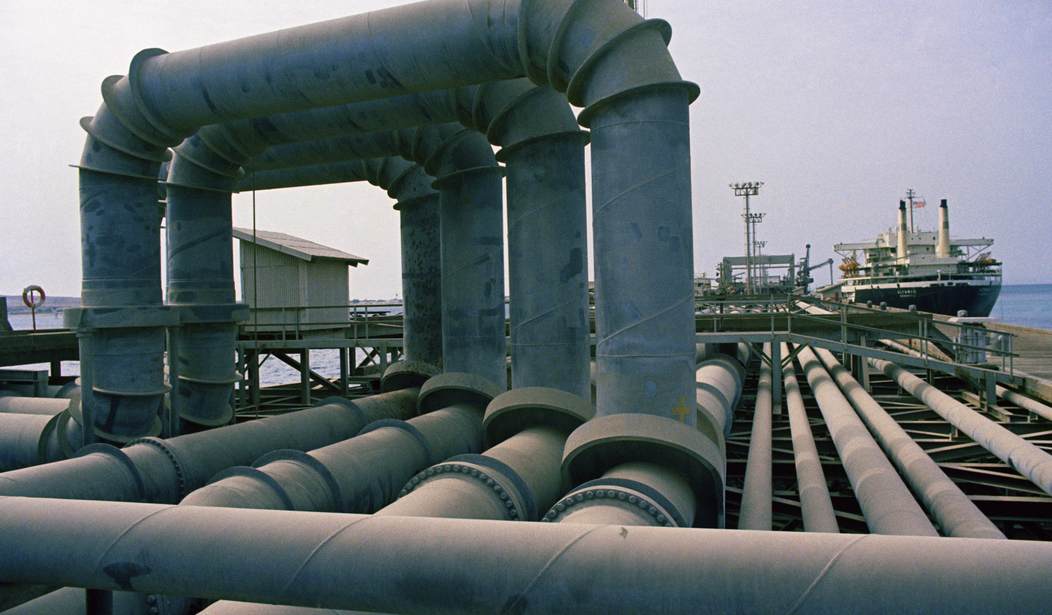
We reported how Treasury Secretary Scott Bessent said the blockade was going to have a real effect on their Kharg Island oil production. We don't have to attack Kharg to force a stoppage of production. If they can't ship the oil out, they can only store so much before they have to shut down. The money from that helps to sustain the Iranian Revolutionary Guard Corps (IRGC). But as Bessent said, they were going to have to shut down production soon and risk serious damage.
Now the regime has made a move that shows how much the blockade is working. They are pulling a 30-year-old empty tanker, the NASHA, out of mothballs to help with their storage capacity. Tanker Trackers explained on Thursday that it would take about four days to get to Kharg, as Maleki explained the math.
My earlier analysis estimated ~13 days before Kharg Island onshore storage hits capacity. @Tankertrackers confirms Iran has pulled NASHA (9079107), a 30yo VLCC, out of retirement to handle overflow.
~13-day figure was based on ~13M barrels spare capacity at Kharg ÷ ~1.0–1.1M bpd net daily inflow, projected from around early-to-mid April, which puts the saturation window squarely around late April, consistent with NASHA being activated today, April 23.
The fact that they are doing that is a big indication that they need to. It looks like a desperation move, rather than a long-term plan, as the Very Large Crude Carrier (VLCC) can only hold about 2 million barrels. So it's a temporary buffer for only about two days. Even Gulf News termed this as scrambling and "trying to buy time before the terminal reaches a critical breaking point."
But the clock is ticking, and this is why they're so upset that the blockade continues.