
DEI Activism Could Be Pushing Donors Away
Diversity, equity, and inclusion priorities have transformed nonprofit governance into ideological enforcement.
Diversity, equity, and inclusion priorities have transformed nonprofit governance into ideological enforcement.
Nearly 20 years ago, California’s legislature considered a bill that would require private foundations with more than $250 million in assets to report the racial, gender, and sexual orientation of their board members, staffs, and grantees. The bill’s sponsors eventually dropped the legislation in large part because those foundations agreed to contribute millions of dollars to causes favored by legislators and activist groups. Thus began a campaign to “diversify” philanthropy, which has now succeeded beyond those activists’ wildest dreams.
For a good example of the activists’ successful capture of nonprofits, look to a recent story in the Chronicle of Philanthropy about the Robert Wood Johnson Foundation. With $13 billion in assets, it’s one of the nation’s largest philanthropies. Like many large foundations, it promotes various progressive causes, such as expansion of Medicaid, racial equity, and, of course, “diversity, equity, and inclusion.”
In 2017, the foundation’s CEO, in keeping with this mission, launched a program to prioritize diversity on its board of trustees. Today, according to the Chronicle of Philanthropy, the organization is “a case study of how one mega-foundation aims to make its leadership look more like America.” Trustees from nine years ago are now gone, and “the board is significantly younger and more racially diverse . . . . Eleven of its 15 trustees are people of color; another is an Iranian-born immigrant.”
Since the 2024 election of its first black chairman—pastor and civil rights activist Starsky Wilson—the foundation’s board has proved much more willing to criticize the second Trump administration than it was the first. “We’ve got board members who are raising families, and they’re impacted by the [Trump administration efforts to] shut down the Department of Education,” Wilson explained. “We’ve got two board members who are working in health care, and they are impacted by the decimation of the public health care infrastructure in America, personally and professionally.”
In that sense, the Robert Wood Johnson Foundation is more activist and ideological in its approach than it was a decade ago, when its board members were more likely to be white men with degrees from elite schools and contacts in prominent law firms, businesses, and investment banks. That shift may explain the foundation’s pivot from improving health care (Robert Wood Johnson himself was one of the founders of Johnson & Johnson) to addressing racial equity and eliminating poverty, because (in the current trustees’ judgment) these are the real barriers to fixing health care. The advantage of a rainbow coalition of board members, it seems, is that the trustees have the same political or ideological points of view.
Just as in higher education, journalism, and Hollywood, the field of philanthropy has undergone a radical shift to diversity, equity, and inclusion in the past decade. Jacob Savage’s essay in Compact describes how organizations in these and many other fields have simply stopped hiring white men, regardless of their qualifications.
It’s not enough for philanthropic board members (and staff) to embrace the ideology of DEI; they must also share the racial and sexual identities of the people whom they are meant to serve. Just as white men ideally should not teach university courses in women’s or black studies, they also should not administer programs meant to serve minorities. Clients will not trust a white man, the thinking goes, unless he shares some important credential of membership in an oppressed group.
The history of philanthropy disproves this line of thinking. Progressive nonprofits frequently receive funds from foundations that don’t have diverse boards (or from wealthy white men). The philanthropists who founded nonprofits appointed trustees in part to keep their organizations from veering off into political directions that would generate public criticism or backlash. Today they are increasingly failing at that task.
Savage asks whether organizations that have engaged in purges of straight white men are more trusted now than they were a decade ago: “Have these institutions become stronger since they systematically excluded an entire cohort—or did abandoning meritocracy accelerate their decline?”
We should ask the same question of philanthropy and the organizations it supports. A little more than half of Americans say that they trust nonprofits, but fewer than 20 percent think the sector is going in the right direction, and the number of donors has been steadily shrinking since the early 2000s. Maybe embracing DEI and fighting the Trump administration are not the prescription for philanthropy’s success.
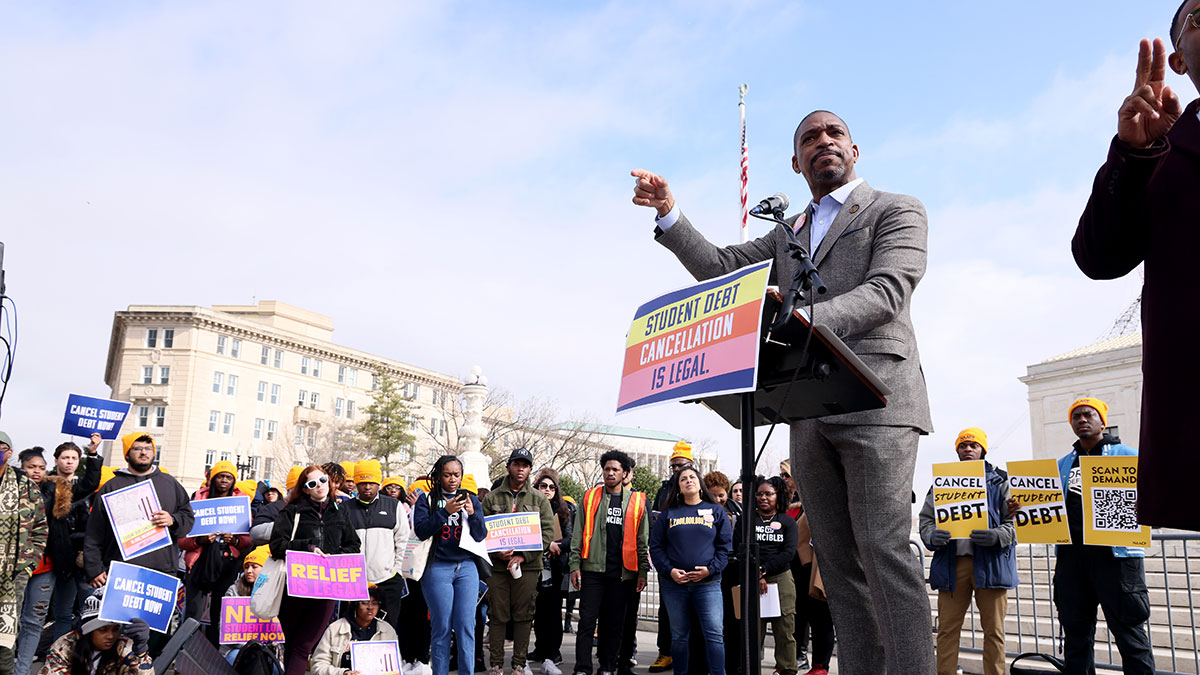
Photo: Robert Wood Johnson Foundation chairman Starsky Wilson (Photo by Jemal Countess/Getty Images for People's Rally to Cancel Student Debt)