 People might be interested in the recent stories of Canadian Premier Doug Ford and his reversal of position on Chinese EV production. Ontario Premier Ford now welcomes Chinese EVs into Canada.
Or people might be interested in the recent story of the EU announcing a historic trade deal with India. The European Union is now looking to find new markets to replace the U.S., while simultaneously agreeing to establish a new immigration/recruitment process to accept massive numbers of Indian migrants.
Yes, Canada reverses their position on trade with China, that’s odd. And somehow the EU immediately forgets their demands for India to stop buying Russian oil or face EU sanctions, another oddity. This is like watching someone you don’t like, get engaged to your smelly, fat ex-girlfriend. [Matthew 15:14]
Canada and the EU take trade and economic positions seemingly against U.S. interests. Simultaneously Mexico modifies all their trade positions to come into alignment with the USA. Yesterday, Mexican President Claudia Sheinbaum announced Mexico will no longer ship oil to Cuba.
What’s going on?
Well, to really understand what is happening you need to look at President Trump’s responses to all of the individual issues outlined above and take a much bigger picture view. President Trump is the master of the ‘self-fulfilling prophecy.’
♦ CANADA – When President Trump was asked about Prime Minister Mark Carney creating a new trade agreement with China, President Trump responded that he didn’t care – it was irrelevant to him. Yet, simultaneously inside the USMCA President Trump has the power to veto any trade agreement between Mexico or Canada and a non-member nation.
So, why didn’t President Trump care? Easy, because in President Trump’s mind there’s not going to be a USMCA; so, he really doesn’t care if Canada runs to violate it. In real terms, Canada doing bilateral deals with other countries, especially deals potentially detrimental to the USA, only strengthens his position on dissolving the USMCA.
If Canada violates the terms and spirit of the USMCA, it makes dispatch of the unliked trade agreement even easier. Canada is helping President Trump remove the congressional justification they could use to block him. If Canada is violating the USMCA (CUSMA), Congress is kneecapped from interference.
Provoking Canada into a trade position, that puts them at a disadvantage trying to stop the dissolution of the CUSMA, stops Congress from opposing the fracture, and then opens the door to a bilateral trade agreement, is creating a self-fulfilling prophecy that is entirely controlled by President Donald Trump.

[I pointed this out on the ‘Russian Sanctions’ map four years ago for a reason.]
♦ EUROPE – In the last few months, the EU has been pressuring President Trump to join them in putting sanctions against India for purchasing Russian oil. Suddenly, all those Russian energy issues are dropped, and the EU signs a trade agreement with India. Again, just like with Canada, President Trump doesn’t care; he’s working on a much bigger objective.
Both Canada and Europe are independently, out of necessity, taking action that takes apart the trade and economic system they created. At the core of the old trade system both Canada and Europe were exploiting the USA, exfiltrating wealth and skimming the independent entrepreneurial innovation that originates from within the U.S. economic system.
That necessary exploitation happened because the USA is innovative (freedom-based capitalism), while the CA/EU system is built on government control mechanisms. The CA/EU energy policy is just one impactful example of their pontificating inability to be insightful when it comes to consequences. The EU and Canada are now stuck looking for markets that will do the dirty jobs, provide them with core components, while simultaneously looking for markets for their finished products.
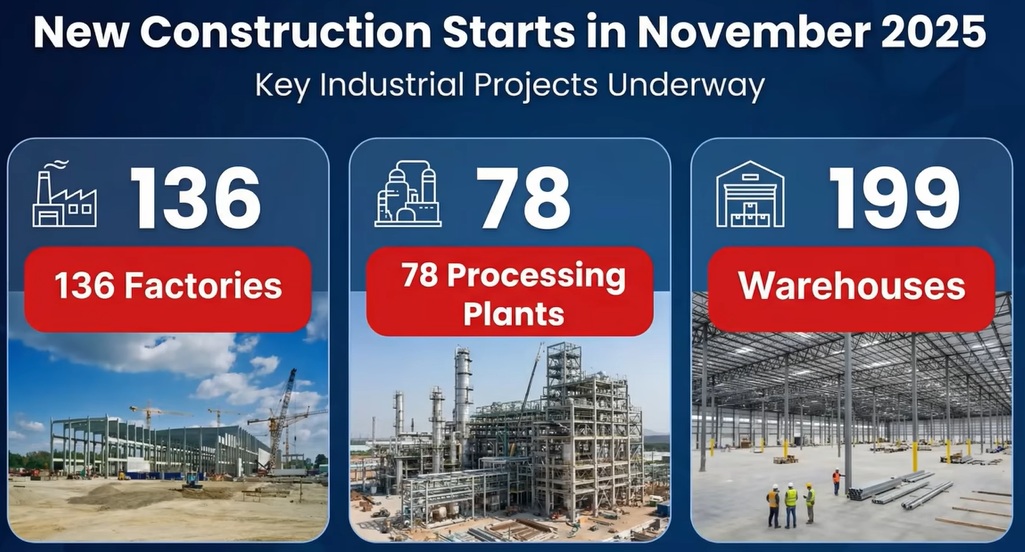
On the other side of the approach is President Trump, working to expand U.S. industrial dirty job capacity, create our own core components, then create finished goods entirely on our own. A complete revitalization of the U.S. industrial and manufacturing base. Our U.S. GDP is currently expected to grow north of 5%. This is not happening by accident.
Additionally, EU Commission President Ursula von der Leyen is not bragging about importing Indian IT workers in a vacuum. If the EU cannot skim off the IT capabilities of America, they have to find another Braintrust to tap. Just like the innovative dependencies of China, the EU is intellectually frigid; compliance is ingrained in their academia. Within the USA, we still have foundational disposition of ‘screw you‘ in our DNA.
Look at the advancements of Artificial Intelligence, or AI. All of the growth in that tech sector is being led by America. President Trump is taking every approach to ensure we remain the world’s dominant power in AI development. As much as Elon Musk’s quirks and quasi-friendly politics annoys me personally, strategically, on the technology side, it’s good to see him chumming around with President Trump; at least that’s what I tell myself.
♦ MEXICO – This is where it gets really, super interesting. You might remember that China was set to invest between $5 billion and $10 billion (total) in Mexico for EV auto manufacturing. In December of 2023, three Chinese auto manufacturers, MG, BYD, and Chery, announced they were going to spend billions building new EV manufacturing plants. Each Chinese manufacturer was initially going to spend between $1.5 to $2.0 billion. By March 2024, the reasoning was evident – Biden was supporting it.
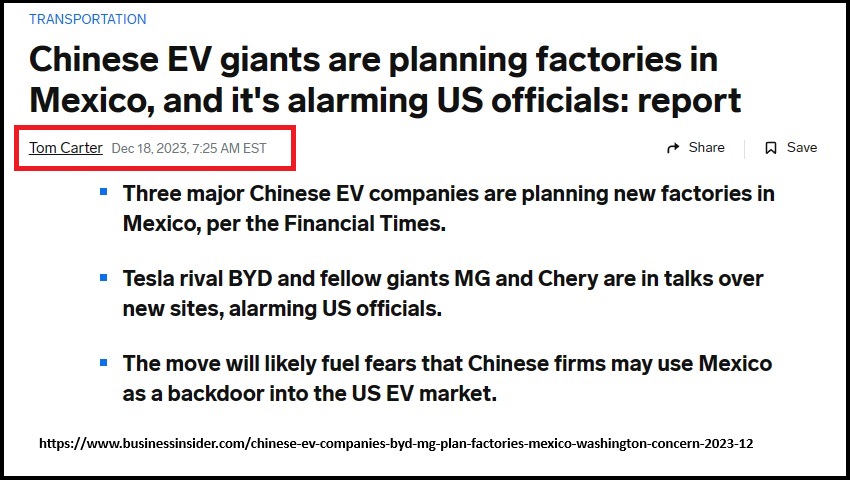
When President Trump won the November 2024 election, all of those Chinese investments and plans inside Mexico were cancelled.
As we noted at the end of last year, splitting the USMCA into two bilateral trade deals, one for Mexico and one for Canada, will be one of the most interesting and long-term economically significant moves in U.S. trade history. It is going to be a lot of fun to watch these negotiations, and the pre-positioning gives us a preview of what is to come. Mexico is doing everything almost perfectly in preparation for their bilateral deal, including their stopping of oil shipments to Cuba.
This alignment follows the Mexican government passing a sweeping set of tariffs against Chinese imports. The Mexican government, led by Sheinbaum, made moves throughout 2025 to stay in alignment with a favorable U.S. trade agreement. Meanwhile, the Canadian government, led by Mark Carney, has been more antagonistic and positioning Canada to lose badly.
 ♦ SUMMARY: Some people have construed the bilateral trade preference of President Trump to be the elimination of globalism in favor of nationalism in trade agreements. While the outcome of Trump’s approach indeed aligns with that theme, it is not specifically the objective of President Trump to eliminate global trade, but rather to focus on specific interests in trade that benefit the unique nature of each party involved.
Canada can embrace China, and Europe can embrace India; in the bigger picture it really doesn’t matter. These relationships only create dependencies which are the natural outcome of globalism. From President Trump’s position, what really matters is what happens within our borders and how the United States economy is positioned. This is President Trump’s singular focus.
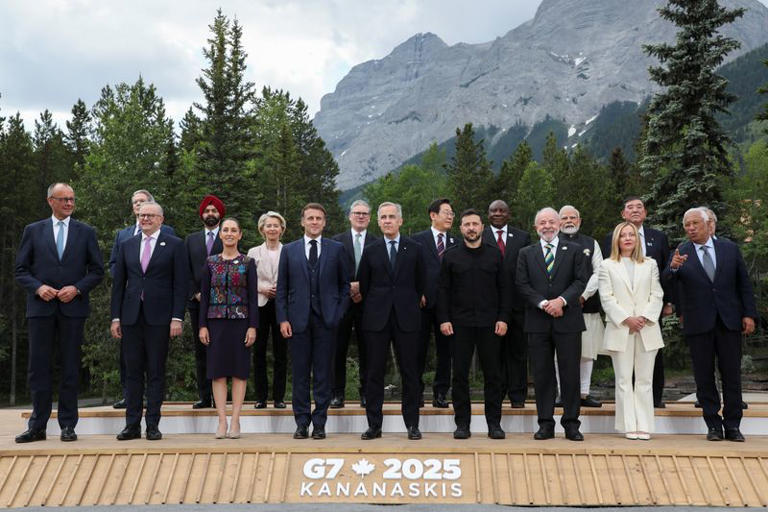
Do you remember President Trump leaving the 2025 G7 meeting in Canada early? The final day invitation list brought Australia, Mexico, Ukraine, South Korea, South Africa, India, the United Nations and the World Bank into the G7. President Donald Trump smartly exited the G7 assembly a day early, he departed before that crowd of interests arrived. The world leaders came because the process to keep USA wealth inside the USA is against their interests. That’s why they came, and that’s why President Trump left.
Globalism, in its economic construct, is a series of dependencies. However, the opposite is also true. If nations are not dependent, they are sovereign – able to exist without the need for support from other nations and systems. If nations are sovereign, then globalism is no longer needed. If each nation of the world is operating according to its individual best interests, the position of Donald Trump, then what happens to the governing elite who set up the system of interdependencies?
“G7”?