Before getting to the details as released for media consumption, three facets deserve emphasis.
(1) The primary objective of Ukraine/EU has been a publicity campaign to retain influence and support. (2) U.S. Emissaries Witkoff and Kushner are silent on the announced negotiated result. (3) Ukraine’s lead negotiator Rustem Umerov notes, “There is a lot of noise and anonymous speculation in the media right now. Please don’t fall for rumors and provocations. The American team led by Steve Witkoff and Jared Kushner are working extremely constructively to help Ukraine find a way to a peace agreement that lasts.”
I would overlay that within the weeks of discussions it is easy to spot distance between Umerov and Zelenskyy, specifically as it pertains to the influence of the EU Leadership group. Meaning, Zelenskyy is a puppet for the EU team, whereas Umerov appears more pragmatic and seemingly more focused on the interests of Ukraine.
Additionally, despite the violence and death in the war, Ukraine President Volodymyr Zelenskyy continues to say he is in no hurry to end the bloodshed. This becomes more important to recognize when you look at the post-Berlin comments from Zelenskyy himself.
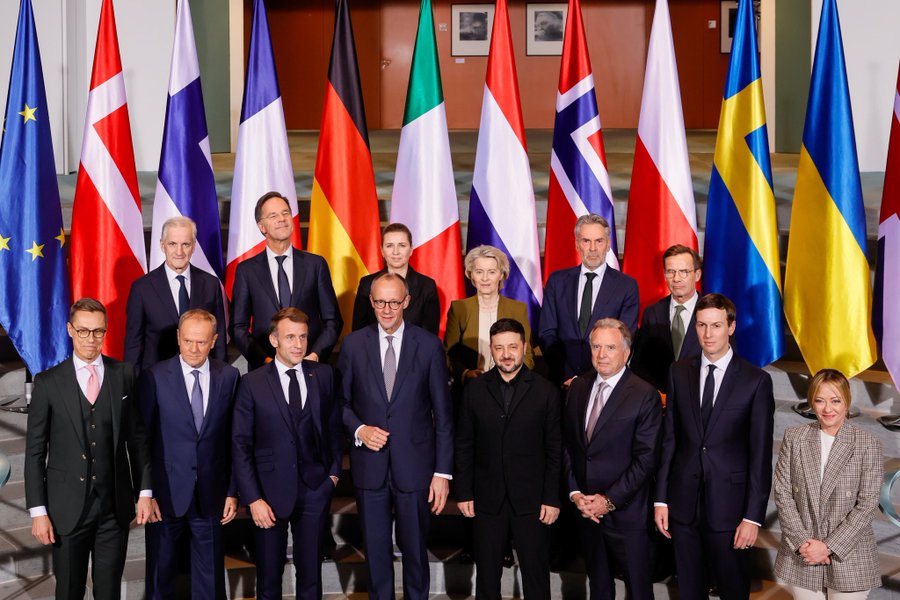
First, to the outcome of the negotiations as expressed by the EU Leadership team.
This is their official joint statement on their position within the framework. Again, not signed or accepted by the U.S delegation. [SOURCE]
The Leaders welcomed significant progress on President Trump’s efforts to secure a just and lasting peace in Ukraine. They also welcomed the close work between President Zelenskyy’s and President Trump’s teams as well as European teams over the recent days and weeks. They agreed to work together with President Trump and President Zelenskyy to get to a lasting peace which preserves Ukrainian sovereignty and European security. Leaders appreciated the strong convergence between the United States, Ukraine and Europe.
Leaders agreed that ensuring the security, sovereignty, and prosperity of Ukraine was integral for wider Euro-Atlantic security. They were clear that Ukraine and its people deserved a prosperous, independent, and sovereign future, free from fear of future Russian aggression.
Both the US and European leaders committed to work together to provide robust security guarantees and economic recovery support measures for Ukraine in the context of an agreement on ending the war. This would include commitments to:
 ♦ Provide sustained and significant support to Ukraine to build its armed forces, which should remain at a peacetime level of 800,000 to be able to deter conflict and defend Ukraine’s territory.
♦ A European-led ‘multinational force Ukraine’ made up from contributions from willing nations within the framework of the Coalition of the Willing and supported by the US. It will assist in the regeneration of Ukraine’s forces, in securing Ukraine’s skies, and in supporting safer seas, including through operating inside Ukraine.
♦ A US led ceasefire monitoring and verification mechanism with international participation to provide early warning of any future attack and attribute and respond to any breaches along with a deconfliction mechanism to work on mutual deescalatory actions that can be taken to benefit all parties.
♦ A legally binding commitment, subject to national procedures, to take measures to restore peace and security in the case of a future armed attack. These measures may include armed force, intelligence and logistical assistance, economic and diplomatic actions.
♦ Invest in the future prosperity of Ukraine, including making major resources available for recovery and reconstruction, mutually beneficial trade agreements, and taking into account the need for Russia to compensate Ukraine for the damage caused. In this vein, Russian sovereign assets in the European Union have been immobilised.
♦ Strongly support Ukraine’s accession to the European Union.
The leaders expressed their support for President Zelenskyy and agreed to support whatever decisions he ultimately makes on specific Ukrainian issues. They reaffirmed that international borders must not be changed by force. Decisions on territory are for the people of Ukraine, once robust security guarantees are effectively in place. They agreed that some issues would need to be resolved in the final stages of negotiations. They underlined that they would support President Zelenskyy to consult his people if needed.
They were clear that as in any deal, nothing is agreed until everything is agreed and that all parties must work intensively towards a solution that could assure a lasting end to the fighting.
They were also clear that any deal should protect the long-term security and unity of the Euro-Atlantic and the role of NATO in providing robust deterrence. They stated that any elements affecting the EU and NATO will be discussed among EU and NATO members respectively.
It is now incumbent upon Russia to show willingness to work towards a lasting peace by agreeing to President Trump’s peace plan and to demonstrate their commitment to end the fighting by agreeing to a ceasefire. Leaders agreed to continue to increase pressure on Russia to bring Moscow to negotiate in earnest.
They all committed to work on rapid further progress in the coming days and weeks to jointly conclude and endorse an agreement for a lasting peace. They reaffirmed their strong support for President Zelenskyy and the people of Ukraine in their fight against Russia’s illegal invasion and in delivering a just and lasting peace.
This statement remains open for other countries to join. [SOURCE LINK]
As noted in the position of the “EU Leadership,” under their plan the Russian sovereign wealth fund will be permanently confiscated by the EU and distributed according to their stakeholder interests. Ukraine President Zelenskyy later stated he expects to receive $40 to $45 billion euros per year from these confiscated assets.
There are two scenarios: 1 – if the war ends, the funds will go toward rebuilding the country; 2 – if aggression continues, Ukraine expects €40–45 billion annually for defense and security.
Here, in his words to the media after the Berlin conference, is where you need to read between the lines for Zelenskyy’s mindset. Notice he is already positioning a continuance of the conflict, “if aggression continues….”
To the issue of permanent confiscation of a captured sovereign wealth fund. Think about the ramifications here, not just to Russia but to the international monetary system. The Russian sovereign wealth fund is not the money of Vladimir Putin; it is the investment fund belonging to the people of Russia.
This precedent, if carried out, means all nations with sovereign wealth funds (Japan, Asia countries, Saudi Arabia, et al) will now look upon those funds as “at risk” investments forever. If the U.S/EU assembly can simply confiscate the EU/USD-based wealth of a sovereign nation, then all nations are at risk of a similar outcome based on the ideological alignment of the control group. Western asset holdings will forever be viewed through this political prism.
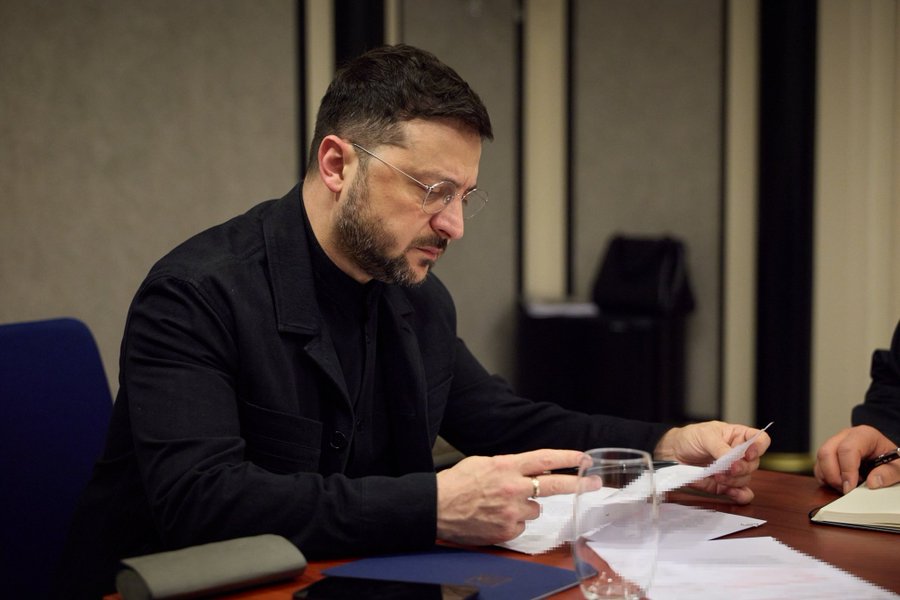 Next, Zelenskyy expects to receive all the Russian funds, or €40 to 45 billion annually from the Russian account holders in the EU if the fight continues.
Presumably this Russian money would be used to continue the Ukraine graft and conflict if the USA refuses to send more money. This is a core element behind what Zelenskyy then said to reporters.
Here are Zelenskyy’s words as quoted and summarized (I have verified by reviewing 3 sources from the media team). The emphasis is mine:
– The U.S. wants a quick end to the war; for us, quality matters. If speed and quality coincide, we’re fully on board, Zelenskyy said.
– Neither de jure nor de facto will we recognize Donbas as Russian.
– Zelensky confirmed talks with Trump and European leaders. According to him, the unity of Ukraine, the U.S., and Europe was demonstrated.
– Today or tomorrow we will finalize the documents. Then, in the coming days, the U.S. will hold consultations with the Russians, followed by consultations with the U.S. President. After that, our teams will meet in the U.S. soon—possibly even over the weekend.
– “I believe we are very close to strong security guarantees. Where there is a Fifth Amendment, as in NATO—meaning a mirror of Article 5 for all Alliance members.
– Ukraine supports the idea of a Christmas truce.
– A reparations loan or other use of frozen Russian assets is a financial guarantee of Ukraine’s security. There are two scenarios: 1 – if the war ends, the funds will go toward rebuilding the country; 2 – if aggression continues, Ukraine expects €40–45 billion annually for defense and security.
– In the first version of the peace plan there were certain points I don’t want to comment on, but importantly, they are no longer there.
– The U.S. is seeking compromise approaches and proposes a free economic zone format, but this does not mean Russian control. At the same time, the President acknowledged that the issue of territories remains one of the key questions, and there is still no consensus.
– “I am ready for elections. If we reach certain sensitive issues and decide elections are needed—if there is a ceasefire, there will be elections.” {SOURCE}
The second point by Zelenskyy is factually stunning. “Neither de jure nor de facto will we recognize Donbas as Russian.” Not within law, nor within a matter of fact, will Zelenskyy recognize the Donbas region as Russian territory.
If accurate and not just PR, Ukraine will not concede the Donbas region to Russia. This is the context behind all other points on regional geography or territories. Zelenskyy will not give Putin the Eastern Ukraine region which Russia currently occupies.
In a very real and pragmatic way this position can make all of the negotiated ceasefire talks, entirely moot. This is also why this appears to be the emphasis: “U.S. officials said that territorial questions — including Donbas — will ultimately be resolved directly between Ukraine and Russia, at the highest political level, essentially leaving the territorial question for the final stage of discussions. {Source}
I’m not sure how the Ukraine-U.S-EU-Russia negotiations can frame all other aspects while simultaneously leaving out the part of territorial concessions until later.
As noted by the official statement from EU Leadership, “as in any deal, nothing is agreed until everything is agreed.” Perhaps this is how they are structuring momentum; keep focused on the small things for agreement, until you hit the wall of major disagreement at the end. This would not be beginning with the end in mind.
I’m not sure who the U.S. officials are in these points being relayed by (pro-Ukraine) media, so take this stuff with a grain of salt, because, well… World War Reddit:
“STRATEGY ON RUSSIA: U.S. officials say President Trump is focused on reaching a conclusion to this conflict that truly stops Russia from moving west: “Under President Bush – Russia moved West, under President Obama – Russia moved West, under President Biden – Russia moved West. President Trump really wants to see this seeded as an agreement that ends that for good. That’s really what we’re trying to find a way to bring there.” {Source}
American officials say that President Trump’s focus is on robust security guarantees for Ukraine and Europe, while also rebuilding economic and political relations with Russia: “President Trump’s focus on this deal has been, number one, we need to make sure that there’s very, very robust security so that the war really ends and this will not happen again. Number two, how we make sure we deal with all the economic issues for Ukraine, so they have a bright and prosperous future. But also that Russia gets back into the global economy, so that they have incentive not to go back to war in the future, and hopefully they get focused on a different project, which is really the economy and being part of the global world, which is possible.” {SOURCE}
U.S. officials say the parties plan to meet again this weekend, likely somewhere in the United States—possibly Miami—where working groups, including military representatives, will review maps and outstanding issues. They believe roughly 90 percent of the issues between Ukraine and Russia have already been resolved, with a few remaining points still to be worked out. As additional information is gathered, the sides will compare remaining positions, including European views on territorial issues.
U.S. officials say there has been clear and acknowledged progress in narrowing the gaps between Ukraine and Russia. “We’ve identified multiple possible solutions to help bridge those gaps, which we’re proposing to the parties. We broke into a working group today focused specifically on this issue, and within about an hour we produced a three-page draft outlining the key points. As we worked through it, we realized that on roughly 90 percent of the issues there was consensus and unanimity of opinion. That reflects a real good-faith effort”, – Americans said {SOURCE}
Zelenskyy’s public statements seem to change based on his audience.
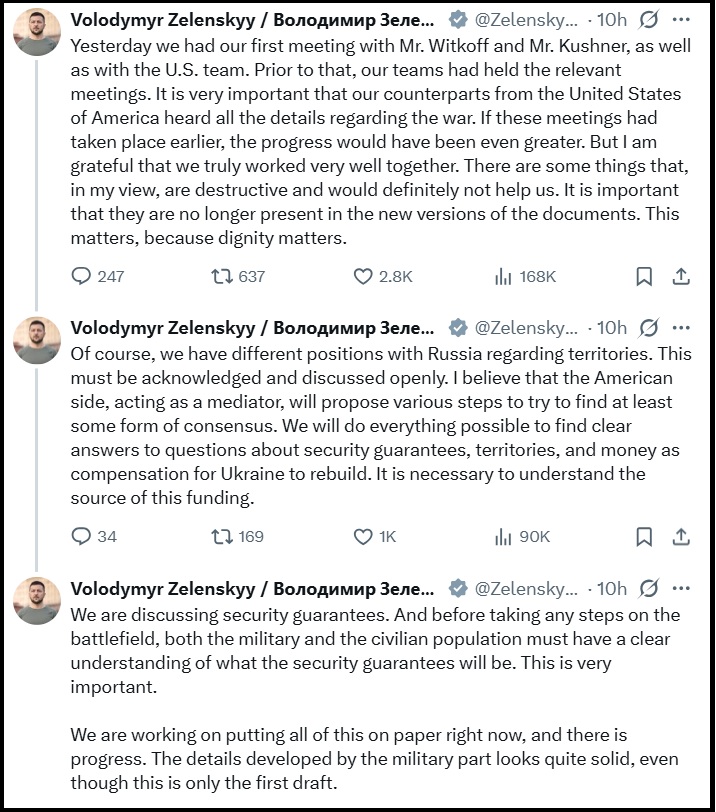
As you can see below, Zelenskky’s wording is fraught with passive-aggressive context and manipulative structure. “If these meetings had taken place earlier”…. blah blah blah. The U.S. team has literally been immersed in discussions with the Ukraine delegation for months.
If there was anything missing in the U.S-Ukraine discussions before, it was/is not an issue of availability from the U.S. side. The only thing that recently changed substantively is Zelenskyy hiding behind the skirt of Merz, Starmer, Macron and Von der Leyen (EU Leaders) to frame his talking points, AND this newly expressed zero-sum position that none of the Donbas will be conceded.
Just as a reminder: Zelensky and David Arakhamia, Ukraine’s initial negotiator, refused to sign the Istanbul ceasefire and peace agreement because, as they said, “we would have to give up NATO, and that requires changing the Constitution, which is impossible.” This was after Zelenskyy received direct pressure from British Prime Minister Boris Johnson to stop negotiating with Russia.
Now, as it turns out, what they said was “impossible” is entirely possible – just as it has always been possible to hold elections during a war. Zelensky’s decisions in 2022/2023 had nothing to do with a genuine position of the state, or best interests for Ukraine. Zelenskyy’s position was driven by a desire for control, power and profit at the cost of the lives and fate of millions of Ukrainians.
Now, Zelenskyy wants a structural security guarantee that creates a de facto NATO alignment. Essentially, all of the NATO security benefits, NATO recognition, NATO protection, NATO tools, and yet not officially a NATO member.
In addition, Zelenskyy demands full expedited entry into the European Union.
So, to summarize the position of Zelenskyy that is supported by the EU Leaders. (1) No concession on Donbas. (2) De facto NATO protection and membership. (3) EU membership and (4) Ukraine control of the Russian sovereign wealth fund.
To the folks in the administration who read here: Please accept that ¹Zelenskyy (et al) is manipulating you into a very narrow gauntlet in order to use the USA clout to achieve an objective that is not part of the administration goal.
Begin with the end in mind and now modify the approach. Tackle the issue of territorial concessions and watch all of these endless discussions collapse upon their own weight because they are missing the foundational block. Russian Federation President Vladimir Putin is not going to retreat from Eastern Ukraine; any more than President Trump would give Texas to Mexico.
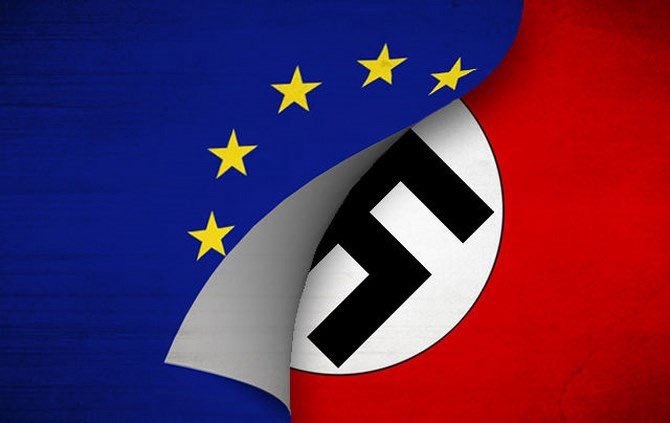
[¹There’s also a better than average likelihood, Zelenskyy is in alignment with a genuine EU/Nazi mindset. Which, of course, was the reason Obama/DoS selected him in the first place.]