
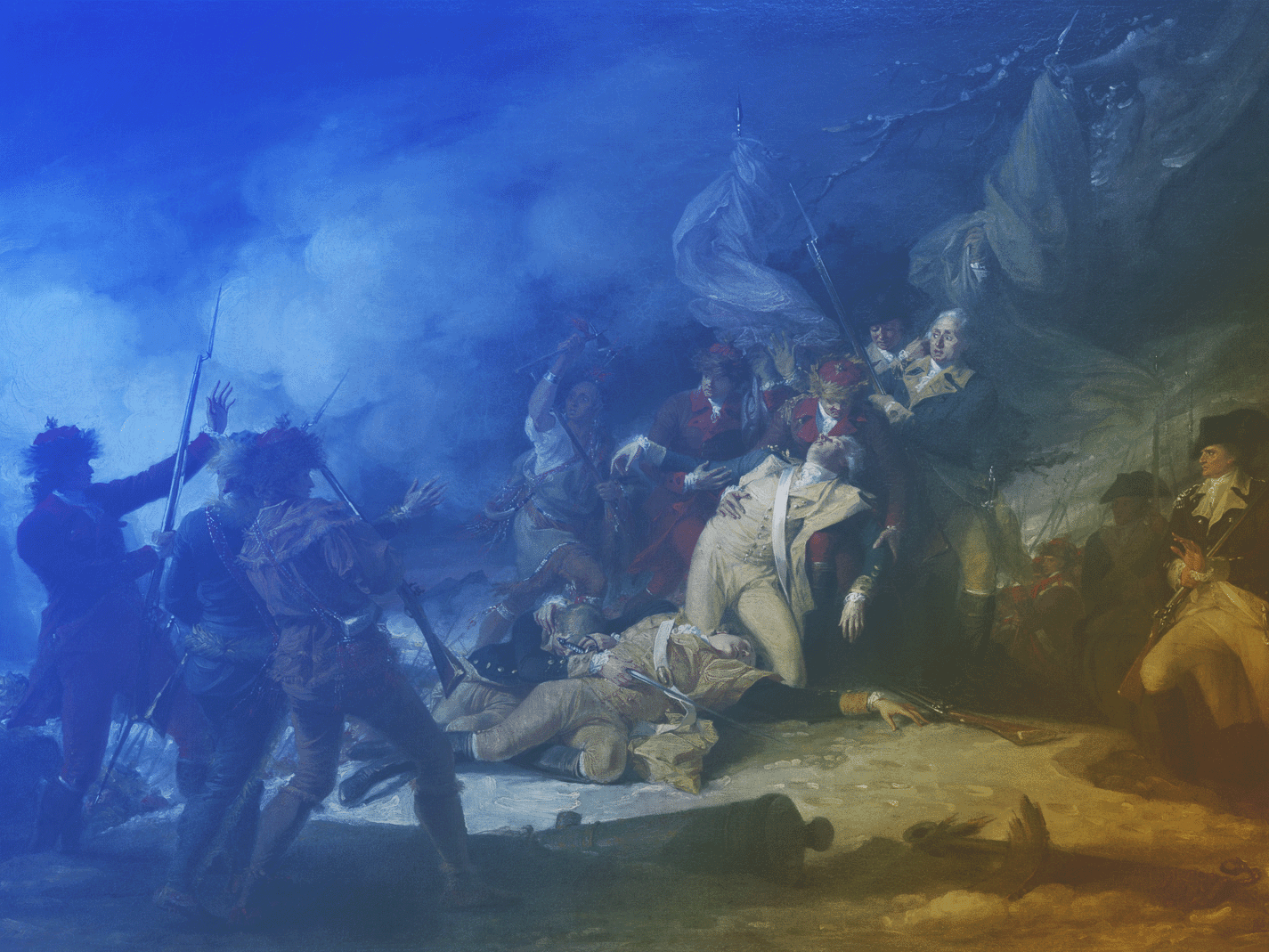
A blizzard raged in Quebec City on December 31, 1775, as the American army charged the walls and the British defenders. The Americans needed snow to disguise how few men and guns they had to attack, but the snow was so thick that their soldiers got lost in the streets beneath the fortress. General Richard Montgomery, the American commander, died from a gunshot to the head as he charged down a snowy street with his sword raised high. Elsewhere in the city, Benedict Arnold’s cannon got stuck in a snowdrift, so he ordered a frontal assault on the Canadien militia; a musket ball wounded him in the leg and ended his service for the day. British troops surrounded Daniel Morgan and his legendary riflemen; Morgan, forced to surrender, gave his sword to the Catholic priest who brought the flag of truce, rather than give it up to a British officer. The bodies of dead Americans littered the snow as the American army retreated in defeat from Quebec’s walls at the end of the day.
It should be a movie. The marketing guys will moan: The Americans lost the battle, the British lost the war, the Canadians mostly were bystanders, who will watch this? But it’s one of the great stories of American heroism—and British, Canadian—with the fate of a continent at stake. And how can you beat the backdrop of fighting in a blizzard, beneath the walls of a fortress, in the cold and awful beauty of the Canadian wilderness?
There were so many reasons the American attack failed. The Quebec Act of 1774 alienated Americans but conciliated French Canadians toward the British crown by restoring Catholicism and French law in much of their traditional territory in Quebec. The Canadiens did not love the British, but they mostly would not rebel when the American army arrived to “liberate” them from Great Britain. The American army in Canada had too few men, too few supplies, and its men were wracked by smallpox. Above all, the enlistment of much of the American army came to an end on December 31—hence the American attack that day, before the army lost any chance of victory. The British army already outnumbered the American army; Montgomery and Arnold attacked against the odds.
But still, they could have won. Much of the British army was drafted from the inhabitants of Quebec City: there was no guarantee they would fight well. The core of the British soldiery was better trained, but battles are chancy things. Arnold, Montgomery, Morgan—these men were daring leaders, ready to risk their lives in battle. Maybe the odds were against the American army, but it could have won. Even in defeat, it was brave. Benedict Arnold kept the American army intact after the battle all winter long, still besieging Quebec City, hopeless of victory, but delaying the British counter-attack toward Montreal, toward New England and New York, for crucial months of 1776. The American army was defeated in the New Year’s Eve blizzard; it was not routed.
There are other tales of American valor in the snow—not as titanic as those of the French retreat from Moscow in 1812, or the Soviet struggle during World War II on the Volkhov front, but heroic enough. Our Marines retreating in December 1950 through the North Korean winter, from the Chosin Reservoir to the evacuation port at Hungnam. The American resistance in December 1944, as the Germans streamed westward through the Ardennes hills in the Battle of the Bulge. The December 1861 retreat of the Unionist Creek and Seminoles from Oklahoma to Kansas, pursued by Confederate armies, was the Trail of Blood on Ice. Many Americans have died on battlefields where the cold and the snow were as deadly as the men they fought against.
We should remember and honor their valor. And take as an inspiration their willingness to fight and die for America, even, especially, in ill-conceived campaigns, where the odds always were against victory. We should take even more as an inspiration the ability of American fighting men to endure through defeat and keep on fighting for their country. Endurance, perseverance, grit—America needs these as much as it ever did.
Private Simon Fobes of Massachusetts left this account of the Battle of Quebec:
It continued to snow furiously. Many of the gun-locks had become so wet that the guns could not be fired. As we marched through into the main street of the city the battle became more and more desperate, the enemy firing from the walls of the city, from the windows of the houses, and from every lurking-place they could find. Our troops were mowed down in heaps. I well remember that Captain Hendricks was shot down dead. I saw my Captain Hubbard leaning on the side of a building. I spoke and said, ‘Are you wounded, Captain?’ He replied that he was, but said, ‘March on; march on.’
That is the lesson from 250 years ago today: March on; march on.
Follow David Randall on X.
Art by Beck & Stone