
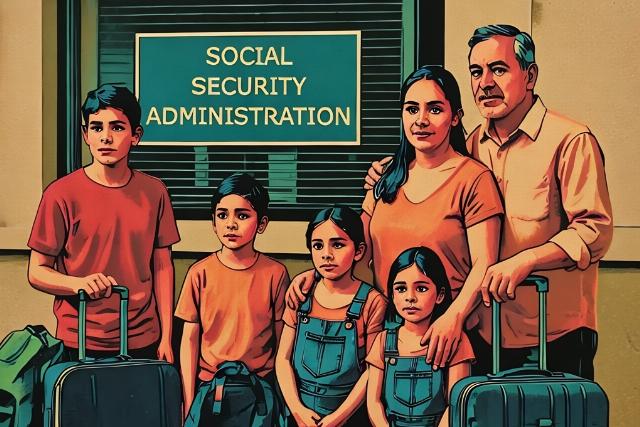
In the shadow of well-meaning slogans and impassioned rallies, a quiet crisis is brewing—one that threatens the very systems built by generations of American workers. Social Security and Medicaid, two pillars of our social contract, are facing demographic and fiscal strain.
At the same time, a growing political movement seeks to legalize millions of illegal aliens, offering them a pathway to citizenship and, eventually, access to these entitlement programs—programs to which they haven’t, or have barely, contributed. The moral impulse behind this push is understandable. But the economic consequences, especially for older Americans and the rising generation, are rarely discussed with honesty.
We can explore the question of naturalizing those who entered the country illegally through the lens of simplicity and critical thought. I have witnessed rallies across the nation, crowds of retirees and working-class citizens standing shoulder to shoulder, passionately endorsing illegal immigration and denouncing ICE as if it were an occupying force.
Many of these same citizens, I suspect, have spent three, four, even five decades faithfully contributing to Social Security. Their payroll taxes were mandatory. Their sacrifices were tangible. Their commitment was unquestionable. Yet few seemed to recognize that the very system they labored to sustain now stands at risk of destabilization by the very policies they so fervently champion.
Let’s be clear: illegal aliens are not currently eligible for Social Security or Medicaid. But if legalized and eventually naturalized, they would become eligible, and that’s where the tension begins.
The Contribution Gap
It is undeniable that many individuals residing in the country illegally do, in fact, pay taxes. Some file returns using Individual Taxpayer Identification Numbers (ITINs), while others are employed under borrowed or fraudulent Social Security numbers. According to estimates from the Social Security Administration, illegal alien workers contributed more than $26 billion to the trust fund in 2023 alone.
 Yet this headline figure conceals a deeper reality. Millions of others remain outside the system entirely, working off the books, paid in cash, and contributing nothing to the tax base or social safety net. This shadow economy not only undermines fairness but also erodes the integrity of the system itself.
Moreover, every position filled by someone who is in the country unlawfully represents an opportunity denied to an American citizen. Jobs that could provide stability, dignity, and upward mobility for legal residents are instead diverted, creating a silent but significant displacement in the labor market.
Even among those who do pay, the duration and amount of their contributions often fall short of what’s required to sustain long-term benefits. Social Security is not a welfare program; it’s an earned benefit. The average American worker contributes for decades before drawing retirement income. Legalizing millions of illegal aliens who have only recently begun contributing, or who may never meet the full eligibility criteria, creates a fiscal imbalance. They will receive more than they paid in, and someone else will have to make up the difference.
That someone is the American citizen.
The Hidden Costs of Compassion
Supporters of mass legalization often argue that immigrants will bolster the workforce and stabilize entitlement programs. After all, most illegal aliens are of working age. But this argument ignores the wage suppression and job displacement that often accompany large-scale immigration.
Harvard economist George Borjas found that illegal immigration reduces wages for low-skilled native workers, particularly those without high school diplomas. In sectors like construction, agriculture, and hospitality, American citizens are increasingly displaced by cheaper, illegal labor. This not only erodes wages but also undermines the tax base needed to fund Social Security and Medicaid.
Moreover, the fiscal drain extends beyond payroll taxes. The Center for Immigration Studies estimates a lifetime net cost of $68,000 per illegal alien, largely due to low education levels and higher use of means-tested programs. Medicare, in particular, faces pressure from emergency care provisions and long-term eligibility expansions. Legalization would only accelerate this trend.
Intergenerational Consequences
The most troubling aspect of this debate is its impact on generational equity. Older Americans, many of whom support illegal migration policies out of compassion or nostalgia, may not realize that their benefits are at risk. Social Security is already projected to run short by 2033, triggering a 23% cut in benefits unless reforms are enacted. Adding millions of new claimants, many of whom contributed far less, will force painful choices:
- Raise the retirement age to 68 or beyond.
- Increase payroll taxes on younger workers.
- Reduce benefit formulas for future retirees.
- Means-test benefits, undermining the universality of the program.
These changes won’t affect the wealthy. They’ll hit the middle class, the very people who built the system and now rely on it. And they’ll hit the rising generation hardest, forcing them to pay more for benefits they may never receive.
Why the Silence?
Why don’t we talk about this? Why do older Americans, who have the most to lose, support policies that could erode their own retirement security?
Many see immigration through the lens of their own family histories—grandparents who came through Ellis Island, parents who worked hard to build a better life. They forget that those immigrants came legally, often with sponsors, and without access to entitlements. Today’s immigration landscape is fundamentally different.
Another reason is media and political messaging. The debate is framed as compassion versus cruelty, not sustainability versus collapse. Few politicians dare to speak the truth: that compassion without contribution is a recipe for fiscal ruin.
Finally, there’s a disconnect between policy and personal impact. Retirees may assume their benefits are locked in, unaware that future COLA adjustments, spousal benefits, and lifetime caps could be trimmed to accommodate new claimants. They may not connect their decades of contributions to the redistribution effects that legalization could trigger.
A Call for Critical Thinking
The older generation and the younger generation alike are, perhaps unknowingly, supporting their own financial demise at the expense of illegal aliens who should not be in the country to begin with. The question must be asked: why can’t they see beyond the talking points? Why do so many blindly support policies that will affect them deeply later—policies that will erode their retirement, suppress their wages, and burden their children?
America is a nation of immigrants, but also a nation of laws, systems, and promises. Social Security and Medicaid are not infinite wells. They are fragile compacts between generations. To preserve them, we must confront hard truths, not just comforting narratives.
Americans need to think with clear heads, not heated emotions. If millions of people who entered the country illegally are naturalized, workers nearing retirement will see their benefits erode, while younger workers will face higher taxes to sustain the system. The younger will pay, the older will sacrifice, and everyone in between will bear the burden—without having truly consented to these outcomes. What was once designed as a safeguard for those who worked and sacrificed may instead become a mechanism of redistribution, eroding the very promise of security it was meant to uphold.