Back in 2020 I said that Georgia and Texas are not Red States. The election is highlighting something that people are not accurately absorbing. This outline might help.
When we traditionally think about Red states or Blue states we think about Red being republican, conservative or nationalist, and we think of Blue as being democrat, progressive or socialist. However, that is not the accurate prism, and it never was.
What determines the political ideology of the state is the financial livelihood of the power centers, powerful people that control the political outcomes. The key words there are “financial livelihoods.” It is the money within the power center that determines the ideology.
The political ideology of Illinois, Minnesota and New York directly comes from how the power interests gain their affluence.
What is the driving element of the money within the state that funds the powerful people, and how is that money made? Those are the questions that determine the politics – Red or Blue it matters not. The critical question is where does the wealth of the powerful come from?
When an outside influence starts to challenge the wealth of the powerful, it is the retention of that finance that determines the political outlook. Let me give you examples.
For the powerful interests in California, New York, Illinois and recently -more specifically and visibly- Minnesota, you will notice the power brokers money is made from corruption of government finance. Take away the access of powerful interests to federal government money, eliminate corruption and you are hitting directly at the center of power.
Enforce lawfulness, target corruption and take away the ability to gain wealth from theft of government money and the powerful political interests who control political power lose wealth. The entire system is based on wealthy people engaged in fraud and corruption to remain wealthy. That dynamic applies to California, Illinois, New York and Minnesota.
However, the same dynamic, albeit under a different auspice, applies to Texas.
Texas industry, and more specifically the billionaires who live in Texas, control the industry and control the political power centers, rely on illegal aliens to achieve their wealth status. Start addressing the illegal immigration issue and you start threatening the wealth that underpins the powerful people who control political outcomes.
Because Texas billionaires rely on the industry of illegal aliens, enforcing immigration laws is against their interests. Deporting illegal aliens becomes a threat to the Texas wealth system in the same way that stopping fraud is a threat to the wealth system in NY, IL, CA and MN.
The fastest way to expose a political ruse is to target the wealth of the powerful interests behind it.
If enforcing lawful behavior targets that wealth system, the powerful interests will change perspectives and decry the enforcement of lawful behavior. That’s the truth at the core of every state political construct.
Why was/is Florida somewhat immune in 2026?
Well, because the wealth of the powerful people in Florida politics is tied to the U.S. stock market. Positive gains in banking, finance, Big Tech and asset management expanded wealth portfolios. The FL power interests are older people, with deep and significant financial holdings. They are no longer dependent on govt fraud, stealing govt money, or industrial use of illegal alien labor at a rate that creates risk.
If you want to turn Florida blue, collapse the stock market and destroy the portfolios of the wealthy people who control political perspectives in Florida. The FL power interests don’t steal money, but they benefit from govt bailouts of failed financial enterprises. The wealth of that set of power interests is not connected the same way.
TX and GA are directly reliant on illegal alien activity for their affluence. Target immigration and get political opposition. CA, MN, IL and NY are directly reliant on govt fraud for their affluence. Target fraud and get political opposition.
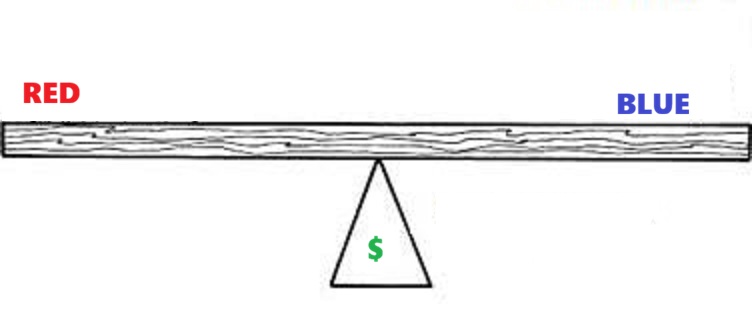
The correct prism to determine “Red” or “Blue” is not to look at surface ideology (conservative of socialist), but rather to look at what creates the wealth of the powerful people who control politics and thereby control the ideology.
That’s where you will quickly determine the freedom continuum doesn’t balance on political perspectives, it balances on the fulcrum of money. If you touch or move the money you tilt the balance of power.
Salvadoran President Nayib Bukele has been waging war on Haitian gangs that have held the Caribbean nation in their stranglehold for years for a while. That came after Salvadoran nationals were captured when they joined the U.N.-backed Gang Suppression Force (GSF) in the nation. The four Salvadorans went missing following an October 18 ambush. Gang leaders have claimed they're dead, but there's no official confirmation of this.
Posting on X on Tuesday, Fils-Aimé thanked the Salvadorean military's commitment "in the fight against gangs" and said the two nations would keep working together, along with the UN-backed Gang Suppression Force (GSF), to "regain control of the territory and restore state authority".
"THE GANGS WILL GET NO SLEEP!" he added.
While he did not provide any further details about the joint operation or the number of casualties, Fils-Aimé posted a still from the video shared by Bukele showing a helicopter firing a projectile at the compound.
The BBC has not been able to verify the video posted by Bukele, nor whether the property is indeed the headquarters of the 400 Mawozo, Haiti's largest criminal gang, which is infamous for carrying out kidnappings for ransom.
Unsurprisingly, Amnesty International Chided both Haiti's Prime Minister and Bukele, saying they "must ensure that all operations conducted by Salvadoran forces in Haiti comply with international human rights law."
Note that Amnesty International doesn't condemn the gangs that have been terrorizing Haiti to the point where the U.N. had to set up a task force. As a pending Community Note says, the gang violence caused more than 5,000 deaths in 2025 alone, "without any warnings or condemnation by Amnesty International."
For his part, Bukele is not bothered by Amnesty International, and even celebrated the massive ratio they earned on their asinine post.
Currently, the post — with 3.7 million views — has more than 9,500 replies and just 1,500 reposts and 2,000 likes.
Incredible, but not surprising and completely on-brand for Amnesty International.
No, "international law" is what the commies say to try and control nations they don't like.
"Bukele is f***ing with Amnesty International because they're asking him to respect the human rights of criminals in Haiti. A total f***ing genius. Hugs!" the post reads.
Bukele is showing the world what leadership looks like. Haitian gangs took Salvadorans and likely killed them. Instead of apologizing or giving them money or trying to understand it, Bukele is obliterating the gangs so they can't hurt anyone else. This is how you do it.
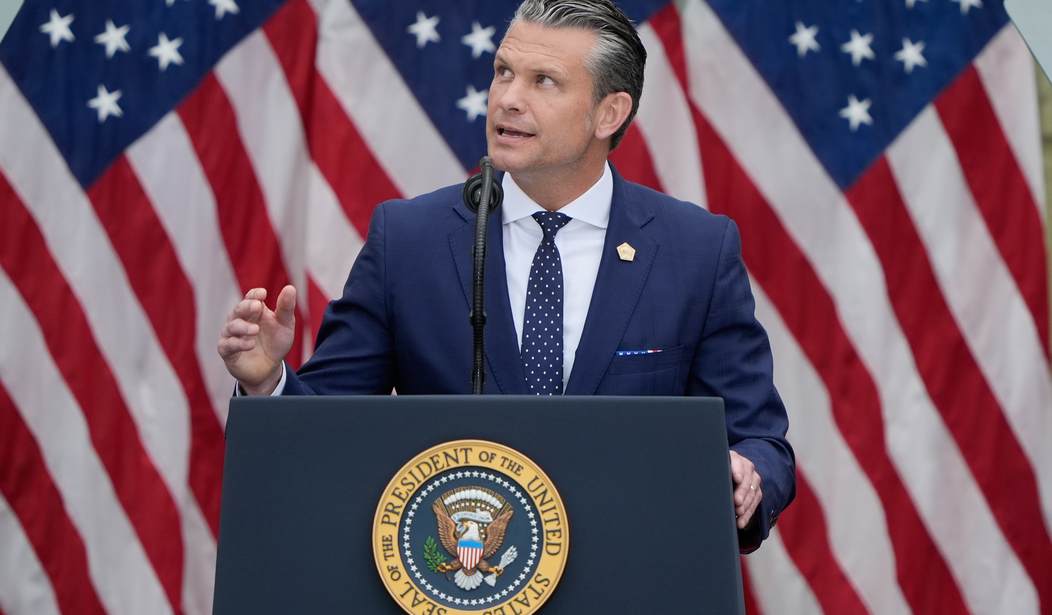
You may have heard a story on Wednesday about Secretary of War Pete Hegseth at the Tomb of the Unknown Soldier for Veterans Day.
The story that was beamed out by many media outlets was that Hegseth and his group were laughing and were admonished by the sentinel on duty.
Except that wasn't true. There was one laugh. Some of the stories said that you could not tell who laughed. But you could tell it was a woman, so it was obviously not Hegseth. So implying or claiming Hegseth laughed is just false. Of course, Democrats are trying to whip up a narrative against Hegseth to try to justify an impeachment.
I get folks on the Left have trouble with knowing what a woman is, but most of the rest of the world can tell. You can hear it here.
Now, she was wrong to do that. She may have thought that since they were leaving and almost up the stairs, it was okay. But that was wrong. Chief Pentagon Spokesman Sean Parnell stood behind the soldier and said he correctly reminded everyone to maintain decorum.
But Hegseth showed why he was right for the job with how he responded to this incident. He just awarded the soldier who admonished the person laughing a medal and praised his actions.
We love soldiers.
We love standards.
Well done, Specialist.
Carry on Patriots.
A Pentagon official confirmed that Hegseth welcomed the 3rd Infantry Regiment, known as The Old Guard, to the Pentagon “where he proudly awarded Specialist Iglesias the Joint Service Commendation Medal for the execution of his duties at the Tomb of the unknown Soldier on November 11, 2026.”
Good on Specialist Iglesias for doing his job, despite it being Hegseth's group. And that's exactly what Hegseth has been trying to encourage with the moves he has been taking to strengthen the military — standards and doing the job.
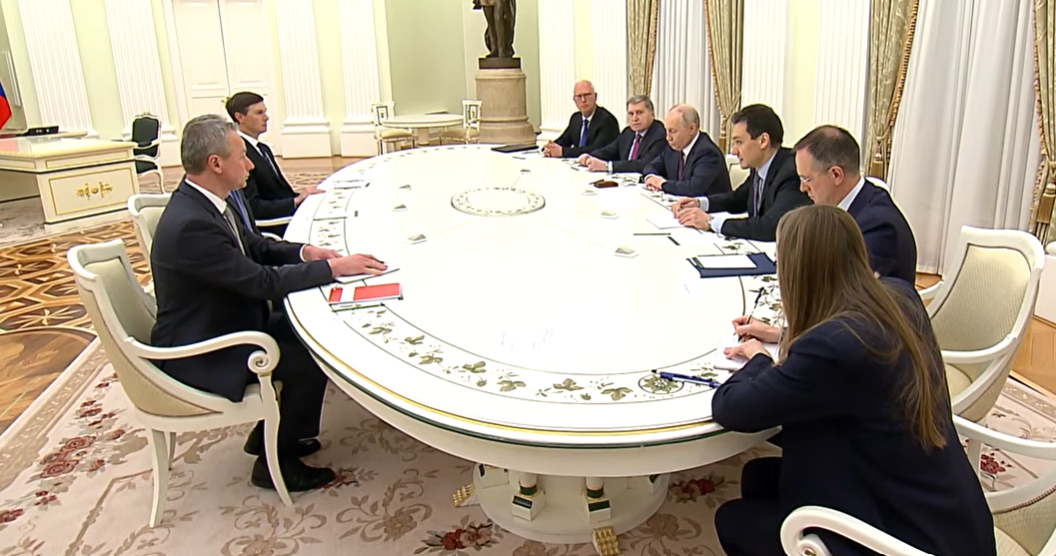
I guarantee you two things. First, there are dozens of U.S. intelligence analysts feveriously watching this video of Russian Federation President Vladimir Putin engaged in discussion with U.S. envoys Steve Witkoff and Jared Kusher. Second, most of the analysts will get their interpretations wrong.
Beyond the unusual and remarkable transparency of Russia allowing the media to witness and record some very substantive points being made, the animated nature of Vladimir Putin [15:00 forward] is not customary for him. Putin is normally stoic in his body language and does not usually animate his words with his hands; in this discussion he does.
After the formalities and diplomatic niceties expressed by Putin, he gets right down to business asking both Witkoff and Kushner to summarize their perspectives on the recent Abu Dhabi talks. You can see Kushner caught off guard when asked to answer a question -specificicity- that would normally not be asked during public moments [14:45].
I can tell you from experience in studying Russian’s close up over a long timeframe, President Putin is frustrated at the remarks from the U.S. side because Russia doesn’t culturally engage in ‘blah, blah, blah.’ You see this when Putin talks about the “grey zones” that are stunningly antithetical to the mindset of any Russian.
In Russia there is Yes or No, there is not this western talk of ‘maybe.’
In Russia there are clear boundaries in almost everything. There is yours and mine, there is no ours. There is right and wrong, there is no “kinda.” When a Russian has something to say, they say it – and there is a point to it, a specific point.
Russians approach things with a ‘do’ or ‘do not’ perspective, it is just their culture.
President Putin, just like any other Russian, is not being curt or rude, he is being direct. Say or don’t say, but do not talk circles about maybe saying or maybe doing; it will piss off a Russian quickly. Do or do not, but don’t talk about doing for the sake of talking about doing. You either do, or don’t – that’s it.
The failure of Americans or western viewers to understand the Russian mindset leads to poor analysis of what Russia says and does. Russians seem rude to western eyes and ears, but they are not – they’re just very direct and they don’t engage in small talk about anything. Everything a Russian says has a point to it, or they just don’t say anything.
With that in mind, watch the video:
1. Vladimir Putin’s Opening Remarks [00:16] Gratitude to the U.S. Administration: Putin welcomes Steven Witkoff and Jared Kushner and asks them to convey his gratitude to President Donald Trump for organizing contacts with the Ukrainian side.
Humanitarian Track & Prisoner Exchanges: He notes that positive results have been achieved on at least one track—the humanitarian exchange of detained persons between both sides—and mentions that another major step in this direction is upcoming.
Recognition of Melania Trump & U.S. Agencies: Putin requests that thanks be passed on to First Lady Melania Trump for her active participation in resolving humanitarian issues surrounding the town of Oleshky in the Kherson region. He acknowledges that this would not have been possible without the support of President Trump’s entire team, including the State Department and the Defense Department (jokingly referencing its rebranding as the “Department of War”).
Assessment of Abu Dhabi Talks: Putin proposes continuing this humanitarian practice by involving human rights commissioners from both Russia and Ukraine. He then asks the U.S. delegation for their assessment of the recent negotiations in Abu Dhabi between Russia and Ukraine, the prospects for future contacts, and their engagement with European representatives.
2. Steven Witkoff’s Response [04:41] Trilateral Format & U.S. Commitment: Witkoff thanks Putin for hosting them and announces that work has resumed in a trilateral format. He conveys President Trump’s strong desire to end the conflict as quickly as possible, noting that Secretary of State Marco Rubio and the broader U.S. team are working diligently toward a resolution.
Positive Atmosphere in Abu Dhabi: Witkoff characterizes the recent meetings in the United Arab Emirates as very positive and purposeful. He notes that Russian and Ukrainian delegations sat at the same table to actively work through detailed issues, pointing to the upcoming prisoner swap—described as the largest ever between the two countries—as proof of tangible progress.
Acknowledgments: He thanks Russian Presidential Aide Vladimir Medinsky for his multi-year commitment to resolving the conflict, and expresses appreciation to Yuri Ushakov and Kirill Dmitriev for their productive meetings and ongoing work.
Role of Europe & Next Steps with Zelenskyy: Witkoff clarifies that while European representatives did not sit at the negotiating table in Abu Dhabi, they were physically present in the UAE, thoroughly briefed, and consulted throughout the process. He adds that immediately following this Moscow meeting, the U.S. delegation will travel to Ireland to brief Ukrainian President Volodymyr Zelenskyy before he returns to Ukraine, expressing hope that they will soon announce the next trilateral meeting.
3. Jared Kushner’s Remarks [11:31] Pathways to Ending the Conflict: Kushner notes that during the talks in Abu Dhabi, representatives from Russia, Ukraine, and Europe all agreed they want to see an end to the armed conflict, though the final steps still need to be worked out. He expresses hope that today’s meeting will identify concrete pathways to bring the conflict to a definitive close, which they will then present to President Zelenskyy to encourage moving forward along one of those paths.
European Security Architecture: Kushner highlights positive movement from the European side, noting that Europe wants not just an end to the war, but a lasting peace afterward. He explains that discussions have begun regarding a long-term security architecture involving Russia, Ukraine, and the European continent to prevent a new conflict from starting—noting that this is closely tied to territorial questions.
4. Vladimir Putin on Territory, “Gray Zones,” and Kostiantynivka [15:01] Focus on People & Rejection of “Gray Zones”: Putin agrees that territorial issues will be discussed today and states that Russia also wants a reliable, “eternal” peace. He emphasizes that for Russia, the priority is the people living in those regions, their culture, and their right to live according to their traditional values. He rejects Kyiv’s proposals regarding “gray zones,” arguing that ambiguous boundaries inevitably lead to disputes and instability, whereas a clear state border line leaves no room for confusion.
The Kostiantynivka Humanitarian Proposal: Addressing conflicting claims over who controls specific front-line areas, Putin proposes replicating the Oleshky humanitarian operation in Kostiantynivka (a town on Ukraine’s defensive line in Donbas where he estimates 400–500 civilians remain).
Five-Day Demining & Media Verification: Putin suggests a 5-day period to demine the approaches to Kostiantynivka and invites U.S., international, European, Ukrainian, and Russian journalists, alongside human rights commissioners from both sides, to evacuate the remaining civilians. He states that if Kyiv claims control of the town, they should ensure security; otherwise, Russian forces will provide security, allowing observers to verify who actually controls the area.
5. Vladimir Putin on Europe and Foreign Troops [23:05] Dialogue with Europe: Putin asserts that Russia has never opposed dialogue with Europe and was not the side that broke off relations, expressing readiness to work with European nations.
Unacceptability of Foreign Troops: He reiterates that the presence of any foreign troops on Ukrainian territory is completely unacceptable to Russia and poses a direct threat to its security—a point he notes was broadly understood during the earlier Istanbul negotiations. Putin warns that if European nations deploy troops to Ukraine immediately after a peace deal is signed, Russia will view them as legitimate military targets, which would immediately reignite the war.
The “Circular Logic” Critique: Putin contrasts President Trump’s proposal—to negotiate comprehensive European security instruments—with Europe’s stance of refusing security talks until after peace in Ukraine, while simultaneously planning to send troops into Ukraine once peace is reached. Illustrating this contradiction with a classic Russian joke about a man claiming he gets money from a nightstand that he himself refills, Putin urges the U.S. administration to work with its European allies so they clearly decide whether they want peace or continued war in Ukraine.
Putin is eyerolling at moments because from his perspective Putin wants this war to end, and he wants it to end on direct and easy to understand terms. The western approach is blah, blah, blah… working toward, understanding, starting the framework, building toward some vague beginning of something that first needs to be defined in order to understand it… blah… blah…. blah.
You can tell from this video President Putin wants direct, simple, black-and-white, regional lines and territory drawn. Europe/NATO has no need to inject themselves into the issues that are between Russia and Ukraine to resolve, and Putin has no respect for the western process of endless paralysis by analysis.

 What determines the political ideology of the state is the financial livelihood of the power centers, powerful people that control the political outcomes. The key words there are “financial livelihoods.” It is the money within the power center that determines the ideology.