Those who have followed the NAFTA/USMCA storyline will remember that Volkswagen made a strategic bet on North America when it decided to expand production into Mexico for the Audi Q5 mid-size SUV brand. That was an analytical mistake as Audi does not make any vehicles inside the USA.
The Volkswagen leadership have made several blunders since that initial decision to open plants in Mexico. The massive push on EVs without understanding the USA market was a strategic mistake. The decision to align financial survival with a deep Chinese partnership was another.
Meanwhile, back in both Brussels and Germany the political calculus around energy policy was catastrophic for the entire auto industry. The costs of industrial production skyrocketed, making the price of SUVs for the U.S. market far above the consumer’s pocketbook, and a pre-existing 25% tariff on Trucks/SUVs made things worse.
Essentially, every decision made by Volkswagen/Audi with the North American market in mind was exactly the opposite of what they should have done. In Germany the entire Volkswagen family of autos is shedding 100,000 jobs in a desperate restructuring effort. However, Audi is now looking at North America again and trying to correct their previous mistakes.

President Donald Trump and Audi Chief Executive Gernot Döllner
Audi is now announcing a $4 billion investment in an SUV manufacturing plant in Macon, Georgia. The facility will make the Q7, Q8 and Q9 SUV models in Georgia with the Q5 remaining in Mexico (for now).
GEORGIA – German automaker Audi has announced plans to invest $4 billion in its first American production facility, to be built in Georgia, with the goal of manufacturing up to 200,000 vehicles annually and creating about 4,500 jobs. The decision was revealed during a campaign rally in Perry, Georgia, where President Donald Trump and Audi Chief Executive Gernot Döllner appeared together on stage, highlighting the significance of the investment for both the region and the company.
Construction on the new plant at the Middle Georgia Mega Site is expected to begin in 2027, with the first vehicles rolling off the assembly line in the early 2030s. The facility aims to produce premium SUVs specifically tailored for North American customers, establishing North America as Audi’s third major production pillar alongside Europe and China.
The announcement comes as tariffs and trade pressures have increased costs for European automakers selling vehicles in the United States. Audi’s US tariffs on vehicles, parts, and raw materials cost the company around $1.4 billion last year. Building cars closer to American customers is expected to help the automaker mitigate these costs and strengthen its competitive position.
While the project has been praised by state officials—Georgia Governor Brian Kemp said, “Audi’s decision to establish its first American manufacturing plant here is another defining moment in that journey”—the investment still requires approval from the Volkswagen Group Supervisory Board. Audi Supervisory Board Chairman Manfred Döss has shown support, emphasizing the need for sustainable, long-term competitiveness. (source)
German automakers are all in a situation where they are trying to retain market share and/or find new market moves that make their financial survival more likely.
Remember, Europe wants China to voluntarily limit the number of EVs that come into Europe from Chinese auto companies in order to save their auto sector from complete collapse. However, Europe cannot force Beijing to limit the number of EVs that come into Europe from China, or Beijing might stop selling them carbon credit certificates that will result in fines to the EU automakers, and that might collapse the EU auto sector.
You would think that Europe would just get rid of the net-zero carbon regulations until they can stabilize their market and get back to a reasonable energy policy. Alas, that would mean reversing decades of climate change legislation.
No, the preferred route is to ask Beijing to limit hurting them. Think about this. It’s a remarkable mess.
Meanwhile today….
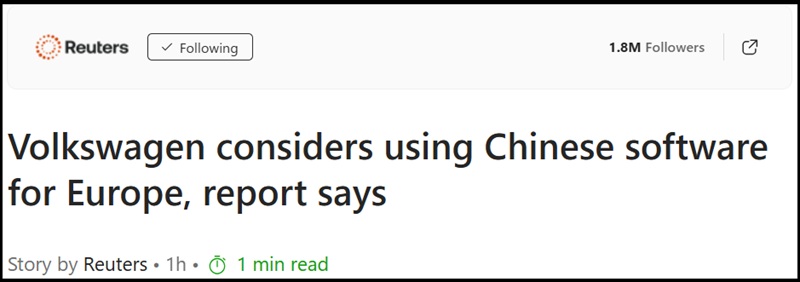
BERLIN, Oct 26 (Reuters) – Volkswagen could roll out the software currently used in its cars for the Chinese market to its mass-market offering in Europe, according to a media report on Monday, in a move that threatens to sideline its US partner Rivian.
Volkswagen’s ‘China Electronic Architecture’, a system developed for Chinese models in cooperation with local EV maker Xpeng, could form the basis for future cars from the group’s core VW, Skoda and Cupra brands, Manager Magazin reported citing sources. (read more)