
Apparently, there was an organized boatlift of north African migrants crossing from France into the U.K earlier today. Various non-governmental organizations were in place with tents and supplies to assist the migrants upon arrival.
By most accounts the influx appears to have been facilitated by NGO’s working with British authorities. However, at various ports where the migrants arrived, they were met with hundreds of young British men who attempted to blockade the activity of the police and nefarious human traffickers.
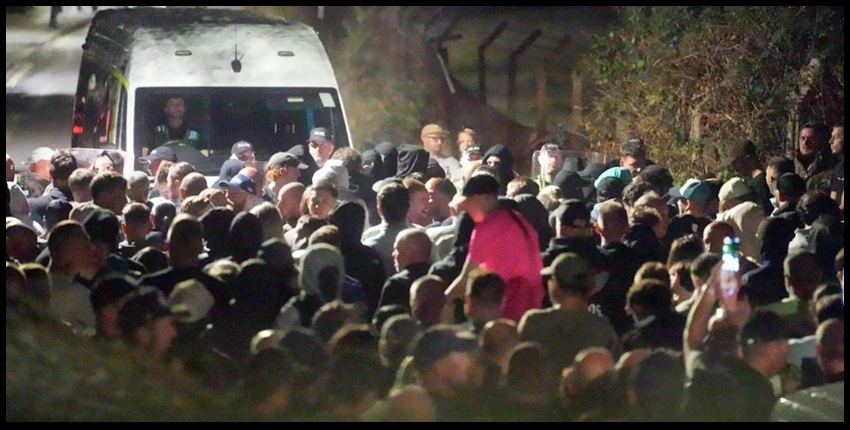
Telegraph – Hundreds of protesters have clashed with police in Portsmouth after a mega-dinghy carrying 140 migrants reached the UK from Normandy.
Around 500 demonstrators are believed to have joined a protest in the area on Sunday night, with some dressed in all black – similar to those who joined an anti-illegal migrant protest which blocked the Port of Dover on Saturday.
The large boat of migrants – believed to be the longest-ever Channel crossing by people-smugglers – was intercepted in the Solent between the Isle of Wight and Portsmouth earlier on Sunday.
Police used riot shields and pepper spray to force the crowds back, but the line broke through the weight of numbers. Protesters then made their way inside the marina compound.
Earlier, George Madgwick, the leader of Reform UK in Hampshire, wrote in a post on X that “over 100 migrant men” had arrived on the Portsmouth shore.
The French coastguard said it had detected the mega-dinghy, which was shadowed by a number of rescue boats in case it got into difficulties. Authorities estimated that up to 140 people were on board the vessel, 90 short of the record 230 who crossed on a similar boat last month.
[…] In a livestream from the scene, Daniel Thomas, known as Danny Tommo – an associate of Right-wing activist Tommy Robinson – encouraged viewers to travel to Portsmouth to join the protest.
Thomas could be seen standing in the sea at the Eastney shingle beach, alongside a small group of other protesters, with police officers looking on.
“Roads are all blocked, they are never going to be able to leave here,” Thomas said.
He added: “It was only yesterday (at the protests in Dover) when we warned them that we will not accept this any more, and that this is no longer an option to tell us that the boat numbers are down.
“This isn’t about the numbers being down… this is about understanding that this has to come to an end now.”
The mega-dinghy – launched from a beach east of Cherbourg in the Baie de la Seine – reflects a change in tactics used by people-smugglers, who have started loading more migrants on to fewer and larger vessels, partly because of the success of law enforcement in disrupting boat and equipment supply chains. (read more)
The Brits’ simmering anger over mass migration is getting hotter than a tea kettle.
Their fury spilled onto the beaches of Portsmouth on Sunday — complete with protesters in the water, blocked coaches, a major police response and even women arriving in kayaks to try to block roughly 140 immigrants from reaching shore.
The extraordinary scenes unfolded at Eastney after a migrant boat was intercepted in the Solent off England's southern coast.
It was not the typical Channel crossing ending at Dover.
The vessel had reportedly traveled from the Normandy coast before reaching waters near Portsmouth, where Border Force, the Coastguard, lifeboats and police converged for a major operation.
British authorities eventually brought approximately 140 people ashore, with plans to transport them to the Manston migrant processing center in Kent.
Then the protesters started arriving. Hundreds descended on the area as word of the landing spread online. Some moved toward the beach. Others gathered around the roads where coaches were waiting to carry the migrants away.
Video from the scene showed protesters attempting to obstruct the operation while police scrambled to establish control.
And then came perhaps the most quintessentially British image imaginable: women in kayaks joining the action from the water.
Footage circulating online showed older women paddling toward protesters positioned near the shoreline, an image that quickly became emblematic of just how unusual the confrontation had become.
It takes a lot for the British to even complain about their tea, let alone join a mass revolt over unwanted foreigners.
Police eventually issued a dispersal order as tensions escalated. Officers carrying shields moved protesters back, while the operation to remove the migrants continued.
The Portsmouth confrontation didn't come out of nowhere.
It came just one day after hundreds of masked demonstrators dressed largely in black descended on Dover and effectively brought Britain's busiest ferry port to a halt.
Protesters linked arms across major roads leading into the port while chanting “stop the boats.”
Traffic backed up for miles. The A20 was affected. Ferry passengers faced delays. At one point, access to the port was completely blocked.
A local Conservative councilor described the demonstration as “coordinated,” saying several hundred protesters appeared to have arrived overnight before positioning themselves on roads into Dover.
Kent Police reported no arrests, and normal port operations resumed around midday.
Two major ports. Two days. Two significant attempts to disrupt the country’s most controversial import: Foreigners.
That is quite the escalation from much of the anti-immigration protest activity Britain has seen over the past year.
The country's protests initially centered heavily on hotels being used to house asylum seekers. Epping became one of the most visible flashpoints in 2025, and demonstrations subsequently appeared around asylum accommodations in numerous British communities.
The politics surrounding the issue have become increasingly combustible as Britain has struggled for years with record or near-record immigration, an asylum backlog and the highly visible phenomenon of migrants arriving across the English Channel in small boats.
The small-boat numbers have actually fallen substantially this year. Government figures cited by the Associated Propagandists show crossings running roughly 40 percent below last year's level. But more than 40,000 people made the crossing in 2025, and the political argument clearly hasn't disappeared with the decline.
If anything, this weekend suggests that at least part of the protest movement is changing tactics. Hotel demonstrations are one thing. Physically blocking access to Dover is another.
Showing up at the location where a migrant vessel is being brought ashore and attempting to prevent coaches from leaving takes the confrontation another step further.
Portsmouth followed Dover within roughly 24 hours. And Britain isn't the only part of the British Isles where immigration has produced increasingly volatile street politics.
Across the Irish Sea, Ireland and Northern Ireland have experienced their own wave of demonstrations — and, in several cases, serious confrontations.
Hundreds marched through Dublin on June 10 demanding a referendum on the European Union's Migration and Asylum Pact. Demonstrators moved from O'Connell Street toward Leinster House, temporarily disrupting traffic and public transportation.
Another national anti-immigration demonstration drew hundreds into central Dublin later that month. Protesters carried Irish flags and banners opposing the EU Migration Pact while chanting “help Ireland, not the world” and “get them out.”
The scene turned darker in Northern Ireland. A brutal knife attack in Belfast in June, allegedly carried out by a Sudanese man, triggered several nights of anti-immigration protest. Homes and vehicles were set on fire, police came under attack and authorities deployed water cannon as masked groups clashed with officers.
The disorder ultimately lasted three nights, with immigrant families reporting that they fled their homes after addresses purportedly belonging to migrants circulated online.
That violence is a deviation from the largely nonviolent disruption seen at Dover this weekend, and it shouldn't be conflated with peaceful anti-immigration demonstrations.
But taken together, the episodes point to something portentous happening across Britain and Ireland: The fight over immigration is moving out of the parliament and into the streets.
Portsmouth may be the most enduring sign of that change yet.
After a migrant boat arrived unexpectedly on Britain's southern coast, hundreds of protesters raced to the scene.
Police formed lines. Coaches were blocked. Demonstrators moved to the beach. And then grandmas showed up in kayaks.
People from every walk of life now feel concern that the government may have a darker motive for all of this mass migration than simply ‘being kind to refugees.’
Britons fear they are losing their country. Americans watching in horror from across the Atlantic also fear that they might be right.