Tuesday, September 1, 2026

Socialist Promises, Promises


The increasing popularity of socialism in America is frightening.  When candidates like Francesca Hong speak of seizing the wealth of the rich, they are speaking of seizing what in most cases took a lifetime of hard work to amass.  Thankfully, the people of Wisconsin had the good sense to defeat her, but only by a small margin.  Others have been more successful, and when they promise free groceries, free housing, free college tuition, free transportation, Medicare for all, and the rest, they are pandering to the worst impulse of parasitism, which goes right along with envy of the rich.

As long as socialism attracted only a small number of voters, it didn’t matter.  But now nearly half of young people in America believe in socialism, and millions of their elders, who should know better, agree with them.  It is frightening because it reminds one of the rise of Hitler and the National Socialists in Germany — and the National Socialists were Socialists.  They and their predecessors in Italy believed that “the State is all, the individual nothing,” and so do American socialists today.

It’s for this reason — the State Is All — that socialists everywhere attempt to eliminate the practice of religion and to outlaw its public expression, as socialists today do in our public schools and universities.  All of their actions are rooted in a single motive: the creation of a centralized, all-powerful State, presumably with themselves in charge.  Though given the predatory nature of socialist politics, those who at first contribute to the movement soon become its victims, as happened in the French Revolution with the Jabobins turning against the Dantonists and other factions, in the Soviet Union with Stalin’s show trials executing thousands of his former followers, and in Maoist China with Mao killing as many as 80 million of his own people and even his followers.

It’s an irony that American socialists accuse Donald Trump of being a “Nazi” when in fact they themselves are much closer to being so.  In many, many respects, the socialist platform echoes the promises and actions of National Socialism in Germany — inevitably, because the fundamental underlying motivation is the same: all power to the State.

Zohran Mamdani and other socialists in office or running for office this year speak of seizing private wealth and turning it over to the State, either through direct confiscation or through wealth taxes.  They want a host of new state-run benefits, which would take the place of and eliminate private businesses.  Anyone working in the medical profession should be very concerned about the socialists’ key policy position of Medicare for All, which means that all those in the medical profession would be working for the State, for whatever the state wishes to pay them.  Since there is not enough money to pay for this promise, it’s inevitable that medical salaries would be reduced and working hours increased.

The crux of American socialism is their promise to “tax the rich.”  This is the glue that holds socialist thinking together, and it is working today because it provides a plausible (but not realistic) means of paying for their many new benefits, and it appeals to the anger and resentment of those who feel they do not have enough, especially as the booming stock market creates mega-billionaires and even trillionaires, many of whom do nothing to disguise their wealth.

The shadow of National Socialism hangs over today’s socialists.  Hitler used the Jews as pawns in his appeal to the masses of Germans who were poor, out of work, hungry, and forgotten.  Suddenly, he offered them hope — and a scapegoat to explain their own failure.  He also spoke implicitly of seizing the wealth of what was viewed at the time as a wealthy class of Germans and promising to employ it for the benefit of the German people at large.  But despite all the promises, what fascism brought to the German people was death and suffering, and that is what the promises of today’s socialists will bring to Americans if we allow it.

There is a remarkable similarity between the way Hitler spoke of “the Jews” and the way America’s young socialists speak of “the rich” (and also of “the Jews”).  Their motives are the same.  Envy is a powerful emotion, and it drives voters to the polls.  If one goes back and substitutes the phrase “the rich” for “the Jews” in Hitler’s speeches (often with phrases like “Jewish financiers” or “international Jewish financiers”), those insanely angry speeches sound very much like the anger coming out of our homegrown socialists.  Certainly, the political methodology is precisely the same.  The vitriol in the speech of some members of the Squad and others on the left is shocking in part because it echoes the strident language and manic delivery of socialists from Lenin to Fidel Castro and beyond.  Likewise, though it is often overlooked, Hitler was aggressively anti-capitalism and anti-Christianity.  As he wrote, “capitalism as a whole will now be destroyed.”  He added elsewhere that “the heaviest blow that ever struck humanity was the coming of Christianity.”

It’s important to note than nearly all of the socialist candidates now running for office in America have spoken out against Israel and engaged in various forms of antisemitism, and perhaps for the same reason.  Jewish people are too often caricatured as “the rich,” and they can become the scapegoat of popular envy here, just as they were in Nazi Germany.  Verbal and physical attacks on Jews have become far more common, spurred by those who should know better, or who do know better but employ the Jews as political pawns.  The fact is that American socialists today have allowed their movement to become infected with the disease of antisemitism, and they refuse to dissociate themselves from it.

Hitler never garnered more than about one third of the popular vote, and he never held an absolute majority in the Reichstag until he was appointed chancellor and gained absolute power.  Socialists in America may never win a majority in a national election, but like the National Socialists, they are impassioned and determined to take control of our country.  If they do, it will not just be billionaires who suffer.  None of them can actually define “the rich,” because in their minds, “the rich” constitute everyone who owns any property, any business, any investments, anything, and all of that is fair game for the State.

Hitler published his manifesto, Mein Kampf, in 1925, and gradually amassed followers and seats in parliament.  Almost exactly 100 years later, we are witnessing the rise of our own version of national socialism.  In 2024, Mamdani was elected Mayor of NYC.  In 2026, Hong, Abdul El Sayed, and a host of other candidates are running or have run for higher offices, and some may get elected.  From there it is only seven years to 2033, the dreadful anniversary of Hitler’s ascension to total power.

One can hope that will never happen here, but one must do more than hope.  One must get out and vote, and encourage others to do so.  One must speak out in an informed way about the danger we now face.  One must never allow socialism to seize power in America.


Podcast thread for Sept 1st


very busy day

Rebalancing Energy Policy: Diversification, Net Zero, and the Erosion of Energy Security

 At the same time, the failure to develop new sources in the developing world has reduced global flexibility.


By George Santos April 2, 2026

Thirty years ago, I was negotiating the Turkmenistan-Afghanistan-Pakistan (TAP) pipeline – later expanded into the Turkmenistan-Afghanistan-Pakistan-India (TAPI) pipeline – one of the most ambitious energy infrastructure projects of its time. The premise was simple and widely accepted across Western capitals: diversify energy supply to reduce vulnerability and prevent its use as a geopolitical weapon. Governments, development finance institutions, and international companies were aligned behind that goal.

That consensus has collapsed.

Over the past two decades, Western governments have steadily abandoned diversification in favor of a zero-sum vision of decarbonization – one that treats hydrocarbons not as strategic assets to be managed, but as liabilities to be eliminated. In doing so, they have recreated the very dependencies they once worked to dismantle, without building a more resilient system in their place.

The shift began in Europe. Russia offered Germany cheap, reliable gas while systematically building political influence and using pricing to pressure Central and Eastern Europe. Germany’s decision to phase out nuclear power accelerated the shift. Russian gas imports rose from roughly 20 percent of European demand in 2000 to more than 40 percent by 2022, and close to half in some markets.

The invasion of Ukraine should have been a strategic turning point. It was not. Europe responded with short-term substitution rather than structural reform. Decarbonization policies remained largely intact, continuing to discourage investment in hydrocarbons. By 2026, Germany had replaced one dependency with another – shifting toward Qatari liquefied natural gas and exposing itself to a different, but equally concentrated, supply risk.

Germany is not alone. Italy and other European countries have followed a similar path. As Italy reduced its reliance on nuclear power and accelerated its net zero policies, it too shifted toward greater dependence on gas from the Gulf. More recently, Italy has sought to increase investment in existing Algerian gas capacity. While this may provide short-term relief, it does not address the central problem: it does not increase the number of suppliers. It is substitution, not diversification.

This is the critical point. Europe is not expanding its energy base – it is reshuffling it. The risk is clear: the same strategic mistake is being repeated. The question is whether European policymakers can break this cycle of short-term adjustment and zero-sum decarbonization and return to a genuine diversification strategy.

Dependence, in other words, has not been reduced. It has migrated.

At the same time, as Western policy narrowed, China expanded its global energy footprint, but not in a way that strengthened systemic resilience. Beijing pursued opportunistic acquisition, securing long-term supply agreements across Central Asia, Africa and South America, while concentrating processing and industrial value within China.

This was not diversification in the broader sense. It did not expand the number of independent supply centers or distribute value chains more widely. Instead, it reinforced concentration, anchoring control, processing and pricing power around China itself. At the same time, China deepened its reliance on a narrow set of upstream suppliers, particularly Russia and Iran.

The result was not a more resilient global system, but a different configuration of dependency. As Western investment retreated and diversification stalled, China’s model accelerated a system in which extraction was geographically dispersed, but control was increasingly centralized. Combined with China’s reliance on Russian and Iranian supply, this contributed to a more fragile global energy architecture, not a more stable one.

I saw this shift unfold firsthand across Central Asia, South-east Asia and East Africa.

In Central Asia, the TAPI pipeline was designed to break the Russian-Iranian constraint on Turkmen gas exports by opening routes to South Asia. It had strong commercial backing and policy support. But as Western focus shifted, momentum dissipated. China stepped in, secured the gas and redirected flows eastward, reinforcing concentration rather than diversification.

In Timor-Leste, following independence, the government pursued a different model: combining extraction with onshore processing to capture value domestically. The potential was transformative – billions in revenue, thousands of skilled jobs and the foundation of an industrial economy. But as hydrocarbons were recast as climate liabilities, Western financing disappeared. External pressure favored exporting raw gas for processing abroad. Timor-Leste successfully resisted, but the opportunity cost has been substantial.

In Tanzania, substantial gas reserves offered the prospect of electrification, industrialization and export growth. Yet financing constraints intensified as global policy turned against hydrocarbon investment. Projects that could have strengthened both domestic development and global supply diversity were delayed. Progress continues with strong support of the Tanzanian authorities, but more slowly, and with fewer partners than would otherwise have been possible.

In each case, the constraint was not commercial viability. It was policy.

Developing countries are not passive actors in this system, and many are increasingly dissatisfied with the available models. China’s approach delivers capital and speed, but it often remains extractive, with much of the value-added processing and industrial benefit captured outside host economies. At the same time, Western disengagement has removed the alternative.

There is clear demand for a different model. A Western approach that combines resource development with local processing, infrastructure and skills transfer would not only diversify global supply but also unlock far greater economic value in the developing world. Properly structured, energy development becomes a catalyst for industrialization, not merely extraction – supporting growth, employment, and long-term stability.  The opportunity exists.

Instead, the current trajectory has produced the opposite outcome.

Recent geopolitical shocks, including conflict involving Iran, have exposed the consequences. As investment declined, supply became more concentrated. When Russian gas exited the European system, dependence did not disappear, it shifted to the United States and the Gulf. Price volatility increased, and renewable expansion – while essential – proved insufficient to offset constrained supply.

The consequences extend far beyond energy markets. Higher energy costs feed directly into fertilizer production and food prices. For developing countries, this translates into rising costs of basic goods, food insecurity, and increased economic vulnerability, particularly for the poorest populations. These pressures were not inevitable. A more diversified global energy system would have reduced both price volatility and systemic risk.

The system has become more exposed, not less.

At the same time, the failure to develop new sources in the developing world has reduced global flexibility. Countries capable of contributing to supply remain underdeveloped, even as demand continues to grow. Had diversification remained the guiding principle, the outcome would likely have been lower volatility, greater resilience and broader-based global growth.

The problem is not decarbonization. It is how it has been pursued.

Net zero has been framed as a zero-sum objective, displacing the broader goals of energy policy rather than advancing them. This reflects a fundamental misunderstanding of how energy systems evolve. Renewables are not, at least for the foreseeable future, substitutes for hydrocarbons at scale, they are complements.

For developing countries, the pathway is coexistence: hydrocarbons alongside renewables. Gas-to-power supports industrialization. Local processing captures value. Infrastructure builds the platform for eventual transition. A blanket financing freeze on hydrocarbons does not accelerate decarbonization, it entrenches underdevelopment and concentrates supply in the hands of a limited number of producers.

A course correction is both necessary and urgent.

Development finance must be reset to prioritize diversification, resilience and economic development alongside climate goals. Targeted support should be expanded for gas-to-power and related infrastructure. The United States, Europe, Japan, and Korea should jointly support strategic energy corridors in Central Asia, East Africa, and Southeast Asia – building new supply, not simply reallocating existing flows.

Above all, diversification must be restored as a central objective of energy policy.

The resources exist. The projects are viable. The partners are ready.

The question is whether Europe can break the cycle of short-termism and zero-sum thinking that has defined its energy strategy for the past decade. And whether Japan and South Korea will move beyond rhetoric and recognize the urgency of building real resilience into the global system.

The time for discussion has passed. What is required now is action.

Without it, the consequences – economic, political and humanitarian – will continue to deepen.

Charles Santos has over 33 years of experience in political and commercial negotiations across West Africa, the Middle East, and Central, South, and East Asia. He served as Special Advisor to four UN Under Secretaries General and was Deputy Head and Political Advisor to UN peace missions in Afghanistan and Tajikistan, where he led political strategy and cross-border engagement during periods of active conflict and post-conflict transition. He led commercial negotiations on the Turkmenistan-Afghanistan-Pakistan-India (TAPI) gas pipeline and has structured and developed energy projects in Uzbekistan, Timor-Leste and Tanzania. He is Executive Chairman of Aminex PLC and a director of UIG Energy.

https://moderndiplomacy.eu/2026/04/02/rebalancing-energy-policy-diversification-net-zero-and-the-erosion-of-energy-security/

Democrats Won’t Even Talk to You


“I want to be President of all Americans,” said Joe Biden. Barack Obama said something similar about there not being red Americans or blue Americans, only Americans, or some such garbage. It’s garbage because in pursuit of that job, and in the execution of it, they do not speak to half the country at all. They want to control you, not talk with you.

During his presidency, Barack Obama barely ever gave interviews to Fox News. Occasionally, he would do the Super Bowl interview with Bill O’Reilly, but that was all that really comes to mind. 

At his press conferences, Obama would work off a printed list of pre-screened reporters in something with all the choreography of a Broadway show. No surprise, or even challenging, questions were allowed or even attempted by the sycophants with press credentials. 

Under Joe Biden, things got worse. He had the list of reporters with the screened questions, but he also had the questions and a picture of the reporter on his little cue card, so he wouldn’t be surprised by a woman or a black person speaking to him after having had a mental episode and slipping back to his youth, when he didn’t tolerate such insolence. 

Where Donald Trump will speak to damn near anyone – the more they hate him, the more likely he is to take their calls – Democrats will only speak with other Democrats. Aside from the occasional shouted question from Peter Doocy he’d respond to, Joe Biden didn’t do a single interview with anyone at Fox News over his four years. Kamala Harris did one, and it was a disaster, but then all of her interviews with non-MSNBC personalities were disasters.

The current media configuration is Fox News either can’t or won’t get Democrats who aren’t named John Fetterman on (my favorite Democrat), and the left-wing corporate media either won’t have Republicans on, they get one on a panel to be shouted over or they get a Trump-hating RINO to agree with the Democrats while pretending it is reluctant or from a place of disappointment. 

Nowhere is this an honest discussion or challenge to the orthodoxy the subject brought into the discussion. 

I don’t think I’ve ever seen a real conservative, either elected or from the punditry world, on MS Now. Honestly, I couldn’t testify that this has ever happened. I only see panels of leftists moderated by white women or gay black men. Aside from a few, it seems like that’s all they employ over there. 

It doesn’t really matter – everyone on the network agrees with everyone else on the network. The closest they come to a disagreement on anything is how close to Hitler Trump is. Some think he’s über-Hitler, while others believe him to be max-Hitler. It’s compelling, Emmy-winning television. 

What you won’t hear is an interview of a conservative. On CNN, they have a conservative they shout down, interrupt or ignore. On the Sunday shows, even though he looks like five people, they only really have Chris Christie. 

Even candidates run in echo chambers. While he went on the Jesse Watters show, Abdul El-Sayed was basically given a softball interview. Whatever you think of Watters, he’s not going to seriously challenge someone like Brett Baier would. 

After the “bro-fest” on Fox, Abdul was actually asked a relevant question about his friendship with racist Hasan Piker. After declaring that he disagrees with Hasan on many things (without getting specific), he said this election is about Michigan, not “a streamer from California.” Someone asked the obvious follow-up question, “Why’d you bring him to Michigan then?” 

Abdul saw the microphone said “Fox News” and immediately dismissed the only relevant question he got from a gaggle of otherwise butt-kissing leftists. No need to talk with half the state, as it’s clear he does not want to be “Senator for all Michiganders,” or else he’d talk with them, too.

We allow it, which is the real problem. People elected politicians who can’t answer tough questions because we don’t insist our politicians answer tough questions. Most hide, only engaging in photo-ops and speeches. El-Sayed only gives speeches and appears on shows where the lips of the interviewer serve as the seat – the kissing is so deep. 

It’s the fault of voters for accepting this, but it is a situation created by the media – the security blanket of the left. If they did their jobs the way they insist they do their jobs, the way the awards they give each other pretend they do their jobs, we’d have a better informed public that would never elect a single one of these frauds. 

But we don’t have that type of media, we have the type that fosters this bubble life because it’s profitable to pander to a select segment of the public. 

It’s our fault for allowing this; for accepting and consuming it to make it profitable in the first place. We should demand better by being better and only vote for people sure enough in their convictions to be comfortable speaking to people who disagree with them, too. 


🎭 𝐖𝟑𝐏 𝓓𝓐𝓘𝓛𝓨 𝓗𝓾𝓶𝓸𝓻, 𝓜𝓾𝓼𝓲𝓬, 𝓐𝓻𝓽, 𝓞𝓟𝓔𝓝 𝓣𝓗𝓡𝓔𝓐𝓓


Welcome to 

The 𝐖𝟑𝐏 𝓓𝓐𝓘𝓛𝓨 𝓗𝓾𝓶𝓸𝓻, 𝓜𝓾𝓼𝓲𝓬, 𝓐𝓻𝓽, 𝓞𝓟𝓔𝓝 𝓣𝓗𝓡𝓔𝓐𝓓 

Here’s a place to share cartoons, jokes, music, art, nature, 
man-made wonders, and whatever else you can think of. 

No politics or divisive posts on this thread. 

This feature will appear every day at 1pm mountain time. 


Every State Needs To Follow Florida In Teaching Kids About Communism’s Terrors


For too long, students have been kept in the dark about communism and are now falling for it all over again.


As the new school year begins, Florida is mandating that lessons on the history of communism be taught to middle and high school students. In accordance with a bill passed last year, this educational initiative will integrate content about communism and its devastating effects on humanity into Florida’s social studies classes, putting it on par with lessons about civil rights and the Holocaust.

Unsurprisingly, communist sympathizers are wailing and gnashing their teeth at this development since it interferes with their dream of resurrecting an evil ideology. No doubt, the Democratic Socialists of America candidates have profited from the widespread ignorance about the communist governing model, which has ruined any society that has adopted it. These days, even the most incompetent DSA politician can win mass support by simply promising free stuff and attacking rich elites.

It’s no secret that legislating pedagogy can backfire. Often, lawmakers will pass laws about what to include in K-12 classrooms, but they forget to provide accompanying materials (i.e., standardized curriculum, textbooks, assessments, etc.) and professional training, which causes a lack of buy-in from teachers and administrators. At best, what follows is a half-hearted compliance that involves creating a blowoff class or giving a short presentation on the topic.

This is precisely what happened to California when it required an ethnic studies class in its public schools. Beyond the obvious partisan motivations behind such a course, there were countless logistical loose ends. It was anyone’s guess which materials to use, how the classes should be taught, or even which ethnicities to include. Worst of all, the state “never allotted money for the course, which meant the mandate hasn’t gone into effect.”

Fortunately, Florida’s rollout has been far more robust and comprehensive, which should help it overcome these problems. As the Epoch Times reports, the standards have been set, the texts are selected, the curriculum has been written, and the money has been spent: “approved resources will be provided to teachers rather than leaving them to find or develop the material themselves.” It also helps that the course designers can pull from preexisting elective courses on the history of communism, so they already have something to work from rather than having to start from scratch.

Moreover, for those who frame this as large-scale Republican indoctrination (merely Florida’s version of California’s ethnic studies class), this is objectively false. Rather, it is the absence of any such instruction about communism in American public schools that qualifies as mass indoctrination. For anyone who has lived through the Cold War, read about communist regimes in the past, or has personal experience with communism (e.g., Cubans and Venezuelans who fled their countries and now live in Florida), it is beyond scandalous how little most Americans actually know about communism.

While they might know about the evils of slavery, colonialism, or Jim Crow, they usually have no clue about communism, how dehumanizing it is, how America spent over half a century opposing it, or how many millions of people have been enslaved and massacred in its name. Rarer still is the student who can even define communism in any meaningful sense.

As a result, many students graduating from high school and college have very distorted notions about this failed theory. This in turn makes them especially vulnerable to Democrat propaganda and shameless leftist influencers. By contrast, right-wing radicalism can usually be resisted since even the slowest students of history know that Hitler, racism, and slavery were all very bad.

I have seen the way this works up close, and it’s disturbing. Years ago, while I was in the middle of teaching a class, a student whom I never taught cornered me and wanted to debate the merits of socialism after finding an essay I wrote years ago condemning it. From what I could tell in my conversation with him, he thought socialism was a benign system that helped the poor, enfranchised everyone, and modernized society. He also believed that countries like the U.S.S.R., Cuba, North Korea, and Venezuela were not actually socialist. There was so much to unentangle, I gave up arguing and told him to email me. He never did.

Days afterward, I learned this student was not some reprobate who hated school, but took AP classes and did quite well in them. His understanding of socialism likely came from the internet, and he never thought to question any of it. Instead, he questioned an English teacher with the intent of “owning him” and bragging about it to his friends. This student can now vote and add his own voice to leftist echo chambers online.

If even bright students can fall for these lies, then it’s safe to assume the same is happening to the majority of people in this age group. Therefore, conservatives who hope to steer these kids away from leftist extremism must make a positive effort to teach the historical record surrounding these ideas at school. As usual, Florida is leading by example, and other states should follow. Not only are they rectifying a serious knowledge deficiency in education, but they are also implementing this program properly.

Ultimately, this is not really about making the kids “based,” but about meeting their educational needs and equipping them to think for themselves. For too long, students have been kept in the dark about communism and are now falling for it all over again. It’s better they learn the right way (at school) than the hard way (under an American communist regime). 


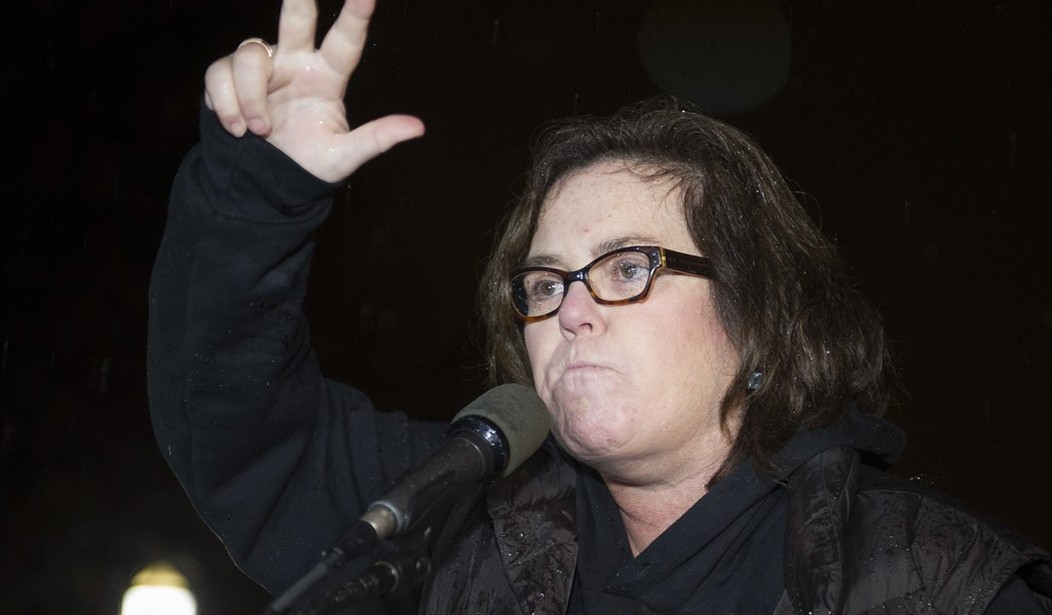
Rosie O'Donnell Did Not Just Say This About ICE, Did She?

Trump Derangement Syndrome is running rampant in Hollywood, and has been for the better part of a decade. One of the worst cases of TDS is Rosie O'Donnell, who actually moved to Europe to "escape" America under a Trump administration. Rumor has it she's looking to re-establish a part-time home in New Jersey, but that's a topic for another story. 

O'Donnell, who is so deranged her therapist couldn't even get her to go a few hours without mentioning President Trump, just levied some insane and insulting accusations against ICE.

"Countries have fallen, stronger and bigger than ours, to fascism and, you know, World War II we lost a lot of Americans over there, doing what was right," O'Donnell said. "Ending this genocide, this holocaust."

"And we all vowed never again, remember? Never again would we allow. Why did the German people allow that? Why did they? Nobody thought it was that bad and they started making gas chambers," she continued. "We're making concentration camps. We're rounding up people without a warrant. We're raping children in detention, in ICE detention, that they're all getting pregnant. And they're separated, males and females. Who has access to those girls? What happens to their babies? What do they do with them? There are big questions."

She's insane. Literally none of what she said is true, but it sure trivializes the Holocaust.

Yeah.

Facts don't matter to people like O'Donnell.

Hundreds of thousands of children went missing under Biden, and many of them were sex trafficked and abused. Where was Rosie's outrage then?

But tell us more about how Jimmy Kimmel's show is "entertainment," CBS.

That's right. O'Donnell is reportedly rejoining the cast of The View. Remind us how that's a "bona-fide" news program with the likes of Rosie, Behar, and Goldberg on the panel?

This is what the Democrats are and what they do: lie and smear ICE agents who are simply doing their job and enforcing the laws passed by Republicans and Democrats. ICE is not some rogue agency doing whatever it wants. But rather than run on a platform of repealing our immigration laws, Democrats are arguing for abolishing the mechanism that enforces them, thereby rendering our immigration laws moot.

Lies like this help sway opinion towards defunding and abolishing ICE.


A Polish Drone Factory Hit, an Italian Ammo Plant Burns. This Is the Warm-Up; the War Is Coming.


Polish prosecutors said Monday that they suspect arson by a foreign intelligence service in a fire at a WB Electronics plant in Skarżysko-Kamienna, calling the blaze a “terrorist crime” involving the “deliberate setting of a fire.”

WB Electronics, one of Poland’s largest private defense firms, makes reconnaissance drones and loitering munitions, including FlyEye and Warmate, used by Ukraine against Russian forces. The factory fire broke out in the early hours of Monday.

Security video footage shows a masked intruder entering the perimeter just before the fire started. There was no significant damage because of the rapid response by company security personnel.

This marks the latest in a cluster of unfortunate occurrences in August 2026 afflicting NATO states that seem linked to those countries’ support for Ukraine.

On 7 August, Poland detained a Russian citizen in a plot to kill a person holding U.S. and Ukrainian citizenship in Warsaw. Prime Minister Donald Tusk announced the arrest on 13 August; see Report: Poland Foils Russian Hit on Ukrainian-American 'Inconvenient' to Putin – RedState. Polish prosecutors later opened a terrorism inquiry into a separate case: a fire at a WB Electronics drone plant in Skarżysko-Kamienna on 31 August.

Poland has been the main target of Russian operations.

In June, a Russian artist whose work criticised Putin was assassinated in Poland. Soon after, the Polish security services detained the suspected killer, who they said was using a Georgian passport.

Last month, a Russian missile hit Poland during intensive attacks on Ukraine. That followed an incident last year in which around 20 Russian drones violated Polish airspace.

On the night of 4–5 August, German authorities found and disarmed an explosive-laden drone near Ukrainian Antonov cargo aircraft at Leipzig/Halle Airport. The drone struck the cargo plane but failed to detonate. A second incident took place while the investigation was underway. This time, another cargo plane was struck by a drone as it attempted to land, but the drone was not recovered. A week later, yet another explosive drone was found near Leipzig/Halle Airport.

On 13 August, a fire at a KNDS Ammo Italy factory in Colleferro was followed by a large blast. The factory makes medium- and large-caliber artillery rounds that are transferred to Ukraine. No one was killed. Italian officials said they saw no sign of a Russian link.


As an ammunition factory in Italy was accidentally blowing itself to smithereens, a major transformer fire caused a power failure that forced ExxonMobil’s Esso refinery in Rotterdam, the Netherlands, to shut down. At the same time, another refinery in Rotterdam was also hit by an explosion that killed one person and injured several others. Totally chance happenings: two refineries get shut down in the same night, in the same city, by explosions every other week.

That same morning, in Rotterdam’s Botlek section, a transformer fire affected units and flare-gas systems. Separately, an explosion at Gunvor Energy’s storage terminal killed one worker and injured six. Port authorities said the outage and the Gunvor blast appeared unrelated. Dutch police said there was no immediate sign of sabotage at Gunvor and that all scenarios remained under review.

One of the reasons for CIA Director John Ratcliffe’s no-notice expedition was reportedly to warn Putin that any attempt to reprise his 2014 aggression which seized Crimea and kicked off a war in the Donbas that led to the 2022 invasion would be strongly resisted by the United States. As a signal, Ratcliffe’s plane touched down in Riga, Latvia, before continuing on to Moscow. See “Both Sides Mum As CIA Head Ratcliffe Made Unannounced Visit to Russia. What Was He Doing There?”.

A decade ago, I laid out how a Russian operation against either Latvia or Estonia could unfold in a way that would not necessarily result in any action under the North Atlantic Treaty. See “How Putin Dismembers NATO Without Firing a Shot: A Scenario From the Cold War”. That scenario has grown more likely since Russia invaded Ukraine. See “Latvia Becomes the Newest Target for Russia’s Denazification Program”.

The Germans are concerned enough that they are also sending their own flaccid, dithering messages.

Relatedly, German NATO officials have been sending their own message/warning to Putin/Russia via leaks to Bild newspaper.  Remarkable military plans/details for a heavy counter attack against Russia.

It is no secret that Russian politico-military doctrine embraces the idea of “escalate to de-escalate.” Russian documents have advocated the first use of nuclear weapons as a way to show that Russia is serious, supposedly leading to a reduction in the threat environment. No one has ever explained how that would work unless it were applied against a nonnuclear, non-NATO nation. That said, Russian political fixture and Putin ally Dmitry Medvedev has threatened to nuke Paris, Berlin or London at least monthly since the war in Ukraine began.

The current string of open and suspected Russian provocations is now running at a very high rate.

According to the Wall Street Journal, about 15 attacks per month are linked to Russian sabotage. Be sure to visit the link and look at the graph of attacks.

The tempo of documented Russia-backed incidents has increased from a maximum of around 10 in many months since 2024 to around 15 a month since April, according to Ukraine’s Sahaidachnyi Security Center, which tracks Russian gray zone activities in Europe. Sahaidachnyi analysts say trends can be difficult to discern because many incidents suspected of being linked to Russia aren’t included in their data.

As Russia’s economic situation deteriorates, Putin will be forced to choose between a larger conflict, which he might think winnable by intimidating the European nations supplying Ukraine with the wherewithal to defend its independence, and the current war, which he cannot win. Putin might opt for the larger war.


G20 Outlooks – Abundance Mindset ‘Build More Pies’ (Bessent) -vs- Scarcity Mindset ‘Divide Up Pie’ (Europe)


What Barbara Boyd describes in this video about the ideological differences in the G20 reminds me of the long battles around MAGAnomics.

One mindset is based on despair, the scarcity mentality, and says there is a limited about of economic pie and it must be divided by government to ensure equitable distribution (Europe/Obama).  The other mindset is based on faith, an abundance mentality, and says we should create, innovate, build and expand economic activity to create more pies (MAGA/Trump).

In this Wednesday update, Barbara Boyd previews the G20 meeting in Asheville, framing it as a clash between an agenda centered on physical economic growth—advanced by Treasury Secretary Scott Bessent—and what she calls the G20/EU’s long-running Malthusian, “green” framework that followed the 2008 financial collapse, bank bailouts, and a shift toward climate policies.

The episode contrasts Trump-era priorities—domestic manufacturing, supply-chain self-sufficiency, critical minerals, energy expansion, workforce upskilling, and new nuclear plans for shipping outlined by Energy Secretary Chris Wright—with European leaders’ efforts to build a “middle powers” bloc and “redirect” citizens’ savings into EU-directed investment. Boyd argues EU priorities include Ukraine war funding, the green transition, and open borders/free trade, and says the outcome of this fight will shape the future ahead of the midterms.