Instead of looking for short-term Band-Aids to mask the beef price problem heading into the mid-terms, the Trump admin should instead focus on ways to incentivize heifer retention in order to increase long-term cattle supply.
While well-intentioned, President Trump’s plan to temporarily permit more foreign beef imports into America without paying higher tariffs will only exacerbate the long-term stock shortage in the cattle industry, and it will directly lead to higher long-term beef prices.
Trump announced Friday that the United States “will allow up to 300,000 metric tons of product for ground beef to be imported with no out of quota tariff” for the next 90 days, and that such product “will be sold at 25 percent below current market prices.” While touted by the president as an effort to reduce ground beef prices for American families, the policy shift was met with concernedpushback from lawmakers representing rural states responsible for U.S. cattle production.
Beef is a very cyclical industry, largely driven by the fact that it takes nine months to create a new calf, and another year or two (at a minimum) to bring it to market and process it. Because of the difficulty of predicting demand that far out, plus the difficulty of matching supply to that demand, we end up with big swings in prices in every five-to-10-year cycle.
Right now, we are at the price peak in the cycle. The only way to bring prices back down is to increase the supply, and that can only happen when farmers choose to retain cows to breed and grow the stock instead of selling them today. This is called heifer retention. When prices are high, farmers want to sell stock. When they’re low, farmers want to hold back the stock.
That’s the revenue side. Then there’s the cost side. Beef costs are driven by the three F’s: feed, fertilizer, and fuel. Right now, the costs of all three are through the roof.
Drought has driven up the costs of hay and corn, so both raising and finishing cattle is more expensive. Fertilizer costs have been high for years, due in part to the war in Ukraine. And gas prices have also been nuts because of Iran.
When costs are high, it makes more sense to sell a heifer than to retain it and breed it. Now imagine what happens when you are at a cyclical peak, leading to high prices, at the same time costs are sky-high: Stock gets sold off instead of being bred, and the supply shrinks. Not good.
So wouldn’t that mean imports are a great way to fill the gap? NOT AT ALL. Why not?
A sudden surge of foreign imports means a short-term (and only a short-term) dip in prices (at best), and that will lead domestic producers to sell even more of their stock right now to get ahead of the dip.
But it’s even worse than that. As stocks dwindle, processors will reduce capacity. They can’t afford to run seven days a week long-term if the long-term supply is dwindling and only providing four or five days’ worth of cattle to process.
So not only will imports not fix the long-term domestic supply problem, but they will actually result in long-term — perhaps even permanent — production capacity reductions as well. This isn’t a theoretical problem constrained to an economics textbook.
This is already happening in the United States. Tyson, one of the biggest beef processors in the country, just announced it’s shutting down a massive facility in Utah due to lack of supply to process. It’s closing another facility in Illinois and selling off a third one in Washington. JBS, another massive processor, shut down plants in Pennsylvania and Tennessee earlier this year. The biggest domestic processors are radically reducing their processing capacity because the long-term stock is too low to support it.
And if you want to know what happens when domestic industrial capacity shutdowns are paired with foreign imports, look no further than the American timber industry after Canada started dumping its subsidized lumber into our markets. Prices for domestic lumber were artificially pushed down, lumber processing capacity cratered, and within a matter of years, America’s lumber industry was destroyed, even though we had more than enough raw timber.
All because of short-sighted trade policy that ignored the obvious long-term effect of imports on supply and production capacity.
Instead of looking for short-term Band-Aids to mask the beef price problem heading into the midterms, the administration should instead focus on ways to incentivize heifer retention in order to increase long-term cattle supply.
President Donald Trump has declared that space will be the new battleground in the fight against communist China’s rise, setting a goal for over 1,000 U.S. space launches annually by 2030.
White House officials say that the new directive to guide America into a “Golden Age of Space Transportation” is aimed at providing “a comprehensive America First approach to assuring reliable, affordable, modernized access to space transportation services that promote a vibrant, competitive, and resilient U.S. space transportation industrial base.”
The new memorandum will supercharge the commercial spaceflight industry by directing it to expand launch and re-entry infrastructure, designate priority space launch corridors, and integrate space transportation into the air traffic control network.
The Trump administration has directed relevant agencies to develop guidelines that will streamline procurement and develop the industry workforce, while also facilitating commercial transportation for both human and robotic trips to the Moon and Mars.
“At a time when our adversaries are challenging American space superiority, President Trump is securing and defending our vital national and economic interests in, from, and to space while unlocking new commercial space opportunities.,” the White House said in a release.
Goals for the future of the industry include increased launch schedules, enhanced military readiness, growth of the space economy, next-generation GPS technology for improvements to agriculture and communication, and expanded American presence in space.
The move comes just months after Americans sent humans around the Moon for the first time since the Apollo era. The next mission of its kind is slated for 2027 with Artemis III.
Haitians who lost Temporary Protected Status (TPS) have had several weeks to report to Immigration and Customs Enforcement (ICE). Those who did not may soon get a visit instead.
Fox News correspondent Bill Melugin reported Friday evening that ICE has arrested "roughly 300 Haitian nationals" in Ohio in recent days, according to a federal source. The agency is now considering a shift toward actively locating and arresting those who did not report to ICE offices after their protected status expired.
NEW: I’m told by federal source that ICE has arrested roughly 300 Haitian nationals in the state of Ohio alone in recent days, as the agency is now considering transitioning into a find & arrest approach after giving Haitians several weeks to turn themselves in to ICE offices since TPS officially ended on July 27th.
I’m told to expect arrests of Haitians to begin to significantly ramp up soon as ICE starts to prioritize tracking down those who never checked in.
That number, 300 arrests in a single state in just a few days, signals that the passive phase is over. The grace period, during which former TPS holders were expected to self-report, has run its course. ICE is now moving to a find-and-arrest posture, going after those who ignored the window entirely. Sources tell Melugin to expect arrests to ramp up significantly in the coming days as the agency shifts its focus toward tracking down those who never checked in.
Federal officials had already flagged Ohio as a priority target. Springfield's large Haitian population made it an obvious starting point, and ICE planned from the outset to arrest former TPS holders with no remaining legal status and place eligible detainees on direct flights to Haiti.
The legal groundwork was already in place. On July 27, U.S. Citizenship and Immigration Services (USCIS) confirmed that Haiti's TPS designation was officially over. Work permits issued solely through TPS went with it.
“The Haiti TPS designation is terminated.”
TPS gave eligible Haitians work permits and deportation protection, not permanent residency, and Haiti's designation had been on the books since the 2010 earthquake.
Some former TPS recipients have pending asylum claims or another immigration status. Those without another legal basis to remain can be arrested and placed into removal proceedings, though immigrants without final removal orders are generally entitled to appear before an immigration judge first. DHS had offered former TPS holders a way out before it came to that: a free flight and $2,600 to leave voluntarily through the CBP Home program.
In a statement to CBS News, DHS riffed off Semisonic's "Closing Time" to make their point clear:
“It’s closing time which means you don’t have to go home, but you can’t stay here.”
Community leaders in Springfield reported ICE arrests outside stores and after traffic stops. They said agents boxed in Haitian pastor Joubert Adrien at a gas station Thursday and took him into custody.
An ICE flight carrying 161 deportees landed in Cap-Haitien Thursday, the first since the administration won its TPS case affecting roughly 350,000 Haitians. Haitian officials said former TPS holders and people who had completed prison sentences were aboard, but did not provide a breakdown.
Haiti has some real issues and high crime rates, but it is not up to the United States to keep the temporary status open after 16 years, especially when former TPS holders had the option of $2,600 and a free flight home.
A Biden-appointed federal judge has struck down the Trump administration’s suspension of immigrant visas for foreign nationals of 75 countries, handing immigration activists another victory against President Trump’s effort to slam the brakes on mass immigration.
And once again, a law passed more than 60 years ago — the Immigration and Nationality Act of 1965, better known as the Hart-Celler Act — is a specter still haunting America’s broken immigration system.
At the heart of the case is the Catholic Legal Immigration Network, Inc. (CLINIC), a “religious” organization that has gotten into the legalized human trafficking racket.
U.S. District Judge Jeannette Vargas of the Southern District of New York ruled that Secretary of State Marco Rubio exceeded his statutory authority when the State Department ordered consular officers to stop issuing immigrant visas to nationals of 75 countries while the administration reviewed public-charge risks.
SCOTUS Wire reports:
“A federal judge has struck down the Trump administration's suspension of immigrant visas for nationals of 75 countries, ruling the State Department policy violates federal immigration law and exceeds Secretary Marco Rubio's authority.”
“Judge Jeannette Vargas ruled federal law expressly prohibits nationality discrimination in issuing immigrant visas. She distinguished Trump v. Hawaii, which allowed nationality-based restrictions on entry, because the State Department policy directly restricts visa issuance.”
“Vargas ruled the policy was reviewable under the APA because it was final agency action: it imposed mandatory instructions requiring consular officers to refuse visas and had immediate legal consequences, even though individual officers implemented those refusals.”
Here is what the legacy media is not highlighting about this huge case: It has to do with the extraordinary numbers of immigrants who are on public welfare.
The State Department policy took effect January 21. The Trump administration selected countries using government data showing rates of public-assistance use among immigrant households by country of origin. Nations above a 30 percent threshold were generally included, subject to some foreign-policy exceptions.
Currently, the United States has 59 percent of non-citizen households and 53 percent of immigrant households on public welfare. That’s according to the U.S. Census Bureau’s 2024 Survey of Income and Program Participation (SIPP).
This is a matter of national security. As Milton Friedman said, “It is one thing to have free immigration to jobs and another thing to have free immigration to welfare. And you cannot have both.”
So, an activist judge, once again, is defending entrenched socialism — literally, the Cloward-Piven strategy designed to overwhelm the system — by overruling the president.
The Supreme Court will once again have to try to restore a bit of sanity to America’s immigration system by striking down this ruling or at least limiting the damage.
But the fact that America is even having to have this battle shows how close the nation is to the precipice.
Psalm 63:3-4 emphasizes the idea that God's steadfast love is better than life itself, prompting believers to respond with praise and worship. This passage encourages worshippers to express their devotion and gratitude, often through physical acts like lifting hands, symbolizing surrender and submission to God.
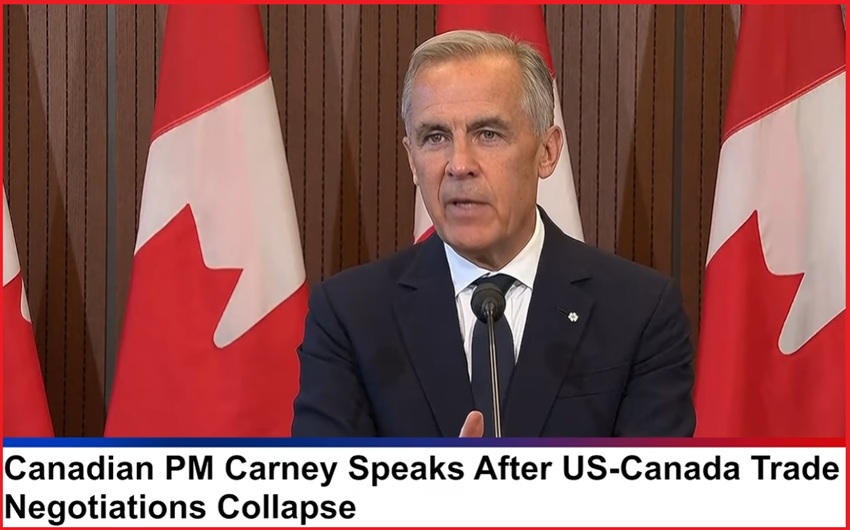
Canadian Prime Minister Mark Carney is delivering speeches, holding press conferences and trying to justify his position following the collapse of negotiations between the USA and Canada. Meanwhile, President Trump and his trade team are intentionally quiet.
In all high-stakes negotiations, deals and financial issues, the apex predators always know you make your point clearly and without reservation, you establish your terms and then you don’t say anything. Total silence. The first person to break the silence is the losing hand. Once your terms are established you stay quiet and then let the other party talk, talk, and talk themselves to yes. Silence is the power.
Mark Carney is telling everyone his position and trying to justify what has taken place. Mark Carney is in a very weak position on both structure and substance of the issues. [I wrote a lengthy explanation HERE]
Within this segment Carney tries to explain what the USA requests were that Canada would not agree to. He notes the U.S. wanted strict control over Canada’s free trade agreements (FTAs) with other countries. What Carney fails to note is that this exists already, right now in the USMCA [Article 32:10 of the USMCA]. The U.S. has termination rights to both Canada and Mexico FTAs with other countries. This is an example of Carney gaslighting Canadians.
In reality, Canada wants unlimited and unrestricted access to the U.S. market as if they were a 51st state. However, Canada will not permit unlimited and unrestricted access to their market for U.S. companies. This, Carney says, compromises the sovereignty of Canada.WATCH:
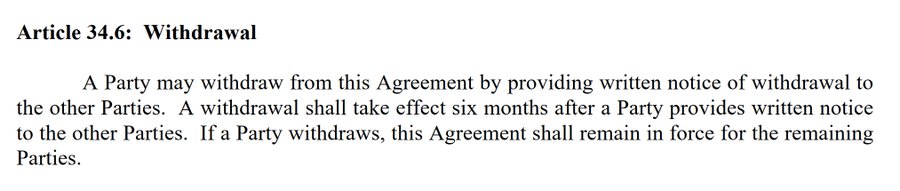
I was confident the discussions would collapse because the Canadian position is based on lies, fraud and political denial. Canada is playing politics hoping to retain their one-sided benefits and outlast President Trump into the midterm election. Trump, however, has already executed the tariffs and the only thing remaining for him and Greer to do is trigger the six-month USMCA withdrawal. [Details Here]
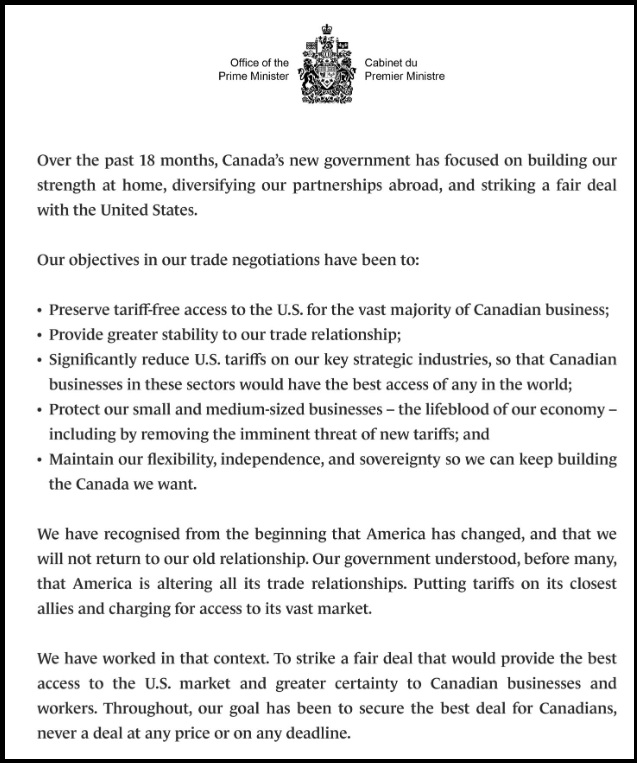
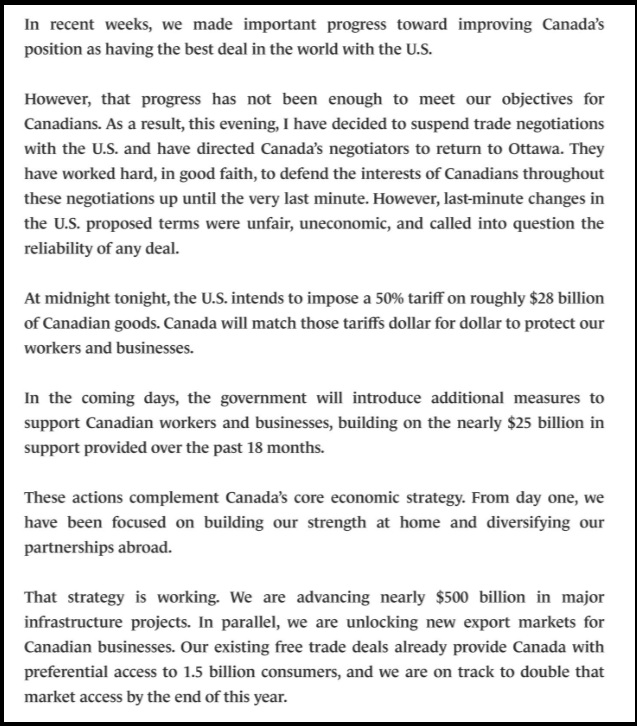
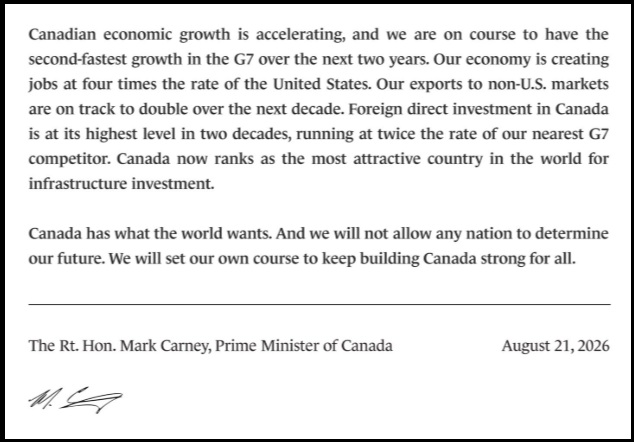
Moments ago, Canadian Prime Minister Mark Carney delivered the news via his X account. Discussions between the U.S and Canada have collapsed. All trade representatives are called back home. The 50% U.S. tariffs against Canada are now in effect. A trade war begins.
First, read the statement from Prime Minister Mark Carney, with the understanding that Carney is making the first statement because the news is exceptionally bad for Canada. Worse than bad.
When the 3-day tariff pause was announced, CTH said to be cautious. When USTR Jamieson Greer and Canadian negotiator Dominic LeBlanc said the terms were “basically agreed”, again CTH said be careful.
The reason for our notes of extreme caution is because the divide between the two economies and trade policy is just too big. There was no way for both sides to close the gap without major structural economic changes within Canada. The issues are not points of friction, they are just too big and embedded within the laws of Canada that would have to change.
Banking regulations would have to change. Intellectual property and media rules, regulations and laws would have to change. Industrial policy would have to change. The Canadian energy policy would have to change. The carbon trading scheme would have to change or be removed. All of this would fall upon Canada to carry out in order to position their economy in alignment with the USA. There’s literally no way for their government to accomplish this against the backdrop of their political ideology.
That was the structural argument and point made by former Prime Minister Justin Trudeau. This is also why the USMCA as a trilateral trade agreement is impossible to maintain. The only trade agreement construct possible is two clearly separate bilateral free trade agreements, one with Mexico and one with Canada.
“Tonight, Canada declined to finalize the trade deal under the terms agreed earlier this week.
Despite the U.S. offer to Canada to receive the best treatment of any major exporter to our market, new demands and walk backs of other commitments by Canada have upended the careful balance reached in the past days. In addition, Canada is continuing to maintain its prolonged retaliation against the United States, including, among other things, flat-out prohibitions on certain American goods and services.
For decades, Canada has enjoyed the most favorable access to the U.S. market of any country. And from the beginning of President Trump’s trade program, Canada has continued to enjoy the best treatment in the world, even after – like China – retaliating against the United States. This week, the United States agreed to provide even better treatment to Canada, offering significant tariff reductions on steel, aluminum, autos, and lumber.
The U.S. offer was also forward looking, and included a historic economic and national security partnership to cooperate on export controls, combat transshipment, enhance digital trade, and align certain external tariffs. The offer would have led to supply chain coordination on aerospace, complementary actions to address unfair trade practices, critical minerals cooperation, increased enforcement against imports produced with forced labor, and the announcement of formal U.S.-Mexico-Canada Agreement (USMCA) negotiations.
This is a missed opportunity for Canada to partner with the United States, which is the fastest growing economy in the G7.”