
like seriously


Maverick Garza has been living on his own since he was 19 years old.
His story, if not unusual, is at least not widely discussed. But his story deserves more attention because, unlike many recent four-year college graduates, Garza achieved financial independence immediately after leaving school.
A 2025 Sallie Mae survey found that nearly half of Americans who had graduated from college within the previous five years were still living with parents or other relatives. Which majors are most likely to move back home is less clear, though one 2015 analysis found that roughly 15 to 16 percent of humanities and history graduates still lived with their parents at age 29. Major aside, more college graduates are living with their parents as high housing costs and student loan debt put financial independence out of reach. As I argued last week, these financial woes are also fueling political frustration among many highly educated young adults.
But Garza never had to move back in with his parents.
Today, at 22, he works as a rig welder in the Houston area. Depending on overtime and per diem, he says he can surpass six figures and has been earning nearly that much since age 20. He has no student debt and tells me that he has recently formed his own LLC for side work building fences and gates. He also hopes to become a Certified Welding Inspector soon, a credential that, he says, carries substantially higher pay.
His decision to pursue the trades was not born out of hostility toward higher education. He initially enrolled in a business program, but after a few classes, he concluded that earning a business degree was unnecessary to accomplish what he wanted.
“I realized you don’t need a degree to own a business,” Garza said. “I decided to work with my hands because you can start your own business based off your skill level and how well you perform.”
Although his parents wanted him to pursue a four-year degree, Garza instead enrolled at South Texas College, a public community college in the Rio Grande Valley, where he earned an Associate of Applied Science in Welding. According to the school’s tuition calculator, the 60-credit program costs about $9,840 for in-district students and $10,440 for Texas residents—a fraction of what many students pay for a bachelor’s degree.
In an era of declining public trust in higher education, community colleges have largely escaped the reputational decline afflicting many four-year institutions. Peter Wood and I noted in February that while four-year institutions have preoccupied themselves with activism, community colleges have remained focused on workforce preparation and serving students priced out of traditional four-year institutions. This has made community colleges a hot commodity.
For Garza, community college just made sense. “I chose a two-year degree with certifications,” he said. “I came out with no debt, already finding a job because the trades are needed.”
Still, he is notably restrained when discussing higher education. Rather than steering young people away from a four-year degree, Garza encourages them to consider all their options before assuming it’s the only path.
Not everyone encouraged Garza to make up his own mind the way he now encourages others to do. When he first entered the trades, many people questioned his decision. “They’d ask, ‘Why would you go into that? You’re not going to have a big degree under your name,’” he recalled.
Those questions are often asked by people who measure the value of work by the credentials attached to it. As Gary Frankel, editor of the James G. Martin Center, recently quipped, some people think the “lawn guy must have a doctorate to be worthy of acknowledgment.”
Garza, however, believes attitudes are changing. “I’ve seen people with four-year degrees completely say, ‘I don’t like it,’ and they go to the trades,” he said. “You get your certifications, build your skill level up, and you’re already making more than someone with a four-year degree at a starter job.”
Prestige, either way, doesn’t seem to interest Garza much. What he talks about is craftsmanship: “I’ve always said take pride in your work. When you take pride in your work, people will see it.”
After all, welding isn’t for the dumb or faint of heart—”You’re lifting stuff daily. You’re getting your body moving. You’re getting over 10,000 steps. You’re sweating,” he said—and Garza doesn’t describe that as settling for less.
“Don’t be afraid to go in the opposite direction,” he said. “Don’t listen to the outside noise.”
Garza’s story doesn’t prove that everyone should become a welder. But at a time when so many graduates of traditional four-year colleges are struggling to achieve financial independence, it does suggest that other paths to a successful life deserve more serious consideration.
Image submitted by Maverick Garza

Reviewing lists of disqualified non-citizen jurors is now taking place in many counties led by citizen inquiry. The disqualification records, “non-juror” lists are public records in many states and counties. These reviews are turning up tens-of-thousands of non-citizens who are on juror lists, which means they are also on voter rolls.
(New Jersey Globe) – About 75,000 noncitizens are summoned for jury duty in New Jersey each year, based on data from three state government agencies, including the Motor Vehicle Commission — a stunning figure that widens the scope of a growing controversy over government databases that may incorrectly identify noncitizens as eligible voters and jurors.
While the number is alarming, there’s no indication that noncitizens have served on a jury since the judiciary implemented additional guardrails to prevent it.
“Prospective jurors are asked about their citizenship and other qualifications when they complete the mandatory juror qualification questionnaire,” said Pete McAleer, a spokesman for the New Jersey Administrative Office of the Courts. “Those who advance are reminded of the eligibility requirements during jury orientation and are directly questioned about their citizenship during jury selection by the judge and, as permitted, the attorneys.”
In between, potential jurors watch a training video that includes the citizenship requirement.
The revelation of noncitizens making their way into jury pools comes three days after Gov. Mikie Sherrill disclosed that an alleged software glitch at motor vehicles led to the inclusion of roughly 6,600 noncitizens on New Jersey’s voter rolls; Sherrill blamed the vendor, IDEMIA, and said less than 400 noncitizens have voted in recent elections.
According to McAleer, the judiciary processes more than one million summonses annually for potential jury service and randomly selects records provided from the Division of Elections, the Division of Taxation, and the MVC. (read more)
That 75,000/yr number are just those summoned people who disqualified themselves by being truthful about their status. I firmly believe the average non-pretending American will soon to realize/admit that many non-citizens actually remained on juries and passed judgement during trial.
Illegal aliens voting in elections is happening, we all know it and even though the media is still trying to retain their lies, you can tell that stance is softening against the reality. However, illegal aliens sitting as jurors in trials, will create a big-time constitutional mess that is something the communist left and media will never admit.


WASHINGTON, D.C. — The Supreme Court dealt an enormous blow to American sovereignty and civilization when it decided that any random person born on U.S. soil had the full benefits of citizenship, but many in the conservative movement do not view the high court’s betrayal as the end of the road for eliminating so-called “birthright citizenship.”
Chief among those conservatives is John Eastman, Director of the Claremont Institute Center for Constitutional Jurisprudence, who spoke optimistically about the road ahead during an event on Capitol Hill concerned with the next steps after the disappointing defeat in Trump v. Barbara.
“I don’t think it was a loss at all. Yes, we lost 5-4 on the constitutional question, but if you think about where we were just a few years ago, I mean, almost uniformly everybody said, ‘This is settled by the Constitution — the only way you can change this is a constitutional amendment,'” Eastman said. “There were a lot of people that thought … that it would end 9-0.”
Barbara started as a challenge to an executive order from President Donald Trump interpreting the 14th Amendment’s citizenship clause not to include any foreigner who happens to give birth in America, but Eastman noted that the initial challenges to that order show just how universally judges accepted the incorrect notion of birthplace citizenship.
Eastman, who won an award at the event for his foundational work since the 1990s making legal arguments against birthplace citizenship, noted how the first case to challenge the order actually saw the judge threaten lawyers defending Trump’s order with sanctions and a referral for discipline.
Recalling the 5-4 opinion at the high court again, Eastman said, “think about how far we have moved the discussion, not just not just in the legal community, but nationwide in just a relatively few short years.”
Just because the Supreme Court decided this case now, with its current makeup, does not mean that the issue will take 50-plus years to overturn, as with other extremely harmful decisions like Roe v. Wade, many at the event noted. In fact, some think that this issue can be resolved rather quickly if conservatives are creative enough about how to line up the next challenge for the court to review.
“This is not like Griswold in terms of the violence done to the law. I don’t see this is going to spawn a series of precedents that’s going to erode our republic, like Griswold led to Roe and led to Lawrence v. Texas and Obergefell,” Roger Severino, Vice President of Economic and Domestic Policy at the Heritage Foundation, said. “I just don’t see that sort of same progression because it was an originalist debate, which is a victory in itself.”
For Iowa Solicitor General Eric Wessan, the court found it much easier to strike down an executive order than it likely would have a piece of legislation, which would have two co-equal branches of government challenge the constitutional edict of the third co-equal branch. On the constitutional question itself, it will likely take personnel change, but the court is one justice away (e.g. Chief Justice John Roberts) from being able to affect change.
“While the chief wanted to close the door firmly shut on reassessing the constitutionality of birthright citizenship, they really left the door ajar, and there’s a lot of room for creativity in what to do next,” he said.
Wessan pointed to three areas that Barbara either did not address or where the Supreme Court would have no jurisdiction to block government policy, including declaring an invasion. Gov. Greg Abbott, R-Texas, and Trump have both declared an invasion at the southern border, and if that is the case, “and I see no reason why that wouldn’t be so,” Wessan said, then the court has no ability to weigh in on the kind of response needed to repel it.
Moreover, even under the legal logic used by the Barbara majority to maintain birthplace citizenship, the children of invaders would never be entitled to such citizenship.
Wessan supported the Citizenship Act of 2026, introduced by Sen. Jim Banks, R-Ind., which would legally define the millions of illegal migrants crossing the border an “invasion.” It would also block children born in the U.S. to illegals from obtaining citizenship and assert that Congress — not the Supreme Court — has primary jurisdiction to set rules for naturalization and immigration.
Elle Rogers Bernstein, general counsel for Banks, sat in for the senator during a panel as he attended the memorial service for the late Sen. Lindsey Graham, R-S.C., and explained that “an ‘invasion’ is not a lawyer’s term. It’s not a term that has a precise definition that’s for the courts to adjudicate. It’s for the political branches to decide. The operative question is not, ‘Do we think a court would agree there’s been an invasion?’ The operative question is, ‘Does Congress have the courage to say that our country has been invaded by 15 million illegal aliens and counting?'”
Banks’ bill also fits well with Wessan’s second option left open by Barbara, which is statutory redefinition. Banks’s bill would do that, but there are numerous bills that have been introduced that would address the issues in different ways, presenting separate challenges for the Supreme Court to have to wade through if it attempts to overturn the statute, once passed.
“For a Supreme Court that cares so much about its own legitimacy and popularity, the idea that they would undo or counteract a massive legislative achievement like that, I think it presents a much tougher question for them practically, even if not necessarily jurisprudentially,” Wessan said.
The third area Barbara left open is regulating birth tourism — where foreigners are able to give birth on American soil to obtain citizenship for their child, then move back to their home country to raise them. While the Barbara regime currently allows that to happen (though, not explicitly), Wessan believes it could be easily made illegal by statute.
Birth tourism is an enormous problem under the structure of birthplace citizenship. Once the child turns 18, they are an adult U.S. citizen, no matter if they ever stepped foot in the country after they were born, and by the time they are 21, they have the ability to petition for their parents to become citizens, too.
Severino noted that U.S. territory Northern Mariana Islands is a massive hub for Chinese birth tourists to obtain American citizenship, where there are now more birth tourist Chinese born on the islands than actual Americans.
Banks’ bill is one of many on both sides of the legislature, but Bernstein believes conservatives should be attacking birthplace citizenship from all available angles.
“Let 1,000 flowers bloom,” she said. “Let’s do a constitutional amendment, let’s test cases, let’s try to end the technicalities of birthright tourism.” Invoking Abraham Lincoln, she added that on this issue, “As a nation of free men, we must live for all time or die by suicide.”
Ethan Harper, chief counsel to Sen. Eric Schmitt, R-Mo., said he believes legislation is the easiest way to address the problem. Schmitt introduced the American Citizenship Act, which limits birthplace citizenship to those born to at least one American parent and removes that capability from tourists, visa holders, and illegals. It also revokes citizenship improperly issued to the children of diplomats, a phenomenon that is explicitly rejected by even the Barbara majority, but is still taking place.
According to Harper, Korean newspapers are running articles criticizing their diplomats for dual loyalty after 139 Koreans were born to them, but received U.S. citizenshhip.
There are other separate legislative fixes to different aspects of the issue, including basic things like noncitizens not being counted in congressional apportionment, only allowing American citizens to hold public office (currently, there are numerous elected officials and judges with dual citizenship), and prohibiting noncitizens from receiving federal benefits.
While simultaneously pursuing a policy to “deport them all,” Bernstein said, there can be some institutional disincentives for illegal aliens or immigrants, generally, to come to the U.S. in the first place.
One option is fixing employment so that it is actually illegal — with heavy consequences — for employers to hire aliens, coupled with ending parole, temporary protected status (TPS), and work authorization for virtually everyone.
Harper added that worksite enforcement, including arresting noncompliant CEOs in a public display, could shift the incentives for businesses to pursue foreign labor to begin with. Another very potent possibility would be debanking all illegals and foreigners with “legal status” who should not be in the country.
That would stop their ability to make any money working in the U.S. as well as block them from remitting the money back to their home country.
Banks and Schmitt have other bills as well, including Banks’ Nuclear Family Priority Act, which would end parts of chain migration by taking parents out of the category of individuals an immigrant in the U.S. is allowed to bring over with them.
Schmitt, similarly, has been trying to end the H-1B program in its entirety.
Ultimately, the question is how capable is Congress, particularly the Senate, to do any of this?
Harper says it may take a broader conversation about the filibuster, but Bernstein says that some of it can be done with a simple majority. Similarly, while Harper said that there are 30 states that have a propensity to elect Republican senators, thereby achieving the 60 votes needed to break a filibuster, Bernstein said that some senators need to be forced to “respond to incentives” like getting primaried.
“We’re having a conversation about citizenship in this country for the first time in a generation, if not more. America 250 really puts things into perspective,” Harper said. “The question of what is an American, as we have 15 percent of the country being foreign-born, a very large illegal immigrant population here, a very large legal immigrant population here, and trying to figure out what does an American look like in the 21st century …”
“We still have a consent of the governed. Did the 14th Amendment get rid of so many things from the Founding that we were not the same country anymore? Are we different now than we were in 1866, 1868?” he asked, stating that the current moment requires conservatives to get aggressive and “go big.”

In its latest escalatory move, on July 20 the State Department released a 100-page report titled “Cuba: The Capital of 21st Century Communism.” The report compiles historical evidence to show Americans how Cuba has long “served as the beating heart of a new and distinct kind of Marxism, forged around an overriding resentment and fundamental hatred of the United States and the broader West.”
As the report explains very competently, the revolutionary emergence of Fidel Castro’s Cuban regime in 1959 marked the shift from the classical Marxism-Leninism of the Soviet Union to the tercermundismo (“Third Worldism”) of the New Left. Traditional Marxism-Leninism had focused on class conflict between bourgeoisie and proletariat, the inevitable revolutionary uprising of the proletariat in industrialized nations to seize the means of production, and the spreading of transnational communist revolution. The Third Worldism of Castro’s Cuba was a “global revolutionary project” which applied the Marxist ideological paradigm in new ways, incorporating the “colonized nations and peoples of the Global South” into the traditional understanding of oppressed proletariat. As the report summarizes:
Castro, Che Guevara, and the other evangelists of Havana declared that the Third World was united by a single struggle for liberation, and that this struggle extended into the imperial metropoles themselves, to the racially oppressed peoples living within the Western powers … Havana was telling a new story — one that was both more romantic and more radical than its Soviet predecessor. It was a story in which the Black Panther, the Puerto Rican militant, and the anti-war student radical were part of the same global drama as the Cuban Revolutionary, the Algerian insurgent, and the Colombian guerilla.
In the wake of the Second World War, the growing movements for decolonization almost universally aligned with communist ideology against the European colonial powers and the U.S., to the extent it was fighting the Soviet Union and its proxies.
In 1966, Castro convened the Tricontinental Conference to bring together Marxist, liberationist movements from across the Third World (Africa, Asia, and Latin America) in opposition to America and the European colonial powers. Castro wanted to foment global revolution, calling for “two, three, or many Vietnams.”
Since 1959, communist Cuba has done as much as they could to export revolution through training and equipping revolutionaries. The report explains all this in much more detail, but the Cubans trained communist guerrillas, revolutionaries, and terrorists from all across the Third World, as well as sending Cuban military advisers to other countries like Venezuela, El Salvador, Yemen, and more. More recently, Cuba assisted in bringing Hugo Chavez’s socialist regime to power in Venezuela in 1999, which gave Cuba access to the riches of Venezuela’s oil.
The report also details the insidious activities of Cuban espionage, especially its chief intelligence agency, the Dirección de Inteligencia (DI). Over the decades, Cuban intelligence succeeded in infiltrating the American government with highly placed spies in the National Security Council, State Department, and CIA.
Americans should especially be incensed that Cuba worked for decades to foment leftist domestic violence within the U.S. by assisting, training, and advocating for the radical left in America. Weather Underground, the leftist student terrorist group infamous for serial bombings in the 1970s, including the Capitol and the Pentagon, built close ties to the Cuban government, traveled to Cuba to meet with the Cubans and North Vietnamese, and organized the Venceremos Brigade trips. The Venceremos Brigade trips are opportunities for Americans to travel to communist Cuba where they receive training and resources to help them further destabilize and decolonize the U.S. from within. Karen Bass, presently the mayor of Los Angeles, infamous for opposing Trump’s immigration enforcement and for accelerating Los Angeles’ decline into a third-world slum, was herself an active member of the Venceremos Brigades and traveled frequently to Cuba in her younger days.
The Cuban government and intelligence operations also have worked to stoke racial conflict in the U.S., supporting the Black Power movements and more recently “Black Lives Matter.” Cuba sought to instill a “militant Third Worldist consciousness among Black radicals,” courting and assisting figures like Stokely Carmichael, Robert Williams, Eldridge Cleaver, the Black Panthers, and the Black Liberation Army. Cuba even provided refuge to Black criminals fleeing the U.S. to avoid justice. Perhaps the most famous example is Assata Shakur, who was involved with the violent Black Liberation Army, convicted for her role in killing a police officer, fled to Cuba in 1984 where she was welcomed as a “martyr,” and lived there until her death in 2025. For decades, Cuba has stoked violent Black Power movements in the U.S., including the destructive and deadly George Floyd riots in 2020.
The report also details how contemporary actors like Antifa, the People’s Forum, and the National Lawyers Guild share the regime’s goals of subverting America and remain closely tied to Havana.
Sanctioning Cuban entities as state sponsors of terrorism creates new avenues to investigate and shut down their U.S. affiliates.
Lastly, as the report details, Cuba has been a means for American enemies like Russia, China, and Iran to get an economic, intelligence, and even military foothold in our hemisphere. One important benefit of the Venezuela operation toppling Maduro in January 2026 was to stop the intrusion of Russian, Chinese, Iranian, and potentially other foreign military and intelligence actors which had safe haven to operate in Cuba and (until just recently) Venezuela. Toppling Venezuela and perhaps Cuba is a way to push back incursions of hostile great powers into our hemisphere.
The report is a long overdue reset of the historical record. Cuba’s fall to a Soviet-backed, Marxist revolution under Fidel Castro was a marked failure of American foreign policy and national defense. As a result, Cuba has flourished for decades as an epicenter of militant global leftism, and we continue to feel the effects of that subversion as leftist domestic violence against law enforcement, ICE, and the Trump administration continue at record levels.
We should be encouraged that the Trump administration is seeking to correct the record publicly and spearhead a political movement against communist activity in the American hemisphere. For far too long, the actions of the radical left in America have been intentionally downplayed or even praised. While the radical left is clearly a domestic problem, it has received critical life support and encouragement from the Cuban regime.
Arguably, there has been legitimate casus belli against Cuba since 1959. It will require prudence to determine the best steps to proceed, and the Trump administration has currently adopted a strategy of maximal pressure through increased sanctions and a naval blockade to stop Cuba importing any oil. A clear-headed American foreign policy should focus on vindicating American interests and defeating Cuba’s revolutionary activities against us, rather than a progressive project focused on “liberating” Cubans.
There remains a range of options by which President Trump can counter and defeat the Cuban hostility. Stopping communist Cuba need not mean nation-building or quagmire. Even as we await to see what the outcome will be, we should be encouraged by the positive steps the Trump administration is taking to correct the failures of the last decades. Putting America First means crushing the radical left in America and their enablers in communist Cuba.
Reuters had a concerning report that China was planning on shipping up to 400 Chinese-made shoulder-fired air defense missile launchers (MANPADS) to Iran, according to three sources familiar with the deal.
The deal allegedly includes Chinese-made QW-12 and FN-16 missiles, the sources said. The report even included the company allegedly involved as an intermediary in the deal.
China is denying it.
China's Foreign Ministry said: "The relevant reports are completely groundless. China has consistently played a role in promoting peace and ending the conflict."
But then, of course, they would deny it.
Iran has been pounded, with much of their supplies used or destroyed. As Reuters notes, they need to rearm because the U.S. has struck the regime's missile and drone programs.
President Donald Trump was asked about it by Fox's Jacqui Heinrich during a press briefing.
Trump replied, "That would be surprising...he told me very strongly he wouldn't partake."
Then he dropped what I think is the warning to China's President Xi. "But he knows I'd be quite disappointed," Trump said with emphasis. "And he's coming here, I think, on September 24th."
That translates to: you know that would be a bad move.
There are a variety of responses he can take against China - from more tariffs to more sanctions - if they go this route. But obviously such weapons are problematic because they're highly mobile, which makes them harder to take out.
As we reported earlier, Trump has already said that they were going to "beat the f**king sh**" out of Iran after the regime attempted a surprise missile attack on U.S. forces in Jordan.
U.S. and Saudi forces then hit Iran-backed militias in Iraq after the surprise attack.
So in addition to an unhappy U.S., China could be getting on the wrong side of the Gulf neighbors as well, especially Saudi Arabia, if they were to engage in such action.


We have been warning for several years about the “new democratic norms” being established on a very totalitarian system of control; specifically, the control of information.
The need for control is a reaction to fear.
Finland is announcing that they will sever their international internet link that is connected to Russia, seemingly wanting to build a virtual wall between Russia and the ‘west’, or at least part of a virtual Iron Curtain they can control.
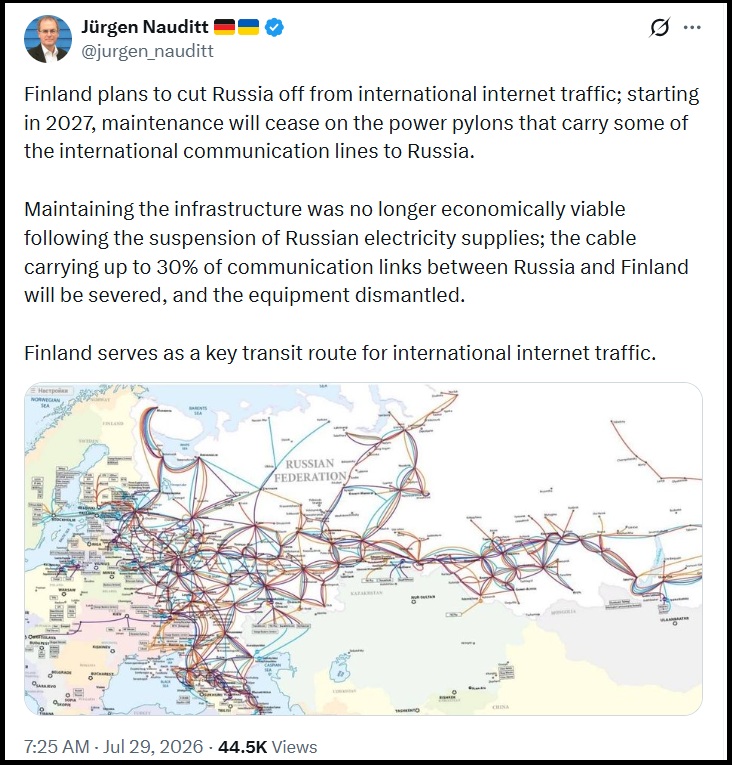
[SOURCE]
Four decades ago, the voice of freedom was heard saying, “tear down this wall.” Today, the modern version of European democracy is taking action akin to saying, “we must rebuild these walls.”
This is a very dangerous approach because a desire to stop discussion, a demand to stop the free flow of challenging ideas, an approach to silence – as opposed to winning the argument, is the exact opposite of freedom; it is the activity of totalitarian dictatorships.
We used to have Radio Free Europe in order to send ideas and information about the inherent value of freedom over the walls to what we called ‘oppressed’ people. Now, the baseline of modern western values is to do exactly the opposite, to block information that may come from the other side of the curtain.
Reasonably intelligent people might ask, what exactly is it the Europeans fear?
It looks like both JD Vance and Marco Rubio were correct in 2025 when they warned Europe what lay at the end of this censorship slope they are chasing. The era of ‘western values’ being understood by both Europeans and Americans has certainly come to an end.
I doubt very much that Russian Federation President Vladimir Putin is against the idea of having Europe sever the internet in an attempt to isolate the people of Russia. Every dictatorial step the ‘west’ makes from covid passports to vaccine mandates, to quarantine camps and beyond, only makes the Russian Federation look more open and freer by comparison.
There is a reason why the Russian COVID-19 vaccine uptake was one of the lowest in the world, and that reason stands as a stark contrast to the claims of the ‘west’. If Russia is such a control state, such a totalitarian state, then why didn’t the Russian people face forced masking or vaccination compliance?
Wait, that doesn’t make sense, right?….
Be careful comrades or you may find yourself asking the questions that all good compliant citizens are not supposed to ask.

