Saturday, July 25, 2026

The Kind of People Who Run for Government Office


“I do not know if the people of the United States would vote for superior men if they ran for office, but there can be no doubt that such men do not run.”Alexis de Tocqueville

What de Tocqueville said here seems to be a rather obvious truism. All we need to do is look at the current Congress—both parties—and most state and even local governments, to realize that “superior men” do not dominate any sector of America’s governmental structure. It’s not that all the people serving in government are Adolf Hitler reincarnated, degenerate, evil people, not even all Democrats. Not every Democrat always does “evil” things; they just believeevil things. Now, I suppose, one could define such a person as “evil,” and I wouldn’t argue the point. But there are some “decent” Democrats who don’t eat (or kill) babies. They just believe other people have the right to do so. That’s bad enough, obviously.

I’m trying to be as nice as I can here, folks.

America does have, and always has had, many decent people. But running a government requires more than just “decent” people. James Madison wrote, “The truth is all men having power ought to be mistrusted.” And he also told us why: “The aim of every political constitution is, or ought to be, first to obtain for rulers men who possess most wisdom to discern, and most virtue to pursue, the common good of the society, and in the next place, to take the most effectual precautions for keeping them virtuous whilst they continue to hold their public trust.” Very few people can be trusted with political power because very few people in government have godly wisdom and virtue. And, the problem is exacerbated by the fact that very few people have godly wisdom and virtue, period.

John Adams succinctly nailed the problem: “Individuals have conquered themselves; nations and large bodies never.” There have been, down through history, even in America, men who have “conquered themselves.” But, as Adams indicated, they are in a distinct minority among humanity. Plato gave us a pretty good clue why this is so: “The first and greatest victory is to conquer yourself; to be conquered by yourself is of all things most shameful and vile.”

Let’s be perfectly honest here: how many people truly, consistently, “conquer themselves”? Now, again, that doesn’t necessarily make them “bad” people or that everything they do is “evil.” But it certainly doesn’t put them in the class of “superior men” that de Tocqueville said rarely run for office, or among the “wise” and “virtuous” Madison said a nation needs to rule it.

And given the fact that so few people can “conquer themselves” and possess the wisdom and virtue necessary “to pursue the common good of society,” then, yes, to re-quote Madison, “All men having power ought to be mistrusted.” For, “if man is not fit to govern himself, how can he be fit to govern someone else?” That’s Madison, too.

And he couldn’t have nailed it more accurately. But, good Lord, what has America become? Graham Platner? Eric Swalwell? Bill Clinton? And Americans elected this latter degenerate cur to the Presidency. Twice! And how many other such “superior” examples of human rot—on both sides of the aisle—could we name? It is horrible that our country has deteriorated to this level of decadence.

The de Tocqueville quote again: “I do not know if the people of the United States would vote for superior men if they ran for office, but there can be no doubt that such men do not run.”

And that was over 100 years ago.

Madison wrote, “I go on the great republican principle, that the people will have virtue and intelligence to select men of virtue and wisdom. Is there no virtue among us?” And his last sentence is most significant: “Is there no virtue among us?”

Is there?

Well, he apparently wasn’t optimistic, and his statements about “all men having power ought to be mistrusted,” and only men of “wisdom and virtue” should be elected. Couple that with John Adams’ “nations and large bodies” have “never” conquered themselves, and we begin to understand why our Founders established a very limited government, specifically defining in the Constitution what it could and could not do. “Our Constitution was made only for a moral and religious people. It is wholly inadequate for the government of any other” (Adams). A people with no self- control, an irreligious people, a people who believe a woman can murder her own baby, a people who allow children to be butchered for sexual purposes, who don’t know the difference between a man and a woman, who don’t know what marriage is, who won’t protect their borders from a barbarian invasion...methinks it would be hard to argue that such a people have elected a “wise,” “virtuous,” “superior” leadership.

De Tocqueville also wrote, “The American Republic will endure until the day Congress discovers that it can bribe the public with the public's money.” Madison warned us about this kind of government, i.e., the government that exists in America today: “Government is instituted to protect property of every sort. This being the end of government…that is NOT a just government, nor is property secure under it, when the property which a man has is violated by arbitrary seizure of one class of citizens for the service of the rest.”

“Superior men,” men (women) of “virtue and wisdom,” men who can practice self-control for the “common good of the society” (not for specific groups of constituents), well, they probably do exist somewhere in America. But, apparently, they didn’t run for office in de Tocqueville’s day, and he wasn’t sure if Americans would have voted for them if they had. They don’t run now, either, and it’s pretty clear Americans today wouldn’t vote for them, either, if they did.


Podcast thread for July 25


'snooze emoji'.

The Fifth Column inside the US and UK


The United States and the United Kingdom are under attack from within.  Consider a small sampling of recent stories that the corporate news media have mostly ignored: 

Communist commentator Hasan Piker — an America-hating, Muslim anchor baby who grew up in Istanbul — continues to tell his followers that the United States deserved 9/11, while celebrating Antifa domestic terrorism and left-wing assassination culture.  After a left-winger allegedly murdered well-known British conservative Ann Widdecombe by bashing her head with a hammer twenty-one times, an Islamic supremacy group called Palestine Action began offering “direct action” training for fellow leftists who wish to learn how to use a hammer to effect “necessary change.”  Linda Sarsour — another America-hating, Muslim anchor baby — wants to burn the Declaration of Independence and “build a document” that celebrates her Islamic supremacist “values.”  An unemployed Ethiopian man somehow living in Minnesota murdered three workers at an apartment complex before blaming “the American system,” racism, and xenophobia.  (Foreign immigrants sure do learn the “woke” victim-blaming routine fast!)  The British government continues to overwhelm small villages by dumping unvetted, military-aged, Islamic males into “refugee” camps filled with many times more “asylum”-seekers than there are villagers.  In the English countryside, creepy migrant males track women and little girls for miles while making threatening, sexual noises.  

This is nuts.  The above stories, unfortunately, are just representative examples of a much larger number of similarly shocking stories coming from the U.S. and the U.K. in the last couple of weeks.  Every day, communists, Islamists, and other left-wingers encourage or perpetrate violence against Americans and Brits.  This is no way to live.  

Can you imagine Americans or Brits from the WWII-generation limply standing by and holding their tongues while foreigners waged war against their countries?  Because that’s what this is — war!  Foreign men who do not belong in the United States or the United Kingdom rob, rape, and murder Americans and Brits.  Then left-wing pundits use their platforms to explain to their brainwashed listeners that Americans and Brits deserve to be robbed, raped, and murdered.  Eighty years ago, foreigners who celebrated grotesque violence against their host countries would have been tossed into the sea.  Now they are handed citizenship, while collaborator-politicians treat them as sympathetic “victims.”

How much longer can this continue?  When will the day come when American and British citizens finally decide that protecting their countries from foreign invasion is more important than minimizing the risk of being called a “bigot”?  These insults — “racist,” “fascist,” “nationalist,” among others — are ludicrously hollow if the price of avoiding them means doing nothing while our countries are destroyed.  

Must Brits really allow Muslim rape gangs to target their daughters in the name of “multiculturalism”?  Must Americans really tolerate Islamic supremacists who celebrate 9/11 in order to demonstrate their commitment to “diversity” and “inclusion”?  Must English-speaking peoples really allow themselves to be conquered by non-English-speaking peoples in order to prove that they are “tolerant”?  Must we really all “coexist” with foreigners who have no desire to “coexist” with us?

This has gotten so absurd.  When an invading army is raping and murdering your countrymen, you don’t take sides with the invaders.  You don’t honor the invaders’ culture; you defend your own.  You don’t disparage your own people as “bigots” and “racists” for simply not wanting to be raped or murdered.  You don’t look past all the raping and murdering and conclude, “Borders are racist; we should really invite more rapists and murderers into the country.”  People who wish to survive the future are going to have to wake up, grow a spine, and acknowledge that they have been under attack for quite some time.

America has distinct advantages over Britain.  Because it is a much larger country, America cannot be conquered all at once.  Because Americans have a Second Amendment that protects their God-given right to self-defense, they do not depend upon mealy-mouthed government authorities to keep them safe.  But in both nations, the threat is the same: Successive generations of government officials have invited foreign nationals to conquer their lands.

There are all kinds of reasons why these traitors might have done so.  Some really do despise Western civilization and wish to see it disappear.  Others are so enamored of cosmopolitan variety that they probably think little English villages are better off with Pakistani flair.  Many are committed to depopulating the planet but find that the more successful they are in preventing their own people from having babies, the more desperate they are for foreigners to fill in labor force gaps.  However, most of these American and British traitors who have spent decades inviting foreigners to invade their own countries did so for the age-old lusts of power and money.  

Inviting waves of poor foreigners into Britain and America has driven down working wages, while driving up the price of homes and basic necessities.  Wealthy people with assets don’t defend mass immigration policies because they’re compassionate; they defend those policies because they’re greedy.  While the cost of assets in the U.K. and the U.S. has risen during decades of open borders, those armies of third-worlders have also turned into reliable voting blocs and street fighters for unscrupulous politicians.  Dividing voters into quarreling groups distracts citizens while giving government officials new justifications for an expansive surveillance state.  Consequently, armies of foreigners have made domestic politicians wealthier and more powerful (at least, in the short term).

However much government officials have profited by betraying their own citizens, the day is approaching when the bill for their decades-long betrayals will come due.  

Britain’s government has spent the last five years trying to get their citizens worked up about an impending Russian invasion.  Politicians and corporate talking heads — many of whom spent the previous decade mocking the Russian Federation for being a third-world “petrol station” destined to collapse — regularly tell Brits that Russian soldiers will soon be at their front doors.  In turn, those politicians and pundits have expected patriotic Brits to catch a “Russophobia” fever and rally around the Union Jack while supporting Westminster’s warmongering.  The problem is, of course, that British authorities have demonized patriotic Brits for waving their nation’s flag for so many years that there is little enthusiasm for fighting a foreign war.  It turns out that native Brits aren’t thrilled about dying for a government that prefers Pakistani, Iranian, Indian, and “Palestinian” flags to those that fly over England, Scotland, Northern Ireland, and Wales.

One must wonder whether British and American globalists ever considered the possibility that normal people do not put their lives on the line for “multiculturalism.”  They do not run up hills in defense of “diversity, inclusion, and equity.”  When governments defame citizens as “racists,” “bigots,” and “fascists,” citizens don’t have much interest in defending their slanderous governments.  When political leaders condemn the people for being “nationalists,” they shouldn’t be surprised when the people become less inclined to defend the nation.  How could politicians reasonably expect citizens to sacrifice themselves for their homelands when those same politicians have already traitorously handed the people’s homelands over to foreigners?  

From the point of view of a lot of Brits and Americans, it makes no sense to fight foreign wars when war is already brewing right at home.  And it makes even less sense to fight for the very governments that have invited raping, murderous foreigners inside the nation’s gates.  When Islamic supremacists openly celebrate 9/11 while enjoying all the benefits of living inside the United States, Americans know the enemy walks among them.  When British authorities cover up the atrocities of Muslim rape gangs, Brits know Whitehall can’t be trusted.  The cost of government betrayal is high and will only continue to rise.


🎭 π–πŸ‘π π““π“π“˜π“›π“¨ 𝓗𝓾𝓢𝓸𝓻, π“œπ“Ύπ“Όπ“²π“¬, 𝓐𝓻𝓽, π“žπ“Ÿπ“”π“ 𝓣𝓗𝓑𝓔𝓐𝓓


Welcome to 

The π–πŸ‘π π““π“π“˜π“›π“¨ 𝓗𝓾𝓢𝓸𝓻, π“œπ“Ύπ“Όπ“²π“¬, 𝓐𝓻𝓽, π“žπ“Ÿπ“”π“ 𝓣𝓗𝓑𝓔𝓐𝓓 

Here’s a place to share cartoons, jokes, music, art, nature, 
man-made wonders, and whatever else you can think of. 

No politics or divisive posts on this thread. 

This feature will appear every day at 1pm mountain time. 


Why the Gordie Howe International Bridge was 'a bad deal for Canada from the start

The new six-lane bridge connecting Windsor, Ont., to Detroit, Mich., is a grand, ambitious structure — and ‘a sweetheart deal for the U.S.’

We learned this week the outcome of Canada’s gunpoint re-negotiation with the United States over revenue from the new Gordie Howe International Bridge, an impressive $6.4-billion cross-border span that Canada paid for and is now finally able to open for traffic on Monday.

The reality of the forced amendments — hammered out under threat from U.S. President Donald Trump who demanded changes to a long-standing binational contract at the eleventh hour — is not so much that it makes the new bridge a terrible deal for Canada, it’s that the changes made a bad deal even worse, according to a source with high-level knowledge of the business of border infrastructure.

“The original deal makes me wonder why Trump was moping about it being a bad deal. It was a steal for the U.S., an absolute steal,” said the cross-border specialist who requested their name not be published as they are not authorized to discuss the matter.

“It was already a sweetheart deal. Trump didn’t need to do anything more to make it a great deal. At the time, everyone in the bridge community all said the same thing: This is a sweetheart deal for the U.S.

“Canada was screwed from the beginning. It was a bad deal for Canada from the start, and it will continue to be a bad deal for Canada moving forward.”

Economically, it might make the Gordie Howe a bridge too far.

The new six-lane bridge connecting Windsor to Detroit with a main span of 853 metres, the longest of its kind on the continent, is an ambitious and grand structure that took 26 years to create.

Visually, with tall towers anchoring splays of 216 diagonal steel cables, it evokes the masts and rigging of sailing ships of yore, like the clippers run by American privateers during the War of 1812 that hijacked merchant shipping.

Looking at the bridge’s economics, its imagery of something out of step with its time seems appropriate, despite its modern amenities; and with recent events, conjuring American raiders of the past aiming north of the border also seems suitable.

The bridge project formally began in 2012 when a deal was signed by the government of Canada and the state of Michigan for a new border-straddling bridge. The deal created the Windsor-Detroit Bridge Authority (WDBA), a Canadian not-for-profit Crown corporation, that would fund construction of the bridge, the plazas for customs facilities, and connecting the bridge to the highway systems in both countries.

The deal stipulated that all tolls from bridge traffic in both directions will be collected only on the Canadian side, and used to reimburse Ottawa for funding the project before sharing revenue with Michigan.

While the business case for a new bridge was debated, its name appealed on both sides of the border, in honour of Gordie Howe, a much-loved and respected Canadian hockey star who spent 25 seasons in the NHL bringing the Detroit Red Wings to glory. Howe died in 2016, two years before bridge construction began.

This January, the new bridge was given final approval by Trump’s administration as an official port of entry into the United States. Washington noted the bridge aligned with the mission of U.S. Customs and Border Protection (CBP) by “protecting the American people, safeguarding our borders, and enhancing the nation’s economic prosperity.”

Article content

This February, however, as the opening of the bridge drew close, Trump took a more personal interest in it and announced he would block its opening until Canada “compensated” the U.S. “for everything we have given them.” He demanded American ownership of “at least half” of the bridge.

A view of the Canadian side of the Gordie Howe International Bridge. Photo by Dan Janisse/Windsor Star/Postmedia

Trump’s demands triggered unhappy negotiating that ended this month with an agreement to amend the original deal, allowing the bridge to open but requiring Canada, for the next 15 years, to share half the bridge’s revenue with the U.S., after recovering operating costs, but before repaying its debt.

Trump’s much publicized amendments, however, might not make much of a real-world difference, according to an analysis by a cross-border infrastructure insider. That’s not because Canada won at the negotiating table this month, but because Canada cut such a lousy deal in 2012.

The question now is, given the economic outlook for the bridge, will there be any operating profit at all to share.

TOLLS AND TRAFFIC

The new bridge was originally pitched to alleviate high traffic volume at other border crossings. The WDBA’s own published origin story roots its timeline in 2000 with “concerns that the existing Ontario-Michigan crossings would not support the anticipated increase in traffic.”

That increase never came. Instead, traffic plummeted.

From that start in 2000 through to 2024, when ironworkers building from both sides joined their segments over the Detroit River, cross-border traffic with Ontario dropped 41 per cent.

According to figures provided by the Bridge and Tunnel Operators Association — a binational organization of operators of 13 bridges and tunnels connecting Ontario to Michigan, New York, and Minnesota — even with the rebound after COVID lows, traffic kept dropping. It is down for passenger vehicles and for trucks.

Combined truck and passenger vehicle crossings over the Ambassador Bridge — just 3.5 kilometres downriver from the Gordie Howe bridge — has dropped almost by half, from 12,220,000 in 2000 to 6,226,578 in 2024.

The spiral isn’t unique to the Ambassador. Traffic on the Blue Water Bridge across the St. Clair River at Sarnia, Ont., is down 33 per cent during the same time. The Peace Bridge connecting Buffalo, N.Y., to Niagara Falls, Ont., is down 42 per cent. To the northwest, the Sault Ste. Marie International Bridge is down 58 per cent.

The downturn in traffic is pinned on many things, such as requiring passports to cross the border after the 9/11 terror attacks, shifting U.S. trade to Mexico, relocated manufacturing, the value of the Canadian dollar, less interest in cross-border shopping, and, more recently, Trump’s tariffs and decreased interest in visiting.

With the new bridge, dropping traffic volume will be divided further. Drivers diverting to the Gordie Howe could cut the Ambassador’s traffic in half, the border crossing insider said.

“The Gordie Howe bridge was built under what I would term very optimistic traffic projections. Those traffic projections are not going to be met.”

One future-facing feature the Gordie Howe offers is free pedestrian and bike lanes.

RENT-FREE FACILITIES

The U.S. CBP facilities on the American side of the bridge are on a 68-hectare site, one of the largest border facilities in North America. On the Canadian side, facilities for the Canada Border Services Agency (CBSA) cover 53 hectares.

It includes 36 primary inspection lanes and 41 secondary inspection bays on the U.S. side, and 24 primary inspection lanes and 16 secondary inspection bays in Canada.

Canadian taxpayers paid to build it all.

Further, according to the U.S. General Services Administration, the Gordie Howe site does not require the U.S. to pay any rent for its large presence on the American end of the bridge. The WDBA’s deal for the U.S. border post lasts 20 years with four 20-year options, likely stretching it to a rent-free century.

That’s a rarity for border infrastructure, where the U.S. government typically pays rent for their facilities.

Across Canada, the Customs Act requires operators of international bridges, tunnels, railways, airports and ports to provide free facilities for Canadian border agents. At most borders, the cost of providing free CBSA facilities is roughly cancelled by revenue from U.S. CBP facilities on the other side.

Not at the Gordie Howe, where the WDBA gets no rent from either side. The bridge authority is also required to pay to maintain all of it.

DUTY FREE-FREE

Tolls from border traffic — particularly from commercial trucks — are the big money maker for border infrastructure, but there is another way to pump it up: Duty free goods such as gas, booze, tobacco and food.

The Gordie Howe bridge doesn’t offer any of that.

“At the Ambassador Bridge, what you have on the U.S. side is duty-free diesel fuel and gas,” said the insider. “If you’re a trucker and you’re going into Canada and you can fill up duty-free, why would you cross at the Gordie Howe bridge?”

Toll booths at the Gordie Howe International Bridge. Photo by JEFF KOWALSKY/AFP via Getty Images

There also aren’t general goods duty-free stores at the Gordie Howe, which is unusual for a large crossing. It leaves the bridge without a boost to nudge up revenue.

Drivers not needing duty free may make a different route calculation, however, as the base tolls to cross the Ambassador are considerably more expensive than at the Gordie Howe.

Stephen Laskowski, chief executive of the Canadian Trucking Alliance, said commercial carriers are happy to have the new crossing.

 Representing more than 5,500 carriers, he said the direct highway access at both ends of the Gordie Howe is appealing to trucking and increased competition will likely lower tolls everywhere.

“You’re going to see some significant shifts in traffic towards the Gordie Howe bridge,” Laskowski said. “It’s just more relief than anything that they can now implement some logistical plans into their operations that are going to introduce savings.”

UNBALANCE SHEET

In Prime Minister Mark Carney’s shifting descriptions of the amended deal, he said net proceeds from the bridge would be minimal or negative in the early years. It seems a recognition of the challenge of profitability.

At the Gordie Howe, the base rate for a passenger vehicle is US$5.75 while a commercial vehicle costs US$8.75 for each axle on the truck. It is cheaper if using a pass.

For a simplistic modelling estimate, assume the new bridge attracts half of the traffic that is currently crossing the Ambassador Bridge; that half of all traffic uses the cheaper pass rate; and all trucks are the common configuration of an 18-wheeler with five axles.

Those tolls would generate about $45 million a year.

The bridge’s operating expenses, however, will be double that, at least, the border expert estimates, giving a lowball estimate of $90 million.

Under the bridge agreement, the WDBA pays a private sector partner, a business consortium called Bridging North America, $1.9 billion over the next 30 years to run the bridge’s day-to-day operations. That is about $63.5 million a year from WDBA regardless of traffic volume.

The WDBA has other expenses, too.

“They have their own staff. They have a PR department. They have marketing. They have a whole staff and their own facilities,” the border source said. Those sorts of additional expenses could be $10 million. The WDBA also must pay taxes to the city of Windsor for its facilities on the Canadian side, estimated to be in the millions.


Children play hockey during the opening ceremony for the Gordie Howe International Bridge in Windsor, Ont., on July 24, 2026. Photo by JEFF KOWALSKY/AFP via Getty Images

Given the operating expenses and diminishing traffic, even without paying off the debt, this modelling estimate suggests it will be hard to find any profit to share with the U.S. — or with Canada’s taxpayers.

“It will never ever be able to get to the point where you have paid off that capital investment, never,” said the border source, but there’s also a reasonable chance the bridge won’t even cover routine operations.

MORE THAN MONEY

Public infrastructure isn’t just about making money, of course. Value comes from more than tolls.

Even if it isn’t the deal Canadians wanted, it doesn’t mean the Gordie Howe bridge isn’t an important and beneficial project, said Windsor’s mayor, Drew Dilkens.

“I expect very little money will actually flow, if any at all, into that (U.S.) regional economic development fund over 15 years,” Dilkens said of the new revenue sharing clause pushed by Trump. “Regardless of the outcome, this bridge will exist for more than a hundred years leaving plenty of time to ensure Canada is repaid the full cost of construction.”

He said the Gordie Howe bridge offers a big boost to the economy and local industries, particularly in the auto industry. “Getting auto parts to assembly plants quickly and reliably further supports our primary industry,” he said.

Dilkens said that the bridge being “in the hands of a government entity and not held under private ownership” brings stability, diversity and security.

Ryan Donally, chief executive of the Windsor Essex Chamber of Commerce, expects the bridge to experience gradual growth as traffic adjusts to a new option.

Beyond the tolls and traffic and routing, Donally said, the Gordie Howe brings an importance that is not tracked by accountants or appearing on spreadsheets.

It brings greater security.

He noted the pandemic protest blockade in 2022 that shut down the Ambassador Bridge, disrupting billions of dollars in trade and forcing manufacturing shutdowns.

“It comes down to economic safety, but also national security,” Donally said. “If I recall, the original discussion that we needed another border crossing is because of 9/11 and recognizing that having redundancy is having safety.”

A request for comment from the WDBA about its finances, the bridge’s economic challenges, and on the analysis by the border specialist went unanswered prior to publication deadline.


In Blue America, Insulting The Third World Is A Blasphemous Offense


The political forces governing blue America now deem it blasphemous to say something rude to their protected class of Third World migrants.


The American public has generally accepted that part of having constitutionally protected speech free of government prosecution means people are able to say mean things. But with leftists’ increasing radicalism and the importation of the Third World, that acceptance is becoming more and more endangered.

That’s the dynamic at play in the case of Shiloh Hendrix, a Minnesota mother found guilty of disorderly conduct on Thursday. The conviction came in relation to an incident that occurred last year, in which Hendrix reportedly called an 8-year-old autistic Somali boy a racial slur after he allegedly took an item from her infant son’s diaper bag on a Rochester playground.

The jury did not convict Hendrix on the charge of disorderly conduct toward the child, but on a charge related to her saying the slur to a Somali man who filmed and taunted her after the incident occurred. As a result, she has been sentenced to a stayed 90-day jail sentence, along with supervised probation, 200 hours of community service, and a $1,000 fine. Her defense attorney has signaled he will appeal the decision.

There are quite a few reasons to find this prosecution enraging.

For starters, one can find Hendrix’s rhetoric morally wrong while simultaneously acknowledging that it’s protected speech. There’s also no indication that her rhetoric amounted to “fighting words” or that she planned to hit the child, a point which the kid’s father reportedly admitted to when first interviewed about the incident by police. (The father, Shire Jimale, waited more than a week to contact police about the dust-up after the video of it had gone viral online and seemingly changed his position on whether he thought Hendrix would hit his son a day after his first interview with investigators, according to The Post Millennial.)

Second, it’s particularly egregious to convict (let alone charge) Hendrix for her conduct toward the cameraman when the video suggests he was the one who pursued her. And if that weren’t bad enough, that Somali videographer, Sharmake Omar, was charged in 2022 for allegedly raping and sexually assaulting a 16-year-old girl. (The Olmsted County Attorney’s Office later dismissed the charges “in the interest of justice” last year.)

Many countries throughout the world today have blasphemy laws prohibiting acts or speech deemed to be offensive to religion. U.S. states have also adopted such laws over the course of American history — specifically pertaining to Christianity.

But in wastelands of modern blue America, the new “religion” is leftism. And the political forces governing these areas now deem it blasphemous to say something rude to their protected class of Third World migrants.

Just look at how the media and their Democrat allies brushed aside the massive fraud scandals implicating such populations across states like Minnesota and Ohio. Dare to point out these migrants’ abuse of welfare programs or their lack of interest in assimilating into American culture and one is immediately attacked with the typical accusations of Islamophobia and xenophobia.

The prosecution of Hendrix is simply the next phase in this game plan.

Even if Hendrix manages to get her verdict overturned on appeal, the damage has already been done. Making her suffer through the costly and lengthy legal process is the entire point. That she was found guilty and sentenced is just an added benefit for those supporting her prosecution.

Democrats understand that their survival as a political party rests on importing millions of foreign nationals into the United States — especially those from the Third World. They will do whatever is necessary to court these individuals and bring them into the folds of the party.

And if that means they have to destroy Americans and their constitutional freedoms in the process, then so be it.


Shiloh Hendrix Won’t Be The Last Victim Of The Left’s Fight To Criminalize Speech


Words may be offensive and rude, but they are not violence.


While at a Rochester, Minnesota, playground with her son last April, Shiloh Hendrix watched as an 8-year-old Somali child allegedly ran to her diaper bag and stole something. Hendrix reportedly shouted at the child and called him the n-word. A fellow Somali bystander, Sharmake Omar, began following and recording Hendrix and asked if she called the child a racial slur. Hendrix confirmed she did, and then called Omar the same slur as well. During this interaction, Hendrix is seen walking away from the Somali nationals.

Omar told Hendrix that her speech was “hate speech” and that he would post the video for the world to see. (Notably, Omar was charged in 2022 for allegedly raping and sexually assaulting a 16-year-old girl. The charges against him were later dismissed “in the interest of justice.”)

And the world did see it — and had the opportunity to judge for itself. Whether viewers of the incident condemned her, criticized her, or defended her, it was all their prerogative to have their own First Amendment thoughts on her use of her First Amendment right. It’s how free speech works.

Yet on Thursday, the government also decided that it should get to judge Hendrix’s First Amendment right. Hendrix was found not guilty on disorderly conduct toward the child but guilty on one count of disorderly conduct toward Omar, who taped a portion of the incident. Hendrix was ordered to pay a $1,000 fine, placed on probation, and ordered to complete community service. Her defense attorney reportedly plans to appeal the decision.

Defending Hendrix’s constitutional rights requires no defense of her language. The First Amendment was not written to protect only the speech that is approved by an ever-changing society. If free speech requires the government to rubber-stamp its morality, then there would be no reason for the First Amendment in the first place.

Prosecutors attempted to get around Hendrix’s First Amendment right by arguing her use of slurs amounted to “fighting words” (which are not protected by the First Amendment since they can provoke immediate violence). But the video makes such an argument hard to believe. Omar is the one who approached Hendrix, followed her as she walked away, recorded her, and repeatedly goaded her into saying the word again. Hendrix never advanced toward Omar. In fact, the only thing that Hendrix’s words provoked was content creation for Omar, who purposely goaded her into saying the slur again so that he could make viral content.

But this case represents the logical conclusion of the left’s insistence that “speech is violence.” Such a claim creates the permission structure for censorship and punishment: If words are violence, then silencing and punishing the speaker is justified. It’s the entire reason the left constantly uses that phrase whenever it wants to force ideological conformity.

The University of Colorado Boulder said that refusing to use a mentally ill person’s preferred pronouns can be an “act of violence.” Ann Coulter was shouted down by students at Cornell who claimed, “Your words are violence!”

In both cases, the “speech is violence” iterations had the same effect: They justified (at least in the left’s minds) censorship. The label of “hate speech” serves a similar purpose. It allows someone to shut down any argument or discussion or even justify violence by accusing someone of being hateful — even though the First Amendment does not have a hate speech exception and the Supreme Court has repeatedly affirmed this.

Shortly after Charlie Kirk was assassinated, then-MSNBC analyst Matthew Dowd said Kirk was “one of the most divisive … figures … who is constantly sort of pushing this sort of hate speech” and that “hateful thoughts lead to hateful words, which then lead to hateful actions.”

Tyler Robinson is reported to have said that Kirk “spread too much hate” and that “some hate can’t be negotiated out” and then allegedly followed that conclusion to its (in his mind) logical endpoint.

Kirk’s assassination is the ultimate consequence of pretending that speech and violence are interchangeable. If someone’s words are violence, then actual violence is justified. If someone’s speech is “hateful,” uses it to create the moral permission structure for others to respond to said “hate” speech as they see fit.

Words may be offensive and rude, but they are not violence. Free societies ought to preserve that distinction. Omar was free to call Hendrix’s speech hateful. He was free to publish it and let the public judge her. But what should concern everyone is that the government thought it should punish her too.


Trump Angers Some in Turning to a Never-Used Immigration Court; the Inspiration for It Is Hilarious


RedState 

Feathers on the leftists and the media, as they are so often prone to, are getting ruffled once again by the Trump administration. The latest reason for their plumage becoming unkempt is a step taken by the Department of Justice to employ a previously unused immigration court for a case. You see many of the expected characters getting upset by this, with a very distinguishing feature: 

They have no idea what they are upset about.

This concerns the DOJ turning to the Alien Terrorist Removal Court, and you are forgiven if you know little to nothing about it. This was a court established some 30 years ago by Congress, but that had, up to this point, gone unutilized. The purpose of it is to shield any classified information exposed in the course of a trial from being made public in trial records. Therefore, the entire proceedings in said courtroom are kept secret. This bothers certain sectors of our nation.

CNN details some of the characteristics of this fresh-from-the-box court, and you can detect the essence of disapproval from the report.

  • The court gives the government enormous latitude to keep secret – including from the person it is trying to deport – its reasons for believing an immigrant is a terrorist. And it closes off many of the avenues migrants typically have for contesting their removals.  

It also closes off the media from gleaning the details of the case, yet they still are sounding pestered that this is taking place. Look just at the headline from CNN, and we get a sense of their dyspeptic attitude: “This Court Was Created 30 Years Ago and Never Heard a Case. Trump Wants To Change That.” Ward covered the initial filing and some of the complaints heard immediately after, such as Politico claiming that legal scholars challenge the use of this court—scholars who go unnamed and unattributed, mind you.

This is not an unfamiliar approach seen in the press during the Trump years: Complaints have been made about employing laws or enforcing policies that are outdated or rarely used. The president was scorched when he promised to invoke the Insurrection Act to justify sending the National Guard into D.C. to tamp down crime. Canadian tariff battles in the early part of his second term were rooted in the Smoot-Hawley Tariff Act, an “old” trading policy from the 1930s. These were sold in the press as invalid employment of laws because they were dusty standards no one uses today. This argument derived from an inability to demonstrate they were illegally applied.

And now the struggle is greater, given the ATRC is relatively new, and so the approach is, “Well, no one ever used it before!” Yeah…and so…??? It is still valid. Trump is simply the first president to remove the shrink wrap. This effort therefore needs to be denigrated in other fashions, such as referring to the ATRC as “a zombie court.” (Hint for Mother Jones: You cannot “revive” something never previously used.)

But what brings more amusement to the table is how the DOJ may have become inspired to turn to this option that still has that New Court Smell. In March of 2025, during a contentious hearing with DOJ representatives, Judge James Boasberg, who has become a repeated and infamous blockade against the administration’s immigration efforts, actually broached the idea of using the ATRC, in possibly a dismissive fashion. 

  • Boasberg asked the government what the role of the court was in ensuring that people aren't improperly deported to Salvadoran prisons. He also raised the Alien Terrorist Removal Court as an avenue for the Justice Department to remove aliens who are suspected of terrorism. It was established by Congress in 1996, but it has never been used to deport a suspected alien terrorist. 

It seems Boasberg might have been provocative in that exchange. Given he knew that he was steering the DOJ lawyers towards a never-used court option, you get the sense he was sending the administration down a legal cul-de-sac. But now they have turned his misdirection into leverage and activated this never-before-used option.

It remains to be seen how effective this court option can become. The judges tasked with the ATRC are given more latitude, as they have to rule over arguments and evidence not entirely revealed and even kept from the defense. There are also many implications of due process possibly being violated and becoming a matter for the Supreme Court to rule over. 

It is for this reason that it is suspected that those legal hurdles have prevented the use of this court previously. But there is a wry reality that the administration was inspired to turn to this option by the very judge who has mostly seemed intent on ruling against them. 

And now we sit back and watch with amusement as the expected groups and journalists come out barking about the case being brought – a case they have no way of knowing the particulars of and therefore are entirely unclear what it is they are upset about.


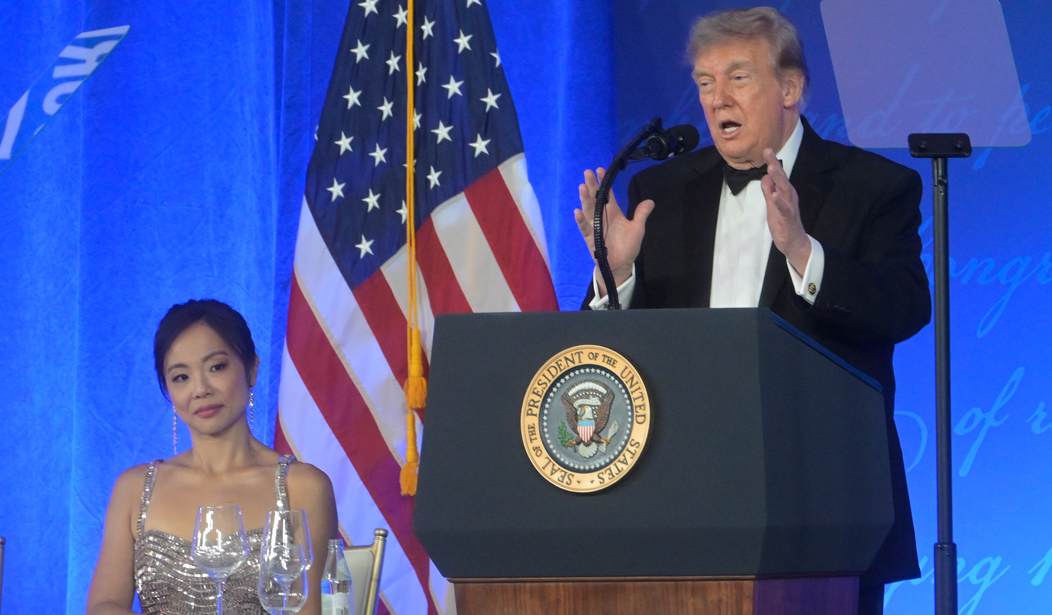
Trump Roasts the Media, RFK Jr., and Nikki Minaj at WHCA Dinner. Here's What You Missed.

Trump Roasts the Media, RFK Jr., and Nikki Minaj at WHCA Dinner. Here's What You Missed.


President Donald Trump addressed the second go-around of the White House Correspondents Dinner on Friday night, stressing that “in America, we do not yield to political violence.” 

The last dinner was cancelled before the president could address the media due to an attempted assassin firing shots at the Washington Hilton. Friday’s event was at a smaller venue at the Waldorf Astoria, a former Trump Organization property. 

“As I said three months ago, the show must go on,” Trump said. 

“Just like my presidency, the second time is always better — and a third time will be better yet,” he said, adding that he was “only kidding about running for a third term. 

Trump said that the attempted shooting was an “assault on our democracy itself,” saying people like Secretary of War Pete Hegseth and White House Deputy Chief of Staff for Policy Stephen Miller exhibited “extreme bravery.” 

The president also specifically honored Secret Service agents, including Officer Vincent Victor Gonzales, who was hit in the chest with a bullet during the shooting. 

“Oh, that was gonna be a doozy. I was so liked,” he said of his original speech, noting that he changed the tone of his remarks given the April incident. The president notably used the address to make the case for supporting the White House ballroom project. 

Despite the occasional seriousness of the night, Trump did not hold back with his jokes.

He said that when Secret Service shouted “get down,” the rapper Nikki Minaj, who was a guest at the first dinner, started twerking. 

"How the hell did you not see that coming?" Trump said of Oz the Mentalist, the entertainment at the dinner for one of the initial events, and the do-over. 

Additionally, he said that “this place is the really the largest group of Trump derangement syndrome people ever put together at one time, I suspect.”

"Some of you are lucky that our last dinner was cut short because I had brought with me what would possibly have been. I'm telling you, I had something I was going to go after you,” Trump continued. 

He also poked fun at Health and Human Services Secretary Robert F. Kennedy Jr., calling him a “piece of work.” 

Noting the beef tenderloin served at the dinner, the president said that Kennedy “personally ran over the cow with his car.”

"He also suggested an appetizer featuring his favorite cut of male raccoon roadkill,” Trump quipped. 

The president also clarified that the time when then-President Barack Obama roasted him at the 2011 dinner was not when he decided to run for president, as the moment has frequently gone viral for implying it was a turning point in Trump's decision to run.

Trump noted that he may return to the event next year, as he has always skipped the dinner while president, with this year being the exception. 

Toward the end of his remarks, he put on a Trump 2028 hat and quipped that the night was "far worse than he actually thought" while also thanking the press and saying that it is the "golden age of America."