Wednesday, June 24, 2026

The Historical Roots Of The American Experiment At 250


Dangling atop the smoldering burn pit of history is the American experiment of 250 years. It dangles atop what history we know, not what history has, unfortunately, been lost over time.

What is that experiment? What do we mean by the phrase “the American experiment”?

We mean three separate philosophical legs to the stool of governance and civil society:

1.    The development of the person, not the group to which the person belongs

2.    Moral Law as the highest law of the land

3.    Federalism as the governing structure most amenable to liberty

Certain historic figures stand out in the development of this experiment.

Basil Cardinal Bessarion (1399?-1472)

When the Catholic Church split by schism in 1054 into the Latin (Western) version and the Greek (Eastern) version, it was militarily weakened. The debate causing the break involved whether the Holy Spirit comes from the Father alone or from both the Father and the Son as equals.

While the distinction may seem small to us now, it was not small then. The Eastern church in Constantinople (now Istanbul in Turkey) could not withstand a Muslim attack in 1453 (even with some help from Rome) and was destroyed. This event marks one of the large turning points in the development of the West, not for its sheer devastation, but for its inadvertent nudge to a backward Europe toward a prolonged journey in search of human betterment.

From around 3 BC to 1 BC, original scripts authored by Greek philosophers, poets, and mathematicians, among others, were housed at the Library of Alexandria in Egypt. After several centuries, these precious documents began to be slowly transferred to the eastern Catholic Church in Constantinople and would have been destroyed in the attack of 1453 but for the efforts of Cardinal Bessarion who helped remove them from harm’s way. Lost would have been Plato, Homer, Sophocles, just a few of the Greek geniuses of their time, and lost would have been the impact of these minds on Europe and the emergence of the Renaissance.

It is the Renaissance—1400 to 1600—with its acceleration in scientific observation, intellectual excellence, and innovative invention, that forms one basis of the philosophical undergirding of the American experiment. By saving Greek intellectual thought, Cardinal Bessarion brought Plato to the discussion in Europe regarding the development of the person, and that discussion and debate guided America’s Founders as they tried to create a realistic governing system for the new nation.

William Bradford (1590-1657)

Heading for northern Virginia but landing in rocky Massachusetts on November 11, 1620, it is not only William Bradford’s revolutionary leadership of the Pilgrims that matters, but it is also the effect on America of the book he brought with him: the Geneva Bible.

Virtually forgotten until a painstaking revision was published in 2007 to commemorate the settlement of Jamestown, Virginia, in 1607, the Geneva Bible is the first English translation of the Old and New Testaments and was first published in 1560 and dedicated to Elizabeth I of England. Its uniqueness is not just the painstaking translations, but also the annotations in the margins that helped everyday readers understand Biblical meaning in what was called at the time the “vulgar tongue.” And so, with an angry crew ready to mutiny and return home, William Bradford, with the Geneva Bible in mind, created the first founding document of the American experiment, the Mayflower Compact:

“We do covenant and combine ourselves into a civil body politick.”

We do ordain and establish this Constitution

“For our better ordering and preservation.”

To ensure domestic tranquility, [p]rovide for the common defense

“To enact such just and equal laws”

Establish justice

“For the general good of the colonie”

To promote the general welfare

While wrapped in Christian overtones, this is basically a secular governing contract asking those consenting to it submission and obedience to the rule of law. William Bradford led the struggling Christian commune with the Geneva Bible in one hand, burial shrouds in the other, and left no doubt that one basis of the American experiment is a belief in and an adherence to the Moral Law of the Old and New Testaments of the Bible. The Bible, in its many versions, remains the basis of how we know right from wrong as individuals in a “civil body politick.”

Also, certain concepts developed by many historic figures, including ancient Greek philosophers, stand out in the development of this experiment.

One of those concepts is Federalism. The American experiment is not about democracy. Democracy was feared by the Founders, who knew that ochlocracy was as dangerous as tyranny. The US Constitution protects minority geography through the Electoral College and the even number of Senators for each state. Without the concept of Federalism, with its horizontal (separation of power) and vertical (state vs national) divisions of power, mobs might rule America under the guise of the democratic. This unique governing concept was weakened by the US Supreme Court. It should be restored and applied by the current Supreme Court as we celebrate our 250th year dangling atop the smoldering burn pit of history.

Podcast thread for June 24


Jeez....

Prescient Mark Steyn


I previously saw an interesting discussion with NVIDIA Jensen Huang where in the context of AI he was asked: who is the smartest person you ever met?

Jensen Huang paused for quite a few moments thinking about the question before he answered.

Huang then redefined the word “smart.”

‘Smart’ is a word we have historically used in reference to ‘intelligence’.  If a person was intelligent, we say that person is smart. However, in this era of AI at your fingertips, we must break this connection.

Intelligence, the assembly of knowledge about a particular matter of discussion, is no longer limited to educational or real-life training or study by people who focus intensely on subject material.

All of the knowing about a system, any system, process, history or discussion topic is now available almost instantly to anyone in this era of artificial intelligence.

The NVIDIA CEO then continued, therefore, once we break our historic reference connecting ‘intelligence’ and the generalized term ‘smart’, we can properly address the question you present.

Who is the smart man? Or, in the context of the originating question, “who is the smartest person?”

With this baseline established, Jensen Huang then outlined the traits of the smartest person.  The smartest person is not the person with the greatest knowledge; the smart individual is the person who can tune into the frequency of the universal moment, look at the human reality of what is factually taking place that has not yet become an input into the AI capture record, and then predict the material outcome – the destination of knowledge that has not yet arrived.

Essentially, Huang explains the smart person is alone, tuning themselves into the vibration that is the consequence of human activity, financial interests, geopolitical movement, social transformation, economic shifts and cultural modifications.  Then, positioning their interests at the place in the future where they predict all the activity will arrive.

The accuracy of prediction, or predictive positioning, then determines the scale of smart.  The more accurate a person is under this perspective, the smarter they are.

I agree with this perspective.

All of human knowledge is now being assembled into AI databases for exploration by anyone with a keen interest or stake in the subject matter.  Knowledge is no longer the valuation of ‘smart.’  The ability to predict the next step, phase or moment is the smart attribute.

With this context, we can now look back over the past few decades, not looking for the most intelligent voice, but rather looking at the accuracy of current position, contrast with the outline from the voices who make the predictions.

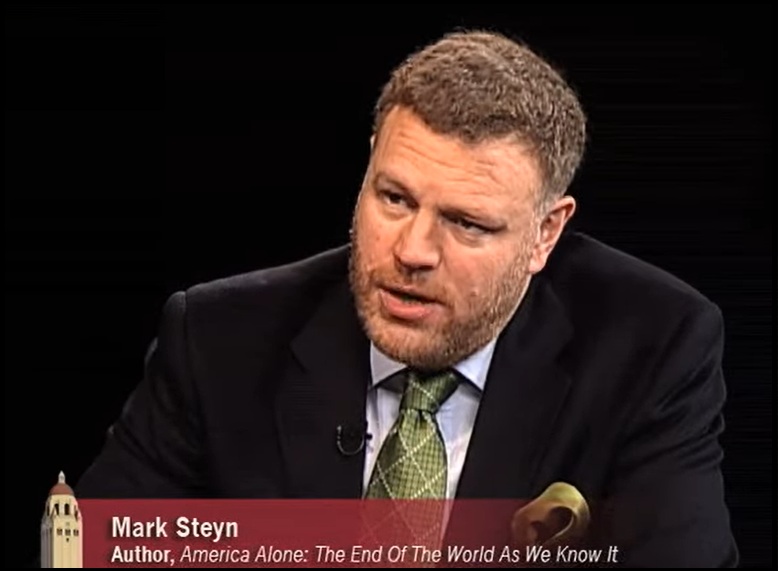
This interview about the ramifications of cultural change in Europe was given in 2010, sixteen years ago, centered on a book written by Mark Steyn and the context within the questioning is looking forward over a period of about 20 years.

Remember, this is 2010, written before the “arab spring, long before Brexit, well before President Donald Trump and the MAGA agenda as policy and before the U.K churned through seven prime ministers’ in a decade.

Remarkably, Steyn discusses/predicts what would happen if Islam tried to reform; if the U.S. pulled NATO resources out of Germany; if the U.K doesn’t radically alter direction and much more.

Watch the discussion or put the interview on play while listening to it in the background as you go about your tasks.  Remind yourself at moments throughout the roughly 30 minutes, that the interview took place fifteen years ago.

Mark Steyn, a writer, political commentator, and friend of the Treehouse outlines his 2010 prediction about the destination of the Western world during a discussion with Peter Robinson.


[Amazon Purchase Link]

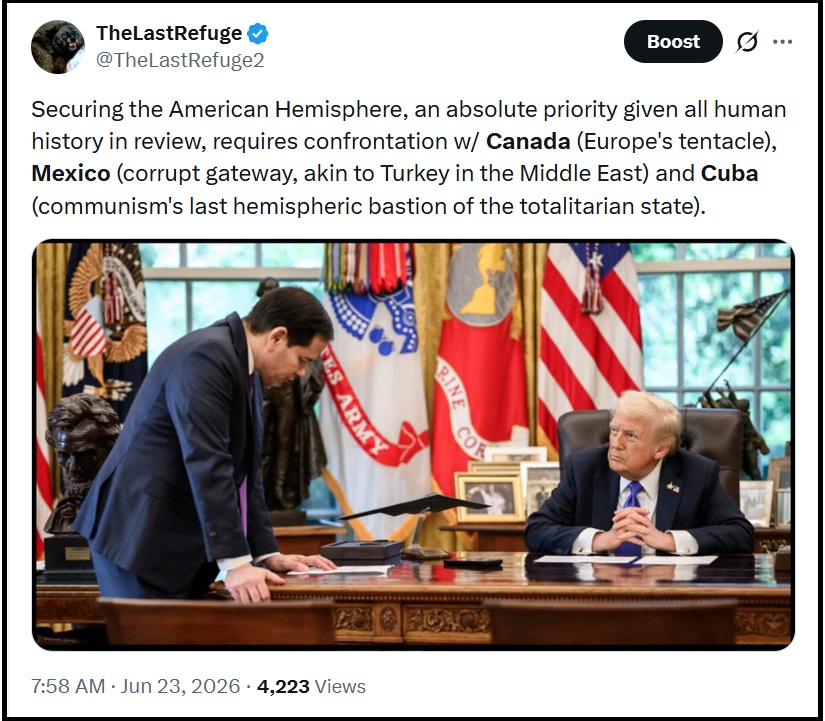
CTH has no financial association with any of this; I just find it super interesting, because my research folder is growing increasingly large with material behind a hemispheric shift. {TWEET}


Randi Whinegarten

 Randi Whinegarten

The union boss continues to spew drivel, regards teachers as victims, and at the same time takes advantage of them.

Randi Weingarten, president of the American Federation of Teachers, wrote a hyperbolic piece titled “America’s Teachers Can’t Afford to Teach,” which appeared in Time magazine on June 11.

The excessively whiny article is filled with half-truths meant to make readers feel sorry for impoverished, underpaid teachers. Among other things, she asserts that the vast majority of American educators are living paycheck to paycheck, taking on debt to buy groceries, and facing other financial hardships.

She maintains that the pay gap between “teachers and other college-educated professionals—known as the ‘teacher pay penalty’—has grown to 27 percent. To put it plainly, people with the same level of education and experience can make far more doing almost anything other than teaching. We cannot accept this as an unfortunate reality or an accident.”

But when you look at the facts, which apparently is an alien concept to the union boss, you get a very different picture. While it is true that teacher salaries nationwide have not quite kept up with inflation, Weingarten tells only part of the story, omitting many perks afforded to educators.

Just Facts, a nonprofit dedicated to researching and publishing verifiable facts on critical public policy issues of our time, analyzes teacher salaries and reports that in the 2021–22 school year, the average U.S. teacher earned $66,397 in salary and $34,090 in benefits, including health insurance, paid leave, and pensions, for a total compensation of $100,487.

Also, full-time public school teachers work an average of 1,490 hours per year, including time spent on lesson preparation, test construction, grading, providing extra help to students, coaching, and other activities, while their counterparts in private industry work an average of 2,045 hours per year, about 37 percent more than public school teachers.

Weingarten also fallaciously claims that teachers in states with union-backed collective bargaining agreements (CBAs) earn 24 percent more than those in states without such agreements.

However, those without an agenda tell a very different story, arguing that CBAs actually hurt the bottom line for all teachers. Mike Petrilli of the Fordham Institute writes that teachers in non-collective bargaining districts earn about 12 percent more than their unionized peers. Other research by Michael Lovenheim and Andrew Coulson produced similar findings. In 2018, University of California, San Diego professor Augustina Pagalayanreported that CBAs do not improve teacher pay.

It’s worth noting that union dues for teachers are quite high these days. In Los Angeles, for example, full-time educators pay about $1,500 in dues annually.

Weingarten also never explains where the bulk of union dues are spent. According to a Pew Research poll, about 58 percent of public K–12 teachers lean Democratic and 35 percent lean Republican. But OpenSecrets reports that in 2024, the American Federation of Teachers gave $3,069,063 (99.89 percent) to Democrats and a scant $3,323 (0.11 percent) to Republicans.

Additionally, while she bemoans low teacher pay, the money she collects from them goes to pay her a hefty salary. As the Illinois Policy Institute reveals, Weingarten’s current yearly income is $514,488, making her a one-percenter.

Another fraud perpetrated by Weingarten concerns a book she wrote last year, Why Fascists Fear Teachers: Public Education and the Future of Democracy, which she claims will “empower us and give us hope.” The problem is that every word from the union boss is nonfactual claptrap.

As Aaron Withe, Freedom FoundationCEO, writes, the book opens by comparing the Nazi occupation of Norway to the current state of American education and “argues that anyone who disagrees with the author’s vision for public schools is, in some meaningful sense, a fascist.”

Perhaps the biggest deception in Weingarten’s book is its portrayal of her role during the pandemic. “I led the AFT in developing a concrete plan to reopen schools as quickly and safely as possible,” she claims.

Bald-faced lie.

In reality, she repeatedly argued for keeping schools shuttered throughout the spring and summer of 2020, while her union aggressively lobbied the CDC to revise its school-reopening guidance. Two of her language recommendations were adopted verbatim.

Weingarten also outrageously used members’ dues to pay for her fiction-laden book.

Researcher Maxford Nelsen combed through the AFT’s most recent LM-2—the annual financial disclosure unions file with the U.S. Department of Labor—and unearthed a detailed accounting of how member dues were used to produce Weingarten’s book.

The AFT paid nearly $1 million to a New York law firm, and its attorney is likewise thanked in the book’s acknowledgments for reviewing the manuscript. When the New York Postasked about it, an AFT spokesperson claimed the review was done pro bono, but the union LM-2 says otherwise.

There was also $6,000 for fact-checking, $5,212 for a single-author photograph by a Washington-based photographer, and $64,090 to a literary agency that lists AFT, not Weingarten, as its client.

Nearly 30 AFT staff members are thanked in the acknowledgments, prompting questions about their role in the book’s creation. Meanwhile, travel costs for Weingarten’s nationwide promotional tour are not itemized separately but were almost certainly substantial.

In other words, teachers paid for nearly everything. Weingarten may not have contributed a single dollar to the enterprise.

Weingarten was also one of the more strident leaders in 2025’s anti-Trump “No Kings” movement. She wrote, “At every turn, this president has undermined the rule of law, weaponized the federal government against the people it should serve, and divide and silence us. And now, the same far-right groups that cheered his chaos are smearing those of us who are organizing peacefully for justice.”

The hypocrisy here is glaring. This is a woman who has served as AFT president since 2008 and, before that, led the UFT, AFT’s New York City branch, for 11 years. Additionally, teachers do not vote for her directly; only delegates do.

At the end of the day, Randi Weingarten is a dishonest, left-wing, hypocritical bloviator who always points the finger at others for various problems.

Other than offending the dishonorable queen, teachers have nothing to lose by saying goodbye to their union and can save a lot of cash in the process.

* * *

Larry Sand is a retired classroom teacher with 28 years of experience and served as president of the nonprofit California Teachers Empowerment Network from 2006 to 2025. He currently works to raise awareness of the shortcomings of our education system.


🎭 𝐖𝟑𝐏 𝓓𝓐𝓘𝓛𝓨 𝓗𝓾𝓶𝓸𝓻, 𝓜𝓾𝓼𝓲𝓬, 𝓐𝓻𝓽, 𝓞𝓟𝓔𝓝 𝓣𝓗𝓡𝓔𝓐𝓓


Welcome to 

The 𝐖𝟑𝐏 𝓓𝓐𝓘𝓛𝓨 𝓗𝓾𝓶𝓸𝓻, 𝓜𝓾𝓼𝓲𝓬, 𝓐𝓻𝓽, 𝓞𝓟𝓔𝓝 𝓣𝓗𝓡𝓔𝓐𝓓 

Here’s a place to share cartoons, jokes, music, art, nature, 
man-made wonders, and whatever else you can think of. 

No politics or divisive posts on this thread. 

This feature will appear every day at 1pm mountain time. 


SCOTUS Upholds Border Officials’ Ability To Parole Green Card Holders Who ‘Committed’ Crimes


The U.S. Supreme Court upheld border officials’ ability to parole green card holders who have “committed a crime involving moral turpitude” on Tuesday.

The matter at issue in Blanche v. Lau dates back to 2012 when Muk Choi Lau, a Chinese national and lawful permanent resident (LPR) in the United States, was charged with trademark counterfeiting. Lau was placed on parole upon reentry into the United States, a decision he challenged as unlawful under the Immigration and Nationality Act (INA) following his 2013 conviction. He essentially contended that officials weren’t permitted to parole him since he hadn’t been formally convicted at the time of reentry.

As Justice Clarence Thomas explained for the 6-3 majority, Lau was paroled “pending the resolution of his criminal case, meaning that he was allowed to physically enter the country without being formally admitted.” It was following Lau’s decision to plead guilty that the government “initiated removal proceedings and secured a removal order based on his conviction.” 

Thomas noted that “[n]othing in the INA required the border officer to have clear and convincing evidence that Lau had committed a crime involving moral turpitude before deeming him an applicant for admission.” Under the admissibility steps required by the INA, he added, “Lau was correctly charged with inadmissibility.”

“At step one, the Government properly regarded him as an alien seeking admission because he had committed a crime involving moral turpitude before attempting to reenter the country … So, at step two, he was inadmissible and therefore removable if he satisfied any statutory ground for inadmissibility, including that he had been convicted of a crime involving moral turpitude,” Thomas wrote.

The court concluded that the government possessed the statutory right to charge Lau with inadmissibility and parole him. The justices remanded the case back to the 2nd Circuit Court of Appeals for “further proceedings” in light of its decision and to weigh Lau’s arguments that his crime “was not one involving moral turpitude.”

Justices Sonia Sotomayor, Elena Kagan, and Ketanji Brown Jackson dissented.

Writing on behalf of her fellow Democrat appointees, Jackson argued that “the governing law’s text, structure, and context show that the majority’s view cannot possibly be what Congress intended.”

“Having enshrined a returning LPR’s already-admitted status, Congress could not have meant for the guarantees it was affording to be so cavalierly swept aside. By law, LPRs are as close to citizenship as one can get absent naturalization,” Jackson wrote. “Today, the majority ignores that crucial fact and empowers Government officials to act accordingly.”


Supreme Court Makes It Easier to Exclude Criminal Aliens

Supreme Court Makes It Easier to Exclude Criminal Aliens

The U.S. Supreme Court in Washington, D.C.(Kevin Mohatt/Reuters)

This morning’s Supreme Court decision in Blanche v. Lau is probably the least of the three immigration cases that remained on the Court’s docket, but touches on a large issue: how hard the law makes it to remove criminal aliens from the country. Justice Clarence Thomas wrote the opinion for a 6–3 majority (four of this morning’s five decisions were 6–3 along the familiar ideological divide). The Court struck a blow in favor of the immigration authorities in denying entry to green-card holders where they have committed crimes but have not yet been convicted. Once convicted, if they are still here, they can be removed.

As I’ve previously framed the issue: “Green-card holders can be barred from reentering the country if they’ve committed certain crimes — but what if they haven’t been convicted yet? Can the government prove its case to an immigration judge with evidence it didn’t have at hand on the day the green-card holder tried to reenter? [Muk Choi] Lau himself, a Chinese national, is not a very sympathetic case for this, given that he unquestionably was guilty: He ultimately pleaded guilty to trademark counterfeiting [in 2013] after Obama-era immigration officials let him back into the country to have his day in court. Fourteen years later, he’s still here.”

Blanche v. Lau presents a conflict between two core principles of due process. On the one hand, the accused in criminal cases is innocent until proven guilty, and in many situations in American civil law, we don’t treat someone as a criminal until they’ve been convicted under the procedural protections of the criminal law. (This was the argument Justice Thomas made about civil domestic violence restraining orders being insufficient to justify a citizen’s loss of Second Amendment rights without a criminalconviction, but he lost that argument 8–1.)

On the other hand, the government’s powers under the immigration laws are sweeping, and non-citizens (even lawful permanent residents) can still be excluded or removed from the country through sometimes-abbreviated civil-law processes that do not require a full criminal trial. If it were otherwise, management of the border would be functionally unworkable. Indeed, making the border functionally unworkable is the de facto end goal of many of the legal arguments of progressives. In this case, the Obama immigration authorities stood up for the letter of the law when they insisted that Lau was a criminal who could be excluded from the country, but undermined it in practice by paroling him into the country to await trial.

All nine justices agreed that where the balance is struck between those two poles in this situation is up to Congress in writing the Immigration and Nationality Act (INA): It can provide non-citizens with as much or as little legal protection as it chooses. The due process clause may have a say in ensuring that some legal process appliesthe law as written, but Congress decides the standard. As Thomas noted, the statute provides three standards (quotations omitted; emphasis mine):

  • Lawful permanent residents are usually allowed to reenter the country on the theory that they are already legally admitted, but the Government may regard a lawful permanent resident as “seeking an admission” (and thus as not already admitted) if he “has committed an offense identified in section 1182(a)(2),” §1101(a)(13)(C)(v), including a crime involving moral turpitude, §1182(a)(2)(A)(i)(I).
  • If the lawful permanent resident alien is then required to seek admission, the Government can charge an alien applicant for admission as inadmissible if he has been “convicted of . . . a crime involving moral turpitude” at any time. §1182(a)(2)(A)(i)(I).
  • The Government can charge an already admitted alien as deportable if he has been “convicted of a crime involving moral turpitude” only if that crime was “committed within five years . . . after the date of admission.” §1227(a)(2)(A)(i).

The omission of “convicted of a crime” from section 1182(a)(2) would therefore seem to be persuasive evidence that Congress did not require a conviction before denying automatic entry and requiring a new process to seek admission. The Court agreed: “One does not commit a conviction.” The dissent did not really dispute this. But whereas the statutes governing proceedings to remove or request admission impose explicit burdens of proof on the government (and on the alien, for certain defenses to removal), the statute doesn’t say more about what evidence is needed at the initial border entry stage to determine that the non-citizen “committed” a crime, nor does it say when or how the government needs to have such evidence.

The Second Circuit, in conflict with the Fifth and Ninth, thought that border officials must have “clear and convincing evidence” on hand at the time of their decision in order to exclude; Justice Ketanji Brown Jackson’s dissent for the three liberals stressed that this evidence must be available “at the border” (emphasis in original) because Lau was a lawful permanent resident, and Congress has left the burden on the government to strip lawful permanent residents of their presumptive statutory right of reentry.

In a case such as Lau’s, this is an exploitable technicality, in which a provenly guilty criminal who was let into the country anyway can challenge the inadmissibility finding years after the fact, then (once the government can only remove him, and not deny him entry) use the five-year lookback period to contest his removal based upon an older conviction. But in cases where the government won’t parole the lawful permanent resident into the country, it can be harsh in the other direction, resulting in detention or exclusion from the country while mounting a legal case for admission that can last months or years — on the basis of a decision made right on the spot at the border, without trial. As the dissent observed, even parole downgrades an alien’s ability to work, because his or her green card is confiscated.

Making the best of an unclear statute, the Court started by refusing to read into it anything that isn’t there. The majority concluded, first, that Congress didn’t impose any elevated “clear and convincing” burden of proof on the government:

Nothing in the INA required the border officer to have clear and convincing evidence that Lau had committed a crime involving moral turpitude before deeming him an applicant for admission. . . . Nothing in the INA imposes the burden that the Second Circuit recognized. The statute imposes similar burdens in other situations, but not in this one.

As Thomas observed, the only place the Second Circuit could find this requirement was in Board of Immigration Appeals precedents, and not in the actual statute written by Congress. And he was unimpressed with Jackson’s effort to locate a burden of proof that was not in the statute:

The dissent does not dispute that the INA nowhere imposes the Second Circuit’s clear-and-convincing-evidence border requirement. . . . It asserts that there is a “requisite certainty” that the Government must have at the border, but even after looking to “the text of the statute” it fails to tell us where the dissent’s requirement is to be found. [Citation omitted.]

The Court left unclear exactly what burden the border officers do have to satisfy, or how one would go about reviewing that decision in a subsequent judicial proceeding. The real fireworks with the dissent came over the related question of when: The Court concluded that the government had shown in the subsequent hearing that Lau had been convicted (as the other prongs of the statute require), while the dissent wanted the on-the-spot decision made by the border officer to meet an effectively reviewable standard. What the Court gained in modesty by not squarely resolving some of those issues, it probably lost by requiring the question to come back in another case. It didn’t even resolve Lau’s case, because it sent the case back to the lower court to determine whether trademark counterfeiting is actually a crime of “moral turpitude.”


Foreign-Born Judge Blocks Citizenship Test Saying It Would ‘Purge’ Voters


A foreign-born federal judge in D.C. ruled Monday that Americans are not allowed to check the citizenship of prospective voters because doing so might “purge voter rolls.”

D.C. District Court Judge Sparkle Sooknanan, who is from Trinidad and Tobago, blocked the Trump administration from using an updated database called the Systematic Alien Verification for Entitlements (SAVE) system in order to ensure that only American citizens vote in American elections.

Sooknanan became a U.S. citizen in 2009, but seemingly still retains citizenship in Trinidad and Tobago, which she said she would only renounce “if required by law.” As Sen. Eric Schmitt, R-Mo., pointed out, “If judges can stop Presidents, they should not also be citizens of foreign nations.”

The judge argued that because the database can sometimes have outdated information — for example, if someone obtained citizenship more recently than the last available information — the whole enterprise of making sure noncitizens cannot vote in American elections should be thrown out.

“The agencies were scrambling to comply with an Executive Order aimed at reshaping federal elections, which directed them to create a system for mass voter verification. So they haphazardly combined and repurposed the private information of millions of Americans, including citizenship data that they knew to be unreliable,” Sooknanan wrote. “Since then, states have partnered with the federal government to access the database and are actively removing United States citizens from voter rolls based on inaccurate information. All in all, the federal government has knowingly trampled on the privacy rights of American citizens in a manner that threatens the sacred right to vote. This Court cannot stand idly by while that happens.”

However, as White House Deputy Chief of Staff Stephen Miller sarcastically said, “Judge Sparkle decrees that America belongs to any random alien on planet earth, just like our founders intended.” Department of Homeland Security (DHS) General Counsel James Percival also noted, “It’s amazing how hard the Left will fight to stop us from solving problems they insist do not exist.”

Democrats and the media persistently insist that noncitizen voting does not ever happen, except when it does, in which case it is acceptable. Associated Press reporting about Sooknanan’s Monday ruling is no different, shoehorning in an entire section called “Voting by noncitizens was already rare.”

The Federalist has chronicled numerous occasions of noncitizens voting.

But a decision from a foreign-born federal judge to keep the government from being able to use its own database to enforce its own laws in order to break down a potential safeguard to keep noncitizens from voting is just the latest move in the ongoing judicial coup against the Trump administration.

This is not the first decision of Sooknanan’s that places the interests of non-Americans ahead of the interests of the country in which she serves on the federal bench.

Before becoming a federal judge, Sooknanan was a key Biden Justice Department official who pressed to go after parents the Biden administration deemed “domestic terrorists” for being concerned about what their children were learning in public schools across the country.

“Import third-world people, put them in power, watch your country start resembling their homelands,” Greg Bovino, former commander-at-large of the U.S. Border Patrol, said of Sooknanan. “Mass deportations now, before the next 100 million illegals we have here have anchor babies lock it in.”


Why You Shouldn’t Trust the Bureaucrats

Why You Shouldn’t Trust the Bureaucrats

Trust: allow someone to have, use, or look after (someone or something of importance or value) with confidence: I’d trust you with my life.

Most people don’t trust politicians, yet they dominate our lives. How did this arrangement come about?

Trust is a critical consideration in every relationship. Do people mean what they say? Do they deliver on their promises? If enough people didn’t trust Amazon it would have folded long ago. Friends would cease being friends if they proved untrustworthy. 

We don’t trust politicians but we are stuck with them, at least for now. Some people vote to get what they perceive are better people in office. Yet the government remains a fiscal disaster with a strong inclination for war. There is compelling evidence that our current president, who was elected on a promise of peace, is subordinating the United States to the wishes of another country, Zionist Israel.

Let’s set the relevant facts: The political class has power the rest of us don’t. And they have access to seemingly unlimited amounts of money the rest of us don’t. These are shaky grounds for trusting them.

Sovereignty and Banking

In political science, a sovereign government is generally one that possesses ultimate authority within a territory. Some view the US Constitution as asserting “We the People” are sovereign with the government acting as our agent. That materialized in the form of state sovereignty but was brought to a violent end in 1865. The federal government was thereafter sovereign because it could enforce its claim to ultimate authority.

Let’s look at banking. Banks historically performed two distinct functions. One was custody, the other was lending.

A warehouse bank is a custodian. Depositors pay for the service and expect their money to remain continuously available for withdrawal. The bank’s obligation is safekeeping, not investment.

A savings bank performs a different function. Depositors agree that their funds may be lent to borrowers in exchange for a return. Because some of the funds are committed to loans, immediate redemption cannot always be guaranteed. The depositor sacrifices liquidity in exchange for income.

Confusion arises when these two functions are merged. A warehouse promises constant availability. A lending institution promises a return. The difficulty begins when the same dollar is treated as simultaneously available to the depositor while committed to a borrower.

At that point the issue is no longer merely banking. It is a question of trust and the nature of the promises being made.

In the nineteenth century, events known as “panics”—what we would now call bank runs—occurred when banks could not fulfill their redemption promises. Depositors arrived seeking their money only to discover that much of it had been lent out. Laws restricting branch banking contributed to the problem, but the deeper vulnerability arose from fractional reserve banking itself. More claims to money existed than money available for redemption.

The solution devised by leading bankers and policymakers in the early twentieth century, and ultimately embodied in the Federal Reserve Act of 1913, was a central bank that could act as a “lender of last resort.” Banks unable to meet redemption demands could borrow reserves from the central bank and continue operating.

But this raises an obvious question: Where does the central bank obtain the funds it lends?

Until 1933 the United States remained on a gold standard. Gold coin constituted the ultimate money, while paper currency and bank deposits were legally redeemable in gold. This redemption requirement imposed a restraint on both banks and policymakers. However much money they wished to create, they ultimately had to honor redemption claims.

Following the Crash of 1929, that restraint came to be viewed by many economists and politicians as an obstacle rather than a safeguard. Yale economist Irving Fisher and others believed economic recovery required monetary expansion. Yet the obligation to redeem paper claims in gold limited how far such policies could go.

For the first time in American history, the gold standard itself was increasingly portrayed not as a protector of financial integrity but as an impediment to recovery. With Executive Order 6102, issued on April 5, 1933, President Roosevelt made “the hoarding of gold coin, gold bullion, and gold certificates within the continental United States” illegal. People were ordered to turn over their gold to a local Federal Reserve bank on or before May 1, 1933. Failure to comply was punishable with up to 10 years in prison and a $10,000 fine.

After the passage of the Gold Reserve Act of 1934, the president raised the statuary price of gold from $20.67 per troy ounce to $35, devaluing the dollar and allowing the Fed to inflate its supply. Americans who had been forced to exchange their gold for dollars the year before had been deprived of the increase, but the change hiked gold imports into the Fed and US Treasury.

The United States was not the world colossus then as it is today. Foreign governments retained the right to redeem dollars for gold, a privilege that became increasingly important during the 1960s when France and other nations began converting substantial dollar holdings into gold.

Following President Nixon’s declaration on August 15, 1971 that the US would no longer redeem foreign-held dollars for gold, the dollar became pure fiat. Trust was now placed in the judgment of central bankers who would influence the purchasing power of the dollar through monetary policy. Unlike private counterfeiters, the Federal Reserve is legally authorized to create new dollars. The economic effect, however, is similar in one important respect: new purchasing power enters the economy before prices have fully adjusted. Since the Fed buys Treasury debt with fiat money the government grows fatter and more inclined to engage in extra-Constitutional activities. Consequently, regular Americans, who are victims of inflation, see their dollars buy less as their lives become more endangered from activities such as undeclared wars.

Conclusion

There comes a time when we realize lasting change is impossible under the monopoly-of-force—or “ultimate authority”—form of government. Yet every day we participate in another system of social order—one based on voluntary exchange, contracts, reputation, and consent. It governs billions of economic decisions without relying on monopoly power. The free market is waiting to be fully trusted. I encourage you to consider that as a goal to strive for.


Britain On Edge As Clerics Mull Future Of Caliphate


After the sudden resignation of their leader The Right Honourable Caliph Keir Sheikh Starmer bin Mohammad, the British people are waiting nervously to see who Muslim elders will choose as his successor.

Starmer bin Mohammad served less than two years as Prime Minister under the British Emirate of the Islamic Caliphate of Western Europe, which includes France, Sweden, Belgium, the Netherlands, Germany, Austria, Norway, Switzerland, and Denmark.

“We leave office proud of the work we were able to achieve here in the Emirate on behalf of our new arrival friends, to whom we owe so much cultural enrichment,” Starmer bin Mohammad said, flanked by two men holding AK-47s and whose faces were covered by keffiyehs. “Never had goat before!” he clucked before immediately scream-crying, “Allah forgive me!”

One of the keffiyeh-clad gentlemen clubbed him with the back of his gun, encouraging him to finish the statement.

“We worked diligently to make English streets the ideal hunting ground for our good friends to find their spiritual awakening through ritual beheadings, knife attacks, and rapes,” he blubbered. “We allowed them to kill as many of our countrymen as we could find — though much work remains.”

“Of one thing I am absolutely certain: No one can call me racist,” Starmer bin Mohammad said. “I have many Muslim friends now, so many wonderful Muslim friends, and they’re really good and loyal friends too. Ask any one of them, and they’ll tell you I am not racist and that we are all really good friends and hang out together. Couldn’t ask for a better legacy.”

Starmer bin Mohammad had been vying for the top position since before the caliphate had even fully formed. From 2008 to 2013, as Director of Public Prosecutions, he made major inroads with his future Muslim overlords by allowing some 13,000 of them to get away with the rape and trafficking of young British girls, according to the British Rape Gang Inquiry Report.

That report also showed that at least 250,000 British girls were raped, trafficked, and tortured almost exclusively by Muslim Pakistani men since the 1950s.

Once he became prime minister, Starmer bin Mohammad’s government did even more to shield his Muslim friends from accountability for relentlessly raping his own people. He even shut down public speech so that actual British people were not allowed to talk about their new Third World neighbors.

“Britons are just a couple thousand raped British girls away from finding the peace their religion and culture are so famous for,” he became famous for saying.

The British people will know when a new leader has been chosen when leaders conduct a ritual beheading of 72 British infidels at St. James’s Park The Prophet Muhammad, sallallahu ‘alayhi wa sallam, Man of Perpetual Peace Park, next to Buckingham Palace.