Saturday, June 13, 2026

Jungle Justice: The Tribal Dismantling Of Western Law


In 1991, I had the unique opportunity to host three foreign exchange students from the United Arab Emirates at my home in South Florida. It was a fascinating window into a culture fundamentally different from our own.

Having previously served as a Peace Corps Volunteer and Instructor of Biology at the University of Liberia (1972–1975), I was intensely curious about the social frameworks that shaped different civilizations. In West Africa, the traditional system of dispute settlement known as the palaver bears a distant resemblance to a filibuster. Both sides talk, negotiate, and marshal support. The larger and more influential the factions involved, the more likely the matter ultimately rises to a chief or clan elder for resolution.

One evening, discovery came through a casual conversation. One of the students mentioned he had three mothers. Fascinated by the logistics of a polygamous household, I asked what it was like growing up with so many siblings and mothers under one roof.

His answer was strikingly direct.

“It is simple. There is strength in numbers.”

He explained that in the traditional world from which his culture emerged, the group with the greatest numbers usually prevailed in conflict. Maintaining a large family was not merely family planning. It was protection, influence, and survival.

At the time, I viewed his answer as a remarkable piece of sociological insight—a window into an ancient, clan-based worldview. Thirty-five years later, I have come to see it differently.

What my young Emirati guest described was not merely the law of the desert. It was the oldest political principle in human history: the tribe protects its own, and strength comes from numbers.

For most of human history, justice operated accordingly.

The Western concept of justice did not emerge naturally. Greek philosophy supplied reason. Roman law supplied structure. Christianity supplied the revolutionary proposition that every soul stands individually before God. The Sermon on the Mount weakened the ancient logic of clan vengeance by emphasizing personal responsibility, forgiveness, and universal moral obligations.

Over centuries, these traditions converged into something rare in human history: procedural justice.

The central achievement of Western law was not that it made men virtuous. It was that it severed guilt from bloodline, tribe, and kinship and attached it instead to the actions of the individual.

In the Anglo-American legal tradition, justice is stubbornly individual. You are judged by your actions, your intent (mens rea), and your accountability. The law is blind to your color, creed, lineage, and tribal affiliation.

Or at least it was.

Today, we are witnessing a growing erosion of that principle and a gradual return to the logic of collective responsibility.

Consider the precedent established by the prosecution of James and Jennifer Crumbley, the parents of a school shooter. Prosecutors argued that extraordinary negligence justified criminal liability. Whatever the merits of the verdict itself, the broader cultural enthusiasm surrounding the case revealed something deeper: an increasing willingness to distribute responsibility outward from the individual actor to the surrounding social unit.

The emotional desire to hold parents accountable is understandable. Yet every expansion of responsibility beyond the direct actor raises an uncomfortable question: Where does individual accountability end and collective accountability begin?

That question would have puzzled few people in the ancient world.

In tribal societies, responsibility was rarely confined to the individual. Families, clans, and kinship groups routinely shared both guilt and punishment. Blood feuds were fought between lineages rather than between isolated individuals. A crime committed by one member of the group often became the responsibility of the group itself.

Across the Atlantic, Great Britain presents a different manifestation of the same trend. The increasingly selective treatment of political dissenters, online commentators, and citizens who challenge official narratives has exposed a troubling imbalance. Authorities frequently appear more concerned with managing large, organized constituencies than with preserving equal standards of enforcement.

The lesson is ancient.

There is strength in numbers.

Large, cohesive groups possess leverage. Atomized individuals do not.

This logic now extends far beyond the courtroom. Increasingly, citizens are encouraged to think of themselves not as individuals but as members of demographic categories. Status, grievance, privilege, victimhood, and even moral authority are increasingly assigned according to group identity.

The terminology is modern. The underlying logic is timeworn.

Tribal societies distribute protection, punishment, and status according to group membership. Modern identity politics often does the same, differing mainly in vocabulary. One speaks of clans and bloodlines. The other speaks of demographic categories and historical grievances. Both subordinate the individual to the collective.

The irony is that many advocates of this transformation regard it as moral progress. They believe they are creating a more equitable society by evaluating individuals through the lens of group identity. Yet in doing so, they risk dismantling the very principle that once protected minorities, dissidents, and the powerless from the tyranny of the majority.

Blind justice is fragile. It requires an entire society to agree to set aside the tribal flag, enter the courtroom as individuals, and be judged solely by their conduct.

That idea may be the single greatest moral and legal achievement of Western civilization.

We have long assumed that we could abandon its philosophical foundations without consequence. History suggests otherwise. The tribal impulse never disappears. It merely waits beneath the surface.

When guilt becomes collective, justice ceases to be justice. It becomes arithmetic.

And in a world governed by arithmetic rather than principle, the largest tribe eventually wins.


Podcast thread for June 13


too busy

Shared streets, unshared values


They seem normal at first, don’t they?

Superficial conversations with leftists usually present no surprises.  “Yes, that was a good movie,” and “Wow, the traffic was bad this morning.”  But dig a little deeper — mention a breaking news story — and it hits the fan.  That’s when we discover that this person has views on culture, the economy, religion, law enforcement and other fundamental public questions that diverge profoundly from our own.  He lives in a different world.

Living and working alongside such people is a constant exercise in balancing civility against authenticity.  Politeness may paper over, but cannot resolve, moral and political distance.

The problem stems in part from the nature of foundational beliefs.  Positions on issues such as abortion, economic systems, religion, and law enforcement are rarely isolated opinions; they’re embedded in wider ethical frameworks and identities.  Pro-lifers often ground their stance in a set of beliefs about biological realities and moral claims about duty and human rights, whereas pro-aborts may ground their views in claims about (their own) bodily autonomy.  When neighbors and colleagues who hold those positions attempt to engage, they may find that disagreement is not just about policy details, but about competing narratives of basic biology, human rights, dignity, and responsibility.  That makes compromise emotionally dangerous: Conceding on a policy may feel like betraying one’s moral self.

The asymmetry between public and private stakes may be another source of strain.  Public policy debates carry downstream consequences — laws, taxation, policing practices — that shape daily life.  Thus, political differences are not merely abstract; they affect schools, the workplace, and the distribution of burdens and benefits.  Living or working near someone who supports policies that threaten the unborn, endanger the innocence of children, or threaten security can feel like a direct threat to one’s well-being or to the well-being of loved ones.  This transforms conversational conflict into a lived tension: disagreement is no longer merely intellectual, but existential.

Social rituals and etiquette attempt to contain this friction.  Our communities develop norms — avoidance of certain topics, or a shared commitment to civility — that enable diverse households to coexist.  Yet such arrangements are fragile, and we see them breaking down all around us — teenagers taking over public areas and events, migrants attacking citizens, a loss of civility and a seemingly endless stream of complaints, and baseless accusations.  When the “elephant” is acknowledged, the cracks appear: people may retreat into echo chambers within their social networks, deepen mutual suspicion, or perform a polite but hollow coexistence.  Superficial harmony can become unsatisfying precisely because it requires self-censorship and the suspension of honest engagement with a neighbor whose choices shape the public sphere.

In some cases, the breakdown mirrors intimate relationships that have lost their shared foundations.  Like parents who discover irreconcilable differences and separate “for the sake of the children,” neighbors or fellow citizens may conclude that meaningful association is impossible without shared commitments.  Sometimes this results in political sorting — choosing different organizations, schools, or neighborhoods — or in alliances that minimize cross-cutting ties.  The cost of such sorting is significant: It can erode pluralism, reduce opportunities for mutual understanding, and harden social fragmentation.  But what choice do we have when the disagreements are so basic and so severe?  The political left and right no longer seem to share any common beliefs or goals whatsoever.

For decades, most conservatives have tried to “take the high road” in the face of unending and escalating instances of fraud, corruption, hypocrisy, calumny, physical attacks and even attempted and actual assassinations.  What has it gotten us?  How many times have we seen Democrats openly calling for violence?

Recent election results in California and Maine do not bode well for the country.  At least one third to one half of Americans are enthusiastically supporting candidates and policies that are antithetical to Americanism.  Any reconciliation with such people requires deliberate practices: robust but respectful argumentation and institutional arrangements that protect our human rights and the rule of law.  It also requires non-partisan judges and attorneys general, vigorous and impartial law enforcement, and most of all safe and secure elections.

These seem unlikely in the current socio-political climate, as the left has evidenced no inclination to participate.  Quite the opposite.  Leftists seem poised to burn the place down so they can rule over the ashes.

What’s left?  A national divorce due to irreconcilable differences?


🎭 π–πŸ‘π π““π“π“˜π“›π“¨ 𝓗𝓾𝓢𝓸𝓻, π“œπ“Ύπ“Όπ“²π“¬, 𝓐𝓻𝓽, π“žπ“Ÿπ“”π“ 𝓣𝓗𝓑𝓔𝓐𝓓


Welcome to 

The π–πŸ‘π π““π“π“˜π“›π“¨ 𝓗𝓾𝓢𝓸𝓻, π“œπ“Ύπ“Όπ“²π“¬, 𝓐𝓻𝓽, π“žπ“Ÿπ“”π“ 𝓣𝓗𝓑𝓔𝓐𝓓 

Here’s a place to share cartoons, jokes, music, art, nature, 
man-made wonders, and whatever else you can think of. 

No politics or divisive posts on this thread. 

This feature will appear every day at 1pm mountain time. 


Why Have I Spent a Decade Focusing on FISA


My dearest friends, I have not spent a decade focusing on FISA or the ‘702’ issues because defeating the pending surveillance state has been the priority; that is an ancillary matter against powerful financial interests.

No, the core of my focus has always been on what FISA (702) represents.

FISA (702) et al, is a tool, a key per se’. A key that unlocks a data library. We debate control of the key, but do not spend enough time focusing on the data library itself and what it represents.

I’m not even sure if President Donald Trump is fully aware of this or not, but I am generally confident that DC insiders understand the potential.

The NSA database is essentially a library of information about activity. It is a storage box of metadata and within that data there is a sub-set, a flow of information related to election activity.

Behind that part of the issue, with that thought in mind, you now have an expanded perspective of why the ODNI would be involved in election type investigative activity. The DNI is above the NSA Director. The ODNI is an access point to the data library. Tulsi Gabbard as DNI has a vested interest in all the data housed within that vault.

Congress stood jaw agape at the appearance of DNI Gabbard in Fulton County, Georgia, without actually recognizing what stakeholder interests are represented by the content in Fulton County election warehouses.

Essentially, the NSA data vault shows XXX activity, and the factual paperwork supporting XXX exists in physical warehouses. The data is within a digital library. The factual paperwork is on the ground.

Now, pause for a moment and understand the digital library is one aspect. Access to that digital library is an entirely different kettle o’ fish.

The lockbox to open the digital record is accessed using the recently discussed 702 pathways. As presented for several years, the FISA (702) key is simply a tool. The tool is needed to unlock the data.

Arguably, if you cannot access the data there is no reason to capture it. As a result, without FISA (702) there is no collection, because there is no need for metadata collection. Understood?

As a consequence, FISA (702) is not about foreign stuff as it relates to the common discussion; instead, it is the baseline of the entire data capture. Understanding this takes you to a mental reset.

The capture is never discussed (see Edward Snowden -vs- James Clapper), we only see debate on the access.

So, if you take your thinking back to the data collection itself, then you ask what is in that massive digital vault we call the NSA library.

There’s a lot of stuff in there, including all of the electronic data that surrounds elections. All of that data can be filtered permitting a granular look at election outcomes and all the background electronic communication that comes attached to it. [Hence, the DNI stakeholder interest in Fulton, County.]

FISA (702) essentially represents the authority, the key that unlocks the ability to review the data.

Think very carefully.

If the database contains the digital records of elections, and if those digital records show manipulation of election data, then anyone accessing that massive library would represent a risk.

How many people in DC are in elected office as a result of election manipulation?

Now, does the recent display of extreme concern from specific people in congress start to take on a new context?


Leftist Freak Out Over Elon Musk’s Trillionaire Status Embodies Their Hatred For Success


Tech guru Elon Musk just hit a major milestone by solidifying his status as the world’s first trillionaire. And naturally, leftists are in total meltdown mode.

The freak out started on Friday morning, shortly after Musk’s SpaceX began trading at $150 a share, a figure above its listing price of $135. According to Fox Business, “Combined with his holdings in electric vehicle maker Tesla, as well as other investments and assets, Musk’s net worth is now estimated at about $1.1 trillion.”

Musk’s major achievement was apparently too much for leftists. Across the interwebs, these emotionally fragile figures proceeded to throw temper tantrums at the Tesla founder’s business success.

The Globe and Mail contributor Chris Gay kicked off the pity party with a column titled, “SpaceX IPO makes Elon Musk the first trillionaire. Here’s how to properly hate him.” The outlet has since changed the headline to, “SpaceX is set to make Elon Musk the first trillionaire. Is that a bad look for capitalism?”

Sen. Elizabeth Warren, D-Mass., sent up a smoke signal of distress to her X followers. In lamenting Musk’s trillionaire status, she called for the implementation of a “wealth tax.”

Maine Democrat Graham Platner took a break from grappling with the many scandals plaguing his Senate campaign to weigh in on the matter. The Nazi-tatted candidate from a rich family wrote on X, “Elon Musk just became the world’s first trillionaire. Let’s make sure he’s also the last.”

Hair gel poster boy and California Gov. Gavin Newsom — who’s lived a “charmed life” of luxury and has an estimated net worth of $30 millionlashed out by claiming “The system is rigged.”

Rep. Pramila Jayapal, D-Wash., Obama henchman Jon Favreau, and others were among those to participate in the meltdown.

Some observers may say this is all as purely political. After all, Musk was a key figure in helping Trump’s 2024 White House bid and later spearheaded the administration’s DOGE initiative to root out waste and abuse in the federal government. He also took away a major leftist-backed censorship operation by purchasing Twitter (now X) and ensuring free speech for its users.

But there’s actually a more fundamental reason at play than just politics — one which Democrats will never admit to.

Leftists embrace a collectivist worldview in which individual success must be neutralized. Their entire political agenda demands that individuals be dependent on the state rather than being dependent on themselves.

It’s why the minute “the little guy” achieves a modicum of financial success, Democrats swoop in with demands to “tax the rich” and redistribute his wealth. They can’t have Americans thinking that achieving one’s dreams are possible with enough hard work and determination — qualities that contradict their worldview. Plus, they need the money to fund the government programs designed to trap Americans in a perpetual state of government dependency, a dynamic that further solidifies their power.

It’s important to note that this standard only applies to other people’s money. Left-wingers who supposedly back redistributing wealth, from washed-up actor Mark Ruffalo to Vermont Sen. Bernie Sanders, will moan about “the rich” all day long but never “redistribute” their own wealth.

But that’s the whole ballgame, isn’t it? There’s one set of rules for leftists, and a different set of rules for everyone else. It’s not hypocrisy; it’s hierarchy.

The left’s unbridled hatred for Musk certainly stems from his refusal to bow before their insane ideology. But it’s also based upon an animalistic instinct to oppose success at every turn and ensure a system in which only they have the power.


Iranian Regime Scolds Its Own State Media After It Ticks Off Trump, Indicates How Close Deal Is


RedState 

We reported earlier how President Donald Trump lit up the Iranian state media for leaks that they were claiming about the deal that is about to be finalized. 

As we noted, the regime's foreign ministry spokesperson confirmed the deal was close to being finalized. 

Now, in what has to be a first, the Iranian foreign minister, Abbas Araghchi, scolded the Iranian media for what they had reported about the deal, indicating they were getting things wrong. Then, Trump quoted Araghchi, probably another first. 

Araghchi said:  

The Islamabad Memorandum of Understanding has never been closer. Pending its finalization, the media should refrain from entering speculation about its content.

In line with our responsible and transparent approach, all details will be shared with the public in due course.

That followed Trump chastising the regime for the false details, and saying they'd "better get their act together fast." 

As Townhall's Cameron Arcand reported, a senior Trump administration official had told Townhall that the agreement involved five key points.

1. Nuclear material will be destroyed and removed

2. Nuclear program will be dismantled

3. None of their money released until they perform

4. Strait of Hormuz will be open

5. No Iran funding of terrorist groups

Pakistani Prime Minister Shehbaz Sharif also called out the false information circulating. 

Amid ongoing intense mediation efforts by Pakistan, we are fully aware of incessant misinformation campaign being waged by those who want to sabotage the peace deal. Setting aside the noise, we can confirm that a final, agreed upon text of the peace deal has been reached and Pakistan is now working closely with both sides to finalize the next steps. Peace has never been this close as it is now.


Pres. Trump Shares Video of US 'Lethal Kinetic Strike' Killing Head of Tren de Aragua


RedState 

President Trump has announced that the United States Southern Command has eliminated NiΓ±o Guerrero, the leader of violent Venezuelan gang Tren de Aragua, with a "swift and lethal kinetic strike."  

Trump shared the news in a post on his Truth Social account on Friday night, which appeared to include a video showing the attack:

The post read:

At my direction, the United States Southern Command delivered a swift and lethal kinetic strike to successfully execute NiΓ±o Guerrero, the infamous leader of Tren De Aragua, one of the most bloodthirsty Terrorist Organizations on Planet Earth. Before I returned to office, Joe Biden opened our Southern Border to millions of Illegal Criminals, and allowed this foreign army to rape, maim, and murder American Citizens with total impunity. During my Campaign, I pledged to expel these monsters from our Country, and bring Justice to the families of those they slaughtered, including the precious 12-year-old Jocelyn Nungaray, 22-year-old Laken Reilly, and countless other beautiful souls. With this action, the United States Military has brought retribution for them, their families, and their loved ones. Early in my Administration, I delivered on my promise to designate Tren de Aragua as a Foreign Terrorist Organization, deport thousands of evil criminals, and wage war against the Cartels, who have long been waging war against our Citizens, while weak leaders left America helpless and defensive. This action was coordinated closely with our friends in Venezuela, with whom we are working very well. As a result, Tren de Aragua terrorists no longer have safe haven in Venezuela or anywhere else and, under my leadership, we will find these vicious murderers and drugs lords anytime, anyplace, and send them to the depths of hell where they belong. GOD BLESS AMERICA! President DONALD J. TRUMP


♦️𝐖³π πƒπšπ’π₯𝐲 𝐍𝐞𝐰𝐬 𝐎𝐩𝐞𝐧 π“π‘π«πžπšπ


W³P Daily News Open Thread. 

Welcome to the W³P Daily News Open Thread. 

Post whatever you got in the comments section below.

This feature will post every day at 6:30am Mountain time. 


Conrad Black - 38 Days of Strikes, 60 Days of Negotiations—Is Iran Just Buying Time?


A digital map created by the Hybrid Intelligence department of Helmut Schmidt University shows points of conflict and disruptions in the Strait of Hormuz in April at the launch of the Resilia Innohub innovation hub in Berlin, Germany, on May 27, 2026. Sean Gallup/Getty Images

We talk about an Iran war, but as I speak on June 9, we haven’t had a real kinetic back-and-forth bombing campaign or anything since around April 8. So, we had 38 days of bombing, and then we’ve had 60 days of negotiations.

So, there isn’t really an Iran war right now.

We have a War Powers Act. The Left is all upset and trying to stop the war, but there is no war right now. It’s a waiting game. And what is the waiting game?

The waiting game is that Iran feels that by giving a concession on Monday and taking it back on Tuesday and letting Hezbollah attack Israel and then telling Israel not to reply and then sending a little boat out in the strait, it can delay, delay, advance, retreat, and Donald Trump will allow this because he has got a deadline too.

Their deadline is they’re losing $400 million a day in economic productivity and probably, I don’t know, $2 billion or $3 billion in revenue.

President Donald Trump’s problem is now that we’re less than five months until the midterms and inflation is moderate. It’s not as high as the Biden years, but it’s bothering people, and the gas price is high.

And because the gas price is high, people feel they can raise prices commensurately because they think we’re in a hyperinflation.

I’ve been talking to a lot of contractors lately. They’re not getting work right now, even though the fundamentals of the economy are sound. But people are so paranoid here in California about paying $6.50 a gallon for gasoline, they feel everything will go up.

And so they’re holding off on a lot of their construction projects.

What is Iran doing then? It’s hitting Kuwait. Why does it hit Kuwait? I suppose it has the largest Shia population in the Gulf, and it wants to stir up restive opposition to the royal family. It hits the UAE because it hates the UAE.

It’s the most liberal, progressive, and pro-Western and anti-Iranian of all of the Gulf nations. It wants to show the Arab world that if you, like the UAE, have a detente with Israel, you’re going to suffer.

It hit Israel. Why did it hit Israel? It hit Israel during this so-called peace because it wants to widen the reported gulf or anger between [Israeli Prime Minister Benjamin] Netanyahu and Trump and turn public opinion toward Iran a little bit.

So, what is—how does it all divide? Who gives in first?

Donald Trump is kind of mystifying people because he’s a Jacksonian. He believes in tough deterrence. So, throughout this so-called peace of now 60 days, Iran has had a lot of provocations. They’ve broken the peace. They’ve, as I said, tried to mine the harbor.

They’ve tried to attack U.S. ships. They’ve attacked our allies. And we have sometimes done a little bit of retaliation, but why don’t we just unload on them

As I said earlier, why don’t we give them a list of targets and say, these are going to be hit if you don’t concede to surrender your enriched uranium, get out of the strait and let it be open, stop the subsidies to these terrorist appendages, and surrender your missile arsenal or what’s left of it?

Why doesn’t he do that? I have a feeling he doesn’t do that because he has intelligence that we don’t have, because we don’t have any boots on the ground or embedded reporting that Iran is in much worse shape than we think, and that there are civilians in the Iranian government—the president, some members of the parliament—that are sending signals that they’re not part of the Revolutionary Guard or the theocracy and they feel the people are getting more and more restive, and Trump is looking at them as a transitional government.

Now, the problem with that is we have no idea if those rumors are accurate. They’re kind of based on the fact that we’re getting information.

On the first day when we took out [Ayatollah Ali] Khamenei and some of the henchmen of the theocracy, there were other civilian elected moderates in the general building or vicinity that we deliberately spared on the idea that we want to work with moderates.

But we don’t know whether the moderates are playing good cop and the theocracy and the Revolutionary Guard play bad cop. And how that would work would be something along the lines of, well, the Revolutionary Guard got out of hand again, but they don’t represent the people. They don’t represent us. We want real peace.

Tick, tick, tick, tick, tick—the days go on.

So, at some point, it seems to me that we’re going to have to take the bull by the horns and resolve it. And the way you would resolve it is one of two things. You would either, as I said earlier, give a deadline and say these are the nonnegotiable four items that have to be met on your part.

If you don’t do it, we’re going to completely preclude your ability to wage war. You’re going to have no missiles. You’re going to have no dual-use bridges.

You’re going to have nothing that could be used in a military sense, and it’s going to be a week or two of hard war against you.

Or we could continue to negotiate and not say a word, but every single time they send one missile into Kuwait, one boat into the strait to mine it, one barrage of missiles against ships in the Gulf, one missile against Israel, we do 10.

We do 10 bombings. And we tell them that every single time you show any military aggression or hit any of our assets or our allies, we’re going to reply in kind. And I think if it is true what rumors suggest—that they are starting to crumble economically and the people are getting a little bit excited that there might be a change—and Donald Trump does not want to precipitate military action to either stymie the growing resistance or take out targets that might be useful for a post-theocratic Iran, that’s fine and good, but he is running out of time too.

And because we’ve got to get this economy—all the fundamentals of the economy are good. The jobs reports are good. The stock market is good. Foreign investment is good. Job creation—everything is good except inflation and gas prices.

So, if he can pivot and assure the world that the strait will be open and Iran is militarily defeated or has submitted, we can...

But it has to be very soon because now we’re down to five months.

https://www.theepochtimes.com/opinion/38-days-of-strikes-60-days-of-negotiations-is-iran-just-buying-time-6046713

DNI Tulsi Gabbard Releases New Information on 120 U.S. Govt Funded Biolabs Operating Worldwide


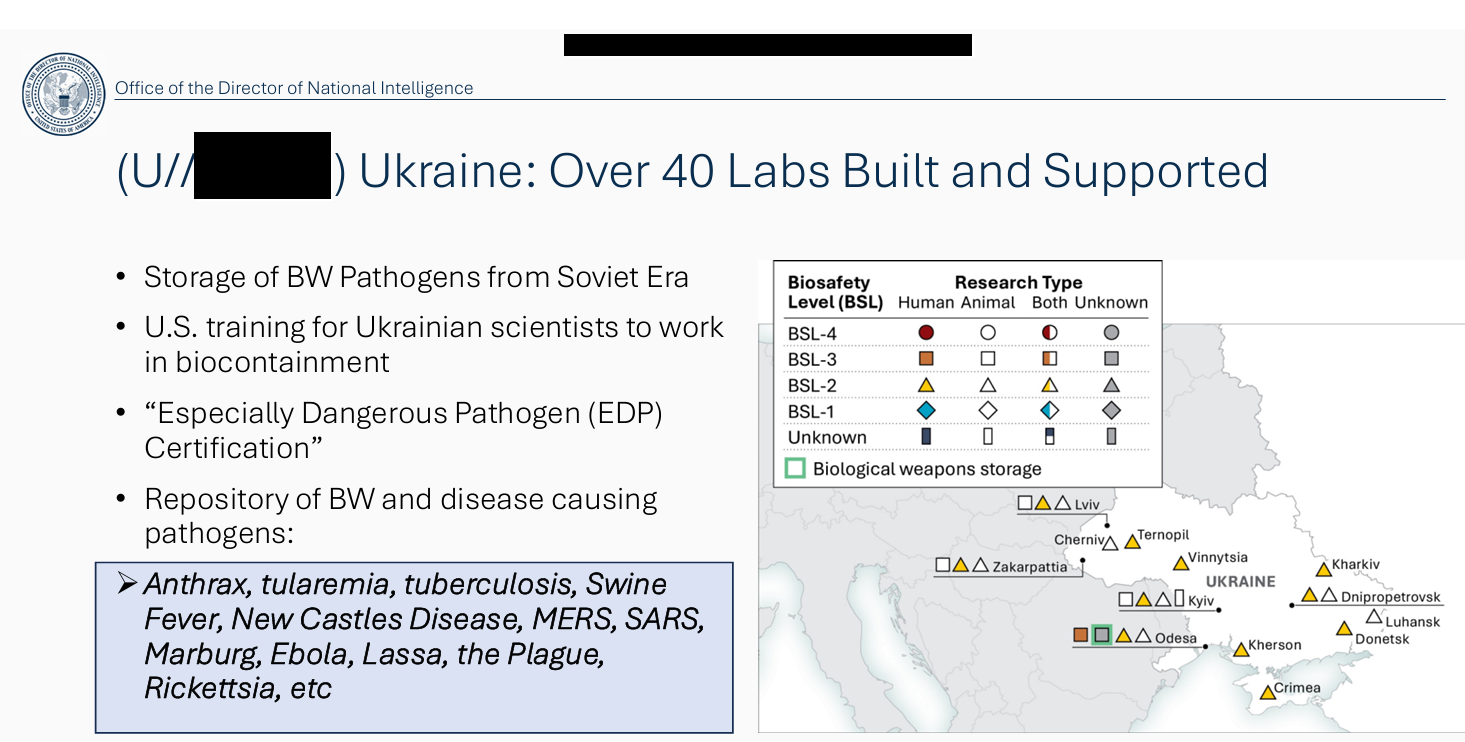
Yesterday, Director of National Intelligence Tulsi Gabbard released the first batch in a series of declassified documents highlighting 120 U.S. government biolabs that are operating throughout the world.  Many of these biolabs are working on weaponized viruses’ and present a significant threat to public safety.

TULSI GABBARD – “Today, I’m releasing never before seen intelligence revealing new evidence of past US government funding for more than 120 biolabs in over 30 countries, including Ukraine.

In support of President Trump‘s Executive Order to end federal funding of dangerous gain of function research around the world, and increase transparency and accountability, ODNI will continue working with partners across the Administration to identify where these labs are, what pathogens they contain, and what “research” is being conducted.” WATCH:


DNI Press Release: WASHINGTON D.C. — After months of searching through Intelligence Community holdings and files, Director of National Intelligence (DNI) Tulsi Gabbard is revealing new evidence of longstanding United States government funding for more than 120 biolabs in over 30 countries. These biolabs include labs in Ukraine, which may be at risk of compromise due to the ongoing Russia-Ukraine war. For example, the Intelligence Community previously warned that a US-funded biolab in Ukraine likely housed dangerous pathogens and remained vulnerable to longstanding threats of Russian attack, seizure, or damage.

The newly declassified evidence can be found HERE.

Until now, evidence regarding the full existence and funding of these laboratories had been knowingly withheld from the American people. The information surrounding the existence, history, locations and funding of these US funded biolabs has been intentionally covered up by powerful people falsely, claiming that they do not exist and accusing anyone who says otherwise to be foreign assets and traitors to America.

Many of these U.S. government-funded biolabs are currently or have previously engaged in research using hazardous and highly contagious pathogens, in some cases to include dangerous Gain-of-Function research, with very little visibility or oversight.

President Trump understands the serious threat dangerous Gain-of-Function research poses to the American people, which is why he took decisive action on May 25, 2025, signing EO 14292 to end federal funding of Gain-of-Function research around the world.

“Despite the obvious potential for catastrophic global impact research on dangerous pathogens in biolabs can have, politicians, so-called health professionals like Dr. Fauci, and entities within the Biden administration’s national security team lied to the American people about the existence of U.S.-funded and supported biolabs, and threatened those who attempted to expose the truth. ODNI will continue to work closely with partners across the government to identify where these labs are, what pathogens they contain to end dangerous Gain-of-Function research that threatens the health and wellbeing of the American people and people around the world,” said DNI Gabbard.

DNI Gabbard issued new guidance to the Intelligence Community directing increased collection on these laboratories and facilities overseas. This directive is already providing new details on clinical trials that are underway at these facilities, raising significant ethical, financial, and security concerns regarding these supposed public health initiatives and U.S. national security.  [SOURCE]

###