Monday, May 18, 2026

The GOP’s Midterm Reversal of Fortune


Winston Churchill once observed that there’s nothing quite like the feeling of being shot at and missed. The Republicans are enjoying that glorious sensation as we speak. Thanks to redistricting decisions in various courts as well as some surprising examples of GOP manhood in their wake, it looks like November is a jump ball. The midterms were supposed to be a rendezvous with disaster, and historically, the tides are still against us. But Democrats have just had the miserable experience of discovering that fate is fickle. Recent events have made it so that Republicans have a fighting chance, and our joy and relief that we’re not necessarily destined for doom is amplified by our delight in hearing Democrats squeal in agony as all their dreams die.

And that’s only the beginning of their pain. The 2026 midterms were going to be a small blip of hope for them before the Democrat success trend line dropped like Swalwell’s pants in the presence of a hard-five Chinese spy. Continuing population shifts will favor the Republicans. For example, migration from traditionally blue cities and states to more conservative red states will increase Republican representation in the House, as red states gain seats due to their population growth and Dems lose them as their future voter base gets deported. This shift will also result in more Electoral College votes for Republicans,  strengthening their position in the coming presidential elections. The future is so bright, the GOP’s gotta wear shades.

But, as long as the Democrats keep wearing those p-hats and the occasional Nazi tattoo, they’re going to keep losing. The South is nearly solid red. Republican legislatures are eliminating many of the racist, reserved Democrat districts (though soft Republicans might spare some districts for now, when the GOP pols get Indianaed next primary season, they’ll get harder). These weren’t black districts. They were Democrat districts. But it’s nice to see Democrats pretend to be interested in their black voter base after years of snubbing them in favor of illegal aliens, Muslims, and perverts, who all rank higher on the Leftist Pyramid ‘O Oppression.

If the Democrats were smart and more cunning than ideologically committed, they could turn this misfortune into a way to make a comeback. It’s an opportunity, if they can take it.

What’s that opportunity? Well, when you have districts that are essentially reserved for Democrats where there’s no chance of Republicans ever getting elected, there’s no need to moderate. There’s no need to talk to anyone who’s not communist or communist-adjacent, and they haven’t been. For years, there’s been absolutely no genuine outreach by Democrats to normal Americans. That weird sour apple doll-faced CIA agent Abigail Spanberger tried to fake it, but her mask – put it back on, please! – came off the instant she swore in. She ran as a moderate and governed as a Marxist.

And you see how that has gone.

The Democrats are going to face a choice, particularly in the South, where they soon won’t be able to count on sure-fire wins. They’re now going to have to compete for the votes of normal people if they want any seats at all, but how do you compete for the votes of normal people when you’re pushing bespoke Bolshevik baloney? Carving up kids to conform to the delusions of their Münchhausen mommies? Importing most of the Third World and paying them to be here? Allowing criminals to run rampant? More taxes for freeloading bums, as well as public employee unions, though I repeat myself.

Normal people don’t want that. 

But what if there was a Democrat who could say “No” to the most extreme nonsense? There was such a Democrat. You’ve got to go back almost 35 years, but there he was. Bill Clinton. Do you remember how he stood by Americans who wanted to work hard and play by the rules? How he wanted abortion to be safe, legal, and rare? How he thought criminals should go to jail and people shouldn’t be on welfare forever? That’s all a Dem anathema now, but it would be hugely popular if they brought it back, and it would allow cover for the other liberal things they want. Bill Clinton was no conservative, but don’t confuse him with his clueless wife. He understood that for a Democrat to succeed, he had to make the Democrat Party safe for normal people to raise their families and walk the streets. 

It’s strange that the most despised Democrat today is not the guy with a Nazi tattoo or the avowed socialist or the fake Indian. It’s the Democrat from a swing state who says America should defeat its enemies, that crime is bad, and that maybe it’s a bad idea to have wide-open borders. They despise Sen. John Fetterman (D-PA), but you know who doesn’t despise John Fetterman? The people of Pennsylvania who elected him.

Now, imagine some southern Democrats who are willing to say things like “America is the best country on earth,” "It’s bad to trash our ally Israel to please the Jew-hating freaks in our party, "Criminals should be in jail," and "Unionized teachers need to perform adequately before they get any more money." That guy is going to get a hearing. People are going to listen to him. And when he gets elected, and he might, and he actually governs that way, he’s going to be able to slip in a lot of liberal things that we Republicans can’t stand.

Let’s not fool ourselves. Republicans aren’t winning elections because they’re personally popular. Most Americans despise all politicians. Republicans are winning elections because, in large part, Democrats embrace insane freaky weirdness that repels normal people. But people may well accept a lot of the things Democrats want that are terrible – like single-payer healthcare, as awful as that is – if it’s pushed by someone they trust not to let their children be molested or their savings pillaged. Fortunately, that’s going to be hard for Democrats to do. That’s because their ideology isn’t just a political viewpoint. It’s their substitute for religion. Their bizarre belief system in things like the angry weather gods and structural racism and all the rest are what fill up that space that normal people fill with Faith, Family, and The Flag. You can’t be normal in the Democrat Party. You can’t say, “No, maybe it’s a bad idea to kill an eight-month fetus because mommy feels like it.” You can’t say, “Most derelicts and bums are drug-addicted losers, criminals, or insane people who either need to be in treatment or jail, and they can’t live on our streets and pollute them with needles and hobo droppings.” You can’t say, “No woman has ever had a penis.” You can’t say absolutely true things that everybody knows are true because other Democrats won’t tolerate it, and that makes you untrustworthy to normal people, as it should. But what if they did?

What if you had a Democrat who stood up and refused to genuflect at the altar of Left-Wing weirdness?

Well, then we would have a problem as Republicans. But for now, we don’t have to worry. With the Democrats contorting themselves like yogis to explain why the guy with a Nazi tattoo is cool but the dude who made the OK sign is Hitler, they’re doing our work for us. It may not be that the Republicans are about to enter a winning streak; it may be that the Democrats are about to enter a losing streak. And, fortunately for us, it’s the Democrats who will keep that streak going.


Podcast thread for May 18


Just get a life outside of here.

Trump’s Cleanup Crescendo


In Latin America, in China, in the Middle East, the outline of Donald Trump's plan of action is becoming clear. 

It is of a scale to take the breath away.


It’s obvious to me that during the four-year hiatus from the White House occasioned by a stolen election, President Trump gave thoughtful consideration to what had to be cleaned up domestically and internationally. It’s equally clear that he mapped out how he planned to do that, and despite media, congressional, and judicial intransigence, he plowed ahead. We are at a point now where the blueprint is obvious. It’s a continuing, ascending trajectory.

The Americas

Having hoisted Maduro out of Caracas to stand trial here for his crimes, the U.S. made it perfectly clear that Russian and Chinese security personnel and military equipment were no match for a determined U.S. military. As an impoverished, abandoned Maduro pines away in prison awaiting trial, Cuba is next on the list of places that need fumigation.

The U.S. has offered $100 million worth of humanitarian aid for Cubans who are starving in a country that, absent free oil from Venezuela, is in almost perpetual blackout. Raul Castro has rejected such aid because we insist that it be distributed through designated private charities rather than the Cuban government, which would use it to sustain itself.

This Thursday, CIA Director John Ratcliffe visited there with a message demanding that Cuba open up its economy and send Russian and Chinese listening posts packing. There are increasing riots in the streets, and on Friday, the communist party headquarters in Havana was set on fire. The day after Ratcliffe’s visit, the press reported that Raul Castro was likely to face U.S. criminal indictments.

Jeff Childers explains the administration’s Latin American policy:

Another way you could look at it is that the Trump Administration is deploying Democrat-style lawfare against communists all over the American hemisphere. The historic nature of what we’re doing cannot be understated. Rather than using classic tools of diplomacy, international aid, covert ops, and the military, the Trump Administration is doing something new: using domestic criminal laws and simply exercising jurisdiction over the whole hemisphere as though it belonged to us.

The “criminal indictment” playbook resembles a classic decapitation strike, but without the war part. After January’s Maduro operation, Latin American countries are learning that the US can reach into their countries whenever we want and pluck out the violent strongmen who have always confidently believed they can send drugs and terrorists through our formerly porous borders, co-opt our local politicians and judges, and set up shop here -- without any consequences.

Well… fool around and find out. But it’s bigger than that. These “small stories” are an expression of a new hemispheric policy. We’re not just cracking down on domestic crime at home, we are policing the whole hemisphere. When you combine that with the President’s approach to Russia and China, you begin to see something immense emerging.

Trump has been very firm with Beijing and Moscow in our part of the world. He’s rudely evicted them from South and Central America, the Panama Canal, and the Caribbean. But at the same time, he is also softening our positions on Ukraine and Taiwan, retreating from NATO expansionism in Europe, seeking trade deals with them, and courting both Putin and Xi with high-profile diplomatic outreach.

Wait -- this is where it gets really good. Every bit of all that geopolitical reorganization is happening completely outside the United Nations’ “rules-based international order.”

He is, as Childers observes, making the UN irrelevant. (I could argue that the UN did that itself over recent decades, but fair enough -- Trump has sealed the crooked, corrupt organization’s fate.)

China

There’s been lots of coverage of the visit to China, which, by my estimation, was very successful. As the parties were meeting, the U.S. allowed two or three Chinese vessels safe passage through the Gulf of Hormuz, a passage that China will now be less dependent on as it will be buying oil from our West coast -- a more secure, reliable, and shorter route.

In public statements of what the U.S. and China agreed to, Xi importantly said. “Iran cannot have a nuclear weapon.” He said this just as U.S. forces are once again massing near Iran with the promise of forcing Iran’s capitulation to our terms, most important of which is surrendering its nuclear arms and ambitions.

Due to our blockade, Iran has not been able to ship out any oil. It has exceeded its storage capacity and must nevertheless keep pumping or severely damage its facilities, so it is simply pouring oil into the Strait of Hormuz, compounding its economic woes with an ecological disaster.

Counterterrorism

In line with our efforts to hamstring the mullahs and end international crime in the Western Hemisphere, our counterterrorism efforts are bearing fruit

1. Late on Thursday night @FBI agents landed at New York Stewart International Airport with Mohammad al Saadi in handcuffs. Al Saadi, the leader of an Iran-backed Iraqi terror group is allegedly responsible for more than 20 attacks across Europe and Canada and for planning attacks in the U.S..

2. Jose Enrique Martinez Flores, who goes by “Chuqui,” the highest ranking Tren de Aragua leader to be extradited to the U.S., also just landed in the U.S. in shackles. Flores allegedly oversaw TdA’s drug trafficking, extortion rackets, prostitution rings and murder operations.

Then, last night, in an operation that makes any fictional representation look amateurish, American operators, working with local Nigerian forces, killed Abu-Bilal-al-Minuki, the second in command for ISIS global operations, a man with the blood of countless innocents on his hands, including many Christians.

Election Reform

Even as redistricting efforts take shape, the President has more success bringing foreign dictators around than he has had with Republican senators. He’s not giving up on the insistence of honest elections. Upon returning from China, he tweeted:

"Maryland just had 500,000 Fake Mail-In Ballots revealed.

"We cannot, as a Country, put up with this any longer!!! Voter I.D., and Proof of Citizenship must be approved, NOW.

Crooked Mail-In Voting must be stopped!!! PUT IT ALL IN THE HOUSING AND FISA BILLS. MAKE AMERICA

GREAT AGAIN!!!"

"THE SAVE AMERICA ACT MUST BE PASSED, NOW. Use the Housing and FISA Bills to get it done!

As some Republican senators stall, more and more evidence is finally being made public about the corruption in the 2020 election. How much longer the holdouts can afford to resist in the face of such evidence is unclear to me.

And just as the 2020 election legerdemain becomes apparent, the evidence that J6 was a setup, involving Nancy Pelosi, the FBI, the D.C. police department, and the media, is no longer being hidden. In the latest development, a judge finally unlocked the body cam worn by Officer Michael Fanone, and it substantially contradicts his sworn testimony, testimony that was used to justify imposing severe criminal penalties on mostly innocent people who walked into the Capitol (often at the invitation of Capitol police). 

Wokism May Finally Be Gasping for Air

Activists will probably always be with us, but the consequences for clinging to wokism -- for the media, drops in viewers and subscribers, and for academia, fewer donations and students, for example -- are growing, and I think its clout is diminishing. If so, this explanation of how this abominable French nonsensearrived here might be of interest to you.

(Translated from French) I want to offer my apologies, on behalf of the French, for giving birth to French Theory (which in turn gave birth to the worst of all ideological monstrosities: wokism). We gave the world Descartes, Pascal, Tocqueville. And then, in the intellectual ruins of post-1968, we gave Foucault, Derrida, Deleuze. Three brilliant men who forged, in the elegance of our language, the ideological weapon that today paralyzes the West. We must understand what they did.

Foucault taught that truth does not exist, that there are only power relations disguised as knowledge. That science, reason, justice, the medical institution, the school, the prison, sexuality -- everything is merely a staging of domination. Derrida taught that texts have no stable meaning, that every signifier slips away, that every reading is a betrayal, that the author is dead and the reader reigns supreme. Deleuze taught that we should prefer the rhizome to the tree, the nomad to the sedentary, desire to the law, becoming to being, difference to identity. Taken individually, these are debatable theses.

Combined, exported, and popularized, they form a system. And that system is a poison. For here’s what happened. These texts, unreadable in France, crossed the Atlantic. The departments of Yale, Berkeley, and Columbia absorbed them in the 1980s. They found there a soil that did not exist among us: American Puritanism, its racial guilt, its obsession with identity. French Theory married this substratum, and the child of that union is called wokism. Judith Butler reads Foucault and invents performative gender. Edward Said reads Foucault and invents academic postcolonialism. Kimberlé Crenshaw inherits the framework and invents intersectionality. At every step, the matrix is French: there is no truth, there is only power, so every hierarchy is suspect, every institution is oppressive, every norm is violence, every identity is constructed and thus negotiable, every majority is guilty. That’s how three Parisian philosophers, who probably never imagined their practical consequences, provided the operating software to an entire generation of activists, university bureaucrats, HR managers, journalists, and legislators. That’s how we ended up with a civilization that no longer knows how to say whether a woman is a woman, whether its own history is worth defending, whether merit exists, whether truth can be distinguished from opinion. [snip] A civilization stands on three pillars: the belief that there exists a truth accessible to reason, the belief that there exists a good distinct from evil, the belief that there exists a heritage to be transmitted. French Theory set out to dynamite all three. Not out of malice. Out of intellectual play, fascination with suspicion, hatred of the bourgeoisie that had nurtured them. But the result is there. An entire generation learned to deconstruct and never learned to build. An entire generation knows how to suspect and no longer knows how to admire. An entire generation sees power everywhere and beauty nowhere. [snip] What is being built now, in Silicon Valley, in AI labs, in startups, in workshops, in all the places where people still make things instead of deconstructing them -- that is the response.

Trump is the ultimate builder, and those titans who accompanied him to Beijing are the people who built Silicon Valley, the AI labs, the startups that make prosperity and peace more possible for more people, not the Europeans who conjured up every bad idea in recent centuries.


🎭 𝐖𝟑𝐏 𝓓𝓐𝓘𝓛𝓨 𝓗𝓾𝓶𝓸𝓻, 𝓜𝓾𝓼𝓲𝓬, 𝓐𝓻𝓽, 𝓞𝓟𝓔𝓝 𝓣𝓗𝓡𝓔𝓐𝓓


Welcome to 

The 𝐖𝟑𝐏 𝓓𝓐𝓘𝓛𝓨 𝓗𝓾𝓶𝓸𝓻, 𝓜𝓾𝓼𝓲𝓬, 𝓐𝓻𝓽, 𝓞𝓟𝓔𝓝 𝓣𝓗𝓡𝓔𝓐𝓓 

Here’s a place to share cartoons, jokes, music, art, nature, 
man-made wonders, and whatever else you can think of. 

No politics or divisive posts on this thread. 

This feature will appear every day at 1pm mountain time. 


U.S. Trade Representative Jamieson Greer Discusses U.S-China Trade Status


U.S. Trade Representative Jamieson Greer appears on CBS Face the Nation to discuss current U.S-China trade relations on the heels of the recent Beijing summit.  Brennan in her customary passive-aggressive mode as a professional narrative engineer.  Transcript Below Video:


[Transcript] – MARGARET BRENNAN: We begin this morning with a top member of the president’s economic team, United States Trade Representative Jamieson Greer. Good morning to you, Ambassador.

JAMIESON GREER: Good morning. Good to be here.

MARGARET BRENNAN: It isn’t just a matter of sentiment. Gas is at an average of $4.51 a gallon. Americans have spent $45 billion more on fuel since the war began versus a year ago. The stock market is up, but lower-income Americans are pulling back on their spending. The New York Fed reports households earning less than $125,000 a year are fueling up their cars less often. How do you provide relief to the average American?

JAMIESON GREER: Well, we know that no one wants to see higher gas prices. At the same time, the president is balancing foreign policy considerations. We know that, in addition to wanting to have low gas prices, we don’t want our children or grandchildren to inherit a world where Iran has a nuclear weapon, so the president is focused on affordability in as many ways that he can- that he can. He’s bringing jobs back to America. We’re focused on getting wages up to offset any kind of increase in prices, and we’re seeing prices go down for staples like dairy, cheese, flour, etc. So we’re very focused on this. The president’s focused on it, and we look forward to seeing those prices come down soon as the operations wrap up in the Gulf.

MARGARET BRENNAN: But we have no time frame for that at this point. Let me ask you about what you were just working on in Asia. China said it agreed with the United States to establish a board of investment to consider Chinese investment here in the U.S., and to establish bilateral boards of trade to discuss tariffs. Which products are going to be affected by that board. Are these items outside the current investigations that you are conducting?

JAMIESON GREER: So, when we think about the Board of Trade, we’re thinking about how to manage economic relations between the U.S. and China. These are two economies that are quite different, and we’re focused on trade in non-sensitive goods. When you talk about sensitive goods, you know the most high-tech stuff, you know, things that can be used for military uses, those are things that- those are national security issues. So we’re looking to discuss things like sales of agricultural goods to China, energy goods, Boeings, medical devices. When we talk about the kinds of things we want to be importing from China, there are a number of things, there can be consumer goods, maybe low-tech items, and so we look at those types of areas where we should be trading. On the investment side, the Board of Investment is really about discussing key issues in U.S.-China investment policy. It’s not really an investment program, but it’s to try to almost be like a firefighter and put out issues when they arise between the two countries.

MARGARET BRENNAN: So really this just seems a message of stability, because you were already discussing a lot of these things on a bilateral basis, right? I mean, what’s new?

JAMIESON GREER: So we have never had a Board of Trade or a Board of Investment before, we’ve always had an ad hoc approach with China and the United States, which I think is actually challenging. I think it’s more important to formalize these relations. The United States has a host of tariffs, import controls, export controls on China. China has a number of non-tariff barriers that have been in place for a long time, other challenges they impose to block our imports and things like that. It’s much better to discuss these in a formalized way between our government and their government. In addition to this, we saw China over the past couple of days reduce a host of nontariff barriers on agricultural products, such as beef and poultry, et cetera. And so we’ve seen them already starting to do things to facilitate imports from the United States.

MARGARET BRENNAN: Well, I’ll come back to some of those in a moment, but I want to ask you about tariffs. The president said to reporters he did not discuss tariffs with Xi Jinping at all. Are we in an indefinite trade truce, or were you- are you looking at bringing that tariff rate back to where it was before the Supreme Court ruling?

JAMIESON GREER: Well, the Chinese know, and that’s part of our deal, that the United States can can elevate tariffs to the higher level that we had at the time of what we call the Busan deal in October, when President Xi and President Trump met, following the Supreme Court case in February, about 10 percentage points were knocked off the tariff rate for China. We believe under our deal that we are able to elevate that again. The president is exploring different tools that he has. I don’t want to prejudge a lot of the investigations that are happening. The Chinese know, just like many other countries we’re dealing with, that we’re going to have a certain level of tariff to control our imports, but that we also expect market opening.

MARGARET BRENNAN: Okay, but the last time you were here after the Supreme Court decision, you said that when some of these tariffs expire in July, that you would expect to roll out new tariffs after the end of these investigations under authority 301. So, are you saying now that you no longer expect tariffs to come into place after July?

JAMIESON GREER: Well, I think I was careful to tell you, because my general counsel always tells me to say this. I can’t prejudge the outcomes of those investigations. Those investigations, if they find on- tariff barriers or unfair trading practices, they can authorize the president to take actions like tariffs, like fees on services, like quotas, things like that. So we’ll certainly be presenting the president with those options, if those, if those investigations show what we think they might show, which is that there’s a huge problem with over capacity in China and other countries. So we’ll- we’ll get back to you on the findings in those investigations when they conclude.

MARGARET BRENNAN: Okay, we did see China on Saturday release a statement confirming some of the deals with the U.S., but it was pretty vague. There was no mention of the promise to buy 750 Boeing planes that President Trump told reporters about if the first 200 go well. China said there was a guarantee by the U.S. to supply aircraft engines, but it didn’t mention the 400 to 450 GE engines that the president announced. GE hasn’t commented either. So, how locked in are these agreements?

JAMIESON GREER: So, the 200 Boeings, those are locked in. There’s obviously a future to have more Boeings. The reality is, this is the first major purchase by China in almost 10 years of Boeings or orders, rather. So that’s- that’s going forward, and like the president said. You know, when and if Boeing delivers, there’s- there’s a lot of upside there. With respect to some of the other details. We’re finalizing a fact sheet that will hopefully get out very soon, so we can be clear about the double digit increase in agricultural purchases we expect from the Chinese, and some of the other things that happened and were agreed to during the visit.

MARGARET BRENNAN: Okay, and I know GE is meeting with China today, but we haven’t seen anything from them on the aircraft engines. On the ag products, the conservative Wall Street Journal editorial board questioned whether the summit achieved any of the stated wins, because of how vague these things have been. They said “Mr. Trump boasted about fantastic Chinese purchases of U.S. soybeans in aircraft, but China didn’t confirm the sales, and by our count, this is the second time China has bought the same American soybeans, or is it the third?” They’re kind of arguing you’re playing a shell game here with, like, reannouncing past deals on past agreements to purchase over a period of time. Can you answer these conservative skeptics with any specifics?

JAMIESON GREER: So, first of all, we’ve had a deal in place with the Chinese since October that they would buy 25 million metric tons of soybeans each year for the rest of the president’s administration, so that deal is still in force. What we expect with the new purchase agreements, where the specific number will be announced very soon, double digit purchases of aggregate agricultural products. When I say aggregate, I mean everything else that could be soybeans, that could be beef, that could be grains, that could be dairy products, all kinds of things. So we have the existing soybean deal that they may be referring to, and then over on top of that we have these agricultural products as well, and all of that will be facilitated by Board of Trade discussions with the Chinese.

MARGARET BRENNAN: So still not nailed down, just an aggregate agreement. So how many concessions did the US make? What were those concessions in order to get this?

JAMIESON GREER: Well, one thing, they’re- they’re balance trades here, right? We’re trying to get to balance trade with the Chinese. For a long time, it’s been out of whack. So, when you see something like what the Chinese said, which I can confirm, about a sale of Boeings accompanied by a sale of aircraft and auto parts and spare- auto parts, aircraft parts, and those kinds of things. The Chinese want to make sure that they have regular access to these kind of spare items, so they can continue to fly their fleets. So that’s something we want to do. We are focused on mutually beneficial trade, so when you’re talking about that kind of thing, what we should be exporting, what we should be importing, becomes less a question of concessions and more a question of what’s mutually beneficial for both of us. That’s why we’re so focused on non-sensitive trade, because that doesn’t, that doesn’t require concessions, that’s about working together, talking about what they need, what we want to sell, what we need from them, so we’re already seeing it as they’ve re-registered beef facilities, where beef facilities expired. They’re taking poultry again, they’re working with us on biotech traits to make sure that those types of products that have genetic modification can go into China without any problem.

MARGARET BRENNAN: China still sells more to the US than it buys, but that difference has decreased by about 31 and a half percent. So, thank you, Ambassador.

JAMIESON GREER : Yes, we’re very happy to see that progress. It’s a main goal that we have, and it’s good to be achieving it.


The Climate Myth that Sought to Change Our Way of Life

 The Climate Myth that Sought to Change Our Way of Life

For more than three decades, climate policy has been built on a central premise: that rising populations and expanding economies would inevitably drive ever-increasing pressure on the planet.

Roland Duchatelet & Samuel Furfari for American Thinker


On May 5, 2026, without fanfare, the Intergovernmental Panel on Climate Change (IPCC) made a significant announcement: its most dire climate scenario, the RCP 8.5, is now classified as “unlikely.” For nearly 15 years, this scenario fueled tens of thousands of articles, entire TV talk shows, and the eco-anxiety of an entire generation. It was the raw material for the +5°C projections that were brandished to justify ever more restrictions, taxes, and bans. Today, the IPCC tacitly acknowledges that it will not come to pass. Some commentators welcome this. Others, more discreetly, explain that it was never anything more than an “intellectual exercise.” A curious exercise, whose conclusions shaped 30 years of public policy.

Media outlets celebrate this abandonment but carefully fail to mention that RCP 8.5 was based on the assumption of a global population of 13 billion people. The scenario was far-fetched not just for the past few years, but from day one. Demographers knew it. Successive United Nations reports were already pointing to a very different trajectory. But once fear had taken hold, no one wanted to check the math anymore.

For more than three decades, climate policy -- and not only model RCP 8.5 -- has been built on a central premise: that rising populations and expanding economies would inevitably drive ever-increasing pressure on the planet. This assumption, embedded in global frameworks since the 1992 Rio climate convention, continues to shape policy today.

But the world that gave rise to that assumption no longer exists.

One of us, an international industrialist and investor in the electronics sector, chose two decades ago to invest -- out of conviction -- in wind and solar power to help reduce greenhouse gas emissions. Like many at the time, he believed a profound transformation of energy systems was both necessary and urgent. Renewable energy has since secured a place in Europe’s electricity mix.

That progress is real. But it is only part of the story -- and not the most important one.

The defining change of our era is not technological. It is demographic.

In 1990, the internet did not yet exist. Today, widespread access to information has reshaped societies, empowering individuals -- and especially women -- to make informed life choices. One consequence has been largely overlooked: a rapid and global decline in child per woman.

Across the developed world, birth rates have fallen well below replacement levels. The same trend is now evident in emerging economies. India has crossed that threshold. The United States is following a similar path. Even in Africa, where fertility remains higher, the downward trend has begun and is likely to continue as economic development advances.

The implications are profound. If global fertility stabilizes around 1.5 children per woman by mid-century, the world’s population will peak at roughly 8.5 billion before declining. At 1.3, it could fall to around four billion by 2100 -- half the level once expected. This stands in stark contrast to earlier projections that assumed continued growth toward 10 billion or 13 billion as the RCP 8.3 model.

To understand why this matters for climate policy, consider a simple identity. According to the so-called Kaya equation, carbon emissions are the product of four factors: population, economic output per person, the amount of energy required to produce that output, and the carbon intensity of that energy. For decades, policy has focused on the latter two -- improving efficiency and reducing carbon intensity.

But population is the first term in that equation -- and the only one now undergoing a structural, global reversal.

Importantly, this shift is not the result of coercive policy, and it is right to be so. It reflects voluntary choices, driven by education, economic opportunity, and access to information. It is both peaceful and self-reinforcing. And it operates on a scale large enough to reshape long-term emissions trajectories.

Let’s be clear: we do not advocate for a declining birth rate. We may personally regret this decline in fertility -- and the drop in the birth rate poses considerable challenges to our societies in terms of pensions, the transmission of traditions, and the vitality of our civilization. None of this suggests that environmental challenges should be dismissed. Technological progress and regulation have already improved air quality and living conditions in many parts of the world. These gains should continue.

But it does suggest that current policy frameworks are biased. The assumption of ever-expanding human pressure on the planet no longer holds. The world is entering a phase not of unchecked growth, but of gradual demographic contraction.

This changes the calculus.

The idea that economic activity must be sharply curtailed to address climate risks rests on outdated premises. A more accurate view recognizes that prosperity itself -- particularly education and individual empowerment -- is a powerful driver of both demographic stabilization and environmental improvement.

Climate policy should adapt accordingly.

The world has changed. It is time our thinking caught up.

Roland Duchatelet is a Belgian entrepreneur and industrialist. He founded Melexis, a global leader in automotive microchips, helping secure its enduring position in the semiconductor industry. Over time, he has developed a broader industrial ecosystem, notably through Elex, supporting a range of ventures in electronics, technology, and investment. He previously served as a Belgian Senator.

Dr. Samuel Furfari is a professor of energy geopolitics in Brussels and London, a former senior official with the European Commission's Directorate-General for Energy and a member of the CO2 Coalition. He is author of the paper, “Energy Addition, Not Transition,” and 18 books, including The Truth About the COPs: 30 years of illusions.

Image: Pixabay


Mercedes Willing to Enter Military Production Sector


Mercedes is willing to begin military and weapons production. Historically speaking, this did not work out so well for Europe the last time; however, as with all things German, the expanded backstory is a little more complicated.

Due to a combination of terrible political decisions related to the German and EU energy sector, the German industrial economy is contracting rapidly. Germany is the heart of the EU economic engine.

At the same time as the German economy is contracting, the economic footprint of China in the EU is growing. The core issue centers around a declining auto sector but extends to all ancillary manufacturing outputs.

By following the WEF’s “Build Back Better” program, Europe as a whole has ended up making itself energy-dependent and vulnerable. The Gulf oil and gas crisis, the looming 25% Trump tariffs on EU cars, and the withdrawal of U.S. troops from German NATO bases only add to their growing economic troubles.

Around the same time as this economic convergence, Germany began ramping up its commitments, support, and spending for Ukraine in the conflict with Russia. Subsidy outflows rose just as GDP was falling, a clear example of an economic spiral that can easily spin out of control.

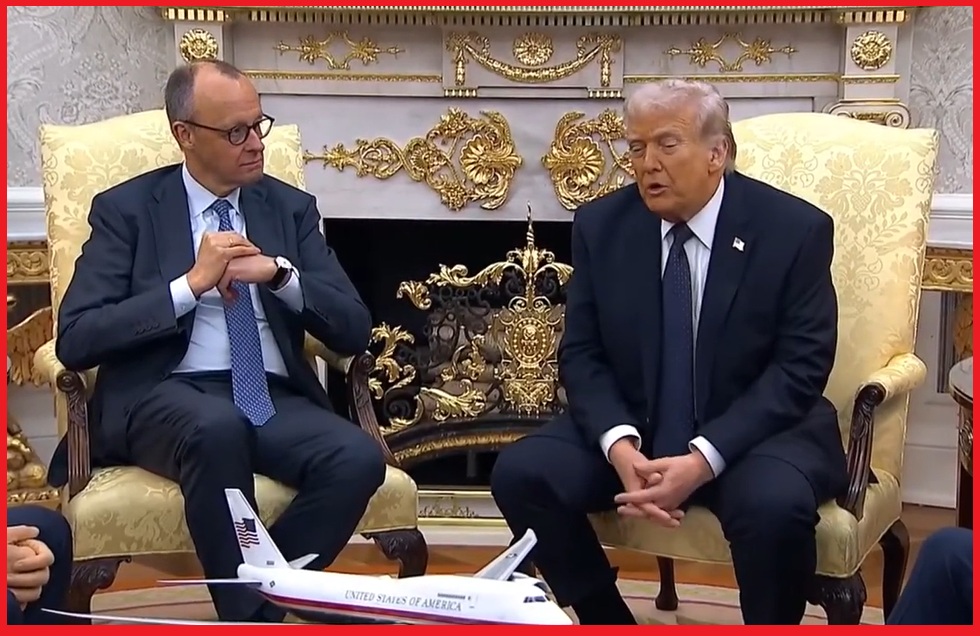
German Chancellor Freidrich Merz is trying to deal with the consequences of exceptionally short-sighted and damaging policy, but reversing the trend would require Germany to focus all policy operations inwardly away from Brussels and the demands of the collective European Union. This is now the core issue in German politics driving bold dividing lines between political power structures.

One of the problems for Germany is the United States presence in the country historically meant they did not need to spend on their national defense. Instead, for decades they spent that money on subsidy programs and expanded German benefits. All was okay until President Trump started to pressure the German government to be self-sufficient. That means Germany had to change government policy.

President Trump has refused to put Tomahawk cruise missiles into U.S/NATO bases within Germany, and Germany has no medium to long-range missile systems. Now, they need to either purchase them or develop their own.

At the same time President Trump is drawing down U.S. military troop levels in Germany, and Germany has changed their conscription laws while requiring all fighting age men to register any extended external travel.

SUMMARY:  The economy within Germany is shrinking, revenues to the government are less, the energy crisis means German citizens need subsidies, the promised payments to Ukraine are more painful, and at the same time the “coalition of the willing” are more confrontational toward Russia yet they realize they can no longer hide behind America’s apron. A hot mess.

Now, before getting to the point of this latest development, remind yourself that China owns a ten percent stake in Mercedes and the vehicles produced by the Chinese auto brand Geely are essentially the outcome of China extracting technology from that stakeholder share.  This brand specific datapoint sits on the sidelines of Europe’s shrinking market share of automobiles as the Chinese share of the market grows.

May 15 (Reuters) – Mercedes-Benz (MBGn.DE), opens new tab CEO Ola Kallenius told the Wall Street ​Journal on Friday that the German automaker ‌was willing to move into defense production as long as it made “business sense”.

[…] Earlier this week, ⁠German ​defense group Rheinmetall announced a partnership ​with Deutsche Telekom to develop a defense shield against drones. (source)

Germans, with a panda in the pocket of their overalls, are willing to start making military hardware to retain employment in the shrinking all-critical auto sector, that is being lost to China.  Think about it.

History may not always repeat; but yes, it certainly does have a tendency to rhyme.

AI in the Classroom Is Our Most Senseless Education Experiment Yet

AI in the Classroom Is Our Most Senseless Education Experiment Yet

High school students discuss an essay for an English class final exam at Thomas Jefferson High School in Denver, Colo., May 2, 2024.(Hyoung Chang/The Denver Post)none

We know that childhood, adolescence, and early adulthood are pivotal times for human development. It should go without saying that, when it comes to education, we need to get the basics right and, maybe even more importantly, avoid getting big things wrong. That’s a daunting charge, but we’re not flying blind. Humans have literally thousands of years of experience in teaching and learning, and brain science has made astonishing gains in recent decades. We know a great deal about what works and what doesn’t. If ever there’s a place for the tried and true — and a place needing protection from the risky — it’s the classroom.

But for whatever reason, we too often treat schools like labs and students like test subjects. Dodgy ideas are brought to life, and kids often pay the price. In the 1970s, schools knocked down walls to build “open classrooms,” which turned out to be noisy and chaotic. Professors invented “whole language” reading instruction, pooh-poohing phonics and longstanding teaching techniques, and harmed countless students’ learning in the process. We filled classrooms with iPads and Chromebooks and allowed students to have constant access to their phones, and now we wonder why kids are addicted to screens. Then there are the political vogues: When the 1619 Project was hot, we invited its curriculum into schools; as trans issues dominated our politics, we allowed schools to hide students’ social transitioning from their parents. And most infamously, we closed schools during the Covid pandemic — in many places, for over a year — and told ourselves that a few hours of online learning was a fine substitute.

But all of these mistakes are likely to pale in comparison to the future costs of today’s senseless experiment with AI.

Students in K–12 schools and higher education are now outsourcing themost important parts of learning to chatbots and similar programs. Instead of reading, students have AI summarize books and articles for them. Instead of brainstorming ideas for projects and reports, they use AI to conjure up ideas. Instead of drafting, editing, rewriting, and reediting, they have AI produce and then improve their papers. Somehow, we’ve suddenly forgotten arguably the most crucial aspect of schools’ academic mission: having students do hard things.

Yes, of course, AI can finish many tasks faster than a human. But that’s precisely why we should not allow AI in the classroom. Learning is seldom about swiftly generating a final product. It’s about the slow, arduous work necessary for getting to a final product. From a great teacher’s perspective, what a student wrote in her final paper is less important than the weeks of researching relevant sources, assembling evidence, and outlining an argument. That great teacher doesn’t want a student to just write the correct answers on the exam; he wants the student to spend hours and hours reading texts closely, figuring out why that formula works, or trying different approaches until landing on the right method.

Very few adults will ever be suddenly asked by a boss to compare and contrast Antigone and Oedipus Rex. Or calculate a derivative or standard deviation. Or explain how Einstein’s understanding of gravity differed from Newton’s. Or choose between the Federalists’ and Anti-Federalists’ takes on the size of republics. But adults do need to assess competing claims. They need the studiousness, the grit, to work through thorny problems. They need to understand budgets and interest rates. They need to wrestle with moral dilemmas and apply old lessons to novel challenges. Schooling builds the knowledge, skills, and dispositions necessary for succeeding as a citizen, neighbor, employee, spouse, and parent. If you want to debilitate a generation, take away all of their practice at developing that knowledge and those skills and dispositions. And if you want to debilitate them while having society believe you’re doing us all a favor, tell them you are providing “innovative” tech tools that enable “efficiency” and “progress.”

Few doubt that AI could advance medicine or spur scientific discoveries. It might dramatically improve city planning and industrial logistics. It could eventually be seen as an absolute godsend in some fields. In fact, this astonishing potential is exactly what’s blinding us to its educational risks. That is, AI could publicly work wonders in the professional world while silently undermining schooling. The telescope revolutionized our understanding of space, but it didn’t jeopardize students’ learning of physics. The microscope revolutionized our understanding of cells and germs, but it didn’t jeopardize students’ learning of chemistry or biology. AI, as currently used, does jeopardize students’ capacity to read, write, calculate, study, and create.

The costs of AI are already being confirmed. Research is showing that habitual use of AI decreases brain activity and can make students dependent. Teachers and professors see its harmful effects on student research and writing, and the value proposition of education. Students themselves express misgivings about the effects AI has on their education — they know it’s hurting their critical thinking skills.

We should concede that AI is a technical marvel while recognizing its enormous limitations. It cannot end the war in Iran or develop an immigration policy that makes everyone happy. It cannot fix the decline in marriage or fertility. It can’t adjudicate the moral claims underlying abortion, euthanasia, or capital punishment. It can’t tell us whether liberty or order should take precedence when addressing prostitution, drug use, and gambling. It can’t make you more honest, judicious, compassionate, or just. We need informed, skilled, reasoning, virtuous people to do all of this, and we only get such people through an educational system that makes them do the hard work of acquiring information, skills, reason, and virtue.

We look at young adults today with their diminished attention spans, elevated anxiety, and decreased capacity to build in-person relationshipsand wonder how in the world we allowed screens to dominate their young lives over the last decade. In another ten years, we’ll look at young adults’ cratered ability to read, write, brainstorm, compare and contrast, weigh evidence, reason morally, and tackle complicated problems and wonder how in the world we allowed AI to do their thinking for them.