Friday, May 15, 2026

America Just Told the UN to Pound Sand on Replacement Migration


The State Department’s May 11 rejection of the U.N.’s International Migration Review Forum declaration isn’t symbolic. It’s a statement of first principles: the American people decide who enters this country, not Geneva. This rejection is the first honest thing the federal government has said about sovereignty in a long time, and it arrives not a moment too late.

The facts don’t require a lot of stage-setting. The International Migration Review Forum, hosted at U.N. headquarters May 5–8, adopted language the State Department correctly identified as an attempt to impose “guidelines, standards, or commitments that constrain the American people’s sovereign, democratic right to make decisions in the best interests of our country.” The framework echoes the 2018 Global Compact on Migration, the same document Trump wisely rejected during his first term. Secretary Rubio put it plainly: opening our doors to mass migration was a grave mistake that threatened social cohesion and the future of our people. Washington skipped the forum entirely. No participation, no signature, no diplomatic hedge. Just a flat no.

Border data confirms what enforcement advocates have argued for years: control works. Southwest border apprehensions in fiscal year 2025 hit 237,565the lowest annual total in 55 years, 87 percent below the four-year average that preceded it. Daily apprehensions in September 2025 averaged 279, fewer in a full day than the previous administration processed in its first two hours. For five consecutive months through September 2025, U.S. Border Patrol released zero illegal aliens into American communities. Daily averages now run 95 percent below the Biden administration’s benchmark. When you hear politicians claim enforcement is cruel, ask them to explain those numbers.

I served briefly in the Marine Corps and watched my brother deploy multiple times as a Green Beret. We learned early that ambiguous rules of engagement get people killed. The same logic applies at the border. You secure the line or own the consequences. Reagan understood this when he framed American security through strength rather than conciliation, a doctrine that translated directly to deterrence. The current statistics prove the point holds. Cartels lose revenue when entry is blocked. Migrant fatalities drop when smuggling pipelines collapse: recorded deaths in the Americas fell from 1,272 in 2024 to 408 in 2025, according to International Organization for Migration data. Families stop paying smugglers for death rides in shipping containers when the economics shift. Weak enforcement doesn’t produce compassion; it produces trafficking revenue and body counts.

Critics will call this isolationist. They’ll argue the U.N. framework promotes “safe, orderly, and regular migration” and that rejecting it signals indifference to global suffering. I’ve heard the same argument from people who defended sanctuary cities while encampment counts climbed and public budgets imploded. Here’s the rebuttal: sovereignty isn’t isolationism. It’s the only mechanism that allows a country to protect its citizens and, for that matter, make deliberate humanitarian choices rather than surrendering that decision to smugglers and U.N. committees. A government that can’t control who enters its borders can’t honor any promise it makes to the people inside them. My wife and I raised three boys in Orange County on the principles of accountability and earned outcomes. You don’t build that culture by making rule-following optional.

The policy path isn’t complicated. Keep rejecting every U.N. mechanism that erodes national authority. Complete physical and technological barrier construction. Fund interior enforcement without apology. Tie foreign aid to deportation cooperation. Shift immigration to merit-based criteria that filter for economic contribution rather than proximity to an open border. No catch-and-release. No criminal releases into communities. I’ve spent 15 years watching local budgets in smaller communities absorb the downstream costs of policies handed down from Sacramento and Washington. The wealthy families I advise demand fiduciary duty from investment managers; the same standard should apply to the people running the government.

The State Department’s statement makes one thing clear: “President Trump is focused on the interests of Americans, not foreigners or globalist bureaucrats.” The Framers didn't cross the Atlantic to take instructions from foreign committees. Neither should we. The U.N.’s migration apparatus has played a similar role for decades—setting frameworks, socializing compliance, and expecting deference. America just declined. My sons watched their father and uncle model the conviction that principles held under pressure are the only ones that count. This country just showed the same spine. The line is held. The only question now is whether we keep it.


Podcast thread for May 15


Things will eventually get better

Good vs. Evil

 Good vs. Evil

There can be only one. Choose a side.

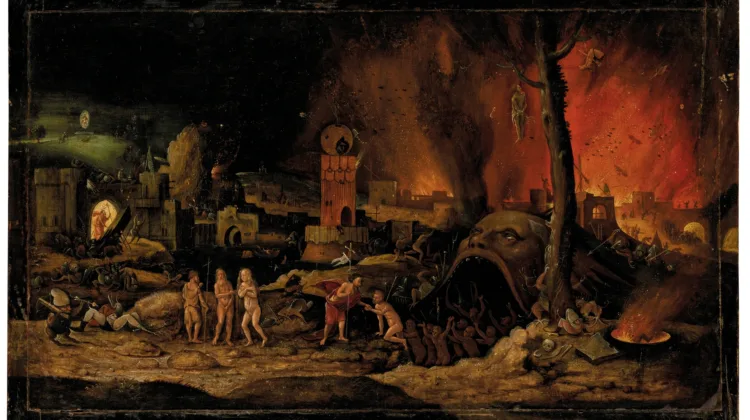
Illustration: “The Harrowing of Hell” by Hieronymus Bosch.

A 300-page report, “Silenced No More,” from an investigation led by Dr. Cochav Elkayam-Levy, was released this week, compiling over 430 testimonies from 52 countries, plus 1,800 hours of photos and videos, detailing the savage butchery committed by the terrorism group Hamas during the October 7, 2023, attack in Israel. The report documents patterns of systematic torture, sexual abuse, mass murder, and other war crimes so depraved and barbaric that the civilized Western mind simply cannot fathom them.

I’m not accustomed to citing the UK’s Daily Mail as a voice of moral authority, but the outlet had the moral and spiritual clarity to post thistoday about the report: “The sadistic sexual violence unleashed by Hamas against men, women and even children on Oct 7 shows that it wasn’t about history or land but pure hatred and evil.” [Emphasis added] Let’s see a mainstream media source like the New York Times or The View have the cojones to say that.

Hatred and evil. There it is – the truth about the enemies the West faces today, both internal and external. They are driven by a demonic – and I use that word intentionally and literally – lust for chaos, a hatred for civilizational order, beauty, and truth. Some have deluded themselves into believing that their motives are righteous and well-intentioned, and will lead to utopian equity; some believe fervently that their “god is greater” and that the world must be brought under theocratic rule by any means necessary; some simply want to watch the world burn. The result is the same: wanton, gleeful destruction of the only true civilization the world has known; mass misery and death; and a nightmarish landscape of terror and torment that rivals any hellish vision by Hieronymus Bosch.

The result, in other words, is evil.

What is evil? Christian theologians such as Augustine, Aquinas, and Boethius have agreed that evil has no nature of its own; it is an absence of good, a willful turning away from God. It is a shadow, parasitic of light. In practice, this means profound cruelty, man’s inhumanity to man, a metaphysical malevolence so dark and bottomless that ordinary people shrink from it in horror.

To be clear: evil is hardly the sole domain of one side of the political fence. It can inhabit individuals of any color, sex, political persuasion, or religious belief. As Solzhenitsyn once put it, the line between good and evil runs straight through every human heart. And psychologists may prefer less highly-charged terms to describe people who commit unconscionable acts, but evil is as evil does.

If you were and are one of the useful idiots worldwide who marched and protested and rioted in support of Hamas in the wake of that October slaughter, calling for the eradication of Israel “from the river to the sea” and defiantly chanting, “You don’t get to choose how we resist,” then you were and are an enemy of civilization and complicit in evil.

If you are in a position of political authority and facilitate the Islamization of society while repressing and demonizing law-abiding citizens who object to being subjected to a two-tier system of justice and demographic replacement, then you are an enemy of civilization and complicit in evil.

If you are law enforcement arresting random street preachers or people who are praying silently in the vicinity of an abortion clinic, while you protect mobs of fighting-age Muslim males who take over public squares and streets to pray in displays of supremacist dominance, then you are an enemy of civilization and complicit in evil.

If you celebrate the assassination of Turning Point USA founder Charlie Kirk, cackle about making a meme of it, crack sick jokes about it among your celebrity friends, and exploit it as a conspiracy theory for social media clout, then you are an enemy of civilization and complicit in evil.

If you openly lament multiple failed assassination attempts against the United States President, wish for assassins with better aim, and fantasize about persecuting your political opponents once you seize power again, then you are an enemy of civilization and complicit in evil. The same applies if you hail as a folk hero a man who shot a healthcare CEO in the back because his ideology dehumanized the victim.

If you believe that people with disordered sexual desires should be allowed to purchase children to show off as little triumphs in their war on the family, or you believe it’s acceptable for doctors to medically mutilate children who were indoctrinated by adults trying to subvert the natural order, or if you believe unborn children are simply dispensable clumps of cells that you can discard when inconvenient, then you are an enemy of civilization and complicit in evil.

These are just a handful of ways in which civilizational hatred and evil are manifesting themselves in our time.

The conflict in which we are engaged today is not merely political, nor cultural, nor legal, though all those are important arenas in which the battle is being waged. At its heart, the conflict is one of spiritual warfare. “For we do not wrestle against flesh and blood,” to cite Ephesians 6, “but against principalities, against powers, against the rulers of the darkness of this age, against spiritual hosts of wickedness in the heavenly places.” Recognizing this is necessary for understanding that, as the Daily Mailnoted, we are not pitted only in a struggle over history or land or political office or economic issues, but in an existential struggle with evil.

It is necessary for understanding with whom it is we are at war, how to fight, and what the consequences will be for losing or surrendering.

So put on the full armor of God, that you may be able to withstand evil in our day, and having given the fight your all, to stand against evil and prevail.


Illustration: “The Harrowing of Hell” by Hieronymus Bosch.


The Democratic Socialists Need a New Model

The Democratic Socialists Need a New Model

The Swedish flag is seen in the Old City, Stockholm, May 7, 2017. (Ints Kalnins/Reuters)none

The capitalist enterprise is alive and well, even in that “paragon of collectivism,” as the Wall Street Journal put it: Sweden.

“Today, nearly half of primary healthcare clinics are privately owned, many by private-equity firms,” reporter Tom Fairless observed this week. “One in three public high schools is privately run, up from 20% in 2011. School operators are listed on the stock exchange.”

In addition, Sweden’s market-oriented reforms have transformed it into an investment hub. “Sweden’s economy is expected to grow by around 2% a year through 2030,” the report added — a level of growth that would keep pace with the United States and eclipse its industrialized European neighbors, like France and Germany.

Even more impressive is what Sweden is doing with its newfound wealth: shrinking the size of the state. Stockholm has lowered its overall tax burden, reduced its health-care and welfare expenditures, and created incentives for private-sector actors and charities to take on what were once government mandates.

Fairless’s report might come as a shock to American progressives, many of whom still hold up the Scandinavian social compact as the model of what state-dominated capitalism should look like. The Scandinavian states, Bernie Sanders said earlier in the decade, observe “strong democratic socialist principles,” and they have some of the “best” and most accessible public services in the world as a result. Alexandria Ocasio-Cortez, too, advocated importing the Swedish model — at least, their confiscatory tax rates on their highest earners. The 2018 PBS documentary “Sweden: Lessons for America?” found a striking number of Americans who believed both that the Swedish model was socialist and that it was superior to America’s.

This misconception about the relative level of socialism that prevails in Scandinavia has long vexed economists. Indeed, it has frustrated plenty of Scandinavians, too. When Senator Elizabeth Warren ran for president on a platform that she claimed would emulate the Nordic experience, onetime Swedish Prime Minister Carl Bildt said her “protectionist impulses are not reassuring from a European perspective.”

What America’s democratic socialists are praising is a bygone era in Swedish politics that the Swedes themselves remember as the bad old days. When the Social Democratic Party was in power in the middle of the 20th century, it sharply increased public spending and taxation rates. “The changes triggered a long period of weak growth, stagnant after-tax incomes, and ballooning budget deficits and debt that culminated in a banking crisis in the early ’90s,” Fairless observed.

Today, however, the wealthy are flocking back to Sweden, and they’re taking their capital with them. Swedish per capita GDP is the envy of the European Union, and the country has become a hub of tech and telecom innovation. Its public services have not suffered as a result of increased privatization. Indeed, reduced public-sector costs for services like health care create “efficiencies” that allow providers to “serve more patients.” Students are flocking to privately operated schools, and “school choice is now deeply entrenched in Sweden.” Even the Social Democrats, now relegated to the opposition, support it.

With even the Scandinavians running away from their unearned reputation as diehard collectivists, it’s not clear where America’s democratic socialists will turn to for guidance. At least they still have Cuba.


🎭 π–πŸ‘π π““π“π“˜π“›π“¨ 𝓗𝓾𝓢𝓸𝓻, π“œπ“Ύπ“Όπ“²π“¬, 𝓐𝓻𝓽, π“žπ“Ÿπ“”π“ 𝓣𝓗𝓑𝓔𝓐𝓓


Welcome to 

The π–πŸ‘π π““π“π“˜π“›π“¨ 𝓗𝓾𝓢𝓸𝓻, π“œπ“Ύπ“Όπ“²π“¬, 𝓐𝓻𝓽, π“žπ“Ÿπ“”π“ 𝓣𝓗𝓑𝓔𝓐𝓓 

Here’s a place to share cartoons, jokes, music, art, nature, 
man-made wonders, and whatever else you can think of. 

No politics or divisive posts on this thread. 

This feature will appear every day at 1pm mountain time. 


SCOTUS Could Do The Funniest Thing And Mandate A Single Election Day At Jay Jones’ Request


Virginia Democrats have accidentally made a case against the months-long ‘election season’ they prize. What if SCOTUS took them up on it? 


Jay Jones, the Virginia attorney general who fantasized about executing a Republican colleague and wished death on his children, has not developed a reputation for thoughtful reflection. So perhaps it’s unsurprising that, in his typographically-challenged frenzy to salvage Virginia Democrats’ gerrymandering efforts, he has accidentally made a case to the U.S. Supreme Court against the months-long “election season” that his fellow Democrats prize. The only thing that could make the cosmic irony sweeter would be the Supreme Court taking Jones up on his request to interpret the Constitution as mandating a single Election Day.

The Virginia Constitution requires constitutional referendums, like the one Democrats rammed through changing the makeup of the state’s congressional representation from six Democrats and five Republicans to 10-1, to be passed twice by the legislature, with an election between passages. Unfortunately for Democrats, when they passed the referendum the first time, voters were already more than a month into the early voting period for the election that was constitutionally required to take place after the referendum’s first passage. The Virginia Supreme Court struck the referendum down on these grounds last week.

Instead of accepting the highest Virginia court’s interpretation of Virginia law, Jones has placed himself in the awkward position of arguing that Virginia’s 45-day election actually takes place on a single day. In an appeal to the U.S. Supreme Court, Jones argues that federal law “expressly fixes a single day for the ‘election’ of Representatives and Delegates to Congress.”

The Virginia Constitution, Jones insists, “unmistakably indicates that, as a matter of ordinary English usage, the ‘general election’ takes place in ‘November,’ not over a three-month period beginning in September.” Election integrity advocates who have long complained about Democrats’ extension of Election Day into a months-long process via early and mail-in voting could hardly have said it better.

Even Vox, hardly a wellspring of serious constitutional analysis, cautioned that Jones was shooting Democrat interests in the foot by asking the Supreme Court to weigh in on that claim.

Of course, Jones is asking to have it both ways: he would presumably like to keep Virginia’s expansive voting season — one of the longest in the country — but would also like the court to define the 45-day period as a single-day event to protect Democrats’ gerrymandering attempt. But the court can easily consider his spirited defense of a singular Election Day without indulging his contradictory demands.

As Jones says, “federal statutes” such as 2 U.S.C. § 7 “settle the question” of when elections should be held. That statute requires that elections for congressional representatives shall occur on “The Tuesday next after the 1st Monday in November, in every even numbered year.”

The Virginia Constitution sets the same date for state legislative elections. In fact, Jones points out, the “Virginia Constitution has set elections to take place on a single day for more than 150 years, long before the General Assembly established early absentee voting.”

His argument bears some similarities to those made by the Republican National Committee and amici in a case currently under consideration by the Supreme Court. He even cites that case, Watson v. RNC, numerous times in his brief. At issue in that case, which was heard by the justices in March, is a Mississippi law that allows mail ballots arriving up to five business days after Election Day to be counted as long as they were mailed by Election Day.

The RNC, joined by the United States and other amici, argued that accepting ballots after Election Day violates the federal establishment of a single Election “Day.” Paul Clement, arguing for the RNC, and U.S. Solicitor General John Sauer, arguing for the United States in support of the RNC, did not challenge early voting — and did not need to do so to win their case. But some amici hinted that expansive early voting regimes that stretch “Election Day” out for months could run afoul of federal law.

As a brief by members of Congress and the American Center for Law and Justice put it, “Allowing ballots to be cast too early … similarly deprives Election Day of its force and meaning.”

Even several justices, during oral arguments, raised the point that a textual interpretation of “Election Day” would seem to call the months-long voting process popular in Democrat localities into question.

“We don’t have Election Day anymore. We have election month or we have election months,” noted Justice Samuel Alito. “Early voting can start a month before the election. The ballots can be received a month after the election.”

Justice Amy Coney Barrett observed: “It seems to me that if you look at the historical practice, what an election meant was showing up in person and casting your vote and being qualified as the voter on that same day.”

Even Justice Elena Kagan, one of the liberals on the court, acknowledged that “if you said to Congress [in 1872, when Congress extended the designated November Election Day to representatives], do you think that the Civil War provides a precedent for early voting generally among the civilian population, I think they would have laughed at you.”

As Clement noted, challenges to early voting have been brought at the circuit court level before, and rejected. However, they have been seriously considered. In the 9th Circuit’s 2001 decision in Voting Integrity Project, Inc. v. Keisling, Clement observed, Judge Andrew Kleinfeld “admits there’s actually a pretty good argument based on the text and [the Supreme Court’s 1997 decision in Foster v. Love] that early voting is problematic.” (In Foster, the Supreme Court had struck down an open primary election process in Louisiana that allowed congressional candidates to win their seats before Election Day.)

Kleinfeld wrote that the federal statute “may reasonably be construed to mean that all voting in federal elections should take place on a single day.” However, the 9th Circuit upheld Oregon’s early mail voting process because federal statutes permitted absentee voting for residents who were away from home on Election Day, and because the court in Foster described an election as being “consummated” on Election Day.

If Jones really wants the court to examine the legality of Virginia’s six-week-long voting marathon, the court has some reading material in Kleinfeld’s opinion and beyond. In an amicus brief for the Claremont Institute’s Center for Constitutional Jurisprudence, filed in support of the RNC in its case against Mississippi, John Eastman laid out a thorough history of the constitutional intent motivating the establishment of a single Election Day.

“A multi-day election is not simply ‘more time to vote;’ it constitutes a fundamental alteration of the legal nature of the event,” he wrote. “It transforms the election from a discrete, simultaneous act of sovereign choice into an extended process – one in which the electorate remains fluid and exposed to the dangers the Constitution was designed to foreclose.”

Virginia’s 2025 election, in which Jones was elected, provides an apt example of the dangers of such fluidity. When news broke that Jones had fantasized about the murder of his Republican colleague and his children, many Virginians had already cast their votes — depriving them of the ability to weigh Jones’ homicidal proclivities in their evaluation of him.

Now, Jones insists that interpreting the prescribed Election Day as “the entire period of early voting beginning in September” is a “novel and manifestly atextual interpretation” of federal and state law. Or, as Chief Justice Cleo Powell of the Virginia Supreme Court put it in her dissent last week, “extending elections in the Commonwealth of Virginia beyond a single day … would directly conflict with the federal mandate that elections for federal offices be held on a single day.”

The RNC didn’t ask SCOTUS to go that far in Watson. But if Jones really wants the court to rule that Election Day, as prescribed in federal law, must be a single-day event, more power to him. If salvaging Virginia Democrats’ gerrymander hinges on turning election season back into Election Day, that’s a trade plenty of Virginia conservatives will take.


How Money Acquires Its Value

 How Money Acquires Its Value

A commonly-held view is that money has value because the government in power says so. For other commentators, the value of money is established because money is accepted. But why is it accepted? Well, because it is accepted!

The demand for a good arises because of its perceived benefit. For instance, people demand food because of the nourishment it offers them. The difference with money is that people demand money not for direct use in consumption but in order to exchange it for other goods and services. According to Murray Rothbard,

Money, per se, cannot be consumed and cannot be used directly as a producers’ good in the productive process. Money per se is therefore unproductive; it is dead stock and produces nothing.

Money is not useful in itself, but rather because it has an exchange value—it is exchangeable in terms of other goods and services. Money is demanded because the benefit it offers is its purchasing power. Consequently, for something to be accepted as money, it must have a preexisting purchasing power.

So, how does money originally acquire purchasing power?

In his writings on this subject, Austrian economist Carl Menger raised doubts about the soundness of the view that the origin of money is government proclamation. According to Menger,

Money is not an invention of the state. It is not the product of a legislative act. Even the sanction of political authority is not necessary for its existence. Certain commodities came to be money quite naturally, as the result of economic relationships that were independent of the power of the state.

He further stated,

An event of such high and universal significance and of notoriety so inevitable, as the establishment by law or convention of a universal medium of exchange, would certainly have been retained in the memory of man, the more certainly inasmuch as it would have had to be performed in a great number of places. Yet no historical monument gives us trustworthy tidings of any transactions either conferring distinct recognition on media of exchange already in use, or referring to their adoption by peoples of comparatively recent culture, much less testifying to an initiation of the earliest ages of economic civilization in the use of money.

The Difference between Money and Other Goods

To recap, the demand for a good arises from its perceived benefit. For instance, people demand food because of the nourishment it offers them. With regard to money, people demand it not for direct use in consumption, but in order to exchange it for other goods and services. Money’s usefulness is its exchange value—it is exchangeable in terms of other goods and services. The benefit it offers is its purchasing power (i.e., its price).

Given that the law of supply and demand explains the price of a good, it would seem logical that the same law should explain the price of money. However, there is a problem with this logic since the demand for money arises because money has purchasing power. Yet if the demand for money depends on its pre-existent purchasing power, then how can this price be explained by demand? We are seemingly caught here in a circular trap, for the purchasing power of money is explained by the demand for money while the demand for money is explained by its purchasing power.

Mises Explains How Value of Money is Established

In his writings, Ludwig von Mises shows how money became accepted. He began his analysis by noting that today’s demand for money is determined by yesterday’s purchasing power of money. Consequently, for a given supply of money, today’s purchasing power is established in turn. Yesterday’s demand for money, in turn, was fixed by the prior day’s purchasing power of money.

Therefore, for a given supply of money, yesterday’s price of money was set. The same procedure applies to past periods. By regressing through time, we will arrive at a point in time when money was just an ordinary commodity where demand and supply set its price. The commodity had an exchange value in terms of other commodities; its exchange value was established in barter. On the day a commodity becomes money, it already has an established purchasing power or price in terms of other goods. This establishes the demand for this commodity as money. Once the price of a commodity has been established as money, it serves as a basis for the establishment of tomorrow’s price of money.

With regard to other goods and services, history is not required in order to ascertain present prices. A demand for these goods arises because of the perceived benefits from consuming them. Consequently, one needs to know the past purchasing power of money in order to establish today’s demand for it. Using the Mises framework—the regression theorem—we can infer that it is not possible for money to emerge as a result of a government decree or government endorsement or social convention. The theorem shows that money must emerge as a commodity. 

According to Rothbard,

Money is not an abstract unit of account, divorceable from a concrete good; it is not a useless token only good for exchanging; it is not a “claim on society”; it is not a guarantee of a fixed price level. It is simply a commodity.

The introduction of electronic money has introduced some confusion regarding the actual definition of money. A growing view is that electronic money is likely to make current cash redundant. Various forms of electronic money do not have an independent “life of their own.” Electronic money is not money as such but a particular way of using money. Various financial innovations do not generate a new form of money, but rather new ways of employing existing money in transactions. Importantly, these financial innovations do not change the nature of money.

The fact that an object must have a preexisting price before it becomes money precludes the possibility that money in a free market could be issued by just anybody. Why would anyone accept notes printed by Mr. Jones or by a famous movie star as money? In similarity to demand deposits, electronic money can function only as long as individuals know that they can convert it into fiat money on demand.

One could argue that the government could by decree force electronic money to displace the current paper standard. This, however, would not work. Mises argued,

The concept of money as a creature of law and the state is clearly untenable. It is not justified by a single phenomenon of the market. To ascribe to the state the power of dictating the laws of exchange, is to ignore the fundamental principles of money-using society.

Conclusion

Using the Misesian framework of money, it is impossible that money can emerge as a result of government decree or government endorsement. The theorem shows that money must emerge as a commodity. This basic principle cannot be changed by legislative decree.


Nick Shirley Went to Cuba to Investigate Life Under Communism. Here's What He Saw.

Nick Shirley Went to Cuba to Investigate Life Under Communism. Here's What He Saw.


Independent journalist and YouTuber Nick Shirley released an investigation into communist-controlled Cuba, aiming to show Americans what more than 60 years of communism can do to a country, especially as some Democrats and left-wing commentators have argued that Cuba’s conditions are driven not by its economic system, but by U.S. sanctions. 

Shirley also claimed that within 24 hours of arriving in the country, he was already planning to escape the country, saying government intelligence agents trailed him throughout his visit. He further alleged that a two-star Cuban general was waiting to interrogate him outside his hotel room at four in the morning.

In one clip, Shirley interviewed a Cuban man who said communism was the worst thing that had ever existed.

"What do you think of communism?" Shirley asked. 

"The worst thing that has ever existed in life. The worst thing that has ever existed in life is communism," the man said, according to a translation. "Because really, no one is a communist."

"What do you mean by that, no one is a communist?"

"What they do is enrich themselves and exploit the people, that's all they do."

In yet another clip, Shirley explained the effect of the U.S. blockade on the country, which has exacerbated the country's conditions, especially when it comes to their supply of oil.

This comes as the Trump administration has signaled that it plans to pursue political change in Cuba under what many have termed the “Donroe Doctrine,” a fusion of the Monroe Doctrine and the president’s name, intended to signal a foreign policy stance opposed to hostile regimes in the Western Hemisphere. 

The basic logic is that the United States should maintain the dominant role in the Western Hemisphere to safeguard its strategic interests and regional stability. The style of foreign policy began when the Trump administration started launching strikes on drug boats coming from Central and South America, and culminated in a military operation that saw Venezuelan dictator NicolΓ‘s Maduro captured and brought to the United States to face justice.


Bill Maher’s Category Error on Socialism

Bill Maher’s Category Error on Socialism

Bill Maher and Senator John Fetterman on Real Time with Bill Maher, in video posted May 8, 2026.(Real Time with Bill Maher/YouTube)none

On last Friday’s episode of Real Time with Bill Maher, Pennsylvania Senator John Fetterman warned that socialism has moved from slur to badge of honor among some Democrats, and that some candidates now go as far as to speak positively about communism — a political and economic system responsible for some 100 million deaths in the last century. Maher’s glib reply was that America, like other Western democracies, is already “quasi-socialist,” because of Social Security, Medicare, and Medicaid.

That answer sounds moderate. It is actually a category error.

Socialism is not any government program. Nor is it any tax. Nor is it a disability check, a school voucher, or a police department. Socialism, properly understood, means public rather than private ownership or control of property, natural resources, and the means of production. Encyclopedia Britannica defines it as a doctrine calling for public rather than private ownership or control of property and natural resources. Merriam-Webster similarly defines it as collective or governmental ownership and administration of the means of production and distribution.

That distinction matters. A safety net inside a market economy, however inefficient, is one thing. Government command over production, prices, wages, capital, housing, health care, energy, and investment is another. Maher blurs the two and thereby gives socialists the rhetorical gift they most desire. If Medicare is socialism, then why not government medicine? If Social Security is socialism, then why not government pensions, housing, childcare, college, energy, and food? If all Western democracies are already socialist, then the remaining argument is only about dosage.

But socialism is not wrong because it is unfashionable among those who remember the horrors of the 20th century. It is wrong because it rests on a false moral premise and fails for a practical reason.

Socialism’s moral premise is that “society” has a superior claim on an individual’s labor and property. In practice, “society” always means politicians, regulators, committees, and favored constituencies. The worker earns, the entrepreneur risks, the saver defers consumption, and the state arrives with a theory of justice that just happens to require other people’s money. There is room in a decent society for charity, mutual aid, insurance, and limited public assistance. There is no moral case for treating productive citizens as state property.

The practical problem is even harder for socialists to escape. Markets are not merely channels for the expression of human greed. They are information systems. Prices tell millions of people what is scarce, what is abundant, what should be conserved, what should be produced, and where labor and capital should move. Friedrich Hayek’s point was that knowledge is dispersed across society, and prices help coordinate the separate plans of millions of people who do not know one another.

Ludwig von Mises similarly argued that when the state abolishes private ownership in the means of production, it destroys the market prices needed for rational economic calculation. Without prices for land, labor, capital, machinery, risk, and time, planners cannot know whether they are creating value or burning it. They can issue orders. They can print plans. They can punish dissent. What they cannot do is calculate as well as free people trading under private property.

That is why socialism keeps producing shortages, queues, rationing, black markets, declining quality, and repression. The repression is not an accident. When the plan fails, the planner does not blame the plan. He blames hoarders, wreckers, speculators, profiteers, foreigners, landlords, doctors, farmers, and shopkeepers. Economic failure becomes a search for enemies.

Maher’s favorite examples do not rescue his case. Social Security and Medicare are not proof that socialism works. They are proof that even popular entitlement programs become fiscally strained when politics promises more than math can deliver. The 2025 trustees’ report projected that Social Security’s Old-Age and Survivors Insurance Trust Fund can pay full scheduled benefits only until 2033, after which continuing income would cover 77 percent of scheduled benefits. The combined Social Security trust funds are projected to cover full benefits until 2034, after which income would cover 81 percent. Medicare’s Hospital Insurance Trust Fund is projected to pay full benefits until 2033, after which income would cover 89 percent.

Nor is American health care an example of unrestrained capitalism begging for socialism. It is already a maze of subsidies, tax distortions, public payment formulas, mandates, licensing rules, third-party payment, and political bargaining. The U.S. Centers for Medicare and Medicaid Services reports that national health expenditures reached $5.3 trillion in 2024, or 18 percent of GDP. Medicare accounted for 21 percent of total national health spending, Medicaid for 18 percent, private insurance for 31 percent, and out-of-pocket spending for only 11 percent. That is not a libertarian paradise. It is what happens when consumers, providers, insurers, employers, and government all face distorted incentives.

The tax debate is similarly confused. When Senator Bernie Sanders talks about “millionaires and billionaires,” he erases the difference between a retired couple with a paid-off house and a tech founder with a private jet. And speaking of the latter, there is no shame in having lots of money by creating value — like Jeff Bezos, Elon Musk, and other captains of industry have done. Nor is it clear that the government can spend Bezos’s and Musk’s money better than they can by plowing their earnings into innovation and business expansion. When politicians say the rich do not pay their “fair share,” they should at least admit the current burden. IRS-based summaries show that in 2023, the top 1 percent paid 38.4 percent of federal income taxes while earning 20.6 percent of adjusted gross income. The top 10 percent paid 70.5 percent.

I am not an anarchist who believes that the government has no role in modern life. But the government should know what it cannot know and should not claim what it does not own. A humane society can protect the poor without nationalizing production. It can regulate fraud and force without replacing prices with commands. It can tax without treating every private fortune as stolen goods.

Fetterman’s warning matters because socialism has become socially fashionable among historically ignorant people who would never tolerate its consequences. They want Swedish benefits, American innovation, Silicon Valley capital, Manhattan restaurants, cheap imports, private pensions, and moral superiority, all while sneering at the system that makes those things possible. They do not want socialism. They want capitalism with a guilty conscience and a bigger bill that’s paid by someone else.

Maher is wrong. The right response to the rising popularity of socialism is not to say, “We are all quasi-socialists now.” The right answer is to say that a free society may choose limited public programs, but it must never forget the line between assistance and control. Socialism crosses that line. It is immoral because it subordinates the person to the plan. It is unworkable because the plan cannot know what free people know through prices, property, profit, loss, and choice. Maher should stop giving America’s socialists an alibi.


CIA Director John Ratcliffe Travels to Cuba Amid Hemispheric Security Push


In a remarkable development, CIA Director John Ratcliffe travelled to Cuba on Thursday to meet with RaΓΊl Guillermo RodrΓ­guez Castro the grandson of former Cuban President RaΓΊl Castro.  Also present at the meeting was Cuban Interior Minister Lazaro Alvarez Casas and the head of Cuba’s intelligence services.

In late April of this year, a few State Department officials visited Havana and held talks with RaΓΊl Guillermo RodrΓ­guez Castro about a potential diplomatic deal. Secretary of State Marco Rubio has also previously spoken directly to Mr. RodrΓ­guez Castro who appears to be acting as somewhat of a bridge between the Cuban government and various Trump administration officials.

VIA CUBAN GOVT Press Release – “Based on the request presented by the U.S. government that a delegation headed by the director of the CIA, John Ratcliffe, be received in Havana, the Directorate of the Revolution approved the realization of this visit and the meeting with its counterpart from the Ministry of the Interior.

The meeting took place on Thursday, May 14, in a context characterized by the complexity of bilateral relations, in order to contribute to the political dialogue between the two nations, as part of the efforts to face the current scenario.

The evidence provided by the Cuban side and the exchanges held with the United States delegation made it possible to demonstrate categorically that Cuba does not constitute a threat to the national security of the United States, nor are there any legitimate reasons for including it in the list of countries that allegedly sponsor terrorism.

During the meeting, it was possible to verify the consistency and congruence in the historical position of our country with the actions of the Cuban government and its competent authorities, in the confrontation and unequivocal condemnation of terrorism in all its forms and manifestations.”

“Once again it was evident that the island does not harbor, support, finance or allow terrorist or extremist organizations; nor are there any military or foreign intelligence bases on its territory, and it has never supported any hostile activity against the United States nor will it allow Cuba to act against another nation.

The interest of both sides in developing bilateral cooperation between law enforcement and enforcement agencies was also evident, based on the security of both nations, regional and international.” (link)

According to CBS News – “CIA Director John Ratcliffe traveled to Havana, Cuba, on Thursday for a rare meeting with senior Cuban officials, an agency official told CBS News, using the visit to deliver a message that the U.S. was prepared to expand economic and security engagement with Cuba if Havana “makes fundamental changes.”

The meeting came as Cuba is contending with a massive power failure to its national energy grid amid U.S. sanctions that have caused an oil and gas shortage crisis to the island nation.

Ratcliffe told Cuban leaders the administration was offering “a genuine opportunity for collaboration” and a chance to stabilize Cuba’s struggling economy, while cautioning that the opportunity would not remain open indefinitely and the administration would enforce “red lines” if necessary, the official said.

The meeting in Havana follows a series of public comments from President Trump that talks with Cuba were imminent. Earlier this week, Mr. Trump said “Cuba is asking for help,” and indicated talks would begin “at the right time.”

Cuban officials publicly confirmed Thursday’s meeting, characterizing it as part of efforts to maintain political dialogue despite what Havana called “complex bilateral relations.” {source}