Tuesday, May 12, 2026

Iran's Crumbling Dictatorship Faces Its Final Reckoning


For years, Western policymakers clung to the belief that the clerical regime in Tehran represented a stable pillar of Middle Eastern politics. That illusion is rapidly collapsing. The Islamic Republic now faces a convergence of crises unprecedented since 1979 – military setbacks, economic decline, diplomatic isolation, and growing public anger. Increasingly, the regime’s survival depends upon repression by the Islamic Revolutionary Guard Corps (IRGC), whose expanding influence has transformed Iran from a revolutionary theocracy into an entrenched military dictatorship.

President Donald Trump’s rapid rejection of Tehran’s ceasefire proposal signals that Washington may finally recognize the nature of the challenge. Iran’s demands – compensation for war damage, recognition of sovereignty over the Strait of Hormuz, sanctions relief, an end to the naval blockade, and guarantees against future military action – reveal a regime seeking time to recover, regroup, and rearm. The West should resist that temptation.

Inside Iran, conditions worsen daily. Inflation has devastated ordinary households. Food prices continue to surge beyond the reach of millions. Rice, chicken, cooking oil, and other essentials have become luxuries for many families. The Iranian rial has collapsed in value, while sanctions, corruption, war, and internet restrictions have paralyzed large sections of the economy.

Such conditions rarely sustain authoritarian systems indefinitely. Economic despair erodes fear, and hardship weakens obedience. Iranian leaders clearly understand this danger. President Masoud Pezeshkian’s repeated calls for “national cohesion” reflect mounting anxiety within the ruling establishment. While state propaganda blames “enemy plots” and “economic warfare,” ordinary Iranians confront a harsher reality every day through unemployment, shuttered businesses, and shrinking incomes.

The regime’s regional position has also deteriorated significantly. Bashar al-Assad, once Tehran’s most important Arab ally, has faded from regional influence following Syria’s prolonged devastation and fragmentation. Hamas has suffered severe losses in Gaza, while Hezbollah faces mounting Israeli military pressure in southern Lebanon. Iraqi Shiite militias, long considered reliable instruments of Iranian influence, now operate in a less permissive political environment under a new Iraqi prime minister. For decades, Tehran built a network of proxy forces stretching from Beirut to Baghdad and from Damascus to Gaza. That network now faces sustained military and political pressure across multiple fronts.

At home, the IRGC remains the regime’s ultimate guarantor of power. Yet even that institution shows signs of strain. Senior commanders have been killed, intelligence failures have increased, and sanctions have sharply restricted revenue streams. Iranian oil exports, the regime’s economic lifeline, face growing disruption under tighter international scrutiny and U.S. pressure. The Strait of Hormuz standoff has further exposed Tehran’s vulnerabilities. Iranian leaders once believed the waterway provided strategic leverage over the global economy. Instead, threats to shipping and energy supplies have increased international anger toward the regime. Energy markets fluctuate with every escalation, while Asian and European governments grow increasingly wary of prolonged instability.

The West now faces a critical choice. One option is to repeat the failed policies of the past – limited sanctions relief, endless negotiations, temporary nuclear agreements, and diplomatic engagement disconnected from realities on the ground. Such policies repeatedly granted Tehran time to rebuild its networks, advance uranium enrichment, finance proxy militias, and strengthen domestic repression. The alternative requires greater clarity and resolve. Western governments should intensify sanctions and enforce them rigorously. Too often, sanctions regimes weaken through inconsistent implementation and political hesitation. Iranian oil exports should face tighter restrictions backed by meaningful penalties for violators. Every illicit shipment reaching foreign markets extends the life of the regime.

Iranian embassies should be closed and their diplomatic staff expelled. In multiple cases, diplomatic missions linked to Tehran have been accused of involvement in espionage, intimidation, surveillance, and plots targeting dissidents abroad. Democratic nations should reconsider the legitimacy granted to representatives of a government that continues to imprison, torture, and silence its own citizens. At the same time, the Iranian democratic opposition deserves greater international attention. The National Council of Resistance of Iran (NCRI) has long argued that the regime survives through repression at home and destabilization abroad. Western governments should now actively show their support for this leading challenger to the tyrannical theocracy.

Critics argue that stronger pressure could further destabilize the region. Yet the Middle East already suffers from decades of proxy warfare, militia activity, and confrontation involving Tehran and its allies. From Lebanon to Yemen, Gaza to Syria, Iranian influence has played a major role in regional instability. Lasting stability will remain difficult while the IRGC continues financing armed groups and threatening international shipping routes.

History offers repeated lessons about authoritarian systems built on fear, corruption, and economic decay. The Soviet Union once appeared permanent until it suddenly collapsed. The Shah’s government looked secure until mass unrest overwhelmed it. Such systems often project strength outwardly while weakening internally. Iran’s rulers now confront many of those same pressures, a collapsing currency, soaring living costs, military setbacks, diplomatic isolation, weakened alliances, and growing public dissatisfaction. These forces create a dangerous and potentially transformative moment.

The West should therefore abandon illusions about meaningful reform emerging from within the current system. Diplomacy without leverage risks prolonging repression rather than moderating it. Appeasement may delay confrontation, but it does not resolve the underlying crisis. This moment demands firmness and unity. Democratic nations should tighten pressure on the regime, restrict its financial lifelines, and stand openly with the Iranian people rather than their rulers. Iran’s future ultimately belongs not to the ayatollahs or the IRGC, but to millions of Iranians seeking freedom, economic stability, and normal relations with the world.

The rejected ceasefire proposal may yet prove a turning point. Tehran expected hesitation and division among Western governments. Instead, it increasingly confronts a recognition that its growing weakness presents a rare strategic opportunity. A regime that once boasted of exporting revolution across the Middle East now struggles to contain economic collapse and preserve its shrinking sphere of influence. Tyrannies often survive when democratic nations lose confidence in their own principles. Iran’s rulers depend as much on hesitation abroad as repression at home. That hesitation should now end.


Podcast thread for May 12


To the victor goes the spoils

The Spine of Justice Roberts


I do not like Chief Justice John Roberts.  I think his loyalties lie more with defending the entrenched powers of the political Establishment than with defending the Constitution of the United States.  I find his jurisprudence squishy.  Although his decisions could be described as advancing, more often than not, conservative viewpoints, Roberts does not seem to have a consistent philosophy guiding his opinions.  

Roberts is a pragmatist.  He surveys the mood of the country and considers how the rest of the members of the Court will vote on any case, and he chooses a position that he feels will best preserve the institutional longevity of the Judicial Branch.  Roberts is, in other words, more interested in maintaining the power of the branch that he embodies than in making tough, but correct, decisions.  

None of Roberts’ rulings better exemplifies this pragmatic, amoral approach to jurisprudence than his 2012 decision to save Obamacare by redefining the individual insurance mandate as a tax, rather than as a penalty.  During oral arguments, the Obama administration barely addressed the possibility that the mandate could be seen as a tax.  Democrats did not want to admit that nationalizing health insurance would increase costs for Americans, and the word “tax” certainly implies that prices will rise (which they did).  

President Obama had been haranguing the Court for over a year that should it strike down his signature welfare legislation putting the federal government in control of American medicine, the decision would be disastrous for the American people and render the Court illegitimate.  Roberts lives in the D.C. bubble.  All his friends live in the D.C. bubble.  The Democrat-controlled corporate news media reflect the prevailing opinions of those who live within the D.C. bubble.  So Chief Justice Roberts chose to avoid leftist backlash (and to protect the Establishment’s sizable financial investments in government-controlled, socialized medicine) by aligning himself with Justices Ginsburg, Breyer, Sotomayor, and Kagan.  

Obama celebrated Roberts’ valuable assist: “The highest court in the land has now spoken,” the president gloated.  It is worth noting that similarly squishy jurist Justice Anthony Kennedy (a man whom Democrats succeeded in elevating to the Court after scuttling President Reagan’s original nomination of Robert Bork and then his replacement nomination of Douglas Ginsburg) actually joined the conservative members of the Court in a dissent that would have invalidated Obamacare in its entirety.  Because Roberts joined the four leftist members of the Court in protecting Obama’s government takeover of the medical profession, healthcare is substantially more expensive and provides substantially worse treatment today.  

Roberts’ constitutionally illiterate and philosophically unsound Obamacare opinion permitted a nefarious government-corporate power axis to take hold that has killed private practices across the country, made every medical doctor a de facto government employee, replaced medical science with government-regulated treatments, and inserted a government bureaucrat inside every examination room.  But Roberts did preserve his standing in the D.C. bubble, maximize the profits of large insurance companies, bankrupt rural hospitals, increase the investment portfolio-generated wealth of insider-trading members of Congress, eliminate small practices that prioritized patient care, and let labor unions off the hook for healthcare obligations that they owed to their members.  Furthermore, an entire generation of young leftists — too ignorant to know that President Obama and his fellow Democrats are responsible for the horrible state of healthcare in the United States today — openly celebrate the assassination of health insurance company executives walking down the street. 

When the issue of Obamacare’s unconstitutionality came before the Roberts Court, the chief justice could have saved the country from all the harm that has come from forcing another illegitimate government power grab upon the American people.  But that would have taken guts, wisdom, and principle.  Roberts has none of those virtues.  He’s a judicial pimp who pragmatically defends the Establishment’s bottom line.  The medical profession in America is worse off and American patients are poorer and less healthy because of Roberts’ cowardice.

What I find particularly galling about the chief justice, however, is that he demands to be respected as some kind of impartial and inherently righteous judicial priest.  If he could admit that he lacks a jurisprudential backbone and primarily represents the interests of the Establishment Blob in D.C., I would grant him some small measure of respect for being self-aware enough to understand that he is little more than a swampy, Leviathan-controlled, gelatinous judge whose opinions can be molded into whatever D.C.’s “elites” need.  But Roberts is not honest enough to do that.  Instead, he pretends to be above venal politics and struts around in his priestly robes as if he represents a branch of government too holy to be tainted by the inherently corrupting influence of power.

Although Roberts never said anything when Obama and his Democrat goons were threatening the Court before its damaging Obamacare decision, the chief justice jumped into action in 2018 to reprimand President Trump during his first term.  Trump had publicly excoriated a 9th Circuit judge for usurping constitutional powers vested to the president of the United States.  In doing so, Trump called the judicial tyrant “an Obama judge.”  Well, that rather anodyne remark threw Chief Justice Roberts into a “Why, I never” tizzy, and the Judicial Branch’s limp caretaker found his way to a member of the Democrat-controlled press in order to correct the president’s errant thinking: “We do not have Obama judges or Trump judges, Bush judges or Clinton judges.  What we have is an extraordinary group of dedicated judges doing their level best to do equal right to those appearing before them.”

Uhhh…sure, Chief Justice Gumby.  Why would a grown man feel compelled to tell such a blatant lie?  The whole country knows that judges come with certain ideological proclivities that influence their decisions on the bench.  While Republican presidents have repeatedly stumbled into nominating raging leftists (among them, Chief Justice Earl Warren and Justice David Souter) to the Supreme Court, nobody has any doubt that federal judges are chosen for their perceived philosophical bent.  

This problem exists only because federal judges have proved incapable of performing their jobs with self-restraint.  In the past, Roberts has correctly defined the Judiciary’s obligations: “Our role is very clear.  We are to interpret the Constitution and laws of the United States and ensure that the political branches act within them.”  But that’s not how most judges act!  Instead of interpreting the Constitution, federal judges rewrite the Constitution.  Instead of interpreting laws written by Congress, federal judges rewrite those laws into laws of their own.  For Roberts to pretend that federal judges have not spent the last century imposing their will upon the American people makes him richly deserving of Queen Gertrude’s quip: “The lady doth protest too much, methinks.”

Eight years later, Lady Roberts is still protesting!  In a speech last week in Hershey, Pennsylvania, the chief justice claimed that judges are not “political actors.”  (Tell that to Justice Ketanji Brown Jackson, whose opinions sound as if they were written by teenaged Marxists with dog-eared copies of Saul Alinsky’s Rules for Radicals!)  Roberts lamented how too many Americans “think we’re making policy decisions.”  (Perhaps that’s because too many judges are, in fact, making policy decisions!)  The chief justice also insisted that it is “not appropriate” for Americans to criticize individual judges.  

Well, perhaps Chief Justice Roberts should convince his federal judges to stop behaving as partisan hacks!  Rather than permitting, through his silence, individual judges to usurp the powers of the president of the United States, perhaps Roberts should call those tyrannical judges out by name.  If he wants the Judicial Branch to be perceived as “independent” and “nonpartisan,” then he should insist that judges exercise constitutional self-restraint!  

But he won’t do that.  Because Roberts has opinions but no spine.


Power, Islamism, and the Crisis of Western Rationality

Power, Islamism, and the Crisis of Western Rationality 

The abandonment of reason and moral restraint has united modern ideologies around the worship of power.

The abandonment of reason and moral restraint has united modern ideologies around the worship of power.

Islam turned away from the natural philosophers for a valid religious reason. The triumphant Ashari school believed that the trend of philosophy to see the world primarily through chains of cause and effect, as science and logic do, rules out an omnipotent Creator. How could the source of the world and its natural laws be ordered about and restricted by His creations? This, they ruled, is idolatry — worshipping a created thing, either the laws of nature which God created, or worse, worshipping human thought and making God subsidiary to it.

This has been a major issue taken up by serious thinkers outside of Islam. And it is not stuck in the past. Among many other moderns, C.S. Lewis criticized what he called “scientism,” the unscientific assumption that the present state of knowledge represents the last word in truth, and those who credential each other agree beyond all debate that religion and God are irrelevant to modern thought.

Religion in this American tradition deserves to be center stage in our celebration of America’s 250th year.

That mindset was shared by the Western diplomats and politicians who treated the growing Islamist movement as a laughable thing. Even after September 11, this dogma did not let go — think of Obama’s dismissal of ISIS as “the JV team.” Classic religion was for much of the elite a spent force, of antiquarian interest at best, or the realm of “bitter clingers.” Its devotees could be managed without breaking a sweat. They continue to misread the significance of Islamism’s worship of power, and so are played by the mullahs like puppets into behavior that in a saner age would be shunned as treacherous.

More darkly, as liberal ideology in the West collapsed before organized ideologues into the awarding of power to groups on totemic qualities of racial and sexual tribes, the Left has found itself greatly attracted to the Islamists. One might think this the least likely of alliances. Adherents of the most fashionable variants of sexualized political identity have been at the forefront of those demonstrating for the serial rapists and torturers of Hamas and the mullahs of Iran — when it is no secret that in every place where they hold power, they set off an auto da fe by stringing such folk up by crane and leave them hanging (Iran) or by pushing them off rooftops (Gaza). At the very least, their right to protest, even politely, like pro-Israel demonstrators, would not be tolerated for a moment, and they would end up slaughtered by the tens of thousands, as was the treatment we observed throughout Iran and in Hamas-held neighborhoods only a few months ago.

But alliance it is. Its little secret is that both the toxic mutation of Islamism and the post-rational Left (and, off in the corner, the mutant grievance party of ex-rightists as well) agree in seeing power as the only coherent thing to worship. True, the Left always pretends, like the liberal elite before them, that religion has been left behind. But they, like all human beings, must rely on premises and axioms that cannot be proved; they just pretend that their own principles are not as dependent on faith as those they deride. 

And having thrown all rational considerations away in the death spiral of woke mythology and its clouds of lies, they recognize in the Islamists people essentially like themselves. They have done the same thing, just under the flag of a religion which they have stripped of rationality and heart. So, the Left mythologizers find they can just overlook the religion part of it for two reasons: they can smoothly shoehorn the Islamists in as just another oppressed ethnicity; and they see the Islamists overlook most everything rational, human, and spiritually compelling about religion just as they do.

What they do not understand is the confluence of religion and rationality that has resulted in the development of the politics of freedom, a free market, and free inquiry, each of which has yielded the best results of anything ever tried in human history. Because they do not understand it, because it reinforces their conviction that they need not measure up to any standard that they do not control, they do not try to measure themselves by how they contribute or despoil the civilization that has discovered that confluence. Left to chance, their furthering of civilization is a crap shoot. And since there are far more bad choices than good ones, just as there are far more wrong answers than right ones on a test, leaving it up to chance leads to ever-increasing civilizational entropy.

As in the Islamic world, medieval Christianity and medieval Judaism also wrestled with the deep and momentous issue of the right relation of rationality and humanism to the faith claims of religion. There were those like Aquinas and Albertus Magnus who developed profound approaches of how to integrate faith and reason. There were those like Johannes Reuchlin and Pico della Mirandola who embraced a religious humanism and found crucial insight and support in Jewish texts and Jewish teachers. But at the same time, there were those who fought science tooth and nail, and who did not shrink from torturing and burning those who disagreed with them and slaughtering or expelling those who held to different faiths. 

In the medieval Jewish world, there were great philosophers and men of learning like Moses Maimonides, Levi ben Gershon, and Hasdai Crescas, who likewise saw a world in which faith and knowledge were intertwined, but others so opposed rationalism that they went as far as to go to the Inquisition to beg them to intervene and forcibly suppress their opponents.

Yet for all that, there was not the resounding turn away from philosophy and the project of integrating of science, humanities, and faith that took place in the wake of the expulsion of Averroes and the condemnation of his books in the early 13th century.

Yet here we are, after having built a civilization so free, so prosperous, so welcoming, that the rest of the world wants to leave its home and come here to have it for themselves. Here we are being told to throw it all away and embrace the irrational worship of capricious power, vindictively applied. To join the Jacobins, the Stalinists, the Nazis, and their power-worshipping forbears in bringing Western civilization down.

The old liberal elite, the mainline of American progressivism, placed themselves within the American story. The American religious tradition had its place for them — think of the photo of FDR singing a hymn in the shipboard service held when he met with Churchill in Newfoundland in August 1941. The uniting symbolism of religion was a theme of American politicians from the Founding on. Those on the liberal left could identify with Jefferson’s use of religious language even while holding to a radical theology — the philosophers of Islam, Judaism, and Christianity all spoke of the usefulness of religion for holding a nation together, on the most practical of terms. 

But in the American left’s lurch into neo-Jacobinism, that has been tossed out the window. The formulators of the new creed believe that all the old narratives, especially the deepest ones, the uniting religious narratives, were all instruments of oppression, meant to generate false consciousness and complacency in order to facilitate exploitation. The religions suppressed sexual nonconformists, suppressed women, suppressed free thinking. Good riddance to all that, say today’s neo-Jacobins. Throw it all out and wipe the slate clean.

And yet now, as the nihilism of their attack on narratives overtakes them, and as Hobbes’ war of everyone against everyone looms, they rediscover the necessity of at least latching on to a religious story that has given practical service over the centuries. If it enables power, why not?

But in their new-found appreciation for being part of an age-old narrative, they seem to have dropped every moral stand they took in making their case against America’s old religious tradition. 

Hate the patriarchy? No problem with the entirely male government of Iran.

Concern for women’s rights? They embrace a regime that shoots women in the streets by the thousands for opposing being coerced into religious dress. They fawn over the orgiastic mass rape and sexual torture of October 7 as if it were Woodstock Nation instead of the dawning of the Age of Nefarious. They seem unfazed by the many reports of the rape of virgin women before they are hanged, because they believe virgins go to heaven.

Concern for sexual nonconformists? They embrace the regimes that torture and kill them.

Concern for coerced thinking and expression? They embrace the regime that placed a fatwa on the head of a Nobel laureate Muslim author, condemning him to death, and succeeding in blinding his eye and forcing him to hide like a witness under protection. They shut down the internet at will and they persecute or execute nonconforming religionists like the Bahai. 

Perhaps the greatest uniting idea of the Left has been their pretension to be the leader in the fight against re-emergent Nazism. But this too means nothing except for its use in attaining power. We see how under the influence of the uniting story of the power-worshipping Islamist sectarians, they joined them in driving forward the definitive Nazi project — the war on the Jews, first as a recognized nation, then as a people with political rights, and then for alienating them from the most basic of rights, the right to life.

There is a far better way than this to come back to the necessity of religion. Our worship is not just of the God as omnipotent, but of God as the source of all knowledge and the hidden coherence that makes thought possible. It is also of God who is always good, whose example requires us to always bind our power to benevolence. 

That task humbles us, as we can see both up close and in the grand view how often we fail at that. But seeing that honestly, our civilization teaches, leads us to humility, which frees us to approach truth by shedding our prejudices and ego. Our civilization knows religion that sees itself, allied with science and philosophy, teaching how we can humble ourselves before truth in all its forms, learning how to uncover that which is hidden under the opaque shell of egotism in all its forms, and to see the wondrousness of this world and the blessings it contains that wait for us to labor  for them and to harvest them. It is a religion that honors humanity’s striving to know itself and know from where we have sprung and what underlies us even in all our differences. 

America led the world in placing religion beyond the reach of governmental interference. It did so precisely because this gave religion its greatest power: to address the core of the human soul without coercion and so to create a firm foundation for freedom in every other part of life — thought, politics, economy, and more. A religion that respects differences even as it shows our constitutional unity under one God.

Religion in this American tradition deserves to be center stage in our celebration of America’s 250th year.


🎭 𝐖𝟑𝐏 𝓓𝓐𝓘𝓛𝓨 𝓗𝓾𝓶𝓸𝓻, 𝓜𝓾𝓼𝓲𝓬, 𝓐𝓻𝓽, 𝓞𝓟𝓔𝓝 𝓣𝓗𝓡𝓔𝓐𝓓


Welcome to 

The 𝐖𝟑𝐏 𝓓𝓐𝓘𝓛𝓨 𝓗𝓾𝓶𝓸𝓻, 𝓜𝓾𝓼𝓲𝓬, 𝓐𝓻𝓽, 𝓞𝓟𝓔𝓝 𝓣𝓗𝓡𝓔𝓐𝓓 

Here’s a place to share cartoons, jokes, music, art, nature, 
man-made wonders, and whatever else you can think of. 

No politics or divisive posts on this thread. 

This feature will appear every day at 1pm mountain time. 


Susan Kokinda Outlines Background of Anti-Trump Global Progress Action Summit Held in Canada


This video presentation is very well worth reviewing. Thankfully the British-centric perspective is dropped and Promethean Action PAC focus more on the overall ‘globalist’ political machine driven in North America by Obama’s leftist political operation, the Center for American Progress (CAP).

Kokinda stays away from the ‘intelligence‘ aspect of the background (which is good – not her lane).  However, for accurate and affirming context on the geopolitical part of the Kokinda review, make sure you have read “Segment 4” (just updated) from the remarks of Russian President Vladimir Putin when he was asked about whether his upcoming trip to China was related any way go President Trump’s trip which takes place this week.  President Trump and President Putin have spent several hours on the phone together in the past seven days. Putin’s responses in SEGMENT 4 are quite revealing.

PROMETHEAN PAC – “As President Trump prepares to travel to China, this episode argues that Putin’s remarks about Russia’s “partners and friends” (China, India, and the U.S.) reveal a shifting global alignment that alarms the Obama–Soros network. It examines the Global Progress Action Summit in Toronto, where Barack Obama appeared and Center for American Progress leaders, including Neera Tanden and Patrick Gaspard, framed Trump’s presidency as an “interregnum” and promoted Mark Carney’s “Principled Pragmatism,” described as preserving globalist structures while rebranding to address public backlash. The script contrasts this with what it calls a “new strategic map” driven by Trump, Putin, and Xi, highlighted by Victory Day context, an announced Russia–China energy deal, and Trump’s proclamations. It concludes that Democrats seek midterm gains but face setbacks from redistricting rulings, prompting renewed efforts to win back working-class voters.”


Remembering Pre-Chair Kevin Warsh

Remembering Pre-Chair Kevin Warsh

A central banker has two lives: the first is spent studying neoclassical money supply mechanics; the second begins when they realize the real world doesn’t work that way. If Warsh has not entered the second phase, he soon will, since he’s been tasked with the impossible: to helm a machine that requires no operator.

Let’s review several comments he made, on video, noting his pre-Chair ascension. We may one day look back at this and determine his trajectory. Will he achieve monetary enlightenment, or become captured by franchise entanglement like his predecessors?

Just two years ago at a Stanford graduate class, Warsh offered moments of candor regarding the 2008 crisis, having already served at the Fed since 2006.

At 11:32 min: 

The global banking system was insolvent and the last people who knew were the regulators that were responsible… But then what was crafted in the years since was what I believe they described as fundamental reform... And I think on that the results are less than were hoped.

It’s notable to admit the results weren’t stellar, but the idea that the Fed would ever be “in the know” prior to a crash (before stock traders, hedge funds, and banks) sounds naïve. Rest assured, when the next crash happens, the Fed will once again be the last to know. 

At 21:10 min: 

Whether one bank should make 25 billion or 100 billion dollars, not a particular interest to me, but when they do something that is useful for their customers and they profit by that’s great. When they make mistakes, there has to be a cost to it, there’s a cost to it in virtually every other business and it strikes me the business of banking should be no different.

Fair assessment. What he describes is moral hazard, which is inherent to the Fed: the notion that banking profits should be privatized while banking losses should be socialized.

At 47:36 min: 

The 21st century can be America’s century, but not if we follow a Chinese five-year plan. The 21st century can be America’s century if we go back to rewarding success and punishing failure. 

Sounds good in theory. If we cannot abolish the Fed right now, then at least we should strive to stop propping up the banking system. Of course, the whole point of the Fed is to literally prop up the banking system, so perhaps this is just something nice to say in a classroom.

Looking back to just last month at the Senate hearing:

Americans are no doubt feeling it. I think that means a regime change in the conduct of policy... a different new inflation framework... I think it means using tools differently. The Fed has an interest rate tool and a balance sheet tool. My view is the interest rate tool gets in the cracks.

This was said for his job interview, and job interviews are notorious for saying what sounds great even if it doesn’t work out in reality.

He wants to “get in the cracks” by controlling interest rates, but to do that he would have to use the money supply to increase or decrease rates. Manipulating interest rates without manipulating the money supply sounds like the impossible; whether he understands this remains unclear. However, if Warsh actually lessens the reliance on the expansion of the balance sheet, that would become one step closer to a freer market.

Overall, we can look forward to the year ahead as the $40 trillion debt looms, potentially with runaway interest rates and a Jerome Powell still in the boardroom. Hopefully, some economic truth and even casual-realist methods can be explored… but this is just a hope. 


Progressivism Is Incompatible With Classical Learning


Altogether, the rules, expectations, and disciplinary consequences largely determine a school’s culture and values.


At long last, classical education might finally become mainstream in the U.S. After so many years of classical schools’ successes versus the many decades of progressive public schools’ failures, The New York Times deigned to publish an essay in favor of the classical model. In it, writer James Traub notes how Eagle Ridge Academy, a charter school in a suburb of Minneapolis, has been reviving classical virtues, assigning books from the Western canon, and thriving as a result.

Unfortunately, Traub is not an educator, but an unapologetic leftist boomer whose last experience of a K-12 classroom was during the Vietnam War. He has no problem basing his whole argument on a singular observation made in one class at one school. As such, his analysis is utterly superficial — missing the forest for the trees — and comes away with the wrong conclusion.

As a high school English teacher at a public school who has his own children enrolled in a classical charter school, I can attest that the first thing to look for in a good school is its actual pedagogy, not the vibes it gives to visitors. For instance, while Traub marvels at a thoughtful discussion over a scene in the Aeneid, he never bothers to check how the students are assessed on the book, nor does he consider just how much harder the Roman epic is to read than the typical fare served up at public schools. In my experience, most public school teachers today don’t assign books at all (opting instead for short passages and excerpts) and avoid objectively testing kids on their reading (opting instead for group projects).

Although he cheerfully notes some of the student work in the halls showing a concern for modern-day issues like the environment, at no point does Traub stop to wonder what the technology policy is at the school or whether kids need to have hall passes. At most classical schools, the rules are strict and simple: no technology at any time and remain in class as much as possible. At most public schools, it’s the complete opposite: kids are nearly always on technology (school-issued and personal), and many of them loiter in the halls with impunity. Basic safety, class disruptions, and chronic distraction are always challenges for even the “good public schools.”

Discipline

Most importantly, Traub never thinks to ask what happens to kids who do not follow the rules at Eagle Ridge Academy. Are they invited to sit in a circle with their teachers, counselors, administrators, and a few peers so that they can talk about their struggles with meeting expectations? Are they sent right back to class after being referred to an administrator for discipline? Do they get infinite extra chances if they are the right racial minority or play the right sport? Because all these responses are quite popular at public schools.

If Eagle Ridge is like other classical charters, they likely have a demerit system that eventually ends with repeat offenders being expelled. It obviously helps that their students apply to go to their school and must accept these rules beforehand. This allows administrators and teachers to demand better conduct and more academic effort. If any of it seems too difficult or unfair, families can send their children to the neighborhood public schools, which will do everything possible to accommodate their deficiencies.

Altogether, the rules, expectations, and disciplinary consequences largely determine a school’s culture and values. Because classical schools like Eagle Ridge can force their students to wear uniforms, read the Aeneid, and have civil debates, and can kick them out if they refuse to cooperate, they can then have them seriously consider the classical virtues of “wisdom, justice, courage and temperance.”  

Christian Values

However, it’s all too common for progressives like Traub to ignore this essential framework for an orderly civilized school and assume its success has everything to do with the messaging. If young people are sufficiently indoctrinated with the proper combination of approved values, they will then apply themselves in the classroom and become upstanding individuals. Better still, these values are not necessarily Christian or conservative, so leftists who read The New York Timescan promote them with a clear conscience.

But actions speak louder than words, and when it comes to classical education, those actions are most definitely Christian and conservative. Holding kids accountable, stressing agency and personal responsibility, honoring the Western tradition, and implementing a meritocracy are all Christian conservative priorities even if educators avoid citing Bible verses and parables from the Gospels. On the flip side, erasing standards, flouting tradition, and making excuses all in the name of diversity, equity, and inclusion are part and parcel of secular progressivism.

Reform

It therefore follows that in order to reform public schooling and thereby ensure that “every future American citizen would receive an education like the one they get at Eagle Ridge,” every school district will have be entirely transformed from the inside out. In practical terms, administrators would have to administer discipline, teachers would have to teach content, and students would have to study and behave. Disruptors and distractions would have to be removed. Leftist ideology and gimmicky progressive pedagogy (i.e., project-based learning, standards-based grading, social-emotional learning, etc.) would be replaced by conservative sensibilities and tried-and-true traditional pedagogy (i.e., direct instruction, objective assessments, allowing failure, etc.).

Then, and only then, could excellence and virtue ethics truly take root, not just because students see it on the walls or have a conversation about it, but because they are already applying it every day in their lives.

Moreover, it would require honesty about the problems plaguing schools today, which seems to be a real struggle for most progressives. Perhaps they know that ensuring a quality classical education for all American students is only possible if they are willing to ditch John Dewey’s failed progressive model and admit that conservatives and Christians might have been right about education all along. 


Third world migrant crisis in the US is actually worse than it is in Europe

Third world migrant crisis in the US is actually worse than it is in Europe

While we’re all distracted with the European problem, our nation sinks and drowns.

Olivia Murray for American Thinker
Autism article image

Listen, I’ll be the first one to admit that I’ve been hyperfocused on the migration problem consuming Europe, writing on it fairly frequently. 

When you see what Western gems like Paris, London, Berlin, Brussels, and Edinburgh have become, it’s easy. The crime rates are surging, from vandalism to rape and murder, infamous and unforgettable images make it into our news feeds—like the African migrant cooking his breakfast on a Western war memorial or the freaky East African-looking guy grinning from his taxpayer-paid flat balcony after going on a stabbing spree—and Arab delinquents are caught destroying historic walls that have been standing for centuries.

And while we do have our own examples of the migration problem in the U.S., like Laken Riley’s murder and the Somali fraud scandal, they’re relatively rare, or framed in the media as being small scale occurrences—tempting us to think it’s worse in Europe than here. But I think we’re being extremely naive, living in “the white,” fat, dumb, and (relatively) happy.

I first realized that things are actually more dire here than they are in Europe when I went to the U.K. a couple of months back. In the small towns, things still felt and looked distinctly English, Irish, and Scottish (respectively). Small towns in the U.S., even in places like Alabama where I live? Athens, where my kids go to school, is full of Haitians, I’ve seen gaggles of Islamic women covered from head-to-toe in their burkas in Moulton where I go to buy local farm goods, and I refuse to go to Walmart anymore after being jostled down the aisles by diminutive Central Americans one too many times, with not an English-speaking customer to be found. (I was the only American in a sea of foreigners, literally, in my own home country.)

When I visited Blackpool? Only white English people. I didn’t see a single migrant.

When I visited Inverness, Dún Laoghaire, Wrea Green, Dingwall, and Fort Augustus? All Anglos, with a few Asians working the sushi restaurant at which we dined. Again, not a singleAfrican or Arab third-worlder.

The big cities? When I went to Dublin, I saw a whopping two Muslims, women with hijabs, participating in the St. Paddy’s Day celebrations, speaking English, and decently Westernized. Not ideal, but at least they know the language, having probably been born there. (I wrote on my trip to Ireland for the AT newsletter, so here’s a quick AT subscription plug for access to exclusive essays that won’t appear on the site.)

Okay, that’s all anecdotal you might say, and fair enough—but let’s look at some numbers.

14.1% of the EU’s population in 2024 reportedly consisted of foreign-born individuals. In Germany, where the numbers are notoriously bad, the overall migrant population is around 20%.

The U.S.? We have a population of roughly 342 million—and around 100 million are foreigners who need to be deported/repatriated:

It started at 10 million 30 years ago with millions a year entering since then under all administrations ( except Trump), culminating in 20 to 30 million additional under Biden alone. Given on the ground assessments across all major regions of the US in conjunction with both…

— Gregory K Bovino (@GregoryKBovino) April 20, 2026

That’s a whopping 30% of our population being non-Americans, whether they have “legal” status or not.

Consider that the 10-12 million number was what they said…back in the 1970s:

This document is from the 1975.

They have been claiming "10 to 12 million illegals" for forty years. https://t.co/IVgsNcFlsRpic.twitter.com/VUpLhRxRcT

— John Birch Society (@The_JBS) April 21, 2026

Also consider that since Hart-Celler, which eliminated the prioritization of immigrants from Western nations to instead permit all the net negative individuals from the darkest corners of the globe, some 60 million“immigrants” have flooded into the U.S.—then they reproduced like rabbits. Europe, just by virtue of being small and with limited room for growth, has less migrants. The U.S., with tons of space and a massive economy, is bearing the brunt.

While we’re all distracted with the European problem, our nation sinks and drowns.

Image generated by ChatGPT.


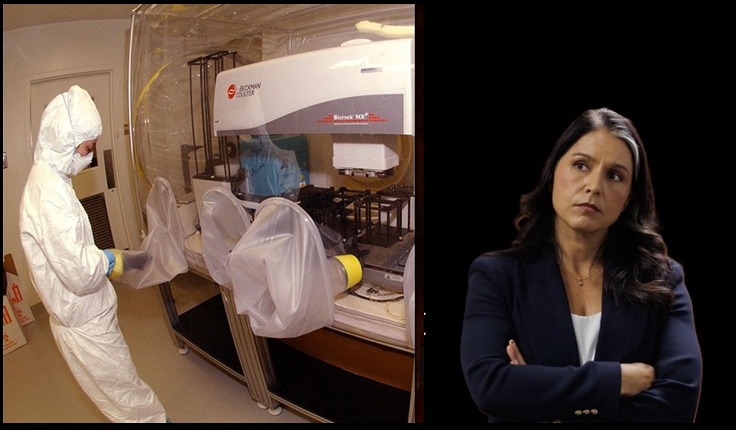
DNI Tulsi Gabbard Investigating 120 Foreign Biolabs Funding by U.S. Government – More than 40 are Located in Ukraine


Oh boy, she’s at it again. 🙂  According to a report within the New York Post, Director of National Intelligence, Tulsi Gabbard, is now investigating 120 foreign biolabs that are funded by the U.S. government – potentially involved in ‘gain of function’ or weaponized virus research.  More than 40 of the labs are identified operating in Ukraine.

Keep in mind, DNI Gabbard recently took control of the CIA development of Artificial Intelligence systems pulling In-Q-Tel, the CIA-backed venture firm, under management of ODNI.   Through a series of what seems like well-coordinated moves by Secretary Rubio, CIA Director Ratcliffe and DNI Gabbard, a significant amount of the CIA’s operations is no longer in the dark network.

USAID has been dissolved (Rubio/Ratcliffe); the Directorate of Analysis taken out of CIA and into ODNI (Ratcliffe/Gabbard); the President’s Daily Brief now assembled by the ODNI (Ratcliffe/Gabbard); Artificial Intelligence systems, In-Q-Tel under ODNI management (Ratcliffe/Gabbard), and now Intelligence Community (CIA) biolabs being identified, investigated and potentially removed from operation.

The biolab issue is a current concern given the discoveries of former National Institute of Allergy and Infectious Diseases (NIAID) Director, Anthony Fauci, lying to congress and the American people about funding gain of function research in Wuhan, China.  However, given recent events we might even file this under proactive election integrity measures.

WASHINGTON — Director of National Intelligence Tulsi Gabbard is investigating more than 120 biological laboratories abroad that were funded by US taxpayer dollars for decades, as part of an effort to end potentially risky experiments with viruses pursuant to President Trump’s executive order on so-called “gain-of-function” research.

Gabbard told The Post Monday in a statement that her team is going “to identify where these labs are, what pathogens they contain and what ‘research’ is being conducted to end dangerous gain-of-function research that threatens the health and wellbeing of the American people and the world.”

“The COVID-19 pandemic revealed the catastrophic global impact research on dangerous pathogens in biolabs can have,” the spy chief also said.

“Yet despite these obvious dangers, politicians, so-called health professionals, like Dr. Fauci, and entities within the Biden administration’s national security team lied to the American people about the existence of these US-funded and supported biolabs and threatened those who attempted to expose the truth.”

Under new guidance from Gabbard, the US Intelligence Community will review research at all US-funded biolabs, which would include facilities engaged in gain-of-function experiments that could increase the transmissibility of viruses, as well as work for defensive purposes against dangerous pathogens.

Office of the Director of National Intelligence officials noted that the foreign labs extend into more than 30 countries, and several had received funding in the past through a Department of Defense program that sought to dispose of weapons of mass destruction after the end of the Cold War.

More than 40 of the biolabs under review are located in Ukraine — and could “be at risk of compromise” due to Russia’s war, ODNI officials noted. (read more)