Thursday, May 7, 2026

How the American System Reshaped the World and why globalism seeks to destroy it


Freedom exists in the absence of government control.  We are free when we are able to worship, speak, write, make a living, and protect our families and property without fear that government agents will punish us for our actions.  America’s Founding Fathers embraced an expansive view of personal liberty that recognizes the inherent right of each person to do as he sees fit, so long as that person refrains from infringing upon the liberties of another.

Right away, then, freedom comes with some restraint.  If we each lived alone on our own island, no-one’s liberty but our own would matter.  When we live within a society, our freedom comes with certain encumbrances — namely, an obligation not to poach the freedom of others.  There is, in other words, a moral consideration that necessarily accompanies the exercise of freedom.  Do my actions cause someone else harm?  Does the expression of my will unfairly restrict the expression of another?  Do my decisions unjustly deny someone else’s liberty?

Harmfairnessjustice — these are words essential to every person’s moral reasoning.  They are subjects that are dissected and analyzed throughout the Bible.  Because our common law has evolved from a Biblical worldview, our legal system is rooted in Judeo-Christian morality.  Therefore, an American who tries earnestly to be a good Christian is also likely acting within the boundaries of American law.  

Taken together, freedom, moral restraint, and legal punishment operate in concert within any society.  To the extent that a member of society can reasonably govern himself, State-implemented punishment becomes unnecessary.  When members of society abandon self-control and pursue personal liberty recklessly or in ways that threaten the liberty of others, State-implemented punishment steps in to provide legal constraints where moral restraint proved ineffective.

Thus, there is a natural relationship among personal freedom, moral conscience, and State force.  The more that people pursue their freedom in moral and just ways, the more irrelevant the State becomes.  A society whose people are individually capable of governing themselves has no need for the machinery of government.  The policing of a population’s legal obligations and the application of State-enforced punishments become not only redundant but also unjust infringements upon personal liberty.

It is no coincidence that free societies exist where there is a high degree of mutual trust among people.  If a shop owner trusts that customers will not steal, then businesses can thrive without a government police force monitoring private transactions.  If customers trust that manufacturers will refrain from making harmful products, then commerce can thrive without the need for government regulatory agencies.  If members of society recognize that the fruits of an individual’s labor belong to that person, then property rights are respected without the need for courts and lawsuits.  If public debate, dissent, and personal expression are highly valued, then there is no need for government agents to police words and ideas as “hate speech,” “harmful speech,” or “disinformation.”

High-trust societies are natural incubators of freedom.  Accordingly, fostering trust among members of society maximizes personal liberty.  How do societies cultivate trust?  In a word: culture.  

Culture is that collection of customs, mores, attitudes, traditions, beliefs, habits, language, and ways of life that bind a people together.  Culture is an unwritten code of conduct passed from one generation to the next.  Culture is the essential glue that allows common members of society to move in the same direction without any obvious director.  Societies with strong cultures do not need external police forces because members of society “police” themselves.  

When that culture includes a profound respect for personal freedom, private property, religious liberty, free expression, and self-defense, the mutual trust that exists among citizens naturally secures the blessings of liberty.  It is no accident that an American, Thomas Jefferson, wrote the Declaration of Independence two hundred and fifty years ago.  It is no accident that representatives from America’s original thirteen colonies devised together a Constitution that both greatly limits the powers of government and explicitly protects the inalienable rights of Americans.  It is no accident that Americans’ respect for private property transformed an unsettled continent into the wealthiest, most innovative, and most influential country in the world.  A moral people committed to personal freedom can build, do, and accomplish anything.  A moral people committed to self-government can remake the entire world.

It is not difficult to see why the New World’s values have always threatened the Old World’s grip on global power.  In a world where intelligence, hard work, and dedication matter more than titles of nobility and unearned inheritance, the common man is capable of generating wealth without a feudal lord’s permission.  In a world where free speech and freedom of assembly are cherished political virtues, the common man is capable of forming opinions without the help of so-called “elites.”  In a world where self-defense and private ownership of firearms go hand in glove with self-expression and private property, the common man is master of his castle and servant to none.  

Globalism’s “elites” have been pushing the idea of a “New World Order” for decades.  But it is important to remember that when Americans declared their independence from the British Empire, they established a “New World” order that has continued to the present day.  Two hundred and fifty years after the Declaration of Independence, the United States is the wealthiest, strongest, and most robust nation that has ever existed.  It has 4% of the world’s population but influences every part of the globe.  When Old Europe pushes for a “New World Order,” old aristocrats are desperate to return to the social conditions that existed prior to 1776.  Globalists want the “Old World Order” rebranded as something new.

Ask yourself how you might go about destroying America’s “New World” order, so that the Old World’s feudal system can return.  If you want to dismantle Americans’ economic and political freedoms, then you need to wreck Americans’ mutual trust.  If you want to turn Americans against each other, then you need to ruin the foundations of their shared culture.  In order to weaken the bonds of culture, you must first discourage self-restraint.  By discouraging self-restraint, you encourage demands for government control.  By empowering the State, you diminish the sphere of personal freedom.  When the people have been denied freedom for long enough, they forget what it means to be free.  Eventually, when the government offers “free” welfare in exchange for obedience, the descendants of free people accept their new chains.  They accept total government control.  They accept slavery.

Flooding Western countries with foreign immigrants has never been about compassion.  Globalists use mass migration to destroy any semblance of social trust.  “Multiculturalism” has nothing to do with fostering civic peace.  Globalists “divide and conquer” populations in order to more easily rule over the dismembered parts.  Anti-Christian programs do not exist to protect “diverse” points of view.  Globalists attack Christians because Christian virtue cultivates the moral restraint necessary for freedom to thrive.  

For globalists, freedom is the enemy.  Government control is their greatest friend.  You cannot destroy the former and promote the latter until the natural bonds of society are first broken.  Totalitarianism never arrives by decree.  It comes by request.  In the two hundred and fiftieth year of America’s “New World” order, remember this: Our freedom is always under attack.  Be vigilant and defend it.


Podcast thread for May 7


Day after day after day..

Democrat Policies Ruin Everything


When I first moved to Baltimore after college, way back in 2001, I was pretty well stuck in the city and DC, as I lived near the train station in Baltimore and worked near it in DC and had no car. I walked to a small, local grocery store and could, on occasion, borrow a car from a friend for a trip to the suburbs to go to a Target or Best Buy on the weekend. It was like a field trip outside my cage.

One place to go was Towson, north of the city, and the Towson Town Center. It was a mall, but an “upscale” mall with higher-end stores and a classy feel to it and the immediate area. 

Well, times have changed and the Town Center is a shell of what it once was. Local media describe it this way: “Shoppers who once packed Towson Town Center say the mall has changed dramatically in recent years, with crime concerns and a growing number of vacant storefronts reshaping what was long one of the region’s premier shopping destinations.”

Liberal policies ruin everything.

I haven’t been to Towson for more than a decade, so I can’t personally attest to how bad it feels, but reports have the mall with a 26 percent vacancy rate, which will give the impression of a ghost town. There are few things more depressing and eerie than walking through an empty mall and the connected parking garage, so once the downward spiral starts, it is hard to stop.

Then, just a couple of weeks ago, Apple announced it would be closing its location in the mall and the local Democrats began to pay attention. A random clothing store or cell phone or jewelry kiosk closing is one thing, but Apple? That’s news.

Apple stores are very popular, but even a popular store can’t justify continued existence in a dying mall in a city being choked by liberal policies.

The Democrats, both in the U.S. House and Senate, from Maryland, are terrified to be seen (rightly) as the reason the Apple store is closing, so they sprang into action. Rather than addressing the overall state of taxes and crime – it’s amazing how people being robbed make others not want to go to where they are being robbed, and going soft on retail theft only encourages more retail theft and makes staying in business, frankly, stupid. Apple is not stupid.

Maryland’s Democrats – Senators Chris Van Hollen and Angela Alsobrooks, U.S. Representatives Steny Hoyer of district five, Kweisi Mfume of district seven, Glenn Ivey of district four, Jamie Raskin of district eight, Sarah Elfreth of district three, Johnny Olszewski of district two, and April McClain Delaney of district six – sent a letter to Apple demanding to know why it is closing its store.

According to a press release, “The lawmakers are requesting detailed information from Apple regarding the decision-making process behind the closure, including whether relocation or other operational adjustments were considered. The letter also seeks clarity on the company’s assessment of economic impacts and its plans to support affected employees through severance and job placement assistance.”

They want an answer by May 15.

Were I Apple's CEO, I’d find the nearest copy machine (provided Apple still has them around their headquarters, otherwise I’d go to a FedEx Office), pull down my pants, climb up on it and make several copies, shifting each time to make sure I got the best angle, of my glorious rear end, sign a copy of the best image for each of those Democrats and send it to them. I might even frame them.

The gall of Democrats, who have had effective control of the state for decades, demanding a private company explain why it is no longer worth it to continue to operate under their horrible governance is Olympic-level in its absurdity. Apple will never say that, if they say anything at all, but it’s worth saying.

These Democrats are desperate to be seen as caring about the closure, so they aren’t noticed for being the reason for it. It’s how the left operates – they are “ready to solve” problems they’ve created without ever acknowledging they’ve created them or suggesting the repeal of the policies responsible. Ever forward…that’s “progressivism.”

I hope Tim Cook goes with my copy machine idea, honestly.


Price Gouging, Now Personalized Thanks to Surveillance Pricing and Collusion

Price Gouging, Now Personalized Thanks to Surveillance Pricing and Collusion 

Corporate greed isn’t just bad ethics — it’s the fastest way to make socialism sound reasonable.

Corporate greed isn’t just bad ethics — it’s the fastest way to make socialism sound reasonable.

With Democrats becoming more assertive in their embrace of socialists such as Bernie Sanders and Zohran Mamdani, the abundance and prosperity we enjoy in a free-market economy are under threat. (RELATED: At What Point Do We Stop Tolerating Bernie Sanders?)

But free market capitalism is also threatened by the corporate embrace of unscrupulous business practices. There is a disturbing modern management philosophy that seeks to financialize all aspects of a business’s operations by mining every possible dollar from each customer engagement. This may produce short-term gains, but it destroys long-term brand equity, and more importantly, it erodes consumer trust. By treating customers as prey, unethical executives are providing ammunition to the enemies of free markets.

A particularly nasty method of revenue-mining customers is the use of “surveillance pricing.” Back in the pre-digital era, customers walked into a store and simply bought a product for the posted price. In the digital era, however, customers’ preferences, spending habits, and price resistance are made available to merchants. Unlike “flex pricing,” in which there is different pricing based on the time of day or distance involved in fulfilling the order, we are starting to see examples of pricing being tailored to a specific consumer based on what an algorithm calculates that specific customer is willing to pay.

As documented by Consumer Reports a few months ago, and then reported more broadly, consumers using Instacart to purchase groceries at chains such as Target, Costco, and Safeway were subject to “algorithmic pricing.” The price charged to a specific customer was determined by how sensitive the algorithm determined the customer was to higher prices. If two customers were buying the exact same item at the exact same time, they were charged a different amount. Consumer Reportsperformed an experiment in which online shoppers concurrently ordered identical baskets of groceries. The price of that basket of groceries varied from $114 to $124.

Surveillance pricing is also much different from loyalty programs, which provide customers with cheaper pricing if they are loyalty members or for bulk purchase discounts. In those situations, all customers still have access to the same pricing. With surveillance pricing, however, the price a consumer is charged is based on his online digital shopping patterns. With strong consumer and political backlash, Instacart soon suspended its algorithmic pricing. What’s disturbing is that the moral compass in some corporate executive suites is so defective that this practice was allowed to occur at all.

JetBlue recently found itself in a similar PR nightmare, as it seemingly acknowledged that it prices airline tickets based on a customer’s internet search history, rather than based on the current price of that ticket offered to all consumers.

A customer trying to book unexpected travel for a funeral checked the price online, then a day later went to book the tickets, only to find the price was now $230 higher. That can happen because pricing changes day to day based on seat availability and other factors. The customer tagged JetBlue in an X tweet that read, “I love flying @JetBlue but a $230 increase on a ticket after one day is crazy. I’m just trying to make it to a funeral.”

The shocking response from JetBlue’s X feed seemed to explicitly confirm that the airline employs surveillance pricing by stating that if the consumer would make his internet search history unavailable to JetBlue, a better price could be obtained. Specifically, the tweet from JetBlue read, “Try clearing your cache and cookies or booking with an incognito window. We’re sorry for your loss.”

After these tweets went viral, JetBlue quickly deleted its tweet and went into damage control mode, stating that “The reply from our JetBlue crewmember on social media was incorrect, and we apologize for the error. JetBlue fares on JetBlue.com and our mobile app are not determined by cached data or other personal information.”

Meanwhile, Amazon has apparently been strong-arming its vendors, such as Levi’s and Hanes, to coerce Amazon’s competitors to raise their prices. Amazon understandably wants to hold its pricing and margins, but this seems to indicate that price collusion is happening among competitors, at the expense of consumers.

As reported by CNBC, based on documents released by the California attorney general, Amazon would send links to its vendors showing competitors (such as Walmart and Home Depot) undercutting Amazon’s pricing. If the vendor did not pressure the competitor to raise the price being charged to consumers, Amazon would throttle visibility on its website for the vendor’s products.

Specific examples, as documented by the California attorney general, included:

  • A 2022 communication between Amazon and Hanes, in which Amazon sent links pulled from Target and Walmart’s websites, which showed lower prices than Amazon was charging. Hanes then confirmed that it had “reached out to Target and Walmart to have the prices increased.”
  • Amazon advised eye-drop maker Allergan that it was suppressing online visibility of Allergan’s products because Walmart was undercutting Amazon’s prices. Allergan subsequently replied to Amazon that “Walmart got their price back up,” and Amazon agreed to stop throttling visibility of Allergan’s products.

The actions alleged against Amazon are clearly violations of federal statutes prohibiting collusion and price fixing, specifically the Sherman Anti-Trust Act.

But even worse is that these actions, be they price fixing or surveillance pricing, are unethical, and they erode consumer faith in free market economics.

Consumers — who are also voters — might see themselves as being asked to choose between the promise of socialism or the morally bankrupt business ethos that has made price fixing and surveillance pricing reputable in some corporate C-suites. While corrupt business practices would still be preferable in that either/or scenario, we shouldn’t want voters thinking they must choose between the lesser of two evils. Ethical corporate behavior is imperative if we are to defeat the siren song of collective economics. (RELATED: Decommodification: The Dark Matter of Zohran Mamdani’s Agenda)

Corporate America must police itself better, and we free-market advocates on the political right must also police corporate misbehavior. In the meantime, there needs to be laws prohibiting surveillance pricing, and there must be consequences for those engaging in anti-competitive behaviors.


🎭 π–πŸ‘π π““π“π“˜π“›π“¨ 𝓗𝓾𝓢𝓸𝓻, π“œπ“Ύπ“Όπ“²π“¬, 𝓐𝓻𝓽, π“žπ“Ÿπ“”π“ 𝓣𝓗𝓑𝓔𝓐𝓓


Welcome to 

The π–πŸ‘π π““π“π“˜π“›π“¨ 𝓗𝓾𝓢𝓸𝓻, π“œπ“Ύπ“Όπ“²π“¬, 𝓐𝓻𝓽, π“žπ“Ÿπ“”π“ 𝓣𝓗𝓑𝓔𝓐𝓓 

Here’s a place to share cartoons, jokes, music, art, nature, 
man-made wonders, and whatever else you can think of. 

No politics or divisive posts on this thread. 

This feature will appear every day at 1pm mountain time. 


Don’t Overlook Justice Clarence Thomas’ Concurrence In Racial Gerrymandering Case


In Louisiana v. Callais, the Supreme Court struck a major blow against race-based policymaking, holding that the law protects voters from discrimination, rather than mandating that states create racial gerrymanders as an ostensible corrective to discrimination. The decision builds on a string of cases whereby the Roberts Court has distinguished itself by rightly opposing present “anti-racism” as a remedy for past racism — with potentially massive political implications.

Yet as righteous as Louisiana v. Callais is, it modifies legal precedent, rather than jettisoning it. And in a terse but provocative two-page concurrence, Justice Clarence Thomas, hearkening back to an underappreciated opinion of his from some 32 years ago, argues that to achieve constitutional colorblindness the court must go further: Instead of just rolling back racial gerrymanders, it should jettison the entire corpus of fundamentally corrupted jurisprudence that spawned the pernicious practice.

The landmark Louisiana case, and past rulings, have centered fundamentally on the court’s approach to challenges to political maps and districting schemes as racially discriminatory under Section 2 of the Voting Rights Act (VRA). The court has done so in part by developing tests concerning geography, demographic makeup, voting patterns, and the “totality of circumstances” to determine whether such maps or schemes pass legal muster — weighing disparate impact above discriminatory intent. Based on precedent and past Justice Department pressure, primarily Southern states have taken to drawing majority-minority districts — that is, racial gerrymanders purportedly benefitting minorities — to preempt challenges to their maps as dilutive and therefore discriminatory.

That is what Louisiana did in adding a second majority-minority district to its six-district political map – only for that map itself to be challenged as an unconstitutional gerrymander. The court held in Louisiana v. Callais that indeed the map was unlawful. Justice Samuel Alito, writing for the majority, found that while VRA Section 2 ironically can provide a compelling reason for race-based districting, it did not require Louisiana to do so. The court’s revised reading of the VRA raised the threshold for challenging a map’s constitutionality under its previously established standards, focusing on “intentional discrimination” over disparate impact — accounting in part for increased minority voter participation and representation in the South.

Thomas’ Concurrence

Justice Thomas, joined solely by Justice Neil Gorsuch, concurred in the opinion. But Thomas argued that the court has approached the VRA in a fundamentally flawed way, and, notwithstanding its Louisiana ruling, has consequently promoted a perverse system of proportional racial representation. He would dispense with new interpretations or updated tests. To end the “disastrous misadventure” that has seen the court drive “legislatures and courts to ‘systematically divid[e] the country into electoral districts along racial lines,’” Thomas says judges should get out of the business of entertaining districting and other challenges under the VRA altogether.

The quoted text comes from the justice’s concurrence in Holder v. Hall, an opinion Thomas invoked in his Louisiana concurrence. The 1994 Holder case concerned whether under Section 2, plaintiffs could challenge the size of a single-member county commission for diluting minority votes. In a splintered ruling, the court found they could not.

There, Thomas, joined only by Justice Antonin Scalia, explained why the court should not permit such a challenge — an explanation that applies to today’s districting cases. And he detailed why the associated rulings were so detrimental to our constitutional order and body politic — arguments that remain relevant with precedent persisting, even if now in modified form.

Section 2 Does Not Cover Districting

Congress passed the Voting Rights Act, Justice Thomas recounted, to eliminate discriminatory practices that kept blacks in the segregated South from being able to register and vote. Section 2 holds that citizens shall not be denied the right to vote on account of race through any discriminatory “voting qualification,” “prerequisite to voting,” or “standard, practice, or procedure.”

In Justice Thomas’s straightforward yet apparently radical reading, Section 2 does not cover districting. The relevant terms, “standard, practice, or procedure,” Justice Thomas wrote some three decades ago, “reach only state enactments that limit citizens’ access to the ballot.” “Districting systems and electoral mechanisms that may affect the ‘weight’ given to a ballot duly cast and counted are simply beyond the purview of the Act,” he asserted. And if Congress had wanted to amend the Act to cover vote dilution, it could have done so.

Thomas made these arguments in an extensive analysis of the statute, establishing that the court twisted itself in knots, eliding the law’s text, and relying on a selective reading of legislative history to not only use the VRA to adjudicate vote dilution cases, but as a “device for regulating, rationing, and apportioning political power among racial and ethnic groups.”

The kinds of judgments the Supreme Court undertook based on its expansive reading of the VRA, Thomas argued, reflected that the court had erred from almost the beginning. Dating back to 1969, the court interpreted the VRA to encompass practices and processes beyond registering and voting, including ones that might be deemed “dilutive.”

Forcing Political Questions

This forced the justices to answer expressly political questions. They had to define what an “undiluted” vote would look like, and then what the best system was to achieve it. The court would rule on whether single-member or multi-member districts better represented minorities; and whether the extent of group representation hinges on the “influence [it has] over a greater number of seats, or control over a lesser number of seats.”

The court necessarily would also have to rule not only on “how” representatives are elected to represent minorities, but “how many” such representatives must be elected as a proportion of all seats.

These were “questions of political philosophy, not questions of law,” Justice Thomas charged, and they were ones that went “beyond the ordinary sphere of judges.”

Once the court waded into these matters, Thomas found, it landed on a theory premised on the view that members of common racial or ethnic groups “must all think alike on important matters of public policy and must have their own ‘minority preferred’ representatives holding seats in elected bodies if they are to be considered represented at all.”

‘Political Apartheid’

To Thomas’ chagrin, the court would effectively endorse the idea that combatting discrimination required permitting the practice of engineering of districts to ensure roughly proportional representation by race. “[W]e have assigned federal courts the task of ensuring that minorities are assured their ‘just’ share of seats,” including through “drawing majority-minority single-member districts,” he noted.

By “systematically dividing the country into electoral districts along racial lines,” the justice lamented, the courts had participated in “an enterprise of segregating the races into political homelands that amounts, in truth, to nothing short of a system of ‘political apartheid.’ 

“The clear premise of the system is that geographic districts are merely a device to be manipulated to establish ‘black representatives’ whose real constituencies are defined, not in terms of the voters who populate their districts, but in terms of race,” Thomas thundered.

These contemptible consequences, he said, including the racial polarization that they would generate, flowed naturally from the court’s jurisprudence. The court therefore should consider whether the mess it had made required a “systematic reexamination” of its interpretation of the VRA.

Justice Alito’s opinion in Louisiana v. Callais seeks to better harmonize this arguably flawed precedent with the VRA’s text, the Constitution, and practical reality — including the laudable decline in “entrenched racial discrimination” in America.

That opinion took courage, given the vicious opposition the court faced, and the blowback it knew it was likely to engender by potentially threatening a dozen or so blue racially gerrymandered districts in red states.

And the opinion may well achieve the goals sought by Justice Thomas.

But his concurrence some three decades earlier demands another look. It suggests a further Voting Rights Act reckoning is still needed, not only to purge race-based policy from our electoral system, but to restore the proper role of the judiciary itself.


Repeated warnings about COVID shots, and Biden admin did nothing

Repeated warnings about COVID shots, and Biden admin did nothing

Senator Ron Johnson brings the receipts.

Autism article image

Wendi Strauch Mahoney for American Thinker 

Sen. Ron Johnson (R-Wis.)’s latest COVID-19 vaccine oversight report, released April 29, 2026, alleges that Biden-era FDA officials ignored internal warnings that the agency’s existing vaccine safety surveillance system had a known blind spot and declined to adopt a newer data-mining method that allegedly identified dozens of additional statistically significant safety signals.

Those warnings came from Dr. Ana Szarfman, then a senior FDA official working in the FDA’s Center for Drug Evaluation and Research (CDER), who told FDA officials in early 2021 that their vaccine safety surveillance system had a known blind spot because of “masking,” a data limitation that can inhibit the detection of safety signals.

Szarfman collaborated with Dr. William DuMouchel, then Oracle’s chief statistician and the inventor of the data-mining algorithm supporting the FDA’s existing system, to implement an updated methodology called the Regression-Adjusted Gamma Poisson Shrinker (RGPS) and compare its results against the FDA’s existing Multi-item Gamma Poisson Shrinker (MGPS) method.  Szarfman and DuMouchel claimed that RGPS was better able to adjust for “masking” in the data, meaning the FDA’s existing system could allow safety signals to go undetected.

On March 26, 2021, Szarfman shared an analysis that found “49 examples of extreme masking,” with more than 20 adverse-event examples showing a statistically significant safety signal after adjusting for masking.  Johnson’s report states that these safety signals included adverse events such as sudden cardiac death, Bell’s palsy, and pulmonary infarction that the FDA’s existing methodology had not previously detected.

Szarfman and DuMouchel shared similar analyses at least three other times, in April, May, and July 2021.  Their analyses

yielded even more statistically significant safety signals with higher values for adverse events, including acute myocardial infarction associated with Moderna and Pfizer-BioNTech (“Pfizer”) COVID-19 vaccines, non-site specific embolism and thrombosis associated with the Janssen (“Johnson & Johnson”) and Pfizer vaccines, dementia associated with the Pfizer vaccine, and Death and sudden death” associated with the Moderna and Pfizer vaccines.

Szarfman wrote emails to FDA officials warning them about the limitations of the FDA’s MGPS system.  However, in May 2021, FDA officials directed Szarfman to “hold off on creating and sending data mining reports and analyses,” and in September 2021, Dr. Peter Marks warned Dr. Patrizia Cavazzoni, then-director of CDER,  that Szarfman’s work could “create erroneous conflicts that feed into anti-vaccination rhetoric.”  Despite being told to “hold off,” Szarfman continued to generate and distribute her and DuMouchel’s analyses.

By May 24, 2021, federal health officials had acknowledged that, for “the age groups 16–17 years and 18–24 years,” the Vaccine Adverse Event Reporting System (VAERS) was unambiguously “signaling for myopericarditis.”  According to Johnson’s report, despite that evidence, Biden health officials “continued to fail to immediately warn the public” about COVID-19 vaccine–related cardiac events.

In addition, a key document trail shows that FDA officials acknowledged the limitation Szarfman had flagged.  In September 2021, Dr. David Menschik noted in a draft that the FDA’s existing empirical Bayesian (E.B.) data-mining system had “multiple limitations” and that COVID vaccine reports could mute disproportionality scores, especially if both mRNA products were associated with the same adverse event.  His draft language, the report notes, appeared in preprint versions of a vaccine safety paper but was removed before final publication in The Lancet.  In that same month, Szarfman continued to urge senior FDA officials to utilize her and DuMouchel’s data-mining system, underscoring that their method was “much better at unmasking signals than MGPS.  It automatically identifies and corrects for confounders.  This is an important function to have, given the pandemic situation,” she added.

The report goes on to highlight concerns over access and transparency regarding COVID-19 vaccine data.  The FDA had been sending weekly COVID-19 data-mining reports to CDC officials.  However, records show that in 2022, the FDA stopped routinely sending them.  One CDC official later wrote, “I think that because of the FOIAs we may have asked the FDA to stop sending these weekly data mining outputs.”  Johnson’s report notes that this happened after FOIA requests and congressional requests sought the same E.B. data-mining analyses.

The issue highlighted in Johnson’s report is not whether every VAERS signal proves causation, but rather whether federal health officials had warning signs, knew there were blind spots associated with the existing surveillance tool, and still rejected Szarfman’s proposed fix while limiting distribution of safety data and continuing to reassure the public that the vaccines were safe and effective.

The report builds on Johnson’s long-running COVID vaccine safety oversight, dating back to 2021, including letters to CDC, FDA, NIH, and HHS about adverse-event reports, safety surveillance systems, myocarditis in young people, “hot lots” and lot-variation data, VAERS data, and E.B. data-mining analyses.  Johnson also convened several public roundtables to discuss the COVID-19 vaccines, which he and other critics have described as “experimental mRNA gene therapy,” while federal health agencies repeatedly assured the public that the vaccines were “safe and effective.”  On May 21, 2025, Johnson released an interim report from the U.S. Senate Permanent Subcommittee on Investigations alleging that federal health agencies “downplayed the risk of myocarditis and other adverse events following COVID-19 vaccination.”

Following that, in December 2025, Johnson wrote a letter to HHS Secretary Robert F. Kennedy, Jr. about Dr. Vinay Prasad’s memo on child deaths following COVID vaccination, as well as continued reports of myocarditis and the Biden administration’s extension of COVID vaccine liability protections.  Prasad’s memo stated, among other things, that Biden health officials failed in numerous ways “to take seriously” the dangers of the COVID-19 vaccines, especially in children ages 7 to 16, stating that “we may have harmed more children than we saved.”  Johnson questioned in the same letter why the FDA allegedly reviewed only 96 death reports when VAERS had reported 38,913 worldwide deaths associated with the vaccines as of Nov. 28, 2025.

In March 2026, Johnson also released nearly 2,000 pagesof Biden HHS records and preliminary findings showing that, as early as November 2022, federal vaccine safety systems had detected a statistically significant ischemic stroke safety signal in individuals 65 and older following the Pfizer bivalent booster.

Johnson’s March 2026 release states that “rather than immediately issue a formal warning to the public, documents show that in December 2022, the Biden White House and HHS pushed to ‘increase uptake of the booster’ for people 65 years and older.” Johnson’s investigation further alleged that discussion of the safety signal continued into 2023, including a draft CDC-FDA “communications plan” that appeared to underscore the Biden administration’s continued desire to “increase uptake of the booster” while continuing to downplay the concerning safety signals associated with the mRNA vaccines.

Image: spencerbdavis1 via PixabayPixabay License.


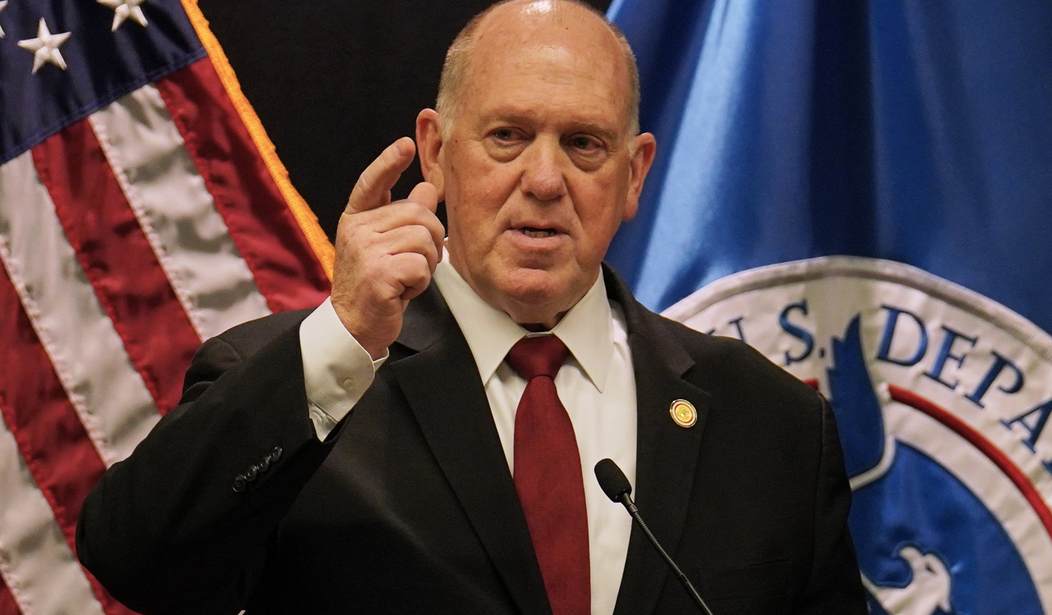
Homan to Hochul: Block ICE and We’ll Swarm NY Streets


RedState 

Never let it be said that the Trump administration's border czar, Tom Homan, doesn't take his job seriously. He's determined to round up and repatriate every illegal alien in the United States, and he is determined to do that with or without the help of any state or city where these illegal aliens might be found.

In the latest demonstration of this, Mr. Homan has told the state of New York, through Governor Kathy Hochul, that if New York tries to limit the reach of Immigration & Customs Enforcement (ICE), then he will flood the zone with ICE agents.

ICE, ICE, baby.

Speaking at a border security expo in Arizona, Homan said he would "flood the streets" with immigration agents in states that take steps to limit cooperation with the federal government. He singled out Hochul's "Local Cops, Local Crimes Act" legislation, which is currently being considered by lawmakers amid snarled negotiations over the state budget.

“We’re gonna flood the zone," Homan said in remarks, highlighting the Trump administration's immigration strategy for the coming year. "You’re gonna see more ICE agents than you’ve ever seen before ... because you forced us in this position."

Homan said ICE will also be targeting "collaterals" — people who weren’t targets of immigration officers but are still living in the U.S. illegally — as part of the next wave of mass deportations.

"I don’t care how long you’ve been here, if you’re here illegally, entered this country illegally, you cheated," he said in the remarks. "You cheated the system."

But then, this happened:

He (Homan) met with Hochul shortly after making the remarks, and appeared to back away from a crackdown after that encounter and a meeting between Trump and New York City mayor Zohran Mamdani, who took office in January. 

OK, now that just makes one wish to have been a fly on the wall during that meeting between President Trump and Mayor Mamdani. Was some kind of deal made?

Immigration, including dealing with people in the country illegally, is the province of the federal government. Local and state governments can not override federal authority on this, although they can decline to offer assistance. And Tom Homan has been pursuing his repatriation tasks with zeal since his appointment. Dealing with illegal immigration was one of President Trump's major campaign points in all three campaigns, and in none more so than in 2024. 

It seems unlikely that either President Trump or Tom Homan will back away from their goals now. The border is closed, with cross-border traffic brought down to a trickle after the Biden flood, and we've seen some high-profile repatriations, not to mention quite a few people who accepted the offer of a free plane ticket home and a handful of American greenbacks, to go home. But the job isn't anywhere near done, and I expect that New York will still see some roundups of illegal aliens, whether Governor Hochul likes it or not.

To Mr. Homan and to President Trump: Stay the course. 


U.S. awaits Iran response to latest deal offer

 Iran's foreign ministry spokesman Esmaeil Baqaei said the U.S. proposal remained 'under review'

A man walks past a large banner depicting Iran's current supreme leader Ayatollah Mojtaba Khamenei and his predecessor and late father Ali Khamenei along a street in Tehran on May 6, 2026. Photo by - /AFP via Getty Images

The United States was waiting on Thursday for Iran to respond to its latest proposed deal to end the war in the Middle East and to reopen the key shipping lane out of the Gulf.

Asian stocks soared and oil prices fell after US President Donald Trump said once again that an agreement could be near after positive talks, and Iran said it would pass on its latest position to mediator Pakistan.

Any agreement to prolong the ceasefire between the United States and Iran could also lower tensions in Lebanon, where an already fragile truce with Israel was under renewed strain after a strike on southern Beirut killed a Hezbollah commander.

The war, launched by the United States and Israel in late February, has seen Iran respond with attacks across the Middle East and impose a chokehold on the Strait of Hormuz, the gateway to the Gulf oil and gas industries and a strategic trade route.


Smoke rises following Israeli bombardment in southern Lebanon as seen from a position across the border in the Upper Galilee in northern Israel on May 7, 2026. Photo by JALAA MAREY /AFP via Getty Images

Trump had this week briefly launched a naval operation to escort commercial vessels and force open the strait, only to stand it down within hours, citing progress on negotiations with Iran, which have been mediated by Pakistan and supported by Washington’s Gulf Arab allies.

In Iran, however, many were wary of increased repression as the war drags on.

“The economic situation got worse, and this government has become even more brutal,” 49-year-old Ali told AFP journalists in Paris from the Iranian city of Tonekabon, using only his first name for fear of retribution.

‘Under review’

“We’ve had very good talks over the last 24 hours, and it’s very possible that we’ll make a deal,” Trump told reporters on Wednesday, adding his now habitual threat to return to bombing if Tehran refuses to back down to US demands.

Iran’s foreign ministry spokesman Esmaeil Baqaei said the US proposal remained “under review” and Tehran would communicate its position to mediator Pakistan “after finalising its views”.

According to a report from US network NBC News, Trump’s U-turn came after Saudi Arabia — whose Crown Prince Mohammed bin Salman reportedly talked directly to Trump — refused to allow US forces to use its airspace and bases for the Hormuz operation.


This photograph taken during a media tour organized by the Hezbollah’s media office shows a banner with a picture of late Iranian supreme leader Ayatollah Ali Khamenei, placed amid the rubble of a destroyed building near Sayyid al-Shuhada complex in Beirut’s southern suburbs on May 6, 2026. Photo by ANWAR AMRO /AFP via Getty Images

US news outlet Axios, citing two officials, reported that both Tehran and Washington were close to agreement on a one-page memorandum of understanding to end the war and set a framework for negotiations on Iran’s nuclear programme.

Trump has claimed that Iran’s leadership is divided, in the wake of the deaths of many senior figures in US and Israeli strikes.

But President Masoud Pezeshkian said Thursday he had met with the country’s supreme leader Mojtaba Khamenei, who has not been seen in public since his appointment in early March.

“What struck me most during this meeting was the vision and the humble and sincere approach of the supreme leader of the Islamic revolution,” Pezeshkian said, in a video broadcast by state television.

Khamenei, reportedly wounded in strikes on the first day of the Middle East war that claimed the life of his father and predecessor Ali Khamenei, has released only written statements since his appointment.

Oil prices fall

Oil prices fell again, tumbling by two percent Thursday — having fallen around 10 percent over the previous two days — and Tokyo’s Nikkei index led another strong rally across Asia stocks, fuelled by revived optimism that the talks will bear fruit.

In this picture obtained from Iran’s ISNA news agency on May 4, 2026, vessels are pictured anchored in the Strait of Hormuz off Bandar Abbas in southern Iran. (Photo by Amirhossein KHORGOOEI / ISNA / AFP via Getty Images) /

Energy prices are still much higher than before the conflict, but international standard Brent and US benchmark West Texas Intermediate are both now below the symbolic $100 level.

Markets have been particularly concerned about the Strait of Hormuz, which in peacetime carries a fifth of the world’s oil and LNG trade as well as a good chunk of its fertiliser.

On the Lebanese front, Israel struck Beirut’s southern suburbs Wednesday in the first such attack in nearly a month, killing a senior Hezbollah commander from its elite Radwan force.

In a video released by his office, Israel’s Prime Minister Benjamin Netanyahu said: “I say to our enemies in the clearest possible terms: no terrorist is immune. Anyone who threatens the State of Israel will die because of his actions.”

The Israeli military said in a statement Thursday that an “explosive drone impact” had wounded four of its soldiers — one severely — in southern Lebanon the previous day.


https://nationalpost.com/news/world/u-s-awaits-iran-response-to-latest-deal-offer

Spooked by Creepy Mamdani Video, Billionaire Prepares to Flee Hostile NYC and Take His Jobs With Him

Spooked by Creepy Mamdani Video, Billionaire Prepares to Flee Hostile NYC and Take His Jobs With Him

AP Photo/Yuki Iwamura

It started with an undeniably creepy, stalky video starring New York City's dashing young communist mayor, Zohran Kwame Mamdani. The mayor posted the video on Tax Day, April 15. In it, he announced the creation of a so-called pied-Γ -terre tax — a tax on luxury second homes within city limits. That was the commie part of the video; the creepy, stalky part was that he chose to film it in front of a building that houses a penthouse belonging to one individual billionaire. Mamdani called the man out by name — Ken Griffin, founder and co-owner of the Citadel hedge fund and securities empire — and stoked envy by disclosing what he had paid for his apartment. Observe:

Griffin was understandably disturbed by Mamdani's dox-y message. "It was creepy and weird," he told moderator Sara Eisen at the Milken Global Conference on Tuesday. "I mean, like, Knock, knock, knock on the window. Like, the mayor of New York City?"

"I had to go back and look at it again," Griffin related. "I mean, like, you literally looked at it the first time, you're like, 'You got to be kidding me,' okay? And then the second time, you're like, 'You know what? This, actually, this has gone from creepy to actually not really creepy — this has gone to frightening. Because the CEO of United Healthcare was killed just a few blocks from my house, and anything that creates, like, an agitation in the extremists on either side of the aisle is a frightening dynamic." 

He's not wrong: It's chilling stuff.

Something the menacing mayor never mentioned in his covetous propaganda clip is that Griffin is already an extremely generous benefactor of the Big Apple. My colleague Robert Spencer reported in April:

The thing is, however, that Ken Griffin is not really a problem for New York City. The Washington Free Beacon reported Saturday that Griffin, along with legendary music mogul David Geffen, made a “joint $400 million donation to Memorial Sloan Kettering in 2023. This constituted “the largest single donation the cancer center has ever received.” Griffin has also given “$40 million to the Museum of Modern Art, $40 million to the Museum of Natural History, and $15 million to the poverty-fighting Robin Hood Foundation.” The Free Beacon adds: “Sources tell us his gifts to city institutions total around $600 million.”

All told, Griffin "has donated more than $2.5 billion to advance education, opportunity, and health sciences initiatives that significantly transform people’s lives," according to Citadel's website.

Then, there are also the enormous contributions that Griffin's business endeavors make to NYC's overall prosperity. "…Griffin, whose Citadel and Citadel Securities together employ approximately 5,000 people, is currently building Midtown's tallest skyscraper right on Park Ave.," the Free Beacon noted, "something a mayor with any understanding of how to help working people would be welcoming and celebrating."

It's never enough, of course. Imagine how it must feel, after accomplishing what this man has accomplished and giving back what this man has given back, to be low-key threatened and simultaneously offered up as a gift of plunder to the city's Marxist masses by a preening socialist who's never built a single thing in his life.

The real, visceral gut-punch for Griffin had to have been the potentially deadly doxing by the mayor of New York City. The New York Post commented:

Griffin, who has sparred with president Trump over economic policy, said he admires the president’s “resiliency” for surviving multiple assassination attempts.

“You know, I’ve had my differences with President Trump over the years,” he added, “but the idea that he has survived three assassination attempts is just, it’s just incomprehensible. I mean, could you imagine the state of mind that you would be in having survived not one, not two, but now three separate [attempts?]”

Maybe it's finally sinking in for Griffin that Marxists are the worst people. I've said multiple times that it's wealthy business leaders' and investors' own fault for not taking the communist threat in New York City seriously. The moment Manhattan District Attorney Alvin Bragg indicted a former U.S. president on B.S. charges — March 30, 2023 — every wealthy person who chose to stay in that nascent s-hole has no one to blame but himself.

Better late than never, though, even if Griffin stands to lose substantial investment by getting the heck out of there.

"So where does that leave us at 350 Park?" Eisen asked him at the Milken conference. 

"That leaves us with the fact that we went to Miami and revised our building plan to make it a bigger office building," he replied.

"You're bailing?"

Griffin would not answer directly. He began by insisting that moving his company to NYC in 2022 was the right move before launching into an encomium of Florida as a business-friendly state.

Sounds like it will be a drawn-out, long goodbye from a man who hates to admit it's over. But it's over. Griffin will never see New York City the same way again. Even if Mamdani is no longer mayor someday, the people who elected him will still be the voting majority in that rotten apple.

It is super-sad that the American left’s zombie army, which it has built with a combination of a wholesale mental illness cultivation policy and polluting the culture with political hate and fear, has made our country unsafe for leaders. Be they political (Donald Trump), business (UnitedHealthcare CEO Brian Thompson), legal (Supreme Court Justice Kavanaugh), or social (Charlie Kirk), anyone who steps up and leads is now a target.

Except for leftists, of course.

Who can blame Griffin for not wanting to die at the hands of the next whacked-out leftist zombie foot-soldier? For not wanting his family to deal with his loss simultaneously with the cheers of the despicable, hardened left? And for not wanting his fairly earned fortune confiscated and redistributed to strengthen the very system that created this poisonous atmosphere?