Saturday, March 28, 2026

Mines: Weapons That Wait


Leading his fleet into Mobile Bay in 1864, Admiral David Farragut voiced the famous line, “Damn the torpedoes! Full speed ahead!”

Actually, the Confederates had no torpedoes as we know them today. Farragut used the contemporary term for mines, which sank the 2,100-ton monitor Tecumseh and damaged several other Union vessels.

Since then, mines have been a constant in naval warfare, recognized as “weapons that wait.” Often, they are used offensively and defensively by both sides in a war, threatening the passage of enemy vessels or deterring them from entering friendly waters.

In 1945, the U.S. Navy and the Army Air Forces bottled up Japan’s remaining naval and merchant ships by mining the home island waters. The once all-conquering Imperial Navy was reduced to rusting in place.

Frequently, months to years are required to remove mines after peace returns. In five months of 1919, the U.S. Navy helped sweep 70,000 Allied mines from the 240-mile stretch of the North Sea between Norway and Scotland. The extensive mine “barrage” was an effective counter to German U-boats but required removal for commerce to proceed.

One of the best-known examples of postwar mine removal was Operation End Sweep after the Vietnam War. With the signing of the Paris Accords in January 1973, the U.S. deployed surface vessels and aircraft to meet the requirement for removing thousands of mines from North Vietnamese coastal and riverine waters. Though many mines had gone “sterile” by then, the process took six months, with the task completed in July.

Little known is that the officer directing End Sweep, Rear Admiral Brian McCauley, turned his attention to clearing the Suez Canal the next year. The vital waterway had been blocked for eight years with sunken or stranded ships, wreckage, and mines on both banks.

The Tanker War

Mines re-entered the public consciousness during the 1980s when Iran launched “the tanker war,” particularly targeting Kuwaiti shipping in the Persian Gulf. Because 20 percent of the world’s oil supply originates there, the 21-mile chokepoint at the Strait of Hormuz and adjacent waters had to be cleared.

A worldwide maritime survey noted, “Strait of Hormuz to be on the alert for possible terrorist activities.” Therefore, Lloyd's of London identified the Strait as a war zone requiring additional insurance and raising the cost of petroleum products.

Iran’s methods were not limited to mines. Fast small craft often attacked merchant shipping, which was defenseless against such threats. Meanwhile, at least 35 international vessels struck mines in 1986-87 alone, some being sunk.

In 1987, President Ronald Reagan authorized Operation Earnest Will, with American warships escorting Kuwaiti vessels in the Strait. Third-party operators hastened to reflag vessels under the Kuwait registry to qualify for American largess.

But that year, the U.S. was caught terribly short. The Navy had just 22 mine warfare vessels but only 3 active-duty minesweepers, all based in the U.S.: the Korean War-vintage USS Illusive (MSO-448), USS Leader (MSO-490), and USS Fidelity (MSO-443). The ocean-going vessels left the East Coast in September, transiting the Suez Canal to arrive on station in early November.

Subsequently, three U.S. Navy ships suffered mine damage in the Strait: the destroyer USS Samuel B. Roberts in April 1988, plus the helicopter carrier Tripoli (LPH-10) and the cruiser Princeton (CG-59) on the same day in February 1991.

The Mine Threat Today

From Vietnam through 2024, mines inflicted 78 percent of the damage to U.S. naval vessels: fifteen versus one each for combined aircraft/torpedo, missile, and small craft.

Frequently, the United States relies on NATO and other allied navies to provide minesweepers. This month, President Donald Trump wrote, “Hopefully, China, France, Japan, South Korea, the UK, and others, that are affected by this artificial constraint, will send Ships to the area so that the Hormuz Strait will no longer be a threat by a Nation that has been totally decapitated.”

But deploying the vessels from far afield in sufficient quantity, especially from Asia, is likely to remain a challenge.

During President Trump’s Operation Epic Fury, launched on February 28, air strikes often targeted Iran’s navy, which has largely been destroyed or immobilized. On March 10, the Department of War announced the destruction of 16 mine-capable vessels, including speedboats that can carry multiple weapons.

Epic Fury has targeted all aspects of Iran’s ballistic missile infrastructure, including plants that manufacture components. Given the exceptionally detailed intelligence exhibited by the U.S. and Israel, presumably the same policy could apply to mine production. But the allies should consider the likelihood that Tehran will disperse its manufacturing and storage facilities, especially since the mine option is paramount in the wake of Epic Fury.

Taiwan 

Meanwhile, on the other side of the globe, the smoldering situation involving Taiwan requires attention to mine warfare. Again, the weapons that wait pose offensive and defensive threats with the communist People's Republic of China and the nationalist Republic of China facing one another across the 110-mile-wide Taiwan Strait. The ROC Navy owns about ten mine craft, mostly foreign-built. In vivid contrast, the PLA(N) disposes of dozens of minelayers and sweepers that would be essential to an amphibious invasion of the island.

But a 2025 survey by the Center for Maritime Strategy concluded, “The current state of American minesweeping capability is grim. The Avenger classof mine countermeasures ships is nearly 40 years old. Of the 14 vessels originally built, only eight remain -- all forward-deployed in Manama, Bahrain, and Sasebo, Japan. In a Taiwan crisis, the four Sasebo-based MCMs would take nearly two days to reach Taiwan at top speed and under ideal conditions.

“The Navy plans to retire four of the remaining Avenger class hulls this fiscal year, reducing the fleet’s mine countermeasures ships to just four platforms, which themselves are scheduled to be retired by 2027.”

Whatever any specific situation, globally, those who rely on maritime commerce will remain aware of the weapons that wait.



Podcast thread for March 28


quiet weekend.

Normalizing Deviant and Unhealthy Behavior


You've seen them at the checkout counter, in supermarkets and health foodstores, in head shops, and around town: employees who wear nose rings, or piercings in the center of the nose, through the nasal septum, or through the thin piece of cartilage underneath the septum that separates the right and left nostrils.

When recently scoping out a new dental office, to my complete and utter amazement – shock actually – two of the front office staff, both females, sported nose rings. Call me whatever you want, but at that juncture, I didn’t seek to learn anymore about the practice.

Too Prevalent, Too Risky

What prompts a person to have a bull-like nose ring? Even if the chances are low, why risk incurring an infection, a septal hematoma (broken blood vessels), an allergic reaction to the metals in the piercing, or scarring? Why riskdeveloping a blood disease, including hepatitis B and C, HIV, and tetanus, from an unsterilized needle? Why risk bumping into something and hitting a nerve, potentially causing permanent damage? And how, exactly, does one effectively handle a runny nose?

How long before the advocates of “anything goes” seek to normalize nose rings so that no one should be aghast when someone in a public position has one? So, why not doctors and nursespolice officers, firefighters, postal workers, and, for good measure, elementary school teachers?

Let's induce everybody to have nose rings because, after all, this is simply an option for expressing oneself! Let's not refer to them as nose rings; they’re facial adornments …or something like that.

Deviance on Parade

One of the two major political parties seeks to normalize human behavior, which, in a saner society, might be a sorely needed topic of discussion and derision. This political party employs a variety of tactics, such as the renaming of issues. Consider pedophiles. They are attracted to children and would like to groom them, have sex with them, perhaps keep them as sexual slaves, and ensure that they stay silent.

Pedophiles revel in having children at their beck and call, for years on end, if possible. Leftists now refer to pedophiles as “minor-attracted persons.” Voila! You are no longer a predator if you seek to have sex with a child. You're a “minor-attracted person.” It's a lifestyle! It's a choice! Some people opt for it; most don't. It's no big deal!

Once a notable segment of society opens Pandora’s Box and proceeds as if dubious behavior is normal, there’s no end to it. A case in point: The fat acceptance movement is growing in the U.S. With two-thirds of adults now either obese or morbidly obese, and the number growing all the time, it was inevitable that fat acceptance would ‘inch’ forward.

How dare you criticize my lifestyle choice? So what if I can't make it through the bus door, or I need two bus seats, or my health is so precarious that I might drop dead at any moment? Who are you to charge me for two plane seats? This is my body, and I'm entitled to have it extend as far as it does. Who are you to look at me skeptically? Who are you to pass judgment at all?

Far Too Predictable

Have the “facial adornment” movement, the “minor-attracted persons” movement, the “fat acceptance” movement, and other such movements been predictable? Likely yes, and with a traceable origin. To illustrate: Once there were bums, tramps, hobos, and vagrants. If you merely hung around town, without anything to do, for hours on end, you could be arrested for loitering.

Why would any community have had such laws on the books? It does not benefit a community to have people hanging around bus stations, train stations, libraries, and park benches idly for untold hours. While local governments don’t seek to make everyone workaholics, especially for grown men and women, continual public idleness is undesirable.

Today, vagrants, bums, and hobos are called “homeless people.” Certainly, some individuals are homeless due to unforeseen or unfortunate circumstances. Still, once the blanket term “homeless person” came into vogue, elements of civilized society began to fray.

Voting With Your Feet

If you have a nose piercing and work at the checkout counter, I might have little choice but to have you ring up my goods. If you work in a medical facility, I'm going elsewhere. No, I do not spend my day contemplating how to avoid people with nose rings. Concurrently, I don't want to spend my day around them.

If we all spoke up at the outrage of having people in various professions and industries with nose rings serving us, perhaps employers would get the message.

Incidentally, some anthropologists, physicians, and sociologists have a term for when people pierce themselves in questionable locations. They call it self-mutilation.


Olympics Bans All Balls From Women's Sports

Olympics Bans All Balls From Women's Sports

Image for article: Olympics Bans All Balls From Women's Sports

Babylon Bee

LAUSANNE — In a landmark statement intended to simultaneously clarify lingering questions regarding trans athletes in events and prevent any potential confusion in the future, the International Olympic Committee announced that it was banning all balls from being used in women's sports.

With debate raging over the legitimacy of allowing male athletes to compete in women's events, the IOC reportedly decided to err on the side of caution by eliminating the use of balls of any kind in female competition.

"We're not allowing any balls, just to be safe," said IOC spokesperson Ingrid Hergenbergenmergen. "We have heard the outrage over men competing against women, and in the spirit of fair competition, we have chosen to go the extra mile and not allow the use of any balls in women's events."

Discussions were ongoing to determine how certain events, such as volleyball, basketball, water polo, and soccer, would be able to continue without the use of balls, but Olympic officials were confident that they could come up with something. "This is a perfect time to think outside the box," Hergenbergenmergen said. "Simply because a sport has always involved balls doesn't mean it always has to be that way. We simply feel that it's best not to allow the use of balls in women's sports, either in possession of the athletes themselves or in the field of play."

At publishing time, the IOC announced that, in the absence of balls, women's tennis would be scored by judges in a manner similar to that of interpretive dance.

🎭 π–πŸ‘π π““π“π“˜π“›π“¨ 𝓗𝓾𝓢𝓸𝓻, π“œπ“Ύπ“Όπ“²π“¬, 𝓐𝓻𝓽, π“žπ“Ÿπ“”π“ 𝓣𝓗𝓑𝓔𝓐𝓓


Welcome to 

The π–πŸ‘π π““π“π“˜π“›π“¨ 𝓗𝓾𝓢𝓸𝓻, π“œπ“Ύπ“Όπ“²π“¬, 𝓐𝓻𝓽, π“žπ“Ÿπ“”π“ 𝓣𝓗𝓑𝓔𝓐𝓓 

Here’s a place to share cartoons, jokes, music, art, nature, 
man-made wonders, and whatever else you can think of. 

No politics or divisive posts on this thread. 

This feature will appear every day at 1pm mountain time. 


New Document Shows Chief Judge Howell Privately Endorsed Jack Smith’s Get-Trump Lawfare


Behind closed doors, the judge overseeing Trump’s grand jury told prosecutors she ‘loved’ their legal strategy.


A Department of Justice briefing document released by Sen. Chuck Grassley shows that Jack Smith’s special counsel team engaged in private communications with two federal judges overseeing Trump-related investigations: Chief Judge Beryl Howell and her successor, Judge James Boasberg, both Obama appointees on the U.S. District Court for the District of Columbia and both known for their outspoken anti-Trump positions.

The document was prepared for then-Attorney General Merrick Garland on Jan. 13, 2023. It was released by Grassley ahead of this week’s Senate Judiciary Committee hearing on the FBI’s Arctic Frost investigation into the aftermath of the 2020 election. Smith took over the investigation in November 2022, and at that point, his team likely engaged in improper communications with the two judges.

According to the briefing document, Smith’s team informed Garland that they had been in touch with Howell and that “She liked our approach of pursuing the executive privilege litigation in an omnibus fashion,” meaning the consolidation of various motions into a single filing rather than handling each separately. The notes record that Howell was aware such a motion was coming “and loves the idea.” A separate entry referenced a forthcoming meeting with Boasberg scheduled for Saturday, March 18, 2023, the day after he became chief judge, taking over from Howell.

Ex Parte Communications

Judges are generally not allowed to privately communicate with one party in a pending case without notifying the other party. However, there are exceptions. In the dispute over President Trump’s executive privilege before Howell, the issues arose in the context of grand jury proceedings. As Chief Judge overseeing grand jury administration, she and the DOJ were technically allowed to communicate without Trump’s lawyers present on matters strictly related to the grand jury. Such communications could include scheduling witness testimony, addressing procedural questions, or resolving other administrative issues necessary for the grand jury to function.

What they could not do in secret was discuss the substance of pending litigation, offer advice on prosecutorial strategy, signal support for one side’s approach, or endorse a plan that would effectively pre-decide disputes between the parties. Expressing enthusiasm for the DOJ’s omnibus strategy in executive privilege litigation falls clearly into that forbidden category.

The Sept. 22, 2022 Hearing

The problem is compounded by the Sept. 22, 2022 hearing before Howell on the executive privilege matter. Three Trump lawyers, Timothy Parlatore, Evan Corcoran, and John Rowley, were present and actively argued that the DOJ had not met the standard to pierce executive privilege. Notably, Howell expressed skepticism about consolidation, stating, “Although consolidation, at first blush, as I said, you know, usually is something I consider pretty seriously, in the privileged context, I am not sure it does anything more than complicate the discussion when each individual has to be looked at individually with — in context and role; so I am just telling you right off the bat.”

If, as Smith’s briefing document claims, Howell later told the DOJ she “liked our approach of pursuing the executive privilege litigation in an omnibus fashion,” it represents a complete reversal. During the Sept. 22, 2022 hearing, Howell had insisted that these very issues were too particularized to be grouped together, telling Trump’s legal team: “The way I deal with privilege issues, it’s so context specific, witness by witness; the specific role of the witness; timing of the communications; scope of the communications; scope of the role — it is so particularized to each witness.” This forced Trump’s team into a defensive posture, preparing for many separate legal battles. Yet by later secretly endorsing the DOJ’s omnibus plan, she green-lit a mechanism to pierce those privileges in bulk, effectively rigging the process in the government’s favor.

The situation is made even worse by the absence of any formal record. There is no indication that these communications were documented, that a court reporter was present, or that Trump’s lawyers were notified.

The Language of Enthusiasm

Even if we assume for argument’s sake that the communications were technically permissible under grand jury administration rules, the language attributed to Howell, saying she “liked” and “loved” the DOJ’s approach, reveals a deeper problem. Judicial impartiality does not mean having no opinions, but these opinions must be formed through the proper adversarial process. Expressing personal enthusiasm for one party’s litigation strategy is not neutral. Under Canon 2 and Canon 3 of the Code of Conduct for United States Judges, judges must act in ways that inspire confidence in their impartiality and perform their duties impartially. Howell’s comments, if accurate, are incompatible with these standards.

This shift in Howell’s stance was as much about timing as legal philosophy. Smith faced a backlog of individual privilege disputes that could have stalled the grand jury for months. By privately endorsing the omnibus approach, Howell gave the prosecution a fast track to resolve these high-profile cases before her tenure as Chief Judge ended.

On her last day in office as Chief Judge in March 2023, Howell ordered a long list of Trump aides to testify before the grand jury. This included Chief of Staff Mark Meadows, advisers Dan Scavino and Stephen Miller, former Director of National Intelligence John Ratcliffe, ex-National Security Adviser Robert O’Brien, and Corcoran, who had appeared before her a few months earlier when she seemed skeptical about any omnibus consolidation.

Howell’s Prior Statements and Conduct

Concerns about Howell’s neutrality are not limited to the conduct described in the briefing document. In 2023, she publicly stated that Jan. 6, 2021 was the result of “big lies” and warned that the country was at risk of drifting toward authoritarianism. After Trump’s January 2025 pardons of Jan. 6 defendants, she rejected the premise of those pardons, writing that “No ‘national injustice’ occurred here, just as no outcome-determinative election fraud occurred in the 2020 presidential election,” while structuring the dismissals in a way that has left the door open to future charges against the pardoned individuals.

In a separate matter, when Trump ordered the suspension of security clearances for Hillary Clinton’s campaign law firm Perkins Coie over its role in advancing the Russiagate hoax, Howell intervened to restore those clearances and made pointed remarks about Trump, including stating that “you cannot be saying that there was nobody involved in the 2016 Trump campaign that had any connection with any Russian,” and that he “really had a bee in his bonnet about it,” referring to Fusion GPS, the firm hired by Perkins Coie to push the Russia collusion narrative.

With respect to Boasberg, the specifics of his private communications with Jack Smith’s team remain unknown. He later permitted Smith to subpoena phone records of House and Senate Republicans. Boasberg has repeatedly clashed with the Trump administration, for instance, over the use of the Alien Enemies Act for deportations. He also attended Trump’s Aug. 3, 2023, arraignment on charges related to the 2020 election as a spectator, despite having no role in the case.

Questionable Impartiality

Whether Smith’s communications with Howell and Boasberg technically violated ex parte rules depends on what was discussed. What the briefing document suggests, however, is that the chief judge privately endorsed one side’s legal strategy in pending litigation, particularly after expressing doubt to the other side in court. That kind of conduct cuts directly against the foundations of fair and impartial judicial proceedings.

Although she is no longer Chief Judge, Howell remains on the court as a senior judge and has continued to take positions that raise questions about her impartiality, including reinstating Perkins Coie’s security clearances. Realistically, however, there is little chance of meaningful consequences. In the history of the United States, only eight federal judges have ever been removed from office, typically for outright criminal conduct such as bribery. Removal would require a two-thirds majority in the Senate, which is not going to happen. That does not mean nothing should happen. At a minimum, impeachment proceedings should be initiated to put Howell’s and Boasberg’s conduct on the record.


Americans Shouldn’t Need The House To Save Mass Deportations From Weak Senate Republicans


The larger concern is not whether ICE and CBP can be funded, but whether Democrats will be allowed to set the conditions.


House Republicans are reportedly rejecting a Senate deal Friday that would reopen the Department of Homeland Security without funding for Immigration and Customs Enforcement (ICE) or parts of Customs and Border Protection (CBP) — two agencies at the center of our immigration enforcement system.

The Senate struck the deal early-morning Friday, and it was met with celebration by Democrats like Senate Minority Leader Chuck Schumer, who made clear such funding omissions were the result of Republicans caving.

“In the wake of the murders of Renee Good and Alex Pretti, Senate Democrats were clear: no blank check for a lawless ICE and Border Patrol,” Schumer said in a statement. “Democrats held firm in our opposition that Donald Trump’s rogue and deadly militia should not get more funding without serious reforms, and we will continue to fight for those reforms.”

As Fox News’ Bill Melugin reported, the Senate deal did not include any of the items on Democrats’ ICE reform wish-list, such as showing ID, congressional oversight, and agreements not to enforce the law at so-called “sensitive locations.” Such reforms were the reason Democrats “started the shutdown in the first place,” he noted. However, while both ICE and CBP have funding set aside in the One Big Beautiful Bill, Melugin pointed out that ICE’s “civilian support staff/non-law enforcement personnel” are still “getting screwed” by Friday’s Senate deal. Earlier this week he noted these “crucial” workers “haven’t been paid since the DHS shutdown began.”

House Republicans are reportedly rejecting the Senate-passed deal on Friday, instead proposing a “two-month, clean extension of all funding for DHS, including ICE,” according to Fox News’ Chad Pergram.

But the fact that Senate Republicans were willing to concede law enforcement funding to Democrats is still problematic.

The Senate agreement ultimately signaled that immigration enforcement funding can be negotiated. But if funding is negotiable, does that also mean Republicans are willing to treat immigration enforcement as negotiable?

And even if Republicans restore funding through another path, the entire ballgame has shifted. The larger concern is not whether ICE and CBP can be funded, but whether Democrats will be allowed to set the conditions.

Democrats have made clear time and time again that their priority is to illegal aliens — which is how this shutdown began in the first place. Sen. Chris Murphy, D-Conn., said as much on MSNBC in 2024, telling Chris Hayes that Democrats have failed to get a bipartisan immigration bill and in doing so, “failed to deliver for the people we care about most, the undocumented Americans that are in this country.”

Enforcing the law — and our borders — is a non-negotiable for the country. Under Biden, Democrats flooded the country with millions of illegal aliens in four short years, inundating schools, hospitals, and communities, and, most importantly, putting a strain on national cohesion so much so that Democrats like Murphy openly declare they are working on behalf of foreigners. In other words, Senate Republicans should not have attempted to reward Democrats’ endorsement of lawlessness.

Americans recognized the insanity of such open border policies, with a Pew Research poll from September of 2024 finding that for 82 percent of Trump supporters, immigration was a leading issue. The poll also found a 13 percentage point increase in the number of voters who viewed immigration as “very important to their vote” since 2022. That same year, Pew also found 88 percent of Trump supporters backed “mass deportations of immigrants living in the country illegally.” Trump ran and was elected on a platform of mass deportations.

Yet some Republicans in the Senate tried to concede funding for the very agencies on which mass deportations depend. House Republicans may stop the deal for now, but if Senate Republicans have to be told they were wrong on this basic issue, the problem runs deeper than a single vote.


Drill, Baby, Geopolitics: Now It’s a Matter of National Security In a world of chokepoints and cartels, domestic energy isn’t a slogan — it’s strategy.

Drill, Baby, Geopolitics: Now It’s a Matter of National Security In a world of chokepoints and cartels, domestic energy isn’t a slogan — it’s strategy.

In a world of chokepoints and cartels, domestic energy isn’t a slogan — it’s strategy.

Oil prices have rocketed up to a high of $112 per barrel amid the ongoing war in Iran, though not as high as the spikes under President Biden, which saw Brent crude hit $127 in March of 2022. This again shows that U.S. energy independence is essential to national security and stability.

I’m not going to completely defend President Trump’s actions in Iran. I believe one can reasonably make arguments for or against the attack, and I have intelligent friends who fall on both sides of the debate. What I can do is provide some insight as to how America can harden itself for the future. So, dealing with things as they are, and not how we wish they were, why on Earth are we so tied to Middle East oil? Don’t we have enough here?

We do have “enough,” especially when Canada factors into the equation (and, perhaps, Venezuela). But still, it is genuinely in our interest to maintain peace in the Middle East. (RELATED: Venezuelan Oil May Not Come Easy)

Putting it simply without getting into the history: The U.S. dollar is the premier currency in which oil is traded all around the world, but particularly in the Middle East. Thus, stability in the region keeps the dollar in demand. We want the dollar to be in demand globally because when countries like Saudi Arabia receive dollars for their oil, they often reinvest those dollars into U.S. Treasury bonds and other markets that go towards funding some of the U.S. federal deficit.

I am going to assume that the petrodollar system will not change any time soon, which may upset some readers. But this is the most likely reality for the near future. (RELATED: The Price of Gas and the November Elections)

With that being the case, how can we protect Americans from future energy shocks when the Middle East is in turmoil, and the Strait of Hormuz is closed? (RELATED: Five Quick Things: Hormuz)

Some suggest that green energy, specifically wind and solar, is the solution. On the surface, if you know nothing at all about wind and solar except that they make electricity and appear to be “oil-free,” this might sound like a good idea.

But if you’re worried about being dependent on hostile, untrustworthy foreign powers for our energy, further handcuffing us to the largest producer of green tech, China, will not help America over the long term. China funds environmental activist groups here in the United States to wage war on fossil fuels while promoting wind and solar subsidies.

Green energy means Chinese prosperity.

China refines around 91 percent of all rare earth minerals, and nearly all the graphite vital for battery production. The Chinese Communist Party dominates the solar panel industry and produces nearly all the magnets necessary for electric cars and wind turbines.

Green energy means Chinese prosperity.

Nuclear power is genuinely great to add to the grid, particularly as what we call baseload power. We should expand America’s nuclear power footprint. However, it is not a magic bullet. Most nuclear power cannot react to fluctuations in short-term power demand as nimbly as natural gas or coal, though this may change with new technology. The drumbeat I constantly hear is: “Do not plan infrastructure today based on technology that does not exist and can’t be deployed at economic scale yet.”

This is the trap we find ourselves in with the supposed battery revolution that is perpetually “just around the corner.”

President Trump has already expressed support for some practical solutions: we need to cut a lot of red tape in energy and manufacturing industries, build out our refinery and domestic mining capacity, and carefully decouple from China in vital industries. (RELATED: Trump’s Mineral Revolution Secures Our National Sovereignty)

Right now, domestic oil production is limited by refining, transportation, and export bottlenecks. The United States cannot extract giant amounts of oil if there is nowhere to send it. For the first time in 50 years, a new refinery is being built on American soil due to the Trump administration’s energy dominance philosophy. This is a great step in the right direction, but it’s just a step. These efforts need to be made permanent, or a future administration could slam the brakes on Trump’s progress. (RELATED: Electricity Affordability — Trump’s Achilles’ Heel?)

Oil and natural gas are vital to the world, not just for energy but for all plastics, pharmaceuticals, fertilizers, dyes, treated materials, and other petrochemical products. Americans use things made from the byproducts of oil refining every hour of every day. There is no getting away from the fact that modern society depends on fossil fuels.

In The Wealth of Nations, Adam Smith said it was vitally important that countries protect domestic industries that are essential to national defense. Energy, I would argue, falls under this category.

The Trump administration needs support for these aims because access to affordable and reliable energy is paramount to U.S. interests for the foreseeable future.


This Squad Member Called for Taxpayer-Funded Reparations for Illegal Immigrants

This Squad Member Called for Taxpayer-Funded Reparations for Illegal Immigrants


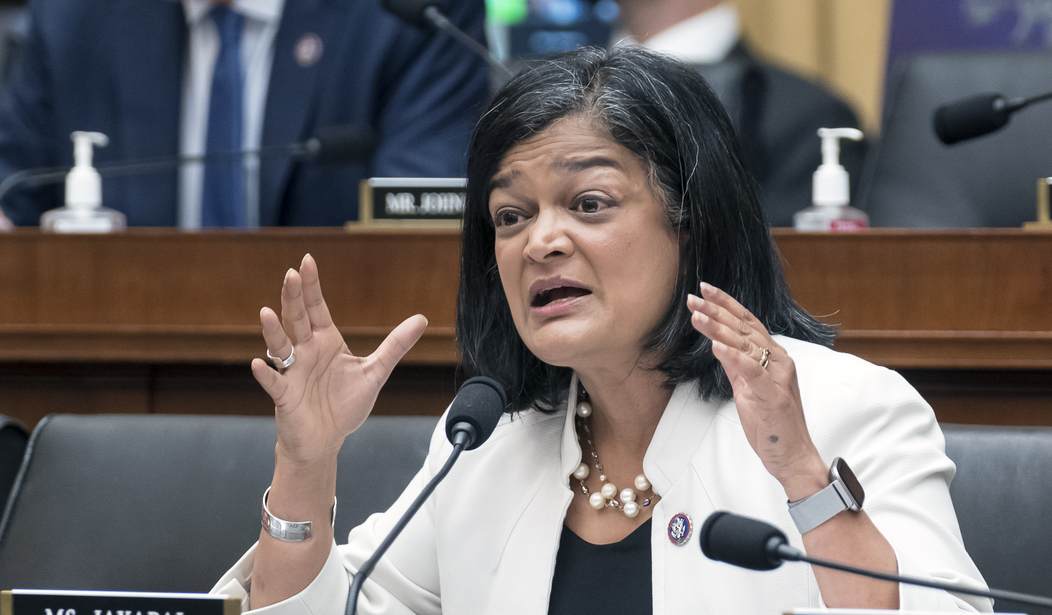
Progressive Congresswoman and member of The Squad, Rep. Pramila Jayapal (D-WA), called for “some form of reparation” to be paid to illegal immigrants for the alleged “trauma” inflicted by ICE agents during President Trump’s nationwide deportation campaign. 

It remains astonishing that Democrats label funding the Department of Homeland Security and its agencies as a waste of taxpayer dollars, yet have no issue using public funds to provide reparations to individuals who broke the law by entering the country illegally.

"We need real accountability, because at the end of the day, the people that have been inflicting this harm need to be prosecuted," Jayapal said. "They need to be brought before us, and they need to be held account for the trauma that they have created, and we are going to have to have some form of reparation."

While the move is likely more posturing than a serious policy that could gain traction, it highlights where some progressive Democrats stand when it comes to representing their constituents. Representatives like Jayapal appear more interested in representing illegal immigrants than the tax-paying Americans who determine the direction of the country. 

They also seem to forget that deporting criminal illegal immigrants was one of the least controversial policies championed by President Trump during his campaign, yet Democrats continue to act as if that weren’t the case.


Vance Makes Definitive Claim About Rep. Omar's Alleged Immigration Fraud, and Things Are About to Heat Up


RedState 

Back in late January, we reported on how House Oversight Committee Chairman James Comer (KY-01) announced that the committee was going to be looking into the sudden wealth of Democrat Rep. Ilhan Omar (MN-05).

It was revealed at the time that her husband, purported venture capitalist Tim Mynett, "went from nearly broke to being worth up to $30 million in just a year, according to her 2024 disclosure forms."

Specifically, Comer noted that "There are a lot of questions as to how her husband accumulated so much wealth over the past two years. It’s not possible. It’s not. I’m a money guy. It’s not possible.”

The news came amid a continued Trump administration-led fraud crackdown in Minnesota, where members of the Somali community were implicated and, in some cases, convicted of widespread fraud, with some estimates putting the number as high as $9 billion in taxpayer dollars.

As RedState readers will recall, Omar herself has long been accused of engaging in immigration fraud, with the claims centering around Omar allegedly marrying a man, Ahmed Nur Said Elmi, who some have alleged to be her brother, in 2009 so he could stay here legally, even as she reportedly was in a marriage with another man.

In December, President Trump's border czar, Tom Homan, noted that these allegations, which Omar has called "sick," were being looked into again amid the fraud investigations that were already taking place in Minnesota.

Fast forward to March, and Vice President JD Vance, who is the head of Trump's anti-fraud task force, just dropped the following bombshell related to Omar:

Vice President JD Vance said Friday that Rep. Ilhan Omar defrauded the US by allegedly marrying her brother to help him remain legally in the country.

“We actually think that Ilhan Omar definitely committed immigration fraud against the United States of America,” Vance told right-wing podcaster Benny Johnson on the latest episode of his show.

[...]

Vance added that he’s been discussing legal remedies with White House deputy chief of staff Stephen Miller, explaining that questions have been raised: “How do you go after her? How do you investigate her? How do you actually build the case to actually get some justice for the American people?”

The vice president claimed the Minnesota Democrat “has been at the center of a lot of the worst fraudsters in the Somalian community” — and that was also something that should be under investigation.

Watch:

In December, Sen. Ted Cruz (R-TX) explained the statutes under which Omar could face criminal liability if the allegations were true - federal marriage fraud, state incest laws, and tax fraud:

As of this writing, there has been no comment from Omar on Vance's definitive declaration. We'll keep you posted on future developments. Stay tuned.