Wednesday, March 25, 2026

The Twilight of the Transgenders


The transgender mania seems to be winding down. While the Trump administration can claim some credit for this, the fact of the matter is that it was beginning to decrease even during the Biden administration despite the Democrats’ desperate efforts to continue promoting the sexual mutilation of children.

In recent years, the glamorizing and promotion of transgenders was undercut by several items. First, detransitioners (persons who changed genders, thereby being mutilated in the process, whereupon they realized they had made a horrible mistake) tried to inform the public of the mistake of transitioning; they also spotlighted the malpractice. Additionally, the UK’s Cass Review, followed by others, revealed that the assertions made by some professional about becoming transgender had no scientific basis, contrary to what had been claimed. Third, several studies showed that those individuals voicing gender dysphoria had psychological comorbidities (i.e., aside from the transgender issue they were mentally ill). Fourth, the revelations about WPATH (the World Professional Association for Transgender Health), the foremost agency besides the Democratic Party in promoting the mutilation of children, showed that the staff were basically ghouls. Lastly, and more importantly, lawsuits have begun to be filed. It may be remembered that it was successful lawsuits that ended the “recovered memory” scandal (mentally ill individuals would go to a feminist therapy who helped the client “recover” dormant memories, wherein it was revealed the client had been “raped” as a child by the father, the uncle, the mailman, the doctor, the neighbor, the local football team, space aliens, etc.).

Despite these events, the supporters of transitioning doubled down. The media kept promoting transgenders while censoring the negative aspects (such as the transgender identity of some crimes, including mass killings). The Democrats transformed the transgender mania into a political dogma, and psychopathic teachers in the schools, including the school boards protected and promoted the transgender mania (all Democrats, incidentally).

However, my previous work on mass behavior predicted the decline, which would have occurred much sooner and more precipitously if not for the Democrats. Many years ago, as a graduate student, I had published some research on the media’s effect on violence.

Subsequently, I published a study showing that many popular social fads followed a predictable pattern. Copycat behavior in social fads is characterized by a bell shape in frequency. Another characteristic is that there is a specific stimulus that sparks the fad. Although I restricted myself to social fads, I pointed out that some political criminal actions, such as airplane hijackings, had the same characteristics and followed the same pattern of development.

Incidentally, the number of hijackings from the United States to Cuba began after Cuba was subjugated by the Communists in 1959, and is as follows:

     1930s         0   
     1940s         0
     1950s         0
     1960s         8
     1970s        24
     1980s         5
     1990s         2 
     2000s         1

Notice the bell-shaped curve, a distinctive feature of all copycat crimes and copycat suicides the latter almost always by young persons.

The school shootings since Columbine is another instance; in regard to school shootings, clarity has been obscured by Democrats politicizing the crimes, focusing on the existence of guns instead of the psychopathic behavior, forgetting the fact that years before Columbine, school shootings had rarely occurred and some schools taught gun safety by having guns in those schools. It was Columbine that was the sparking stimulus for subsequent school shootings, not the existence of guns. Incidentally, my study of copycat behavior regarding Columbine focused on bomb threats of schools, my rationale being that school shootings would be too horrific to be imitated. I underestimated evil.

Copycat suicides occur after excessive publicity of someone famous, such as a “celebrity,” which serves as the sparking stimulus, and the suicides occur in the same manner. For example, a popular South Korean actress’ suicide was overpublicized by the media; in that month, the number of suicides rose by 66%. The method of suicide was the same as that of the actress -- hanging. It can also occur through the “suicide” within a popular film, as with 13 Reasons Why.

The transgender mania began with the sudden obsession and mass glorification of a celebrity who decided to switch genders. Bruce Jenner’s decision to have his penis chopped off was the sparking stimulus. You may remember the orgiastic reaction by the media hivemind.

Several professionals have pointed out in journals that the number of requeststo become transgendered and the number of inquiries in Google on the subject had increased and continued increasing in the years after 2015. One psychologist pointed out that individuals expressing a wish to become transgendered had done so suddenly, which is atypical of how gender dysphoria crystallizes. She called it Rapid Onset Gender Dysphoria (RODG).

Just like social fads.

In summary, despite the efforts of psychopathic teachers and professionals, and despite celebrities parading their transgender/homosexual children as a status symbol in Hollywood, we can expect the continued decline of transgender surgeries. My research, however, does indicate that there will be some sporadic recurrences from time to time, especially since we can count on liberal politicians, both in the United States and in Canada, supporting the sexual mutilation of children.


Podcast thread for March 25


still reeling

Presidents Behaving Badly


Before Washington, DC became America’s capital city, a large swath of land to the south was known as the “Dismal Swamp,” a place where insect-borne diseases and other perils felled early settlers. Construction since these early times has transformed the surface of the capital and nearby suburbs in the Beltway, but the threat posed by the festering swamp of unelected individuals who hold levers of power, important ones, in our vast government bureaucracy and infect the body politic has only risen.

Self-anointed “insiders” and their family members pull down compensation and other benefits from a maze of entities, posing as foundations or institutes, that boldly flout settled laws and regulations, but are never punished. If you’re wondering about what’s going on today, it’s worth looking back to how hard the George W. Bush presidency worked to protect his predecessors from scrutiny, especially on matters related to the Iran-Contra affair.

Days after the National Archivist worked with the Department of Justice and the FBI to raid Mar-a-Lago, I wondered what a librarian might have to fear about Donald Trump’s return to power in 2025. For years, I also mulled over why President Trump repeatedly and haplessly managed to pick manifestly ineffective people to lead the Department of Justice as Attorney General, culminating in his first term with George H.W. Bush loyalist Bill Barr.

Back then, I was not aware of how far Presidents might go to bury inconvenient truths about their tenure in the White House. In the years that have passed, what former presidents say and what they do not write about in their overpaid memoirs has helped me get closer to the truth. The Clinton presidency and the decades since then help clarify this issue.

On his last day in office, Bill Clinton’s early morning pardons of Susan Rosenberg, Marc Rich, Pincus Green, and too many other despicable criminals ignited a firestorm. However, instead of pursuing an in-depth review of Clinton’s early morning clemency decisions, the FBI, Department of Justice, and IRS carried out a limited “investigation” into whether a supposed charity with the legal name “The William J. Clinton Presidential Foundation” was used to exchange contributions for pardons. This demonstrably feeble effort began in February 2001 and vanished into oblivion by early 2005.

Looking back, the George W. Bush administration was remarkably aggressive about protecting Reagan- and Clinton-era information. When George W. Bush assumed the presidency, he did not provide access to certain sensitive records of the Ronald Reagan administration. He should have, for they were statutorily required to become public 12 years after Reagan left office.

Invoking arguably spurious requests for more time to review Reagan’s Presidential Records, Bush’s team waited until November 1, 2001, to issue Executive Order 13233, which flouted the clear intent and letter of the President Records Act. One of the most outrageous elements of this Executive Order (and there are many) was granting the right to assert “executive privilege” to heirs of presidents and to presidential designees who wished to block the release of sensitive records. So, during the entire W. Bush administration records through January 20, 2009, and Reagan-era Presidential Records that should have reached the public by January 20, 2001, were sealed up tight as a drum, as were Clinton presidency records.

Presidential Records for George H.W. Bush—due out starting January 20, 2005 —were also cloistered under Executive Order 13233, locking them up through January 20, 2009.

What do so many have to fear going all the way back to 1981? And why did relations warm up between the Clinton and Bush families? Bill Clinton gave us part of the answer decades ago.

The hardcover (2004) and paperback (2005) editions of Clinton’s My Life are actually quite revealing in numerous respects. Writing about the controversial pardons that his predecessor, George H.W. Bush, made on December 24, 1992, effectively ending investigations into and consequences from the Iran-Contra affair forever, Clinton noted (page 457 of the hardback):

President Bush gave a big Christmas present to some former associates, and potentially to himself when he pardoned [former Defense Secretary] Caspar Weinberger and five others who had been indicted in the Iran-Contra scandal by Independent Counsel Lawrence Walsh. Weinberger’s trial was about to get under way, and President Bush was likely to be called as a witness.

As an afterthought, Clinton observed:

Just two weeks earlier, Walsh had learned that the President and his lawyer, Boyden Gray, had failed for more than a year to hand over Bush’s own contemporaneous notes relating to Iran-Contra, despite repeated requests to do so.

Why did George H.W. Bush and his counsel work so hard to evade producing highly relevant evidence to Independent Counsel Walsh through 1992? What knowledge, if any, did Bill Barr have about these decisions?

If regime change (for the better) occurs soon in Iran, perhaps we may finally learn more about what actually happened under Reagan, Bush, and then-Governor Bill Clinton, when numerous parties defied the law to send money to Central American rebels through leaky foundations, including the National Endowment for the Preservation of Liberty, the Nicaraguan Refuge Fund, and the Nicaraguan Development Fund.

Who cooked up these schemes, and how widely have similar schemes been employed by Republicans and Democrats alike?

The use of ostensibly tax-exempt organizations to siphon taxpayer funds back to the families of influential politicians and to the donor class, while also meddling in foreign and domestic affairs, should certainly be included in the expanded remit that Vice President Vance and Treasury Secretary Bessent have been given to fight fraud.

With the benefit of hindsight and the looming potential to gain deeper access into historical records in America and in relevant foreign countries, especially including Venezuela and Iran, the time has come to revisit how the presidency, until it hit the Trump wall, has spent decades embracing unregulated “globalism”—and how this rush has been aided with tax-exempt organizations tied to former presidents and their cronies.

Over the years, John Solomon has made steady progress unwrapping some of the ways that swamprats seem to have subverted elections, beginning with the election on November 6, 2012.

Meanwhile, the Trump Administration should expand its mission to release sensitive files and expose how dynastic political families in both parties have used nominally tax-exempt organizations to augment power and attract personal wealth, especially including the Bush family; Bill, Hillary, and Chelsea Clinton; Joe and Jill Biden; and Barack and Michelle Obama.


Donald Trump’s Psychological Smackdown of Iran — and What Will Happen Next


Scott Pinsker  | March 25, 2026  |   PJ Media

If you know the enemy and know yourself, you need not fear the result of a hundred battles. If you know yourself but not the enemy, for every victory gained you will also suffer a defeat. If you know neither the enemy nor yourself, you will succumb in every battle

—Sun Tzu, The Art of War

If you could distill PR and marketing to a single sentence, it’d be, “What do I gotta say so you’ll do what I want?” Meaning, it’s 100% outcome based: Theories are fun, but reality is the ultimate litmus test.

Which is why, to build a PR war plan, we only need three ingredients:

  1. An honest, accurate assessment of where we are today.
  2. An honest, accurate assessment of what motivates our target audience.
  3. A clear picture of where we want to be tomorrow (i.e., what “victory” looks like).

That’s it. All the rest is simply a roadmap between today and tomorrow (sprinkled with tactics, measurables, and mile markers). If you know where you are and where you’d like to be, everything else falls into place.

“Know the enemy and know yourself” — Sun Tzu would’ve rocked at PR.

The Iraq War introduced the phrase “shock and awe” into the public lexicon, relying on the PR power of big booming bombs. Undoubtedly, the psychological impact was significant; how could it not be?

Whereas the ongoing U.S.-Israeli war in Iran was surely shocking and aweing to many Iranian mullahs (especially all the dead ones), it probably pales in comparison to either Iraq war. Iran, after all, is nearly four times larger geographically, and in Iraq, more air forces were running more bombing raids.

Stands to reason that more bombs in a smaller area would be more shocking and awe-inspiring.

Plus, today’s U.S. and Israeli bombs and missiles are increasingly targeted, “smart,” and ultra-precise. In the Persian Gulf War, barely 9% of our bombs were smart bombs. It’s unclear what percent of U.S. and Israeli bombs are currently “smart,” but it’s certainly a much larger number.

It’s also unclear what that means: Are ultra-precise, target-specific bombs and missiles MORE psychologically devastating? Or do larger quantities of randomly-landing bombs and missiles deliver a heavier psychological blow?

These are relevant questions because war is a tool — a means to an end. And the endpoint we’re trying to reach is for the Iranian regime to capitulate, stand down, and cede to President Donald Trump’s demands.

Like Carl von Clausewitz said, “War is politics by other means.”

Both Bush presidencies relied purely on military hardware to crack the enemy’s resolve. Their strategy was straightforward, loud, and booming — just like the bombs themselves. 

But one of the things that differentiates President Trump from his predecessors is his outside-the-box thinking. More than any other president in the past 100 years, he’s willing to try new and novel ways to slice the Gordian knot. Both Bushes were creatures of the status quo, but the current president marches to his own drummer. From tariffs to Greenland to “Governor Trudeau” to the Gulf of America, he’s unusually gifted at weaponizing psychological PR tactics.

The English used to be the best at it. From intercepting and publicizing Napoleon’s love letters to their Andrew Dice Clay-esque nursery rhymes about Adolf Hitler’s unfortunate deformities, they were so good at it, Joseph Stalin said at the 1943 Tehran(!) Conference that World War II would be won with “British brains, American steel, and Soviet Blood.”

That was then. Today, U.S. intelligence and Israeli ingenuity have supplanted the Brits at psychological warfare. America’s capabilities are unrivaled anywhere in the world, and Israel’s winning streak of innovative psychological victories — perhaps most notably, its “Grim Beeper” operation that decapitated Hezbollah — keeps growing.

According to some reports, it was American intelligence that learned of Supreme Leader Ayatollah Ali Khamenei’s secret meeting with Iranian leaders; others credit Israel. Either way, the combination of Mossad + IDF + CIA + U.S. Armed Forces has rattled Iran to its core.

In fact, the Wall Street Journal reports that the Israelis are actually chatting with high-ranking Iranians:

The Journal reviewed the contents of one call between a senior Iranian police commander and an agent of the Mossad, Israel’s foreign-intelligence service.

“Can you hear me?” a Mossad agent can be heard, speaking in Farsi. “We know everything about you. You are on our blacklist, and we have all the information about you.” 

“OK,” the commander said in the recording.

“I called to warn you in advance that you should stand with your people’s side,” the Mossad agent said. “And if you will not do that, your destiny will be as your leader. Do you hear me?”

“Brother, I swear on the Quran, I’m not your enemy,” the commander said. “I’m a dead man already. Just please come help us.”

So imagine the psychological profile of the handful of Iranian leaders who still live: They’re probably over 60. Their colleagues are vanishing by the day. After Mossad made everyone’s beeper go boom, they’re terrified of electronic devices. They don’t know who to trust.

And that was before President Trump announced that he’s been conducting secret negotiations with one or more unnamed high-ranking Iranians!

From Iran International:

Whether real or not, President Donald Trump’s statement that Iran has reached out for talks is already having an impact: fueling mistrust within Tehran leadership while easing tensions in global oil markets, even as Iranian officials deny any such contact.

[…]

[Trump] is using ambiguity as a political and psychological weapon inside the Islamic Republic. By saying he has been talking to a very senior Iranian figure without naming that person, he is planting doubt and suspicion among what remains of the leadership.

In current conditions, that matters. Iran’s leaders are living in hiding. Command centers are disrupted. Communications are limited out of fear of interception and assassination.

Meetings are difficult, if not impossible. In that setting, a statement like this will be deeply unsettling. Each senior figure will now be asking: Who is talking to Washington? Who is looking for an off-ramp? What is being hidden from the others?

By naming no one, Trump makes everyone in Tehran wonder who is talking to Washington.

This does not affect only the top. Lower-ranking officials also hear the same message. If they begin to believe that some of their leaders are quietly searching for a way out, they will become more uncertain, more demoralized, and more open to defection.

No matter who came up with the idea (You’re welcome, America!), it represents a new chapter in this conflict. We’re not just shocking and aweing ‘em militarily — we’re now shocking and aweing ‘em psychologically.

President Trump’s announcement accomplished three things:

  1. If one of the Iranian leaders is conducting unauthorized negotiations with the United States, that’s treason. Which means, the mullahs know there’s a traitor within their midst — but they don’t know who he is. Nobody can trust anyone anymore, lobotomizing the remaining brain-trust.
  2. If top officials are cutting sweetheart deals with the Americans, it puts pressure on everyone else to jump ship, too. Being the last man standing in a dying regime is a death sentence. Which means, it’s every man for himself.
  3. If you’re a high-ranking mullah with aspirations of being the next Supreme Leader, you better start negotiating with the Americans, too. It’s a once-in-a-lifetime opportunity!

Over the next several days, the Iranian paranoia will steadily escalate. Whenever a top mullah goes silent, the others will have no idea if he’s dead — or if he’s defected. There will be rumors and conspiracies swirling 24/7, and the remaining mullahs — who are too terrified of Mossad’s black magic to use their smartphones or beepers — won’t know who’s telling the truth.

And the more they stay silent, the more these conspiracies will grow.

Meanwhile, if the Iranian people believe the regime is in near-total disarray, it’ll inspire them to rise up when the bombing stops and retake their country. The probability of a successful rebellion has just dramatically increased.

If the mullahs no longer believe the regime will survive, why should anyone else?

Which means, we won’t need to send ground troops into Iran to achieve regime change — because the Iranian people are the ground troops. They’ll march by the millions, demanding an end to their tyranny.

One of the errors of the Iraq War was focusing exclusively on military success, and not nearly enough on the psychology of the people. And then, when the war ended, we were ill-prepared to manage the aftermath. Far too many young Americans died because of it.

President Trump is no Bush I or Bush II. He’s not simply cracking the regime militarily; he’s shattering it psychologically.

And that’s why this time will be different.

AP Photo/Luis M. Alvarez

https://pjmedia.com/scott-pinsker/2026/03/25/donald-trumps-psychological-smackdown-of-iran-and-what-will-happen-next-n4951051

Consent Decree Brings an End to 'Orwellian' Speech Suppression

Consent Decree Brings an End to 'Orwellian' Speech Suppression

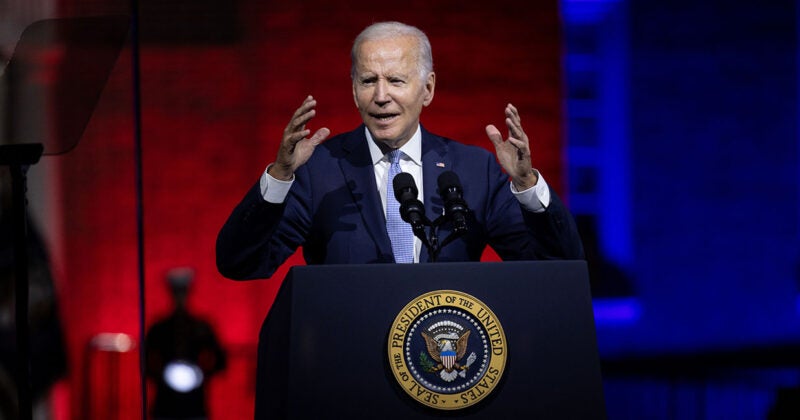
Joe Biden's White House pressured Big Tech companies to suppress speech in violation of the First Amendment, and the federal government is entering into a consent decree to pledge never to do it again.

Then-President Joe Biden in Philadelphia on Sept. 1, 2022. (Nathan Posner/Anadolu Agency/Getty Images)

During the COVID-19 pandemic, federal health agencies and the White House under President Joe Biden pressured social media companies to censor speech that contradicted the federal government’s narrative, but two Republican attorneys general secured a consent decree Tuesday that will prevent the government from returning to that “Orwellian” strategy.

“It was absolutely Orwellian,” Louisiana Attorney General Liz Murrill told The Daily Signal in a phone interview Tuesday. “The federal government is enormously powerful and they leveraged that power to threaten something that these companies hold very dear—which is their Section 230 immunity—and that threat was enough to essentially have these companies make themselves agents of the federal government.”

“Missouri will not allow politicians to police speech,” Missouri Attorney General Catherine Hanaway, also a Republican, told The Daily Signal. “The Biden censorship regime was something straight out of Orwell’s 1984. Missouri is proud to have led the most consequential fight for free speech in a generation.”

The Daily Signal depends on the support of readers like you. Donate now

The consent decree notes that the federal government “unlawfully pressured, coerced, induced, and encouraged major social media platforms to censor their posts” about the pandemic, the reports about Hunter Biden’s laptop, and the 2020 presidential election.

While the First Amendment prohibits the federal government from directly censoring speech, the plaintiffs accused the Biden administration of pressuring social media companies to do what the government itself could not. 

Section 230 of the Communications Decency Act of 1996 grants tech companies legal immunity for speech published on their platforms, though critics have urged reform to the policy.

“One of the most egregious acts of corruption by the Biden administration was its pressure campaign against social media companies to censor the free speech of everyday Americans,” White House spokesman Kush Desai told The Daily Signal. 

“No president and no movement have experienced censorship more in recent years than President [Donald] Trump and the MAGA movement, and this administration is committed to ensuring Americans’ First Amendment rights are never impinged again.”

The Consent Decree

The consent decree, which will end the litigation from Missouri and Louisiana, binds the surgeon general, the Centers for Disease Control and Prevention, and the Cybersecurity and Infrastructure Security Agency from taking any actions “to threaten social media companies with some form of punishment (i.e., an adverse legal, regulatory, or economic government sanction) unless they remove, delete, suppress, or reduce, including through altering their algorithms, posted social-media content containing protected free speech.”

The decree will last for a period of 10 years, well past the next administration.

Murrill celebrated the consent decree as “historic” and “extraordinarily unusual.”

“States are frequently forced into consent decrees often by the federal government but it’s a very, very unique situation for the federal government to enter into one,” she explained.

Censorship and the Supreme Court

The attorney general noted that leaders in the Biden administration were “very deliberately chilling speech they disliked even though it was true.”

A Media Research Center report from 2020 found that many Biden voters said they would not have voted for the Democrat if they had known about the revelations from Hunter Biden’s laptop, which social media companies suppressed after the FBI suggested it had been Russian misinformation.

In 2021, a Facebook staffer told a Biden White House official that the company suppressed “often true content”because it contradicted the White House’s narrative about COVID-19 vaccines.

Louisiana and Missouri, joined by social media users whose content had been suppressed, sued in May 2022, aiming to block the censorship. On July 4, 2023, a federal district judge granted the plaintiffs a preliminary injunction, ordering the government to stop the censorship scheme. 

The Biden administration appealed the case, however, and the Supreme Court struck down the injunction, finding that the plaintiffs lacked standing—meaning they could not prove that the government’s actions resulted in direct harms to them that the court could stop.

As the consent decree explains, however, the Supreme Court found that no plaintiff demonstrated standing for a preliminary injunction, but it did not strike the overall lawsuit.

Amid the litigation, Trump signed Executive Order 14149 on Jan. 20, 2025. The order acknowledged the Biden administration’s censorship efforts and directed agencies to identify and take actions to correct past misconduct. In light of this order, the federal agencies at issue agreed to enter into the consent decree.

Murrill acknowledged that federal entities not covered by the consent decree—notably agencies such as the FBI—arguably engaged in the suppression of free speech via social media pressure. She emphasized, however, that the consent decree sets a precedent that should help address any future attempts to silence speech.

“We’re getting a consent decree that recognizes the federal government’s obligation to abide by the First Amendment and giving us an enforceable means to ensure that they do for the next ten years,” she explained. 

“We can’t undo what they did in the sense that when they throttled people’s speech and they forced their message out to the direct exclusion of contrary messaging,” Murrill noted. “That was an injury to the entire country to deprive them of true speech and true messaging and force the government’s message on them while other messaging was being blocked.”

She noted that, unlike an executive order—which a future president could strike down with the stroke of a pen—the consent decree “creates a binding agreement between the parties that can be judicially enforced.” Terminating the decree would require “a new round of litigation.”


China dominates the rare earth elements industry, but this American company hopes to challenge China's grip


Last week, President Trump postponed a summit with his Chinese counterpart on account of the war with Iran. When Trump and Xi Jinping do meet, here's an agenda item bound to figure prominently: rare earth elements. Right now, China holds a near-monopoly over these strategic metals that are key components in so much that makes the modern world go: smartphones, robotics, EV's; also fighter jets, drones and radar technology. 

That is, China controls materials essential to America's ability to wage war. Tonight, the story of an American company confronting this elemental crisis. It mines rare earth elements, processes them, and makes them into superpowered magnets. And it's part-owned by us, American taxpayers, in an unusual deal crafted by the federal government.

An hour southwest of Las Vegas, in the guts of the Mojave, Mountain Pass, California, might be the ultimate front of our trade war with China. This massive cavity in the ground? Behold, the only active rare earth mine in the U.S. This is an unlikely battleground.

Jon Wertheim: Are we stepping on rare earths, as we speak? 

Michael Rosenthal: Yes. Everywhere you look is, is rare earths.

And Michael Rosenthal and James Litinsky are the unlikely men in charge, two Floridians in the snow, two finance types suddenly trafficking in mining and metallurgy.

Jon Wertheim: You have no background in geology and now, you're running the biggest rare earth mine in the U.S.

James Litinsky and Michael RosenthalJames Litinsky and Michael Rosenthal60 Minutes

James Litinsky: Yeah. This is just such an important site. And the idea that this entire supply chain was on the other side of the world in China. It just occurred to us that someone had to help fix this problem.

The Trump administration is keenly aware of the problem of China's rare earth dominance. Doug Burgum is secretary of the interior.

Secretary Doug Burgum: If you have a cellphone, have a laptop, if you drive a car then you're touching rare earth minerals and rare earth magnets. It's essential to everyday life, but it's also essential to aerospace, telecom, defense systems…

Yes, defense systems. 

According to the military, one F-35 fighter jet contains about a hundred pounds of rare earths, incorporated into its various parts.

Jon Wertheim: Just to be clear, the U.S. defense industry is subject to the whims of China and Xi Jinping for military technology?

Secretary Doug Burgum: Well, this is one of the reasons why President Trump created the National Energy Dominance Council with a broad set of objectives. One of those was to make sure that we had secure supply chains for critical and rare earth minerals. Right now, we don't have secure supply chains of rare earths because China has cornered the market.

Secretary Doug Burgum: They also weaponize it, because if anybody in the rest of the free world said, "Hey, we're gonna start mining and we're gonna start refining," then they would target that particular mineral, dump a quantity onto the market, drive the price down. And companies, including U.S. companies that were profitable suddenly became unprofitable.

Before we proceed, let's dispense with the misnomer: rare earths aren't rare. Here's what is rare: sites with high enough concentrations of rare earths — and accessible enough locations — to make extraction worthwhile. In their purest form, rare earths aren't rocks but elemental metals – deep cuts on the periodic table, numbers 57-through-71 and two others, for those scoring at home.

Julie Klinger: …lanthanum, cerium, praseodymium, neodymium, samarium… 

Julie Klinger is a professor of environmental studies at the University of Wisconsin-Madison and a rare earths expert who's visited mines worldwide and written extensively on the subject.

Jon Wertheim: What are their qualities?

Julie Klinger: The thing that distinguishes rare earth elements are their fantastic magnetic, conductive, and optical properties. So they're used often the way you might use spices in cooking because if you add just a little bit of a certain rare earth element, say, to a magnet, that enables that magnet to be both very small and very powerful. 

Jon Wertheim and Julie KlingerJon Wertheim and Julie Klinger60 Minutes

Geologists found rare earths at Mountain Pass in 1949. By the '60s, individual rare earths were being mined, separated, and utilized, not least europium, which enhanced the color red in early television sets. 

Then, in 1982, researchers found that, another, neodymium strengthens magnets.

Julie Klinger: And these super high-powered magnets are used in everything from, you know, making your cell phone buzz to the navigation components for drones and smart bombs to high speed rail and electric vehicles.

For decades, Mountain Pass was the world's rare earth mine. But gradually, then suddenly, mining and magnet-making began moving offshore… familiar story: China could do it cheaper. 

Jon Wertheim: The U.S. disinvested in rare earths. 

Julie Klinger: Absolutely.

Jon Wertheim: Why?

Julie Klinger: It's a dirty business. It's a risky business. It's a difficult business to really break even. 

In the 1990s, Mountain Pass fell victim to economics and to environmental regulators, after radioactive water leaked into the desert. The mine languished for a decade, until a new company, Molycorp, tried, unsuccessfully, to compete with China and revive the business. James Litinsky was running a Chicago hedge fund, looking for value in distressed companies. When Molycorp filed for bankruptcy in 2015, Litinsky glimpsed opportunity.

James Litinsky: When you're running a hedge fund it's, there's not much tangible to it. You're movin' numbers on a screen. And then I made the mistake of going out and looking at the site. Actually seeing the assets –

Jon Wertheim: Actually seeing what your investment looked like.

James Litinsky: Yes, yes. And I was just blown away by the scale of the assets. 

"The assets"? This massive open pit, these concentric circles: a mine 3,000 feet across, 600 feet deep, with one of the world's richest deposits. Litinsky turned to Michael Rosenthal, then working for a New York hedge fund. The two were close friends growing up. And they decided to partner.

Jon Wertheim: You appreciate the absurdity of the story.

James Litinsky: For sure.

James Litinsky: Two hedge fund guys buy a mine. What could go wrong? 

For a while, plenty. When they bought the mine in 2017, it was under water, financially and literally. Thirty million gallons had puddled at the bottom. There were only eight employees. 

MineRare earths mine60 Minutes

They called their new company MP Materials and got the mine back up-and-running: blasting earth, then crushing rocks into gravel, then milling it into fine powder.

Litinsky took over the business as CEO; while Rosenthal spent long days on site, becoming an expert on rare earth mining and refining. 

Jon Wertheim: How do you characterize the division of labor here?

Michael Rosenthal: I get dirty, and Jim explains what we're doing. 

Today, Mountain Pass employs more than 700. Rosenthal manages the operation.

Jon Wertheim: I cannot get over how extensive and intensive all of this process is once you're done with the actual mining.

Michael Rosenthal: Yeah. The mining is really the easiest part. 

The hard part? Separating the rare earths from the rock, and then each other.

Two years ago, MP reached a milestone: after investing hundreds of millions of dollars, it was able to refine neodymium and praseodymium—to 99.9% purity.

James Litinsky: This is the refined product. This is the money room. 

Jon Wertheim: This is it?

James Litinsky: This is it.

Each bag was worth around $120,000. There were 300 bags — roughly $36 million in inventory, when we visited.

Jon Wertheim: So this fine powder will end up…?

James Litinsky: Could end up in your pocket. 

Jon Wertheim: Could end up in my iPhone.

James Litinsky: Yeah. 

Bags of inventoryBags of inventory60 Minutes

MP needed one last link to bypass China and reclaim the supply chain: making the final product, those high-powered rare earth magnets. So, in Fort Worth, Texas, MP built this facility, where pure rare earth powder from Mountain Pass gets melted, cooled, compressed, diced and eventually turned into, well, these…

In a matter of months, millions will be going into GM cars, and into Apple products, starting next year. MP was fulfilling its business plan, taking rare earths from mine-to-magnets Then last spring, it alchemized from a vertically integrated business to a pivotal player in our national security. 

Last April, President Trump unveiled his global tariffs plan, so-called Liberation Day. China retaliated to devastating effect, choking off rare earths to the U.S. Ford Motors, for one — suddenly without magnets — had to temporarily stop making Explorer SUVs. After a series of trade truces between the U.S. and China, the rare earth spigot came back on. Litinsky says few realize how close we were to economic catastrophe.

James Litinsky: There were major manufacturers that didn't even realize the extent of the rare-earth magnets that they had in their supply chain. We were seeing the economy on the verge of shut down. 

With markets reeling, senior Trump administration officials summoned Litinsky and Rosenthal to Washington. 

James Litinsky: We got called into the Pentagon and it was clear that there was a directive from the president to solve this problem as quickly as possible. 

Jon Wertheim: What did the government want from you?

James Litinsky: The Pentagon wanted a Manhattan-style project to accelerate the entire supply chain of rare-earth magnetics in the country. 

Jon Wertheim: That's the analogy? 

James Litinsky: Those exact words were used. "Manhattan Project" or "Operation Warp Speed." We've gotta work to scale up everything that you're doing as quickly as we possibly can."

A Manhattan Project for rare earths resulted in an unusual deal. The Pentagon agreed to inject $400 million into MP Materials, and took a 15% ownership stake. (So, we, Americans, are all in the rare earth business now.) Plus—critically—the deal came with a guaranteed 10-year price floor for rare earths. So, even if China tries to flood the market again, driving down prices, MP is covered. 

Jon Wertheim: Has there ever been anything like this?

James Litinsky: Well, exactly like this, maybe not. But if you look back, whether it was the railroads or aluminum for aviation prior to World War II or the semiconductor industry, there's actually a long tradition of really critical industries where our country needs to bring on line infrastructure and I think this is one of those industries.

And the government had one more stipulation for MP: ramp up rare earth magnet production tenfold. To do so – MP is building an even bigger rare earth magnet factory also in Texas – that it says could produce enough to meet the country's needs. It's expected to be complete in 2028. Still…

Jon Wertheim: As we sit here today, what percentage of the world's rare-earth magnets are made in China?

James Litinsky: Well north of 90%.

Jon Wertheim: So China in effect can still hold the world hostage here.

James Litinsky: They currently do.

Back in Washington, Secretary Burgum has been a vocal supporter of stockpiling America's critical minerals. He defends the MP deal, even if it strays from the principles of market capitalism.

Secretary Doug BurgumSecretary Doug Burgum60 Minutes

Jon Wertheim: You're talking about equity positions in private companies and price floors, and in this case a demand that production increases 10X, tenfold. Wait a second. That has the whiff of socialism.

Secretary Doug Burgum: I wouldn't call it socialism. I'd call it, I'd certainly call it pragmatism, because free markets work, but they don't work if you have an adversary that controls a monopoly that control the prices--

Jon Wertheim: You're talkin' China.

Secretary Doug Burgum: I'm talkin' about China. There's no market setting the price. It's China setting the price. To get this industry started again, we have to do some things to kick start the private capital. 

Jon Wertheim: This kind of industrial policy you're talking about, does this happen but for China's retaliation to last April?

Secretary Doug Burgum: I think it was, it was a catalyst… 

James Litinsky: Frankly, we probably needed a crisis to wake up. And so - I think if there's a silver lining, in the sense what happened last year was a big-time crisis that we needed. 

Jon Wertheim: I'm struck by how quickly the economics bleed into geopolitics. If China says, "Listen, we're gonna go invade Taiwan, and if you stand in our way, we're shutting off our rare earth magnets."

James Litinsky: Well, that's the risk as it stands today we need permission from the Chinese government to make things. We need permission from the Chinese government to make military things. And the practical reality is, that is not an acceptable condition. And so we have to change this dynamic.

The current U.S.-China trade truce is set to expire in eight months. Absent a new deal, our rare earth supply — short-term anyway — remains vulnerable.


 https://www.cbsnews.com/news/china-dominates-rare-earths-american-company-hopes-to-challenge-60-minutes-transcript/