Saturday, March 14, 2026

How Europe Censors Internet Speech


The European Commission's aggressive enforcement of controls over speech has accelerated since January 2026. It imposed a €120 million fine on X (formerly Twitter) in December 2025 -- carried into 2026 as the first non-compliance decision under the Digital Services Act -- for alleged transparency breaches: deceptive design in the blue checkmark system; inadequate ad repositories; restricted researcher data access. By February 2026 the commission launched investigations into platforms like Shein for addictive designs and illegal product sales and TikTok for similar manipulative features. These probes are designed to induce algorithm and moderation changes, facilitating the export of EU speech standards worldwide. The ability to impose fines of up to 6% of global turnover (revenue) gives unelected officials the authority to dictate “systemic risks” and provides them with substantial bureaucratic leverage over non-illegal political discourse on topics such as migration, Ukraine, elections or whatever content Brussels determines should be moderated.

The DSA was introduced as a framework to combat disinformation and online harm. Its enforcement now reveals something broader: a regulatory architecture capable of shaping how political speech and information circulate across digital platforms. Investigations and compliance pressure encourage companies to align moderation systems with Brussels’ definition of “systemic risk” -- a malleable category that readily expands beyond illegal content into social and political debate.

Acolytes of the Brussels regulatory project often describe this authority in the language of stewardship. European regulators and their state-funded civil-society partners -- from commissioners such as Thierry Breton and Věra Jourová to the NGO networks that promulgate their initiatives -- increasingly cast themselves as guardians of the digital commons, dispensing phrases such as “shared values” and “democratic resilience,” while claiming responsibility -- though not accountability -- for shielding citizens from manipulation, disinformation, and social harm. Yet stewardship traditionally implies responsibility exercised on behalf of others, a principal or benefactor - not the discretionary, self-interested molding of lawful political speech by appointed administrators. The reach now extends beyond speech to everyday social habits and even consumer choices. Order a piñata for your child’s birthday party from Temu tonight; you may be guilty of cultural appropriation tomorrow -- or even before you submit your order. Flagged. Filed. Fed into the algorithms.

In Germany, locally grown censorship efforts have been infused with the code of the DSA; embedding propaganda-like suppression of alternative viewpoints into what have now become routine enforcement actions. In early March 2026, German police conducted their 13th "Day of Action Against Online Hate" -- raiding homes and seizing devices in 140 cases of suspected "criminal content" on social media. This operation -- rooted in laws like the Network Enforcement Act (NetzDG) -- exemplifies DSA-aligned tagging for removal; often labeling conservative immigration critiques or gender policy dissent as disinformation. Recently, even Irene Khan, an expert at the UN (no bastion of free thinking itself), warned in February 2026 that space for free expression in Germany is shrinking, with anti-terrorism laws increasingly used to chill advocacy for Palestinian rights and public criticism of officials. German political parties across the uni-spectrum have escalated this: the Social Democratic Party (SPD) and Christian Democratic Union (CDU) proposed social media topic bans for minors -- including personalized feed restrictions for 16-18-year-olds -- under the pretext of child protection. So the state starts policing speech to "protect children" -- and somehow the only voices being protected are the ones already in power.

Belgium, too, has seen the DSA's concerns metastasize through debates on outright social media bans -- blending child safety rhetoric with potential speech suppression. In January 2026 discussions intensified around prohibiting under-15s or under-16s from platforms, with the French-speaking portion of Belgium considering such measures alongside France and others. Proponents frame this as protection from "addictive design," but it is nothing more than a cut and paste of the DSA's risk mitigation mandates -- requiring age verification that are already evolving into identity-linked access controls; effectively gating free expression behind bureaucratic hurdles.

A positive counterpoint briefly emerged when Belgium's Constitutional Court annulled provisions allowing prosecution of journalists for possessing state secrets -- affirming press freedoms. Yet this ruling runs in tension with broader trends: Belgium's push for bans mirrors EU-wide efforts -- where NGOs like HateAid (accused by U.S. officials of fueling a "censorship-industrial complex") advocate for stricter moderation.

In February 2026, Belgium's Council for Journalistic Ethics (CDJ) -- no oxymoron there -- reprimanded the right-leaning outlet 21News for publishing the unedited transcript of U.S. Vice President JD Vance's February 14, 2025 Munich Security Conference speech: notable for its chastisement of European leaders’ positions on free speech, migration, continental defense and democracy. The CDJ ruled that 21News violated journalistic "social responsibility" by presenting the speech without added context or distancing from potentially "problematic" elements that it deemed possibly racist or anti-democratic. As penance, the outlet was ordered to prominently display the council's decision on its homepage for two days -- compelled public shaming: a digital scarlet letter.

To avoid this regulatory flagellation, European business publications such as The Financial Times and The Economist have routinely told readers how to think about such speech. Curated. Editorially framed. Managed reality, courtesy of the DSA.

Beyond Belgium and Germany, two countries where public signage and early socialization have for decades encouraged men to adopt the seated position while urinating -- the cultural home of Sitzpinkler -- the DSA’s operationalization is beginning to provoke cognitive dissonance. A U.S. House Judiciary Committee report in February 2026 detailed how the commission pressured platforms to censor content in at least eight elections since 2023, including France, Romania, and Slovakia -- targeting "conservative and populist parties" or migration critiques. In January 2026, Polish President Karol Nawrocki vetoed DSA implementation legislation -- citing risks of "administrative censorship." This resistance highlights international concerns as well as internal EU fractures; yet the unelected Commission's persistence -- evident in new "Democracy Shield" hubs for fact-checkers and grant-dependent NGOs -- suggests the slow, step-by-step entrenchment of narrative control.

The U.S. responses, beyond the earlier bans on complicit censors, further expose the DSA's global implications: this transatlantic rift is widening, with plans for a U.S. State Department online portal (hosted at freedom.gov) to enable users in Europe and elsewhere to access content banned under foreign laws -- including the alleged hate speech and racist views of our own Vice President -- a direct countermeasure to European/UK thought control. These developments reinforce the core thesis: the DSA functions not as neutral coordination of narrative; it is the central regulatory apparatus propagating approved narratives, levying fines and penalties, mobilizing state-funded NGO networks, and wielding bureaucratic leverage. An automated version of the Stasi's invisible web: dossiers compiled by compliant platforms and informants, every unapproved thought flagged and filed in real time. A post-digital manipulation world: regulators managing the manipulators.

The system's reach has become so reflexive that questioning its tentacles can make them appear immediately -- mid-sentence, no warrant needed. Case in point: while this author was fact checking the BBC's mistranslation of SecDef Pete Hegseth's March 2, 2026 Pentagon briefing (turning 'regime' into 'people' for Persian-speaking audiences, implying the U.S. was targeting the people of Iran, not the regime), X suddenly demanded age confirmation to continue -- no coincidence in the DSA era.


Podcast thread for March 14


What a day.

No, There’s No ‘Forever War’ in Iran

No, There’s No ‘Forever War’ in Iran

The ‘panican’ critics are saying otherwise, but their charges are easily refuted.

Autism article image

Matt Kane for American Thinker 

The term “regime change” has been a trigger for Americans ever since the invasion of Iraq and the destabilization of the Middle East in the early 2000s.  It is perfectly reasonable to be apprehensive about military affairs.  But even the portion of the U.S. population that leans anti-interventionist would likely concur that a change in the Iranian regime — one that has terrorized both Americans and the world for decades — is a positive development.  Therefore, regime change is not inherently bad or unpopular, but rather a matter of execution.

Due to the failures of prior “regime change” operations, the term has become synonymous with decades-long conflicts that result in countless deaths, as well as enormous waste and destruction, with no clear off-ramp.  Many terms and buzzwords that governments and politicians co-opt follow the same trajectory.  Take “political correctness,” for example, whose original definition called for well mannered rhetoric to prevent escalation but has since been hijacked to mask government misdeeds and allow them to continue by making the public fearful of speaking the truth.  The same can be said for “nation-building,” which in theory refers to efforts to strengthen less developed nations in need but in practice has often served as cover for corruption, instability, and overreach.  The list goes on.

There is good reason, however, to have confidence in regime change operations when they are carried out by President Trump.  His opposition to American intervention in the Middle East following the 9/11 attacks has been reinforced by his clear preference, as president, to minimize death and escalation through the power and precision of the U.S. military — a strategy that has resulted in swift and decisive American victories throughout his more than five years as commander in chief.

Debates about the potential for another long, drawn out war are to be expected.  But assurances that a repeat of a decades-long, boots-on-the-ground conflict is guaranteed immediately following the opening salvo — while the president himself has suggested that the entire operation could conclude in roughly one month, or sooner — are a massive overstatement.  They are also impossible to prove, especially considering Trump’s penchant for keeping his military intentions close to the vest so as not to tip his hand to the enemy.

It was just nine months ago that the immediate aftermath of Operation Midnight Hammer was met with similar assertions that it was “Iraq 2.0,” only for the operation to conclude before most Americans had even heard about it.  The capture of Venezuela’s Nicolás Maduro was another recent example of Trump’s vision for “regime change” carried out to perfection — one that also resulted in renewed cooperation from the target nation in the aftermath, benefiting the United States through new oil and gold agreements.

In other words, this was a “regime change” operation that the vast majority of Americans are surely pleased with.  Therefore, if one were to bet on which route this war takes, the money would more likely be on the opposite of another never-ending ground invasion being speculated on, given the president’s well documented foreign policy track record.

Putting America FIRST on the Global Stage

Trump believes that these actions clearly qualify as putting America first and are consistent with how he has always conducted military operations — both during his first term and in the actions taken this term prior to the Iranian strikes.  His foreign policy, which many are now referring to as the “Donroe Doctrine,” continues to showcase his “Peace through Strength” approach, which has never been pacifistic or isolationist.  Rather, it demonstrates American military prowess to deter hostile action from adversaries while remaining ready to act decisively if necessary.  It also emphasizes addressing present threats while keeping an eye on the future.

As the president recently signaled, this is not about taking minimal risks only to kick the can down the road for future U.S. presidents to deal with.  It is about permanently eliminating the threat now, which, if successful, will create a more stable playing field in the future while providing a blueprint for Trump’s successors to follow in order to continue putting America first.

This is not at all different from how Trump has used leverage in all other negotiations — military or otherwise — throughout both of his terms in office.  The risk of unintended escalation may be greater with Iran than with other nations, but the modus operandi that produced countless peace agreements in his first term and ended eight conflicts (and counting) in his current term is consistent and far from a broken campaign promise.

Making AMERICA Great Again

The final prevalent — but easily disprovable — claim circulating is that Trump is more concerned with making Israel great than with making America great, and that he was cajoled into striking the Iranian regime.  Trump has addressed these claims directly, noting that he may have been the one to force Israel’s hand, not the other way around.  In reality, Trump’s Iran operation aligns perfectly with his long-term plan to solidify American dominance internationally, which alone is enough to discredit this narrative, though many other examples exist.

Trump’s stance on Iran long predates his presidency (and by extension, any relationship he had with Israel) and stretches as far back as the 1980s, following the Iranian hostage crisis.  Since becoming president, he has continued to oppose Iran’s nuclear ambitions, reimposed sanctions after withdrawing from the 2015 nuclear deal, and maintained pressure on the Iranians to agree to a denuclearization deal.  Throughout the early to mid-2010s, well before he even announced his candidacy, Trump’s Twitter feed was filled with posts articulating his consistent stance: that Iran must end its targeting of U.S. citizens, stop funding terrorism, and never be allowed to acquire a nuclear weapon.  All of these tweets (now on X) still exist today.

In addition to his outlook on Iran remaining consistent, since Trump became president, the Iranian regime has made numerous direct threats on his life.  One included a highly detailed video simulating a drone infiltrating Trump’s Mar-a-Lago golf course and carrying out a strike while he teed off.  The regime has also allegedly funded hitmen to attempt his assassination.  Threats to any U.S. official — especially the president — represent a direct danger to the safety and security of the nation and demand immediate action.  The president has an obligation to protect the country from all threats, particularly when he himself is the target.  Trump even mentioned on the campaign trail that if he were the sitting president and a candidate were threatened by a foreign nation (as he was at the time), he would take action to protect a U.S. official, even if he were running against him.

Trump’s statement following the successful strike on Khamenei — that “he got him before he got me” — clearly demonstrates that his actions were at least partially prompted by the regime’s longstanding desire for his demise.  Reducing all of this to the claim that “Trump is doing Israel’s bidding” is an asinine viewpoint, as it ignores evidence of Trump’s own long held views on Iran.

A significant part of most political calculations revolves around elections, yet Trump appears to act according to what he believes is right, regardless of potential political ramifications.  Wars concern voters at any time, but they attract even more attention during a midterm year.  If anything were to go even slightly awry, the incumbent party would suffer — particularly given the challenge of retaining total control when one party holds both the House and Senate.  There is also a risk to his overall legacy.  One of the main reasons he soared in popularity during the 2016 election cycle was his criticism of the “forever” wars Americans were desperate to see ended.  The president is keenly aware of these factors, which makes his decision carry even more weight.

The influencers Trump has successfully dubbed “panicans,” who do not have access to the information Trump possesses, claim to know everything while consistently arriving at the most negative, worst-case conclusions.  Each time they assert that a new Trump action will “cost him the midterms,” they quietly admit they have been wrong, because if their predictions were accurate, they would maintain that the midterms were already lost rather than insisting that each new development will be his undoing.  They have lost all credibility.

Nobody would suggest — especially in the aftermath of the COVID misinformation era, when secret government information was hidden or weaponized to control the public — that people should “trust the experts” ever again.  Trump, however, has demonstrated expertise in this area (among many others) and has more than earned the benefit of the doubt.  He firmly believes that a new era of peace cannot be attained by slapping Band-Aids on decades-long problems, which is why he is attempting to permanently resolve never-ending conflicts once and for all.  High risk, yes — but also potentially astronomically high reward.

Image: Gage Skidmore via FlickrCC BY-SA 2.0.


‘Experts’ Know Less than They Think


All ‘authorities’ should be challenged.


Occasionally I hear credentialed professionals with prestigious titles whine about the so-called “war on expertise.”  It really bothers people who see themselves as “experts” that a growing share of society ignores them.  A psychologist might intuit something revealing from the lack of self-confidence plaguing our “expert” class.  If all the fancy degrees, voluminous curricula vitae, and lofty career positions have failed to instill a resilient modicum of self-esteem, then perhaps all those things are not the true measures of a person’s worth.  

“Experts” do not like to be challenged.  They say things such as, “I have a PhD in this,” or, “I get paid a lot of money to talk about that,” and expect everybody listening to stop thinking and immediately agree with everything the “expert” has to say.  I once witnessed a young “race studies” professor intrude into an online debate and tell everyone that she was correct and everybody else was wrong.  Her evidence?  She cited the costs of her education, her recent promotion, and her new annual salary.  Traditionally, that’s considered a specific kind of logical fallacy known as an appeal to authority.  When appeals to “expertise” replace reason and rationality, false conclusions are more easily justified.  

We have been living in an era rife with appeals to authority masquerading as truth.  In fact, I came across something hilariously unsurprising as I was writing this essay.  Because Internet search engines no longer operate as research tools but rather as propaganda aggregators, I often have to peruse many pages of search results before I find topical and pertinent sources.  Leftwing disinformation index Wikipedia routinely receives prime placement for any online query.  I decided to check how the propagandists at Wikipedia describe appeals to authority these days, and the editors did not disappoint (someone as cynical as I):

“While all sources agree this is not a valid form of logical proof, and therefore, obtaining knowledge in this way is fallible, there is disagreement on the general extent to which it is fallible — historically, opinion on the appeal to authority has been divided: it is listed as a non-fallacious argument as often as a fallacious argument in various sources.”  My sides, they hurt so much as I laugh uncontrollably!  Then Wikipedia’s meaningless equivocation ends with this gem: “Some consider it a practical and sound way of obtaining knowledge that is generally likely to be correct when the authority is real.”  

There you go, kids!  So long as the “authority” is “real,” it’s quite “practical” and “sound” to hand your brain over to the resident “expert” or AI machine and let he/she/it do your thinking for you!  It’s not a “logical fallacy” if the “authority” says it’s not!  How very twenty-first-century of the 1984-like censors, history rewriters, and information warfare specialists who manage the world’s “free” encyclopedia.  Wikipedia may be “free,” but it still levies a steep tax.  The “price” of offshoring one’s thinking to “experts” is a life filled with few cogent thoughts.  That’s too high of a cost for any human seeking wisdom.

Appeals to authority are often absurd.  Since the mid-twentieth-century, most of the handsome or beautiful news anchors who tell the world what to believe have been empty-headed script-readers with subpar intellects (Hello, Dan Rather!).  According to renowned climate scientist Al Gore, Miami and Manhattan should have spent the last decade submerged under ten feet of water.  At the 2018 United Nations Climate Change Conference, then-fifteen-year-old Swede Greta Thunberg told world leaders that they were “not mature enough to tell it like it is.”  Those world leaders — prone to lean directly into appeals to authority themselves — immediately told the planet’s youngest generations to listen to the Swedish teenager if they wanted to survive the carbon apocalypse.  Similarly, noted virologist Bill Gates (I forget: Does he have Nobels in both chemistry and medicine?) assured us that we would all die unless we allowed his corporate friends to inject us regularly with experimental serums and did everything government officials say.  All the very smartest people spent at least two years telling us that only totalitarianism and censorship could save us from COVID.

It may be absurd to mindlessly trust the “expertise” of Dan Rather, Al Gore, Greta Thunberg, and Bill Gates, but it’s no less dangerous to mindlessly trust the “expertise” of someone whom Wikipedia would no doubt describe as a “real authority.”  Dr. Anthony Fauci has all the credentials that people who enjoy credentials salivate over.  He has a medical degree.  He has a trophy room full of awards.  He’s a member of the best institutions.  He was the director of the National Institute of Allergy and Infectious Diseases for nearly forty years, for goodness’ sake!  Wasn’t he even the highest paid employee in the federal government?  Money, accolades, social status — Fauci has it all.  His prestige drips with prestige.  

Yet he told us that COVID couldn’t possibly have come from a Chinese bio-lab (that he and his associates partially funded).  He told us that experimental mRNA “vaccines” would prevent infection…er, reduce spread…er, make symptoms less severe.  He told us that natural immunity was no good (because the pharmaceutical companies can’t profit from that).  He told us to wear one mask (cloth or paper or whatever), then two masks, then three masks, then three masks and a plastic shield.  He told us that small businesses should close their doors, but that “critical” businesses — such as Walmart — should remain open.  He told us that kids should be kept out of school…but perhaps they’d be safe behind plexiglass walls…so long as the powerful heads of public school teachers’ unions thought that “science” was sound.  And plenty of people around the world (including America’s cult of “authority”-worshiping Karens and government-worshiping Democrats) admired Fauci’s lustrous prestige, ignored his illogical and contradictory pronouncements, and did whatever he said.  

That’s the danger with appeals to authority.  When you hand your brain to third-parties, don’t be surprised to discover that “experts” value your life less than you do.

Europeans are learning this lesson the hard way right now.  For decades, the “elites” have shunned hydrocarbon energies and made their economies too dependent upon unreliable wind and solar alternatives.  European “authorities” decommissioned nuclear power plants, even though doing so meant that European industries became more dependent upon Russian natural gas.  Then came the War in Ukraine and the sabotage of the Nord Stream pipelines.  Eventually, Ukraine’s martial-law-holdover-president/dictator, Volodymyr Zelenskyy, blocked oil deliveries from Russia through the Druzhba pipeline to Poland, Hungary, Slovakia, the Czech Republic, and Germany.  And President Trump’s strikes on Iran made it much more difficult for Europe to obtain critical hydrocarbons from the Middle East.  

European “authorities” have spent decades using the “global warming” hobgoblin to scare the public into accepting expensive and unreliable sources of energy whose use will do nothing to “save the planet.”  Those “authorities” have managed, however, to cripple most European industries and make Europe’s cost of living prohibitively expensive.

Inevitably, whenever I even passingly mention Ukraine President/Dictator Zelenskyy, some unhappy readers call me names.  Regular commenter “Megan Draper, M.S.” recently wondered, “how much money the Russian government” must be giving me.  Another commenter going by the handle “asherpat” implied that I am “a Russian influencing agent.”  Putting aside their casual libel, I will point out that both commenters employ another kind of logical fallacy: appeal to ridicule.  Although besmirching my character is one way to counter my arguments, it is not one based on solid reasoning.  

I suggest that all authorities be challenged regardless of their credentials.  Just as degrees are incomplete measures of one’s education, titles of “authority” are poor substitutes for wisdom.  It is our capacity for reasoned debate that helps us separate the wheat from the chaff.


At Annual Meeting, Largest Teachers Union Admits It’s An Activist Front

At Annual Meeting, Largest Teachers Union Admits It’s An Activist Front


Terry Stoops for The Federalist 


At the National Education Association’s annual conference, leaders are doubling down on activism, not educating, in public schools.


Most Americans believe that conferences for public school educators feature practical, hands-on sessions designed to improve academic and behavioral outcomes and effectively manage the various roles and responsibilities assigned to teachers by elected officials and school administrators.


Unfortunately, modern education conferences often look more like political rallies than thoughtful explorations into the art and science of teaching. And no group offers a more politicized conference experience than the nation’s largest teacher union, the National Education Association (NEA).


This week, NEA leaders and its members gather in the union-friendly confines of Chicago for the annual National Leadership Summit. NEA President Becky Pringle’s Summit welcome letter declares that the purpose of the National Leadership Summit is to leverage “organized power” toward “collective activism.” In the eyes of the NEA, the most serious problem facing public education is political apathy.


Likewise, the event’s agenda reflects the NEA’s commitment to radical left-wing politics and shocking indifference toward the nation’s appalling academic outcomes. Scores on the 2024 National Assessment of Educational Progress (NAEP) tests were below pre-pandemic levels in all tested grades and subjects. These academic declines come amid record levels of education spending and a decade of school staffing surges. These are profound problems that the NEA and its allies are unequipped to solve and unwilling to discuss, as the National Leadership Summit makes clear.


What does “collective activism” mean in practical terms? First, collective activism requires compliant politicians and a common enemy. One early-bird session, “Standing Up to Authoritarianism: Advancing Skills to Meet the Moment” promises to offer case studies and resources to help members and its local association “elect pro-public education school board candidates and create policy wins for students and their educators.” Topics include civic resistance and noncooperation to counter the so-called “authoritarian threat,” which is shorthand for the Trump administration and its allies.


Of course, electing “pro-education” candidates is no guarantee that the political class will bend the knee to the whims of NEA leadership. That is why the National Leadership Summit includes a session for members who want to run for a local, state, or federal office. According to the session description, participants will “examine the core components of what it takes to run for public office” and “review the steps to take before kicking off a successful campaign.” NEA members in the halls of power are reliable votes for the union agenda.


Collective activism also requires applying political pressure to elected officials through advocacy. The National Leadership Summit affords attendees the opportunity to hone their lobbying skills in a session titled, “Speak Up and Speak Out: Learn to be an Advocacy Champion for Your Students, Colleagues and Community.” This session teaches members how to coordinate political advocacy campaigns focused on elected officials at all levels of government.


Finally, collective activism requires money, and the NEA has plenty of it. Federal disclosure reports show that the union redirects tens of millions of dollars in membership dues to allied political organizations and mostly Democratic candidates for local, state, and federal offices. But they want more. A summit offers a session titled “Running a Local PAC Drive” to teach members how to raise money for political contributions by creating and operating a political action committee (PAC). These NEA-affiliate PACs would provide additional union-directed dollars to candidates that reflect its values.


And what are the NEA’s values? The National Leadership Summit agenda suggests that the union is doubling down on diversity, equity and inclusion (DEI) by championing a host of economic, racial, and social justice causes prized by the radical left. Notable session titles in this regard include:


  • “Amplifying the Voices of BIPOC and LGBT Members”
  • “Hope Floats: Anchoring Racial and Social Justice in the Floods of Authoritarianism”
  • “Know Your Rights: Leading for Immigration Justice and Organizing for Safe Zone Resolutions”
  • “Read All About It! Embracing Lessons of Racial and Social Justice from Every Voice”
  • “Creating An Anti-Racism Taskforce at the Local Level”
  • “Repairing the Harm: Leading with Accountability and Empathy in Predominantly White Spaces”
  • “The Politic of the Curl: Confronting Hair Discrimination in Schools”


Alternatively, National Leadership Summit organizers could have offered sessions that highlighted the recent success of research-based, student-focused educational reforms in MississippiAlabamaLouisiana, and Florida. The fact that they refuse to do so gives away the game. National Education Association leaders yearn to secure and maintain political power, even at the expense of supporting the kind of high-quality education our children deserve.


🎭 𝐖𝟑𝐏 𝓓𝓐𝓘𝓛𝓨 𝓗𝓾𝓶𝓸𝓻, 𝓜𝓾𝓼𝓲𝓬, 𝓐𝓻𝓽, 𝓞𝓟𝓔𝓝 𝓣𝓗𝓡𝓔𝓐𝓓


Welcome to 

The 𝐖𝟑𝐏 𝓓𝓐𝓘𝓛𝓨 𝓗𝓾𝓶𝓸𝓻, 𝓜𝓾𝓼𝓲𝓬, 𝓐𝓻𝓽, 𝓞𝓟𝓔𝓝 𝓣𝓗𝓡𝓔𝓐𝓓 

Here’s a place to share cartoons, jokes, music, art, nature, 
man-made wonders, and whatever else you can think of. 

No politics or divisive posts on this thread. 

This feature will appear every day at 1pm mountain time. 


Indicted John Bolton Beclowns Himself and Showcases Why His Neocon Mindset is Useless


While under federal indictment for improper retention, holding and releasing classified intelligence, John Bolton appears on NBC News to complain about how President Trump is conducting the war against Iran.

It is hilarious to see Bolton pontificate, with all the customary arrogant self-assurances, that President Trump did not plan for a scenario where the oil flows through the Strait of Hormuz would be disrupted, while simultaneously proclaiming President Trump is giving Russian President Vladimir Putin a gift with the lifting of oil/gas sanctions to support the global market.

His insufferable ignorance is laughable. John Bolton just cannot hear himself.  Trump didn’t plan for the oil shortage, but Trump lifted Russian oil sanctions.  Say that again slowly John, while looking in the mirror.  Trump didn’t plan for an oil shortage, but Trump planned to lift Russian oil sanctions.  Slow it down and repeat as needed, until the ah-ha moment sinks in.


Consider that President Trump did actually plan for the Strait of Hormuz to be closed; perhaps even planned for a long time for the issue {GO DEEP}.  And planned, well in advance, for an offset to deliver massive amounts of oil even with the Strait of Hormuz closed.

Give his narrow and stale globalist mind a little longer than normal to see the strategy; give him quiet time in a room with no windows to contemplate the outcomes he is witnessing; and we might even sell tickets to see the moment his ancient neocon brain explodes.


Trump Needs To Prepare Americans For What Comes Next In Iran


With oil traffic in the Persian Gulf brought to a standstill, Trump isn’t going to be able to simply declare victory and walk away.


It’s been nearly two weeks since the Trump administration launched a war against Iran, and President Trump is beginning to signal that he wants to wind it down. On Monday, he said “we’re way ahead of schedule,” and that the war would be over “very soon.” On Wednesday during a speech in Kentucky, Trump off-handedly declared “we’ve won,” and said it was all over “in the first hour.”

It’s understandable that Trump would be eyeing a quick end to the war, given spiking oil prices, growing public opposition to the war, and criticism from his MAGA base. But at this point it’s looking less and less like the president will simply be able to declare victory and walk away, however politically desirable that might be.

The main reason is that Iran, although badly wounded, is still fighting. This week it began targeting commercial shipping in the Strait of Hormuz, through which passes about 20 percent of the world’s oil supply. Two oil tankers were struck by Iran in Iraqi waters on Wednesday, setting them ablaze and killing one crew member. Videos of the burning oil tankers, reportedly struck by armed Iranian boats, circulated widely on social media. In addition, four other vessels were hit by Iranian projectiles in the Persian Gulf on Wednesday.

Since March 1, more than 20 ships have been attacked by Iran in the Persian Gulf. And it’s not just oil tankers or Western-flagged vessels. All types of ships have been hit, and not only in the Strait of Hormuz but across the Gulf. Marine traffic through the strait has now come to a standstill, with tanker crews unwilling to risk Iranian attack boats and missiles.

The Trump administration is clearly aware of the problem. This week, Trump ordered the release of 172 million barrels of oil from the Strategic Oil Reserve, the largest such release in its history. And earlier this month, he announced the United States Development Finance Corporation would offer political risk insurance and financial guarantees to maritime trade passing through the Gulf, adding that, “If necessary, the United States Navy will begin escorting tankers through the Strait of Hormuz, as soon as possible.”

So far, though, those escorts have not happened, even as Iranian attacks have ramped up. According to some news reports, the U.S. Navy will not be ready to escort tankers through the strait for weeks.

What all this means is that Trump is not going to be able to end the war and declare victory without at least securing the Strait of Hormuz and restoring the normal flow of oil traffic that underpins much of the global economy. Whatever other battlefield successes U.S. armed forces might have in Iran, if oil tankers cannot get out of the Gulf the regime in Iran will be able to impose a punishing political cost on the U.S.

To open the strait, the administration is going to have to choose among a set of actions that are, for obvious reasons, unappealing and unpopular: all-out regime change, the deployment of U.S. ground forces to the Iranian coast (among other possible deployments inside Iran, like using U.S. Special Forces to secure nuclear sites and materials), and Persian Gulf convoys for the foreseeable future.

While much depends on how these things are done, they will likely be deeply unpopular — and not just with Trump’s critics on the left. Polls right now indicate broad support for the war among Republicans and the president’s MAGA base, but the minute U.S. troops set foot on Iranian soil we should expect that support to begin eroding.

That’s why the Trump administration should begin a concerted and coordinated effort now to assuage Americans’ concerns about getting bogged down in Iran. If victory in Iran is going to require more than flying sorties over Iranian airspace and dropping bombs, then Trump and his officials should begin preparing the American people for that eventuality.

Indeed, support for any overseas military action often depends on managing Americans’ expectations. If the message is that the Iran war will be a walk in the park, or that it will be over by the end of the month, and it turns out that major, months-long operations (and possibly ground troops) are going to be required to secure the Strait of Hormuz or enact regime change, that will erode support for the war faster than anything.

What’s needed now, then, is clarity and consistency from the administration about what comes next, given the realities of the conflict at this stage. Thus far, Trump and his subordinates have been unable or unwilling to be as candid about the war as they ought to be, and indeed the White House appears to have no theory of victory in Iran, at least not one it’s able to communicate clearly and consistently. Moving forward, that will need to change.

Israel, for its part, has relatively straightforward strategic goals, namely, preventing the nuclear annihilation of Tel Aviv. It appears to be willing to reduce Iran to a failed state along the lines of Libya to achieve that goal. Given the stakes, it’s hard to argue with Israel’s logic.

But what is the end-state for Iran that we want? What is in our national interest, and what is a political settlement that the United States can live with in Iran? Defining that and communicating that to the American people is paramount for the Trump administration at this juncture. And yes, it’s likely that talking about the next steps in this war, and preparing the American people for escalation, will be unpopular.

Trump obviously wants a quick end to this war for political reasons, but as the conflict takes on a life and a logic of its own, he needs to be realistic with his countrymen about what exactly he’s gotten us into — and how he plans to get us out with something like victory.


Iran Cancels Plan To Attack California After Seeing Gavin Newsom Already Destroyed It

 Iran Cancels Plan To Attack California After Seeing Gavin Newsom Already Destroyed It

Image for article: Iran Cancels Plan To Attack California After Seeing Gavin Newsom Already Destroyed It

TEHRAN — Rumors of the Ayatollah regime's nefarious plot to launch an assault on the west coast of the United States hit a snag on Wednesday, as Iran canceled plans to attack California after seeing Gavin Newsom had already destroyed it.

The Iranian government had issued threats that it was prepared to take revenge on the U.S. by launching attacks against California, but leaders were said to have reconsidered their plan after intelligence reports showed that the state had been completely decimated under Newsom's leadership.

"You can't destroy something that's already destroyed," said a spokesman for the supreme leader. "We were deep into strategizing a way to inflict mass destruction on California in the nation of the Great Satan, but our secret operatives said there's nothing left to do that hasn't already been done there. Rampant crime, crumbling infrastructure, raging wildfires, and, how you say… poop all over the streets. We're not sure we could do anything that would make it worse."

Sources revealed that the Iranians had reached out to Governor Newsom's office to offer congratulations on the job he did wiping out California. "What he has accomplished is impressive," one insider said. "He's done more to cripple America and strike fear in the hearts of Americans than we could ever hope to do. Well done, Governor Newsom. We admire you greatly, sir."

At publishing time, the Iranian government had reportedly asked Newsom if he was interested in becoming the next supreme leader when the position inevitably becomes available.


31st MEU Marines Are Headed to the Persian Gulf As Blockade of Hormuz Takes Center Stage


RedState 

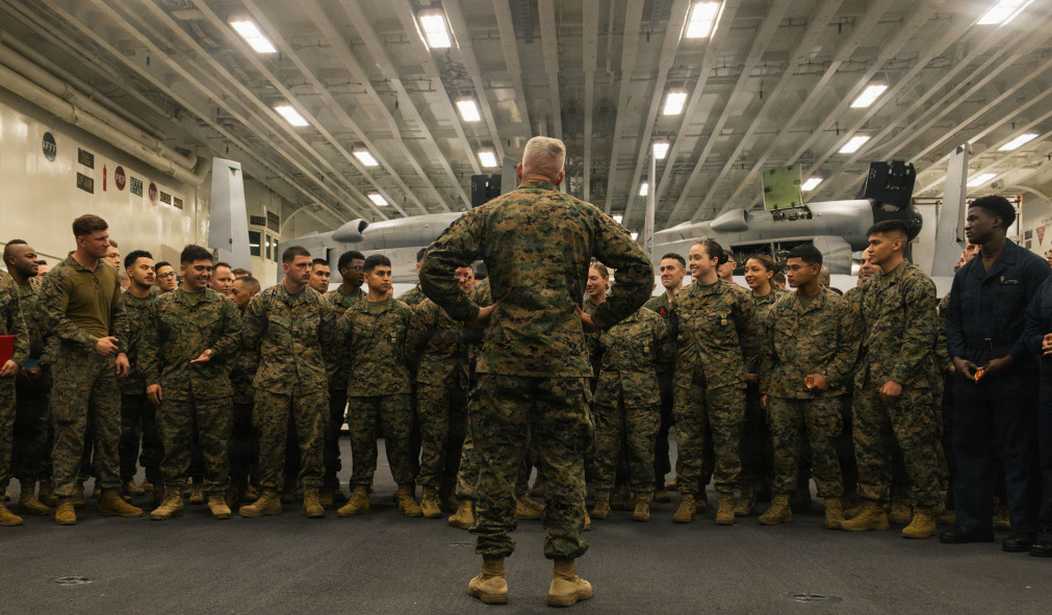
The Department of War has ordered the amphibious warship USS Tripoli and its embarked Marines to the Middle East. The order comes as the war with Iran enters its third week and after a disastrous couple of public relations days in which the administration was forced to play defense against blatantly fake news generated by Congressional Democrats with the active connivance of CNN.

The USS Tripoli, along with the USS San Diego and USS New Orleans, make up the Tripoli Amphibious Ready Group headquartered at Sasebo, Japan. Tripoli's fangs come from the 31st Marine Expeditionary Unit (MEU) stationed at Camp Hansen, Okinawa, Japan. The MEU has about 2,500 Marines, broken into a Battalion Landing Team of about 1,100 Marines and an air wing with V-22 Ospreys and helicopters. The MEU also has self-contained logistics and command-and-control capabilities.

The New York Times and other outlets are reporting that the entire Amphibious Ready Group and the MEU are headed to the U.S. Central Command area of operations. That is an assumption that, though reasonable, is not borne out by what we know. Thus far, two anonymous officials are the sourcing for that story. What is known is that the USS Tripoli with embarked Marines has been ordered into the theater. At a minimum, that will include about 1,700 Marines.

Then what?

If only one ship and part of an MEU are sent, we're looking at either an effort to signal Iran that Kharg Island and other assets have been put into play or the MEU detachment will reinforce embassies and ground installations in the region. Given that it will take a couple of weeks for the Tripoli to arrive, I would place either mission in the "not likely" category. 

If the entire MEU is deployed, then we are probably looking at action to clear the Iranian coast of the forces that have attacked commercial shipping in the Persian Gulf. I would not be shocked to see Kharg Island taken, as it has virtually no civilian population, it is easily defended, and it controls 100 percent of Iran's oil sales.

Iran's selective blockade of the Strait of Hormuz can't be allowed to continue because it sends a message that the U.S. and Israel not only failed to secure anything like a victory, but they actually made matters worse. The necessity of opening Hormuz to navigation under normal conditions is starting to drive strategic thinking about this war. Joint Chiefs of Staff Chair Gen. Dan Caine said that U.S. Central Command will continue to "destroy the Iranian Navy to ensure freedom of navigation, and this means going after Iran's mine-laying capability and destroying their ability to attack commercial vessels." It is a recognition that the destruction of Iran's navy was a necessary but insufficient means to achieve our goal of ending Iran's piracy.

There has been a lot of profoundly stupid commentary online about how difficult it would be to hold Kharg Island. That commentary seems based on the assumption that Iranian guns, to the extent they still exist, could fire on Kharg Island and be able to do so more than once. That is absolute nonsense. If we decide to take Kharg Island, the MEU will bring counterbattery radar and artillery (actually HIMARS missile launchers) with them. This also fits in with President Trump's promise that U.S. Navy ships will start escorting tankers in the Persian Gulf as we did twenty years ago during the Tanker War with Iran.

The fact that an MEU was not included in the original task organization indicates that the administration is concluding that there are things that air power alone can't do. Sometimes you need a 19-year-old infantryman with guts and a bayonet to do the job right.