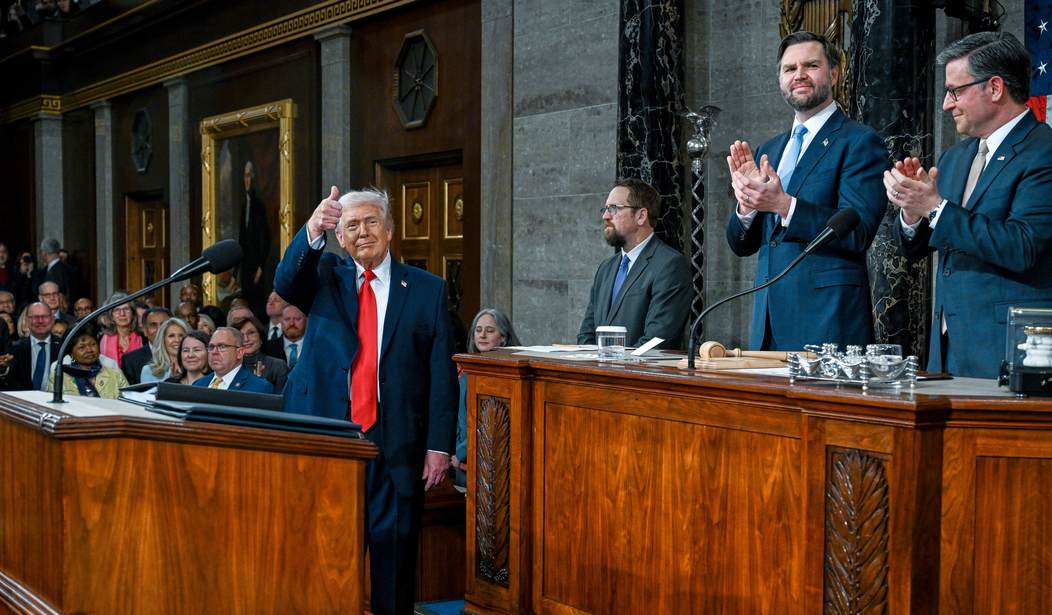
Victor Davis Hanson, an American classicist, military historian, and conservative political commentator, revealed why Operation Epic Fury isn't like the Iraq or Afghanistan War, as other political commentators, Democrats, and panicked isolationists rush to accuse the Trump administration of starting another forever war.
Victor Davis Hanson pinpoints one of the most important differences between the Iran conflict and wars the United States has lost in the past.
No one is coming to Iran’s defense and they are rapidly depleting their arms with no way to resupply them.
Iran has "a finite supply of missiles, drones, and airplanes, and they're being attrited, demolished, destroyed every day, and they're not being replenished. You can't get into Iran, you can't fly into Iran to give them more arms. So they have a finite supply while their enemies do not," Hanson said. "That's very important."
"And more importantly, what would end the war in their favor would be something like the Iraqi war or the Afghan war. In other words, they would have to kill hundreds or thousands of Americans or Israelis to create public backlash to a degree that would force the leadership to back off," he argued. "Or they would have to accomplish stunning strategic victories, maybe blow up the facilities right around the Straits of Hormuz and blockade it somehow, blow up some ships, make it impossible for 20 percent of the world's fossil fuels to get out."
"They don't seem to have the wherewithal," he added. "Each day, as I said, their stock of weapons and stock of leaders is diminishing, and there's no way to resupply it."
Hanson went on to explain that every war the United States has “lost” wasn’t due to a lack of American strength, but rather a combination of continued resupply by foreign adversaries and declining domestic public support. Neither of which is applicable in Operation Epic Fury.
"That's how we lost in Vietnam," he said. "The Chinese and Russian governments were supplying either across the border or at the port of Haiphong. And that's why we didn't win in Afghanistan, because there was an open border with Pakistan. And that's why we had trouble in Iraq. Syria was transferring weapons into Iraq."
"But this is different," Hanson added.
This comes as American and Israeli forces have unleashed devastating strikes on senior Iranian officials and military installations. Within days of the initial assault, roughly 50 high-ranking Iranian figures, including Ayatollah Khamenei, were killed, as our military continues to destroy much of the IRGC's military capacity.
Yet despite America’s overwhelming firepower, its willingness to use it, and the campaign’s glaring success, many are questioning whether this will become yet another endless war in the Middle East. The reality, however, appears to suggest the opposite, that the operation may decisively eliminate one of the principal foreign adversaries of the United States.
The left, including sitting members of Congress, love nothing more than to rail against the perceived threat of radicalized white men and "white supremacists." To listen to the likes of Hakeem Jeffries and Ilhan Omar, one can't turn a corner without encountering a gang of angry white supremacists. While they would have us believe you can find a white supremacist under any flat rock, those people sure seem pretty thin on the ground to the rest of us. I mean, my own Susitna Valley has a mostly white population, but nobody I'm aware of hereabouts much cares what color anyone is, as long as you're a good neighbor. Around here, that generally means minding your own business.
The sad and sorry fact is this: It's not right-wing political violence and terrorism that's on the rise. No, it's the left that is growing increasingly violent. These people won't mind their own business and sure won't leave us to mind ours; they are more than willing to use force to make us mind our business the way theywant. It's getting worse, and plenty of it is motivated by Trump Derangement Syndrome. Last year, the Center for Strategic & International Studies put out a report on the topic.
They find two key things:
The first half of 2025 was marked by an increase in left-wing terrorist attacks and plots in the United States, which continues a trend noticeable over the last decade. In absolute terms, left-wing incidents are on track in 2025 to reach historically high levels in the last 30 years, as shown in Figure 1.
From 1994 through 2000, there was an average of 0.6 left-wing incidents annually; in the following decade, that figure doubled to 1.3 a year. Numbers began to grow substantially, however, in 2016, and from 2016 to 2024, they averaged 4.0 a year. Through July 4, 2025 (thus excluding the Kirk attack), there were five left-wing attacks or plots, which sets a trajectory for a record-breaking year in the last 30 years.
But why, one might ask? Isn't the left supposed to be the warmer, fuzzier, more tolerant side of things? Not according to CSIS's findings.
The increase in left-wing incidents in the past decade is driven by plots and attacks directed at government and law enforcement targets. Of the 41 left-wing incidents since 2016, anti-government extremism motivated 17 of them, and partisan extremism motivated another 11. All left-wing attacks through July 4, 2025, appeared to be motivated by one of these ideologies, and the Kirk killing fits this pattern, although details about Kirk’s alleged killer are still emerging.
The only significant break from this trend was a surge of six left-wing firebombings against pro-life targets (pregnancy crisis centers and the office of an anti-abortion group) in the summer of 2022 around the time of the overturning of Roe v. Wade. These attacks were intentionally perpetrated at night against unoccupied buildings to reduce (though not eliminate) the risk to people.
My friend and colleague Bob Hoge wrote a detailed account of this report last September; read that for more.
We've seen too much of this here in the last year, including such high-profile attempts on the life of a former president, then presidential candidate, and now (again) President of the United States, that being, of course, President Trump. We've seen attacks on cops, we've seen attempts at assassination of other conservative-leaning figures, we've seen arson and riots from the left over matters ranging from immigration enforcement to abortion.
And, of course, there was the brutal assassination of Charlie Kirk, which shook a lot of us.
It seems likely that part of the reason for this rise in left-wing crime and terror is due to the very fact that the prosecutors in these very jurisdictions were the acts are happening are sympathetic to left-wing causes themselves. We've seen this across the Atlantic, where the United Kingdom stepped up security in the wake of a few high-profile jihadi attacks but have done little to nothing in response to the rising tide of left-wing violence.
While lethal violence associated with the far Right has been episodic, radical Islamist assaults have been far more common, accounting for well over 90% of terrorist related deaths over the past 25 years.
Despite this disparity, security institutions have frequently treated Right-wing extremism as comparably dangerous, reflecting pressure to demonstrate political neutrality to counter accusations of ‘Islamophobia‘. Indeed in February 2023, the Independent Review of Prevent concluded that the programme had lost its way and had left the public at risk by focusing far too much on non-violent Right-wing ideology to the detriment of where extant threats actually resided.
Left-wing militancy, by contrast, escaped similar scrutiny. After the retreat of Left-wing terror in the course of the 1980s and 1990s, Leftist violence rarely announced itself through spectacular mass-casualty attacks. Instead, it often appeared through public disorder, vandalism or targeted intimidationembedded within larger protest movements. The relative absence of headline-dominating attacks meant that it seldom featured highly on the security agendain the same way.
Militancy, yes, violence, yes, and it all starts with the rhetoric. Absent an outright incitement to violence, it's difficult to deal with speech, but acts? That's a different story, and it goes hand in hand with the problem many of these exact same jurisdictions have with increasing, non-political crime: Too many invertebrates occupying key roles in city or state justice systems. Lax prosecutions and easy sentences make the cost low enough that the violence is still appealing. In other words, the goblins, political and non-political, will take their chances, knowing that the odds are in their favor.
None of this will end well. There's the old saying explaining a key difference between left and right: The right thinks the left is stupid, while the left thinks the right is evil. And that, indeed, may be at the very heart of the issue; that ironclad conviction among the left that the right is evil, which justifies every act.
The problem, the fatal flaw in their reasoning, is this: If they stay the present course, sooner or later the thinking on the right will change, to the point where the right likewise sees the left as evil, and that is the recipe for an increasing spiral of violence.
And you know what the thing is about violence that the left doesn't know? We're better at it than they are.
Donald Trump promised to stem the flow of narcotics and drugs from South and Central America, and he’s made many moves to accomplish that: shutting down the southern border, capturing and arresting former Venezuelan dictator and drug kingpin Nicolás Maduro, vaporizing smuggling boats in the Eastern Pacific and Caribbean, and more.
Now the United States is teaming up with Ecuador to crack down on drug runners there:
Military forces from Ecuador and the United States have begun joint military operations against organized crime groups in the South American country, the Pentagon said, although as of Wednesday specific details, including the location and scope of the operation, remained scarce.
U.S. Southern Command said in a statement late Tuesday that Ecuadorian and U.S. military forces had launched “operations against Designated Terrorist Organizations in Ecuador,” calling the actions a “powerful example of the commitment of partners in Latin America and the Caribbean to combat the scourge of narco-terrorism.”
The post from U.S. Southern Command continued:
Together, we are taking decisive action to confront narco-terrorists who have long inflicted terror, violence, and corruption on citizens throughout the hemisphere.
“We commend the men and women of the Ecuadorian armed forces for their unwavering commitment to this fight, demonstrating courage and resolve through continued actions against narco-terrorists in their country.” - #SOUTHCOM Commander Gen. Francis L. Donovan.
In another post, Southern Command praised Ecuador for the partnership:
The most effective way to defeat the threat of narco-terrorism is through shared responsibility and collaboration among regional allies and partners.
- #SOUTHCOM Commander Gen. Francis L. Donovan, after meeting with Ecuadorian President Daniel Noboa and senior defense officials March 2 in Quito, Ecuador.
Organized crime and narcoterrorism have been a big problem for the country of 18 million, but Ecuadorian President Daniel Noboa has been taking steps to combat it:
The announcement comes after Ecuadorian President Daniel Noboa revealed earlier this week that his government has initiated a new phase in the fight against organized crime with joint actions alongside allied countries, as Ecuador faces a sustained wave of violence linked to crimes such as drug trafficking and illegal mining.
“Ecuador demands security, our people need to live in peace,” said Noboa, adding that military and police forces will be involved in the operations he described as “very important.”
Obviously, there is a much bigger U.S. operation going down in Iran, but this is important nonetheless because Donald Trump and Secretary of War Pete Hegseth promised to be proactive against the drug scourge rather than reactive, as we’ve been for far too long.
With the moves he’s made since his inauguration in January 2025, he’s showing that he meant what he said.
TEHRAN — Following the death of Ayatollah Ali Khamenei and a significant portion of the nation's leadership, the Assembly of Experts, charged with choosing the next Ayatollah, have opted to appoint a new supreme leader who is already dead.
"He's just going to end up dead anyway," said noted Assembly of Experts member Aziz Mahabad shortly before he was taken out by a tomahawk missile. "So in a way, our new supreme leader is invulnerable. America can do nothing to him."
Iran's new leader, Ayatollah Fulān, is reportedly the corpse of an unidentified male who they believe possesses a keen masculine energy. "We don't know who Fulān was before, but he's really doing a dynamite job so far, no pun intended," said interim President Masoud Pezeshkian shortly before he was blown apart by a stealth bomber. "He hasn't ordered anyone to be tortured or beheaded at all. He might be our greatest supreme leader ever!"
According to American sources, Secretary of State Marco Rubio has already met with Supreme Leader Fulān on two separate occasions. "He has a great silent wit," Rubio said. "I think negotiations are going well and we may soon see an end to this conflict."
At publishing time, American forces received a significant blow to morale when Supreme Leader Fulān was bombed, but remained in control of his government.
Secretary Pete Hegseth and Joint Chief’s Chairman Dan “Razin” Caine hold a press briefing to outline the latest developments in Operation Epic Fury.
As day #4 unfolds, Secretary Hegseth notes the U.S. and Israeli Airforce are now in complete command of the skies above Iran. The capacity of Iran to launch missiles and drones is shrinking rapidly. Additionally, the Iranian navy continues to be targeted and destroyed.
General Dan Caine outlines the specifics of the targets and forces deployed.WATCH:
Treasury Secretary Scott Bessent appears on CNBC to discuss the Trump administration policies that were proactively deployed during Operation Epic Fury.
The goal of global financial stabilization is actually part of the strategic planning within the White House, including Treasury, Energy and Interior in alignment with the State Dept., Pentagon and national security agencies. Part of that plan was the announcement for the U.S. to underwrite maritime insurance to ensure a minimal disruption to the global energy markets.
Secretary Bessent discusses the insurance facet at the 3:00 minute mark of the video below. WATCH:
Force Majeure is a common clause in contracts which essentially frees both parties from liability or obligation when an extraordinary event or circumstance beyond the control of the parties, such as a war, strike, riot, crime, epidemic, or sudden legal change prevents one or both parties from fulfilling their obligations under the contract.
People would be well advised to wait a few days when announcements are made before jumping to immediate conclusions. The announcement by Qatar Energy of a force majeure notification did not originate from Qatar’s inability to produce contractual LNG supplies…..
…. two days prior to this announcement, India’s top gas importer Petronet LNG Ltd issued a force majeure notice to Qatar Energy and local buyers because its LNG tanker ships were unable to reach the Ras Laffan load port due to the crisis in the Middle East. Without ships arriving to take the LNG Qatar Energy cannot keep producing.
Qatar Energy operates 14 liquefied natural gas (LNG) trains with a total annual production capacity of 77 million tonnes {SOURCE}. If ships don’t reach the terminals, there’s no need for Qatar Energy to keep pumping and liquifying from well heads. It’s a downstream issue.
Bahrain made the same announcement for their refined aluminum exports {SOURCE}. Indonesian company Chandra Asri made the same announcement for petrochemicals {SOURCE}. Chevron made the same announcement two days ago after Israel shut down the Leviathan natural gas field {SOURCE}. Thus, we see the ramifications for the entire region around the Iran conflict zone and the downstream destinations (Asia and Europe) for energy products therein.
Dutch shipping company Maersk has also suspended operation for cargo container ships cancelling all bookings between the Indian subcontinent—India, Pakistan, Bangladesh and Sri Lanka—and the Upper Gulf. {SOURCE} German shipping group Hapag-Lloyd made the same decision.
These are not decisions being made due to maritime insurance or reinsurance rates or availability. These are decisions being made by private corporations that go beyond their actuarial risk. They simply don’t want to operate in a region where there is the potential for loss of life or cargo.
This is not solely an insurance issue and people should pause before offering analysis that only considers the financial aspect.
MAERSK -Maersk announced on Wednesday that it is temporarily suspending most cargo reservations in and out of Iraq as security worries mount throughout the Gulf.
The business said that the ban applies to shipments involving many regional nations, including the UAE, Oman, Kuwait, Qatar, Bahrain, and Saudi Arabia.
Maersk said that the measure would stay in effect until further notice. The firm did not disclose any more information on how long the disruption will endure or the scope of the operating effect.
The decision comes as increased tensions and military action in the Gulf area have prompted worries about the safety of maritime routes and logistical operations, hurting commerce flows via many Gulf nations. (LINK)
Susan Kokinda and the Lyndon LaRouche network give their perspective on the British reaction to the U.S. strikes against Iran. The analysis has some value from a review of the historic relationship of the British imperialist policy toward matters of foreign entanglement and the control mechanisms that have historically flowed from the U.K
As a consequence of British government policy much of the Kokinda analysis accurately touches on the root cause of U.K response. However, the emphasis on the modern UK government as the lead of a global control network is not always as severe or complicated as the Lyndon LaRouche network would espouse.
Prior to visiting the White House, German Chancellor Fredrich Merz had just returned from China and gave a press conference in Germany saying Germans need to “work harder” and “ditch the four-day week” to compete.
Merz visit to Shenzhen shocked him, and he is right to be rattled by the cold indifference of Chairman Xi Jinping. This was Merz first visit to meet Chairman Xi in person. A cold and productivity focused Merz just met an even colder and more productivity focused industrial giant.
Merz met the industrial dragon and returned home visibly shook. The Chancellor thought he represented an apex industrial nation. However, he experienced something far more industrial than he ever imagined.
As noted by Nina Schick:“Take Germany’s famous auto industry, 5% of GDP, 800,000 jobs, but losing ground fast. VW’s market share in China has plunged from 24% to 15% in four years. Chinese brands doubled their European market share in 2025 and now outsell Mercedes on the continent. Germany lost 120,000 industrial jobs last year. And cars are just the most visible example.
But it’s not just competition. Germany has some of the highest industrial energy prices in the world, nearly triple what the US pays. After shutting down nuclear and losing cheap Russian gas via Nord Stream, Berlin built its first LNG terminal in 194 days. Now 96% of the LNG arriving at those terminals comes from the US. (That LNG is even more important in light of events in the Gulf….)
The US is Germany’s second-largest trading partner (€240 billion in two-way trade last year.) German auto exports to the US fell 18% in 2025 under tariffs. Merz cannot afford a trade war with Washington. Today, he watched Trump threaten to cut off all trade with Spain, while sitting next to him in the Oval Office. He backed him up.
Now look at how Merz is positioning on Iran. Spain blocked the US from using its bases. Sánchez called the strikes “unjustified.” Starmer hesitated before eventually allowing UK bases for “defensive” strikes. Merz is the first EU leader invited to the White House for a tête-à-tête with Trump.
Days before, he said legal assessments under international law “achieve relatively little” and that now is “not the time to lecture allies.” Compare that to Sánchez insisting Spain’s agreement with the US “must operate within the framework of international law.” From a German chancellor, Merz’s position is seismic.
And none of this is separable from home. Germany’s economy is in its fourth year of industrial contraction. An aging population, a shrinking workforce, sky-high welfare costs, and an immigration debate that’s handing the AfD seats on a plate. Merz needs the US relationship, because it’s one of the levers he has left to keep the economy blowing in the right direction.
All of this points to a Germany that’s understood its critical vulnerabilities and is pursuing a hard-nosed realpolitik in response. To stay industrially competitive, they need American LNG. They need access to US compute and critical hardware. They need EU member states to spend on defense: something Trump has been remarkably effective at unleashing.
The result is an astonishingly pro-Trump German chancellor. In a country where only about 15% of the population views Trump favorably. The question isn’t whether Merz has realistically assessed Germany’s vulnerabilities (he’s starting to see the bigger picture). It’s whether this wins or loses him votes at home. And on that, my guess is it won’t. {LINK}
Fredrich Merz thought he was an apex predator, until he met Xi Jinping.
Suddenly, Merz looks at the unpredictable Trump, an apex predator who swims around Chairman Xi as if it’s just another boring Tuesday, with an entirely new perspective.
Chancellor Merz realizes that this rather unorthodox American President likely possesses the only qualified skillset that can deal with a REAL apex predator like Xi.
Fredrich Merz dismounts his EU high horse and uppishness turns into respect.