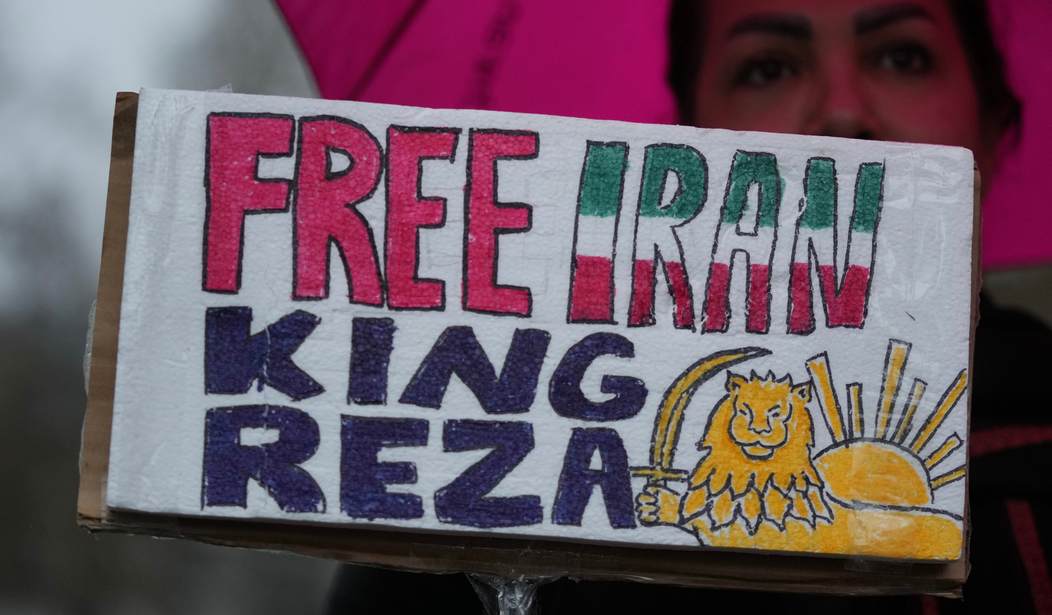
Ever since Iran’s “Islamic Revolution” succeeded in erecting a theocratic regime whose leaders condemn America as the “Great Satan,” call for “death to America,” and kill American soldiers, a question has hung in the air: How many years would the United States tolerate an Islamic dictatorship that murders American citizens, threatens America’s economic interests, and annually celebrates having held fifty-two Americans hostage for four hundred and forty-four days by burning American flags? The answer might be forty-seven.
As is his wont, President Trump appears to be grabbing the status quo by its ear and squeezing it as it squeals in pain. The theocratic police state that has brutally run Iran for nearly a half-century has also financed, provided material support for, and carried out more acts of terrorism around the world than any other nation. Iran’s agents have murdered civilians on every populated continent and murdered members of America’s Armed Forces on both land and sea. Iran’s Islamic terrorists don’t build; they bury roadside bombs meant to mangle the bodies of unfortunate travelers. Iran’s Islamic terrorists don’t support free trade; they seize private maritime vessels and mine international shipping lanes. Iran’s Islamic terrorists don’t seek peace; they demand the nuclear destruction of Israel and the United States.
President Obama begged the Iranians for mercy by conceding to the terrorist regime’s every demand in a lopsided nuclear “deal,” handing the Islamic theocrats billions of dollars in cash, and betraying American victims of Iranian terrorism whose court judgments have never been satisfied. The Obama and Biden administrations were so desperate to prop up Iran’s Islamic tyrants that the Democrats bent over backwards to appease terrorists who celebrate the slaughter of Americans.
President Trump has chosen a different path. In the forty-seventh year of a destructive Islamic terror-state, America’s forty-seventh president has decided that governments celebrating the deaths of Americans should not be allowed to exist. Trump gave Iran’s “Supreme Leader” Ali Khamenei numerous chances to submit to American demands. Khamenei chose “death to America,” so now Khamenei is dead. This continues a trend in American military posture over the last several months. After giving Venezuelan dictator Nicolás Maduro the chance to choose exile (an opportunity he refused), President Trump snatched him up in the middle of the night and likely ended twenty-seven years of communist rule in one of the Western Hemisphere’s most important countries. By quarantining the waters around Cuba and preventing oil shipments from reaching the island nation, President Trump’s actions may lead to the collapse of a communist regime that has been in power for sixty-seven years. When Trump’s carrots don’t work, he pulls out big sticks.
From a position that prioritizes America’s strategic interests, these actions were long overdue. After all, it has always been a bit incongruous for the United States to project “superpower” and “unipolar” strength, while appearing seemingly incapable of squashing Iran’s Islamic terrorists or the advance of communist regimes within America’s own backyard.
As the world changes quickly and likely becomes more dangerous for the foreseeable future, President Trump has decided that it’s time to “settle all family business.” That famous movie line — from Mario Puzo and Francis Ford Coppola’s masterpiece The Godfather — seems appropriate for these circumstances. In the film, Al Pacino’s Mafia don utters it after having successfully taken revenge against every party that had ever injured his family. Today, America’s “Don” is patiently, methodically, and strategically doing the same thing. Although his political enemies have abused the “justice” system to investigate him frivolously, secure improper convictions, and tarnish his reputation, President Trump is no criminal. But he is a bit of a “gangster,” in the sense that he knows how to use America’s reputation for strength in a way that protects American lives. When America’s enemies consider harming Americans away from home, they must now look up the street to see if President “Don” is already swinging his nail-spiked bat. Unlike some of his invertebrate predecessors, Trump understands that effective deterrence requires the biggest, baddest dude on the block to deliver an occasional beating.
While President Trump’s warnings to Venezuela, Cuba, and Iran have not been mere bluster, his actions against those countries’ leaders are not the products of mindless rage either. Look around at where the world is heading. Whether we are ready for it or not, the global technology landscape is rapidly changing. The era of Artificial Intelligence is here, and it will likely change everything. Not only are we already seeing how AI will replace human jobs in almost every professional field, but also we have begun to see how AI will dramatically reshape the battlefield. Reports indicate that AI may have assisted Delta Force operatives in their mission to extract Maduro from his heavily fortified Caracas compound. AI-operated “drone swarms” have hunted targets in Russia and Ukraine. AI systems are already curating online information, policing social media platforms, and assisting in state-directed information warfare. The U.S. Department of War is integrating AI across military platforms.
As U.S. military planners quickly adapt to technological innovation in order to stay ahead of enemies and adversaries around the world, long-term strategic worries mount. Can the advantages of AI be effectively corralled, or will AI also become an effective and deadly tool for hostile regimes? One of the lessons learned during the War in Ukraine has been that relatively inexpensive drones can cause colossal damage to weapons systems that cost billions of dollars. If guerrilla insurgents (or rogue regimes or terrorists) with minimal resources can inflict tremendous damage upon superior fighting forces, then the limitations of asymmetric warfare go out the window. If AI proliferates across the globe, then presumably nuclear proliferation follows, too. We are heading toward a future when AI, drones, and even inexpensive autonomous robots will likely minimize the disparate military lethality of poor and wealthy nations.
With such an unpredictable future headed our way, President Trump is settling the American family’s past business before old foes have a chance to transform into something even more threatening. He is urgently addressing American vulnerabilities around the world. His actions reveal intent to prepare for the worst-case scenarios rapidly heading our way. His attack on Iran should be seen through this lens.
Consider the geopolitical chess moves that President Trump has made in his first year back in office. He has reasserted the Monroe Doctrine and is actively building “Fortress America” in the Western hemisphere. He is strengthening economic and military alliances with regional powers such as Japan, India, Israel, Saudi Arabia, Argentina, Poland, and Hungary. He is working to neutralize hostile regimes that threaten global fuel supplies and international shipments. He is expanding American control over regions of the world with abundant supplies of hydrocarbon energies and other natural resources that have become only more critical in the emerging AI age. He is even looking for ways to cooperate with the Russian Federation, create economic ties with long-term adversaries, end unnecessary wars, and build the foundations for some semblance of peace. President Trump is right now preparing the United States for an uncertain future in much the same way that an industrious squirrel stores nuts to survive the harsh winter ahead.
Attacking Iran comes with risks. Only time will tell whether this military operation makes America safer and the world more stable. Ask yourself this, though: What is it that the president sees down the road that has convinced him to take action against Iran right now? As with all decisions that come from the Oval Office, there’s always much more to the story than what is plainly visible. Threats are growing. Uncertainties are exploding. President Trump is battening down the hatches because the storm outside is brewing. He seeks future peace through present strength.