Friday, February 6, 2026

Trump Can End America’s Immigration Chaos — If Congress Is Forced to Act


Washington treats America’s immigration crisis as if new laws are required, even though the real problem has always been accountability. The truth is simple: we already have laws and a border. For decades, Washington refused to enforce them. President Trump is the first president in a generation to draw that line and enforce the law without blinking, restoring resolve to the Oval Office.

As the 2026 midterms approach, President Trump is in a position no modern president has held, a rare opportunity to permanently fix America’s decades-long immigration dysfunction. This moment did not arise from a policy workaround or legal maneuver. It is the direct result of the collapse of every escape hatch Congress relied on to avoid responsibility. The era of lawmakers outsourcing immigration reform to executive orders, activist courts, and bureaucratic non-enforcement is over.

The failure is clearest with Deferred Action for Childhood Arrivals (DACA). After Congress refused to act, the Obama administration created the program by executive action in 2012, granting temporary deportation protection and work permits to certain individuals brought here as children. But DACA lacked congressional approval, permanent legal status, and meaningful enforcement mechanisms to ensure accountability. Democrats used it to justify broad non-enforcement. Republicans used it as an excuse to avoid legislating. Dreamers were left in permanent legal limbo, governed by court orders instead of law. That workaround is now collapsing as courts make clear that executive action is no substitute for statute, with the Fifth Circuit declaring DACA unlawful.

At the same time, a majority of Americans support permanent legal status for DACA recipients when tied to clean records and contribution — a clear signal that voters want Congress to do its job.

That reality gives President Trump leverage no modern president has ever had. He can credibly say what previous presidents avoided: this cannot be solved by executive orders, memos, or lawsuits anymore. Congress must do its job.

There is also an undeniable collapse of blue-state governance driven by the illegal immigration crisis. For years, Democrats hid behind sanctuary labels and moral slogans, insisting compassion is a policy substitute. This fiction collapsed when bills were due. Cities are now absorbing sharply increased costs across schools, hospitals, housing, and emergency services, forcing cuts to core public services to close widening budget gaps. New York City estimates taxpayers will pay over $10 billion over three fiscal years for the illegal immigration crisis. After spending billions on shelter, food, healthcare, and emergency services for illegal immigrants, the city imposed across-the-board cuts. It is clear that unlimited illegal immigration is unsustainable when even progressive mayors like then-New York City Mayor Eric Adams publicly warned that their cities could not absorb these costs without federal intervention. This strips Democrats of their favorite talking point, that enforcement is unnecessary or cruel. The truth is, disorder is expensive.

This is where the generational opportunity becomes clear. President Trump can force immigration reform back to Congress by refusing new executive workarounds and tying federal funding to legislative action.

The real divide in Washington is whether there is the political courage to fix the illegal immigration crisis created by the Biden administration. After flooding the border with tens of millions of illegals, Democrats are demanding amnesty. Senate Majority Leader Chuck Schumer recently made that explicit, calling for the mass legalization of this population, locking failure into law.

Americans cannot support amnesty under any circumstances. Those who crossed the border illegally under the Biden administration face a clear choice under the Trump administration: voluntary departure or removal. Any other approach permanently destroys the credibility of our immigration system by rewarding lawbreakers and guaranteeing another surge of illegal immigration in the future.

There is a solution if Congress does its job by legislating. Lawmakers should grant DACA recipients’ permanent status, conditioned on proof of long-term residency, clean criminal records, full background checks, and education, work history, or military service. For anyone else who entered illegally under the Biden administration, the only relief should be departure. Immigration reform only works when Congress gets the sequence right and enforces the law.

We have seen Washington get it backward before. In 1986, Congress passed the Immigration Reform and Control Act, granting amnesty and legal status to millions of illegal immigrants while promising enforcement would follow. It never did. The message was unmistakable: get in, wait long enough, and legalization will come. Amnesty first, enforcement never, and American communities paid the price.

That history is why order matters now and why the filibuster cannot continue to shield lawmakers from accountability.

This is the real governance test Washington has avoided for decades. Immigration will not be fixed until Congress is forced to act. This is Trump’s once-in-a-generation chance to end the cycle and make reform permanent.


Podcast thread for Feb 6


Let the games begin.

If Trump Fills A Supreme Court Vacancy, Here Are Three Suggestions


This past weekend, conservatives celebrated the twentieth anniversary of the confirmation of Justice Samuel Alito. The rest of the country should have joined the celebration. One of the most respected conservative decisions of the George W. Bush Administration, Justice Alito’s appointment signaled the first real step by Republicans to place real, reliable conservative jurists on the bench.

Justice David Souter had failed President George Herbert Walker Bush, and Chief Justice John Roberts has been a hit-and-miss disappointment. With Justice Sandra Day O’Connor’s resignation (another Republican nominee who turned liberal on the court), Bush 43 had a chance to shift the court in the right direction. His first nomination, White House Attorney Harriet Miers, was a massive failure, a circus of moral cowardice trying to avoid a contentious confirmation process. To save face and shore up Republicans’ declining chances for the 2006 elections, Bush needed a winner.

Enter Samuel Alito, sometimes nicknamed “Scalito” for his conservative leanings. Unlike Roberts, he had a clear pro-constitution record of jurisprudence. As expected, he faced unprecedented attacks on Capitol Hill, similar to what Robert Bork and Justices Thomas and Kavanaugh faced during their confirmation hearings. Facing Alito, Democrats recognized that they could be losing a somewhat reliable liberal jurist for a more right-leaning justice and court to follow.

Thankfully, Bush 43 held his ground. Despite the filibuster rules still in effect for judicial nominees, the Republican Senate (55-45) achieved a cloture vote with willing Democrats (a number of whom still represented conservative states in the South and the Midwest). The Senate finally confirmed Alito 58-42, viewed at the time as close and contentious.

When Alito was sworn in, Democrats and liberal pundits hoped that he would turn into another Souter-O’Connor disappointment. To progressives’ chagrin and conservatives’ acclaim, Alito has voted reliably to restore constitutional norms through strict construction and originalist interpretation of the Constitution. He authored the stunning and much-needed Dobbs v Jackson decision, reversing the abortive (pun intended) Roe v. Wade, and he has consistently urged revisiting and reversing other rulings with damaging precedents.

George W. Bush may have failed on many policy issues during his term of office, but Alito’s confirmation (along with his ongoing legacy of tax cuts) makes up for those losses.

Twenty years later, Alito (75 years old) and Thomas (77) have established a remarkably constitutionally conservative bulwark for future courts. But the question remains: How much longer can they hold their seats on the court before time and chance take them from us? Granted, Alito and Thomas remain in good health, with no record or reports of major health challenges, and we hope they continue that way, but one or both may be eying retirement.

Advertisement

Still, Republicans should be wise, not allowing conservative justices to linger on, only for them to pass away during a Democrat Presidential administration. Would we want a possible President Newsom or Shapiro to replace Thomas or Alito?

If most conservatives had their way, Chief Justice John Roberts would have been replaced by now. His horrid failures on Obamacare and his insistence on maintaining precedent have slowed restorative efforts to rectify the country’s checks and balances. The court needs a Chief Justice who will demonstrate not just leadership and advocacy for judicial independence, but also restore constitutional preeminence against branch supremacy. Justice Roberts still fights to maintain stare decisis, even though the Framers of the Constitution never intended for judicial rulings to supplant the legislative branch.

Chief Justice Roberts is a spry 71-year-old but might grow tired of getting outvoted by his conservative colleagues. Now is a good time for Trump to consider future nominees.

To set up the best short-list, Trump should consider Justices Thomas’s and Alito’s former clerks. If they have been appointed to federal district or circuit courts, even better. The candidates would most likely demonstrate respect for originalism, strict construction, and constitutional restoration, since a caseload of judicial precedents needs to go: Obergefell v Hodges, Griswold v ConnecticutLochner v. New York, etc.

Are there any likely candidates already?

Last week, Trump joked about nominating US Senator Ted Cruz (R-TX). It’s not a silly idea at all. He’s young (or at least young enough at 55) and in good health and standing. He boasts a commanding legal pedigree as a Harvard Law graduate, receiving praise from staunch liberal professor and civil rights attorney Alan Dershowitz. He also clerked for Chief Justice William Rehnquist (a decent conservative who voted against Roe v Wade). As Solicitor General for the state of Texas, Cruz argued nine cases before the Supreme Court, one of the longest records in modern history for a U.S. senator. Assuring his credentials as a constitutional restorer, Cruz has repeatedly criticized the courts’ judicial activism, including the same-sex marriage decision Obergefell v Hodges.

Cruz’s sharp mind will not only ensure conservative constitutional rulings but also help direct the court back to its true original founding and meaning. Trump may be overestimating Democrat designs to remove him from the US Senate, but his Republican colleagues would be more than happy to promote him out of the upper chamber.

Which other high-profile nominees could President Trump consider?

US Senator Mike Lee of Utah would be a fantastic choice. He’s not only a great conservative, but he’s also a staunch constitutionalist. Senator Lee clerked for Justice Alito, both when Alito served on the Third Circuit Court of Appeals and on the Supreme Court. Lee comes from a long line of legal minds. His brother served on the Utah State Supreme Court. As far as character is concerned, Lee took out a RINO incumbent US Senator during the Tea Party Wave of 2010, and he has voted consistently on that record. He has authored several books onconstitutional jurisprudence. And like his US Senate colleague from Texas, he’s relatively young!

Another nominee, and this might be a long shot, but worth considering: Florida Governor Ron DeSantis. Disaffected conservatives turned off by Trump’s first-term failures and/or supposed unelectability switched to DeSantis during the 2024 primary. Because MAGA voters resent him for (in their view) betraying Trump and challenging him, DeSantis may have burned too many bridges with the Republican grassroots to have another chance at the Presidency. If the retiring Florida Governor’s presidential ambitions are gone for good, President Trump should consider him for the Supreme Court.

Governor DeSantis has a broad understanding of our constitutional principles and history. He wrote an extensive treatise about our Founding Fathers and the constitutional principles of our Republic. In his speeches, governing philosophy, and policy wins, DeSantis has restored and furthered respect for the natural law and natural rights basis of American jurisprudence.

He’s also very young, active, and undeterred in his commitment to America’s moral vision and values.

No matter who Trump nominates to the Supreme Court (if there is a retirement), Trump has nothing but good options available. US Senator Ted Cruz has a commendable record and a fearless spirit. US Senator Mike Lee is a grounded and well-rounded legislator. DeSantis is not afraid to shift culture with legal power.

Each of those candidates has the record, rhetoric, and character to be Trump’s next Supreme Court nominee.


Moral Universalism and the Minnesota Lesson

In the West, it is a widespread belief that everybody else in the world shares our perception of right and wrong, 

but nothing could be further from the truth.


As highlighted by non-Western immigration, the West’s crisis is primarily about the loss of confidence in its own moral and civilizational foundations. The “fault line,” in Samuel Huntington’s terminology, is the fateful encounter between a civilization that doubts its very right to exist and rival moral systems unaccustomed to doubt altogether.

Modern Western liberalism rests on a deceptively simple premise: that human beings, regardless of origin or creed, will respond to freedom, generosity, and equality with reciprocal goodwill. From this assumption flows an expansive immigration regime, a permissive multicultural ethos, and a political culture that treats skepticism as prejudice and prudence as moral failure. Yet the growing tension between liberal democratic norms and Islamist political ideology exposes the fragility of this moral universalism. The collision between a self-doubting West and a political theology that does not share its premises about equality, citizenship or truth actually poses an existential challenge.

The West once understood itself as the bearer of a particular civilizational inheritance that nevertheless made universal moral claims. Its universalism was not abstract but rooted—emerging from specific historical experiences, religious traditions, and institutional forms. Today, however, Western elites increasingly mistake universalism for interchangeability. They deny that civilizations differ meaningfully in their moral assumptions or political consequences. In doing so, they abandon the cultural confidence that once allowed the West to extend hospitality without fear of dissolution.

Political Islam—Islamism—is usually distinguished from Islam as a private religion. The former stands for more than heightened religiosity or cultural conservatism. It is a comprehensive political worldview that subordinates civil law to religious authority, rejects the moral equality of believers and non-believers in governance, and understands political legitimacy as derived from divine command rather than popular consent. Liberal democracies err gravely when they assume that such a worldview can be neutralized by welfare benefits, civic education or symbolic inclusion alone. Ideologies are not dissolved by kindness; they are challenged by rival moral clarity.

This error is not accidental. Liberalism, especially in its post-Christian and post-national form, has lost confidence in its own moral foundations. It nonchalantly treats all value systems as functionally equivalent, all conflicts as misunderstandings, and all resistance as the product of exclusion or trauma. Moral relativism, once a tool of anthropological humility, has become an instrument of political paralysis. A society that refuses to judge cannot defend itself. The result is not tolerance but blindness—an inability to recognize when liberal norms are being exploited by actors who do not reciprocate their moral commitments.

Europe offers the clearest warning of this dynamic. Its struggles with parallel societies, communal voting blocs, speech restrictions imposed in the name of tolerance, and the quiet erosion of secular public space are dismissed as cautionary tales exaggerated by reactionaries. Yet Europe is not destiny; it is diagnosis. Its predicament reveals what happens when civilizational self-confidence collapses and is replaced by administrative humanitarianism. The lesson is not inevitability but consequence.

The Minnesota experience provides a microcosm of this broader Western failure. Over several decades, state and federal authorities pursued an aggressively humanitarian resettlement strategy, motivated by compassion and moral idealism. Yet compassion untethered from realism becomes an instrument of self-deception. Persistent reports of welfare fraud, clan-based political organization, and resistance to assimilation have been treated, not as governance problems but as taboo subjects. Institutions trained to interpret all disparities through the lens of victimhood are structurally incapable of asking whether certain cultural or ideological frameworks actively undermine liberal expectations of transparency, equality, and civic trust. 

At the heart of the matter lies a fundamental philosophical mismatch. Liberal democracy presumes that citizens are equal before the law, that truth is not contingent on group loyalty, and that political authority is limited, accountable, and ultimately secular. Islamist political thought, by contrast, divides the world into believers and non-believers, privileges communal allegiance over individual conscience, and sanctions strategic deception in service of religious or collective goals. These principles are not fringe distortions; they are embedded in classical jurisprudence and selectively revived by modern Islamist movements. To acknowledge this is not bigotry; it is intellectual honesty.

Western elites persist, nonetheless, in treating all moral systems as morally interchangeable. This is why appeals to shared “values” ring hollow. Values are not abstractions floating free of history; they are embodied in institutions, habits, and moral expectations shaped over centuries. When Western officials assume that newcomers will naturally internalize liberal norms simply by exposure, they confuse procedural inclusion with moral convergence. In reality, moral systems compete, and the one that doubts itself most fervently is rarely the one that prevails.

The political ascent of figures such as Ilhan Omar illustrates this tension vividly—not as evidence of conspiracy, but as a symbol of elite moral confusion. Omar is frequently presented as proof that American institutions are inclusive and representative. Yet her public rhetoric and policy positions consistently express hostility towards American power, Western moral authority, and the legitimacy of national cohesion itself. Criticism of these positions is routinely deflected by appeals to identity, as though religious or ethnic background confers immunity from civic scrutiny. This dynamic exemplifies a deeper dysfunction: the substitution of symbolic representation for substantive loyalty to constitutional principles.

It is neither conspiratorial nor xenophobic to recognize that political Islam operates globally as a rival civilizational project. Like all such projects, it adapts tactically to local conditions. In liberal societies, this means working within legal frameworks while rejecting their underlying moral legitimacy. The expectation that such movements will abandon their long-term ambitions out of gratitude misunderstands the nature of ideological commitment. Liberal goodwill is not universally interpreted as virtue; in some moral frameworks, it is perceived as weakness, decadence or proof of civilizational decline.

This brings us to the unresolved question beneath all immigration debates: is morality universal, or is it culturally mediated? Liberalism insists on universality while simultaneously denying the cultural foundations that once sustained its claims. It demands tolerance for all value systems except those that assert their own superiority—yet cannot explain why its own moral commitments deserve allegiance if they are merely contingent preferences. If morality were truly self-evident and universal, there would be no need for civic education, cultural transmission or moral boundaries. The very existence of liberal institutions testifies to the opposite.

The West’s Judeo-Christian inheritance—disavowed but never fully replaced—once supplied a moral grammar emphasizing truthfulness, individual dignity, and the limitation of power. As this inheritance erodes, liberalism loses its immune system. It becomes incapable of distinguishing between difference and danger, pluralism and fragmentation. In such a state, it welcomes rivals not as guests, but as heirs—without ever asking whether they accept the moral terms of the household. 

None of this implies that Muslims as individuals are incapable of loyalty or citizenship. Some are exemplary citizens who embrace liberal norms sincerely. The issue is whether Western societies are willing to articulate non-negotiable civic expectations and enforce them without apology. A democracy that cannot say “no” is not tolerant; it is negligent. Integration is not a one-way moral obligation imposed on the host society. It is a reciprocal process requiring adaptation, accountability, and allegiance to the constitutional order.

The Minnesota case, then, is not an anomaly but a warning. It reveals what happens when humanitarian impulse is severed from political realism, when ideology is mistaken for culture, and when elites confuse moral aspiration with moral achievement. The lesson is not to abandon compassion, but to discipline it with prudence. Liberal democracy can survive diversity. However, it cannot survive the systematic denial of its own civilizational limits.

Ultimately, the question is not whether the West should be generous, but whether it should be honest. A society unwilling to defend its principles will eventually lose them—not to superior arguments, but to its own refusal to recognize that not all worldviews seek coexistence on equal terms.

The tragedy of the West is not that it is being challenged. The natural order of the world is that every civilization—like a “living organism,” to quote Oswald Spengler—must fight for its survival sooner or later. No, the tragedy is that the West no longer believes itself worth defending. As if determined to die.


🎭 𝐖𝟑𝐏 𝓓𝓐𝓘𝓛𝓨 𝓗𝓾𝓶𝓸𝓻, 𝓜𝓾𝓼𝓲𝓬, 𝓐𝓻𝓽, 𝓞𝓟𝓔𝓝 𝓣𝓗𝓡𝓔𝓐𝓓


Welcome to 

The 𝐖𝟑𝐏 𝓓𝓐𝓘𝓛𝓨 𝓗𝓾𝓶𝓸𝓻, 𝓜𝓾𝓼𝓲𝓬, 𝓐𝓻𝓽, 𝓞𝓟𝓔𝓝 𝓣𝓗𝓡𝓔𝓐𝓓 

Here’s a place to share cartoons, jokes, music, art, nature, 
man-made wonders, and whatever else you can think of. 

No politics or divisive posts on this thread. 

This feature will appear every day at 1pm mountain time. 


Trump Takes a Sledgehammer to Deportation Process and Sets Up a Court Fight With Another Activist Judge


RedState 

The Trump administration will publish a notice in the Federal Register on Friday that will demolish the slow-moving process of deporting illegals. The proposed rule aims to streamline the current process and reduce the backlog of cases that has nearly brought the system to a screeching halt. That said, we know it faces an uphill fight as federal judges, acting without jurisdiction, will certainly declare the changes improper at some point.

The Federal Register notice titled RIN 1125-AB37, Appellate Procedures for the Board of Immigration Appeals, extensively overhauls the current process that could lead an immigration case to the Supreme Court.

The first part of the system seems to remain intact. An apprehended illegal is brought before an Article 2 Immigration Judge and given a hearing. The judge either lets them stay or tells them to go home. If ordered deported, a removal order is entered. As we're seeing from the cases popping in the news, it is not uncommon for an illegal apprehended today in Minneapolis, perhaps a contractor working for the Quality Learing Center, to have a removal order dating back two decades.

Breaking the logjam at the Board of Immigration Appeals is the target.

The filing lays out how Trump 1.0 tried to fix the problem.

Among other changes, the Appellate Procedures NPRM proposed: (1) simultaneous briefing schedules for both detained and non-detained appeals before the Board; (2) shortening the reply brief deadline; (3) limiting briefing extensions; (4) harmonizing the 90- and 180-day Board adjudication timelines to both start from when the record is complete; (5) limiting the Chief Appellate Immigration Judge’s ability to hold a group of cases while awaiting certain outside actions; and (6) removing the process for Immigration Judge review of proceeding transcripts.  

How it was sandbagged by district judges.

The Appellate Procedures Final Rule’s effective date was January 15, 2021, but the rule was preliminarily enjoined on March 10, 2021, before its measures were implemented fully.  

 And how the Biden administration just ignored the issue.

The Department finalized that rule in May 2024.  See Efficient Case and Docket Management in Immigration Proceedings, 89 FR 46742 (May 29, 2024) (“ECDM Final Rule”).  As a result, the relevant regulatory provisions of the Appellate Procedures Final Rule that are further addressed in this IFR were rescinded, and the relevant regulatory text was generally returned to its pre-Appellate Procedures Final Rule baseline.  

These are the big changes.

The new regulation will "change the deadline for filing an appeal with the Board from 30 to 10 days, except for cases involving certain asylum applications." This is not as trivial as it could appear. The current filing fee for the BIA is $1,030. There are provisions for filing "in forma pauperis." This requires jumping through more hoops to prove you are indigent. The illegal now has 10 days to find representation and prepare an appeal, as well as pony up money. Historically, claiming you are broke is a good way to get the next flight back home.

Once you appeal, there is no requirement that the BIA will hear the case. Rather, "the default will be summary dismissal unless a majority of current Board members vote to consider the appeal on the merits." There is an expedited hearing process that will "require simultaneous briefing within 20 days of the Board setting the schedule in all cases not summarily dismissed, with no reply briefs and limited extensions." 

Plus, there are deadlines for the BIA:  "the Board shall dispose of all cases assigned to a single Board member within 90 days of completion of the record, or within 180 days of completion of the record for all cases assigned to a three-member panel."  

So an appeal is no longer a way to buy time before a final decision is rendered. The 10-day window makes it difficult prepare, and the BIA will focus on "selecting decisions for review that present novel issues warranting the Board’s attention." If you are lucky enough for your case to be heard by the BIA, it has no more than 180 days to render a judgment. There is still an appeal to a federal appeals court; however, this requires representation and a $600 filing fee.

The rule also strips powers from the Chief Immigration Judge that have historically been used to delay and defeat deportations: "two provisions that authorize the Chief Appellate Immigration Judge to either extend adjudication deadlines in particular cases or to hold cases based on a pending, potentially impactful action, either a new binding case decision or a new regulatory action."  These two changes take away the ability to let cases become inactive through neglect or design. 

For good measure, there is some trolling.

Finally, the Department is making changes to 8 CFR 1003.1, 1003.18, 1003.42, 1003.55, 1208.31, 1208.35, and 1240.26 to change the term “noncitizen” to “alien” and the term “unaccompanied child” or “unaccompanied children” to “unaccompanied alien child” or “unaccompanied alien children”, as appropriate, in accordance with EOIR’s efforts to conform to statutory terminology.

The new rule goes into effect on March 6.

When it goes into effect, we'll see every loony-left judge around the nation issuing injunctions, and then the court fight will start. I'm not an authority on federal administrative procedures, but this rule looks like the administration took the time to do it right. It lays out the authority for every rule change; provides an exhaustive history of how we got to this point; and justifies each action. So while we know it will come under attack-by-lawfare, there is good reason to believe this rule will survive. 


Deporting Illegal Aliens Isn’t Complicated. Don’t Let Democrats Complicate It


It’s useful, if unserious, for congressional Democrat leaders this week to have issued a list of demands in exchange for votes to fund the Department of Homeland Security, which oversees immigration law enforcement. The administration should see it as a reminder that the default position of Democrats is “pretend to support deporting illegal aliens while overcomplicating the process so as to render it impossible.”

Senate Minority Leader Charles Schumer and House Minority Leader Hakeem Jeffries, both of New York, published the demands in an open letter on Wednesday, detailing 10 things they say are needed to strike a deal on more DHS funding. “Federal immigration agents cannot continue to cause chaos in our cities,” the letter said, “while using taxpayer money that should be used to make life more affordable for working families.”

That line right there alone exposes Democrats as dishonest. They have no interest in “working families,” as literally every policy they champion, including open borders, is catastrophic for all of them. In any event, they went on to write that it was “critical” to “come together” for the purpose of agreeing on “common sense reforms” to ICE before Democrats would consent to more funding.

Admittedly, among the 10 proposals, a couple aren’t unreasonable, even if Democrats would surely poison-pill whatever legislation attempted to include them. The demands include body camera requirements, for example, which the administration has already initiated. But the bulk of them are explicitly intended to prevent as many illegal alien deportations as possible, starting with the first one, which insists that ICE agents “require verification that a person is not a U.S. citizen before holding them in immigration detention.”

Agents already ask for proof of legal residency before making arrests of unknown subjects — something Democrats oppose! Relatedly, another one of the demands is for ICE detention centers to “require immediate access to a person’s attorney.” Both ultimatums serve to reinforce Democrats’ favorite method of blocking deportations: endless judicial appeals. Behind every illegal alien’s judicial appeal is an army of pro bono lawyers funded by left-wing nonprofits whose sole purpose for existing is to keep as many foreigners in the U.S. as possible.

Also on the Democrat wish list are imperatives that ICE agents cease wearing masks and be forbidden from conducting operations near “sensitive locations,” including election centers — weird, I wonder why! — and courthouses. Both of those should be non-starters for any Republican in Congress with two brain cells.

The masks are only necessary because Democrat activists have made a sport out of hunting down ICE agents to harass and assault them in the streets and at their homes. Forcing their removal would only serve to make that easier. And the suggestion that law enforcement be forbidden from public legal facilities is preposterous. If an illegal alien can’t be immediately detained following a final court order for removal, there is no point to any of this.

But, of course, there is no point to any of this. Democrats aren’t serious about supporting any deportations.

We Can Never Go Soft on Deporting Illegals, Even If It Becomes Unpopular


Of course, the recent violent confrontations against ICE immigration enforcement officers have come in blue areas, namely Minnesota.

There, protesters, many of them hired hands, intentionally provoke the officers to ignite a reaction for video cameras to capture. 

I wrote here recently that it's hard to grasp the surreal nature of people protesting legally against ICE officers acting legally to arrest immigrants who've not only broken the law by illegally entering the country, but broken other laws here and/or back home in their native country.

The violence and controversial shooting deaths of two protesters have prompted both President Trump and Gov. Tim Walz to move toward cooling the situation. Realizing video images in an age of television can have outsized effects, President Trump, this week, told NBC News, "Maybe we can use a little bit of a softer touch." 

A realization that such violent images involving federal officers can do serious political damage in a crucial midterm election year.

The president then added, "But you still have to be tough." That is crucial.

For the moment, that's reassuring for those of us who strongly believe that deportation of these illegal immigrants accused of crimes is essential, regardless of accompanying controversies.

What gets lost in news media coverage of these protest confrontations is the human impact of crime committed by illegal immigrants, crimes that include rape, murder, molestation, and fatally crashing laden big-rig trucks into civilian cars by inadequately trained illegal drivers. Online accounts and videos of their victims are painful to watch.

Apparently Joe Biden and his seditious cohorts will not be held legally accountable for wantonly permitting some 10 million illegal immigrants to enter this country during his tragic four years. 

But we can get rid of as many of these characters as possible. That's why aggressively and urgently continuing Trump's deportations is essential before America's not always reliable national will collapses.

That's the topic of this week's audio commentary. Click here to listen. And leave your Comments below.

The most recent audio commentary examined the political phenomenon of Democrats always preferring cover-ups to cleanups.

Do you recall anyone, anyone at all, from the happily departed Biden administration confessing regret for the years-long cover-up of JB's deteriorating physical and mental condition? Or any of the legion of Democrats who proclaimed the oldest president ever was sharp as a tack and certainly deserving of another four-year term in office?

You can't. There hasn't been any. It's as if all his screwups, including the lethal Afghan exit, never happened.


WSJ’s Tulsi Gabbard Hoax Is Straight From The Russia-Collusion Playbook


The real story is not the supposed scandal. It is the relentless recycling of the same hoax playbook and the media’s grotesque complicity.


Tulsi Gabbard, the director of national intelligence, is under attack again. A so-called “whistleblower” filed a complaint against her alleging wrongdoing so sensitive that its details supposedly could not be disclosed. The complaint was reviewed and closed because it lacked credibility. That determination was made by Tamara Johnson, a career official who served as the acting inspector general of the intelligence community during the Biden administration. That should have been the end of the story.

Instead, the secrecy surrounding the complaint has been repackaged as proof that something terrible must have occurred. The absence of evidence is now being marketed as evidence itself.

Enter The Wall Street Journal. In a breathless piece published this week, the WSJ reported on the existence of this “sensitive” complaint while strongly implying that its classification alone suggests guilt. To heighten the drama, the article likens the episode to a John le Carré novel. At that point, the piece collapses into accidental self-parody.

In le Carré’s most famous and definitive work, Tinker, Tailor, Soldier, Spy, the entire plot revolves around a compromised source feeding supposedly ultra-sensitive intelligence into the system, sending British intelligence on a manhunt for a threat that does not exist. The secrecy is not proof of truth. It is the mechanism of the deception. The “sensitive” intelligence is the hoax.

So yes, the comparison is apt. Just not in the way The Wall Street Journal intended.

By invoking le Carré, the authors inadvertently describe their own method with remarkable precision. Invent or exaggerate something supposedly sensitive. Elevate the classification itself into the story, and let the audience infer guilt from secrecy alone. This is not journalism. It is narrative laundering, where insinuation substitutes for evidence and secrecy substitutes for proof.

The WSJ never establishes that Gabbard did anything wrong. It does not even claim to know what she supposedly did. The “scoop” is simply that a classified complaint exists. Worse still, the only fact that actually matters is quietly buried deep in the article: The complaint was closed because it was not credible. Judging by the outrage the piece generated across left-wing media, most readers never reached that part.

There is no scandal here. What exists instead is a familiar and well-worn playbook.

The Anatomy of a Hoax

The mechanics are simple and have been deployed repeatedly over the last decade.

First, make an allegation against a political target. The allegation does not need to be supported by evidence. It does not even need to be coherent.

Second, wrap the allegation in extreme classification. Make it “super sensitive,” bury it in a restricted annex, or otherwise render it inaccessible.

Third, leak the existence of the allegation and let the secrecy do the work. The absence of detail generates intrigue, classification becomes a proxy for gravity, and that gravity is then presented as proof.

This is exactly what CIA Director John Brennan, DNI James Clapper, and FBI Director James Comey did with the Obama-ordered Intelligence Community Assessment in 2017. The objective of that assessment was to saddle the incoming president, Donald Trump, with the Russia-collusion narrative. The method was to launder the fraudulent Steele dossier, which alleged collusion between Trump and Russia, into something that appeared official.

In a manner uncannily reminiscent of a le Carré plot, Brennan, Clapper, and Comey solved the problem of how to launder a known fabrication into an intelligence product by embedding it in a highly classified annex of the ICA. The mere fact of its inclusion was then leaked to the media, with CNN breaking the story just days before Trump was sworn in, ensuring his presidency would be immediately engulfed by a manufactured scandal. That is how a lie that the FBI already knew to be false acquired the appearance of gravity solely because it was secret.

The Ukraine impeachment followed the same template. A so-called “whistleblower” complaint about a phone call President Trump had made was treated as inherently damning, not because it was substantiated, but because it was designated as sensitive. When President Trump released the actual transcript of the phone call to strip away the manufactured secrecy surrounding the complaint, it quickly became clear that no misconduct had occurred. By that stage, however, the false narrative was already entrenched, driven not by facts but by the earlier insinuation that something bad must have happened. Incredibly, the Ukraine whistleblower was represented by the same lawyer now behind the Gabbard complaint, laying bare the recycled playbook at work.

The same dynamic played out with the Steele dossier. When BuzzFeed released the full document, anyone could see it was riddled with ridiculous claims, falsehoods, contradictions, and embarrassing errors. Jake Tapper at CNN emailed BuzzFeed’s editor furiously complaining, preferring the public remain ignorant of the actual contents while the “sensitive” innuendo did its work. But it was too late. The Russia-collusion narrative had already embedded itself in the national consciousness.

The current attack on Gabbard follows this same template almost perfectly. A politically motivated individual files a baseless complaint. The complaint is wrapped in classification. That classification is then used to imply obstruction, delay, and wrongdoing even after the complaint is deemed not credible.

Gabbard’s Accountability Efforts

Tulsi Gabbard is not a random official caught in bureaucratic crossfire. She is one of the very few senior figures in this administration who has actively pursued accountability against the institutions that manufactured these earlier hoaxes.

It is no coincidence that The Wall Street Journal’s attack arrived just days after Gabbard was present at the FBI raid on the Fulton County election office. At President Trump’s direction, and in her role overseeing election security, she was on site as materials tied to the contested 2020 Georgia election were seized pursuant to a warrant. That fact alone speaks volumes about whom the president trusts. But it also explains the reaction. Democrats and their media allies do not want a proven fighter with real authority anywhere near investigations into their own conduct.

Earlier, in July 2025, Gabbard exposed Barack Obama’s central role in orchestrating the Russia-collusion hoax by releasing documents showing not only Obama’s involvement but also that U.S. intelligence agencies did not believe Russia preferred Trump. If anything, the evidence pointed in the opposite direction.

Contrast this with the Department of Justice’s recent handling of a complaint against D.C. Chief Judge James Boasberg. The story of Boasberg’s egregious anti-Trump bias was first reported by The Federalist. Instead of submitting documentary evidence, DOJ cited a Fox News clip. The complaint was promptly dismissed. The episode was performative, complete with public fanfare from Attorney General Pam Bondi, and ultimately ended in embarrassment.

Gabbard’s work is the opposite of performative. That dedication has unsurprisingly earned her powerful enemies, and she now faces these attacks largely on her own. Other officials who pursued similar accountability have been sidelined: Lindsey Halligan, who secured indictments against James Comey and Letitia James, is no longer U.S. attorney for the Eastern District of Virginia after her temporary appointment expired, and Ed Martin, who led anti-weaponization efforts at DOJ, has reportedly been removed from that role.

The real story is not the “scoop” or the supposed scandal. It is the relentless recycling of the same weaponized secrecy playbook and the media’s grotesque complicity each time, deployed to suppress anyone pursuing real accountability. Gabbard’s work cuts through that pattern, and the intensity of the backlash against her only underscores the point.


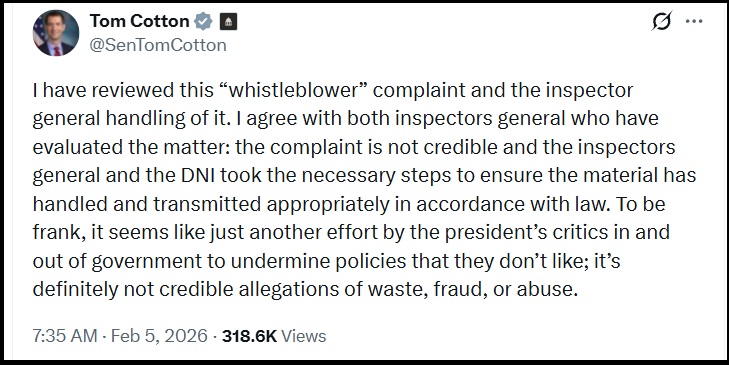
Senate Intel Chair Tom Cotton Reviews IC “Whistleblower Complaint” Against DNI Tulsi Gabbard and Finds it “Not Credible”


Senate Select Committee on Intelligence Chairman, Tom Cotton, outlines via his X account that he has reviewed the intelligence community whistleblower complaint being used in a ridiculous effort to impeach DNI Tulsi Gabbard and finds it “not credible.”

[SOURCE]

The entire construct of this CIA-NIC ‘whistleblower’ operation is transparent.  We have outlined the basic parameters of the entire fiasco {GO DEEP}. The intelligence community/Lawfare operation is a replay of the 2019 intelligence community/Lawfare operation used to frame Donald Trump during the 2019 impeachment effort.

Even setting aside the insufferable politics of it all, our national enemies must be laughing at us and how easy it is to identify the background of the super-secret, classified and “highly sensitive” national security information regarding Venezuela that underpins the baseline for the CIA-NIC effort.

If a simple website can put it together, then certainly our enemies know our own intelligence community is leveraging the rules and regulations around CIA assets to frame domestic political lawfare operations.

It is stunningly embarrassing on a national level.

As a result, I have tried to inform SSCI Chairman Tom Cotton via X with the following message:

Dear Senator Tom Cotton, you are Chairman of the Senate Select Committee on Intelligence. You are a member of the Gang of Eight. You have all the clearances.

Please take a few hours and go to the House Select Committee on Intelligence (HPSCI) scif; sit down with the October 2019 deposition from ICIG Michael Atkinson and read it.

Access should not be a problem with HPSCI Chairman, Representative Rick Crawford, also being a fellow Arkansan.

Read how then ICIG Atkinson gained authority to change the CIA whistleblower rules to facilitate the false claim by CIA National Intelligence Council, Russia desk analyst Eric Ciaramella.

Look at how Ciaramella coordinated with then HPSCI Chairman Adam Schiff, while former AAG of the NSD, Mary McCord, was working as staff on the background structure of the Trump impeachment operation.

Remind yourself of the context. In 2019, ICIG Atkinson was Mary’s former office counsel in the NSD (2016). They worked together on the Trump surveillance in 2016 (Page FISA) and then again in 2019 on the pathway to create an anonymous CIA whistleblower complaint.

What you will notice from that 2019 deposition is the similarity to the whistleblower complaint pathway and IC operation you just reviewed today.

Ciaramella was one of the key authors of the 2017 ICA from his office desk inside the CIA (per Brennan’s instructions to the NIC). Ciaramella was also the anonymous CIA whistleblower in the Trump impeachment 2019. See the issue?

Then ask yourself, if we the ordinary American people can see this stuff and put it together… then what exactly does that say about the SSCI role in oversight?

Warmest best,

A Frustrated American

[CC: DNI Tulsi Gabbard, SSCI Vice-Chair Mark Warner, HPSCI Chair Rick Crawford]

¹The Whole Backstory is Here