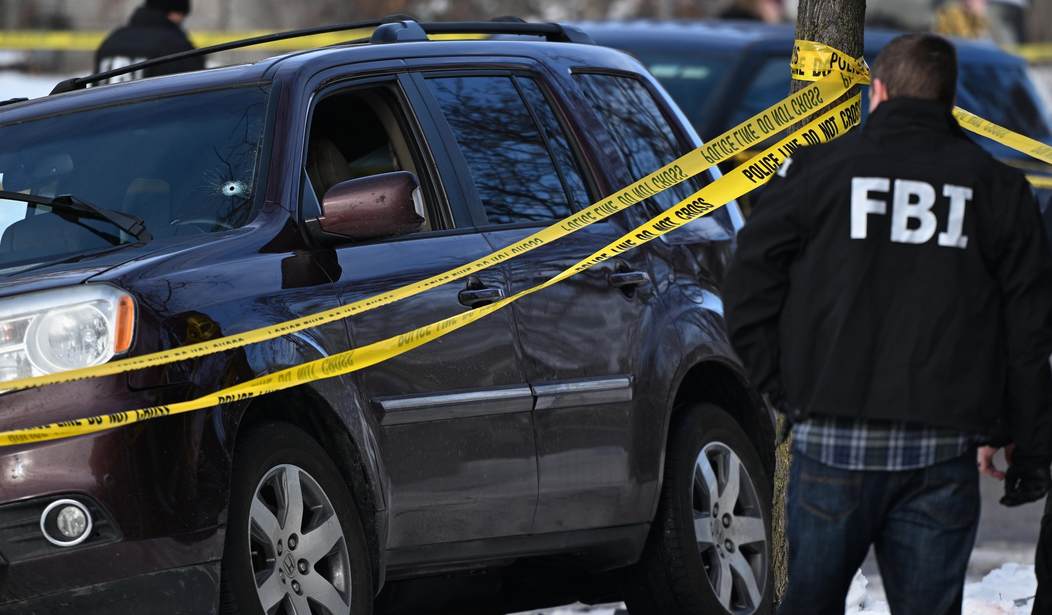
The only perspective that matters is the perspective of the Officer at the time he uses deadly force in response to a threat.
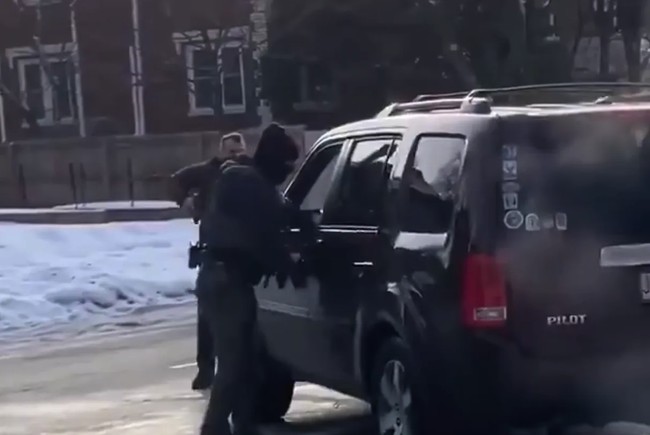
The Image above proves the ICE Officer was justified in his decision to use deadly force. He had no obligation to step out of the way that would benefit her or subject him to prosecution. He had no obligation to allow her to drive away from an attempt to detain her after the Officer at the door of her car ordered her to stop and exit the vehicle.
ICE has two sets of law enforcement personnel — Special Agents who are criminal investigators, and deportation officers who process civil deportation cases. Special Agents are covered by GS-1811 series position with a general description of “criminal investigator.” They are armed and possess police powers to investigate and make arrests for any crime committed in their presence, as well as for the enforcement of all crimes under Title 8 of the United States Code — “Aliens and Nationality.” Within their authority are crimes under Title 18, such as “conspiracy” and “obstruction,” that interfere with their enforcement of the provisions of Title 8.
But the claim floating around social media that ICE officers have no jurisdiction over U.S. citizens is simply wrong. They are law enforcement officers with the authority to detain citizens briefly as part of their investigatory powers, and to arrest citizens who conspire to obstruct and/or do actually obstruct their lawful operations.
Title 18 U.S.C. Sec. 111 is a federal criminal statute involving interference with federal law enforcement:
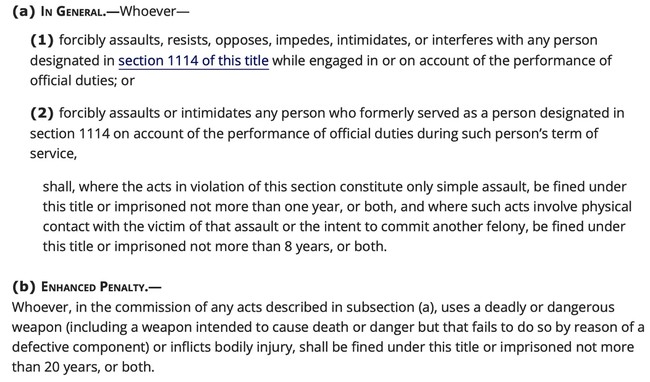
Section 1114 includes within its designation “any officer or employee of the United States or of any agency in any branch of the United States Government (including any member of the uniformed services) while such officer or employee is engaged in or on account of the performance of official duties….”
Subsection (a)(1) makes it a federal crime: assault, resist, oppose, impede, intimidate, or interfere with such employees while they are engaged in or on account of their performance of their official duties.
Without more, such a crime is subject to a maximum penalty of up to 1 year in prison — a misdemeanor.
However, where such acts involve “physical contact” with the officer, or an intent to commit another felony, the maximum penalty increases to 8 years — a felony.
Finally, if in the commission of the offense the defendant uses a “deadly or dangerous weapon”, or “inflicts bodily injury” on the officer, the maximum penalty increases to 20 years.
The Eighth Circuit Court of Appeals, which includes the District of Minnesota, has adopted the Manual of Model Jury Instructions to define the elements of certain crimes. Under the Model Instruction 6.18.111, “assault” on a federal officer is defined as:
An “assault” is any intentional and voluntary attempt or threat to do injury to the person of another, when coupled with the apparent present ability to do so sufficient to put the person against whom the attempt is made in fear of immediate bodily harm.7
Footnote 7: The statute prohibits any acts or threats of bodily harm that might reasonably that might reasonably deter a federal official from the performance of his or her duties. Even if there is no physical contact, the force requirement is satisfied even if the defendant’s conduct places the officer in fear for his life or safety. See United States v. Yates … United States v. Street.…
In Yates, the defendant aimed his truck at a police vehicle as he was driving, but the officer was able to steer away and avoid a collision, i.e., no “contact.”
In the Street case, the incident involved only verbal threats to kill the officers, but no contact. The Eighth Circuit noted how broadly Congress chose to write Sec. 111:
In enacting Section(s) 111, Congress intended broadly to prohibit harm or threats thereof to certain federal officials…. "In order to protect the law enforcement function itself, the statute must be read as prohibiting any acts or threats of bodily harm that might reasonably deter a federal official from the performance of his or her duties." … Congress created the single crime of harming or threatening a federal official, and specified six ways by which the crime could be committed.
Case law across the country has held that any kind of instrument that can be employed as a weapon — even if designed for another purpose — satisfies this provision. Not surprisingly, case law across the country is replete with instances where automobiles were used for purposes other than transportation, with the driver turning them into weapons.
In 2017, the Eighth Circuit decided United States v. Wallace. In that case the defendant was charged with using her vehicle as a deadly or dangerous weapon in the parking lot of a VA Hospital. She was convicted under Sec. 111(b), and sentenced to 48 months in prison. The guideline range was 188-235 months.
"[F]or a car to qualify as a deadly weapon, the defendant must use it as a deadly weapon and not simply as a mode of transportation." United States v. Arrington , 309 F.3d 40, 45 (D.C. Cir. 2002). For instance, using a car "purely for flight" would not trigger liability under § 111(b). …. The jury could nevertheless have reasonably found that by driving toward Atlas and forcing him to jump on the hood to avoid being hit, Wallace used the car as something other than transportation—that she used it as a deadly or dangerous weapon.
The facts of Wallace were that a federal police officer approached the vehicle in a VA parking lot after he observed a person walk to and enter the vehicle after he directed her to stop. The driver then backed the vehicle out of a parking stall, ignoring the officer’s commands that she stop. After the driver had backed out of the parking stall, the officer positioned himself in front of the stationary vehicle and yelled to the driver "Shut the vehicle off. Get out of the vehicle. Police."
When Wallace did not comply, Atlas grabbed his gun. When he saw the kids, though, he holstered it and told Wallace again to shut the car down. But the car lunged forward toward Atlas, who, in his words "instinctively jumped, and I landed on the hood." Atlas jumped on the hood to avoid being struck as "[t]he vehicle came at me."
As noted, Wallace was convicted of violating Sec. 111(b) — assault on a federal police officer while using a vehicle as a deadly weapon.
She did not strike the officer with the vehicle — he jumped on the hood to avoid being hit.
Does this sound familiar?
The point is that Renee Good committed an aggravated felony against the ICE Officer before he drew his weapon and fired his first shot.
IT DOES NOT MATTER WHETHER SHE ACTUALLY STRUCK HIM WITH HER VEHICLE.
As the jury instruction states, the assault is complete “if the defendant’s conduct places the officer in fear for his life or safety…”
That means that when the ICE Officer fired his weapon, he was attempting to “seize” a fleeing felon. All uses of force — lethal and non-lethal — to immobilize a suspected criminal offender are “seizures.” The Fourth Amendment requires that seizures be “reasonable” in order to comply with the Fourth Amendment.
The use of deadly force is a reasonable seizure for Fourth Amendment purposes when engaged in for self-defense responding to conduct that is reasonably perceived by the officer to pose a threat of death or serious bodily injury to him or others around him.
This is the second legal point that is being widely mischaracterized on social media — the Officer’s perception of an imminent threat of death or bodily injury is not limited just to the threat to himself, it is what he perceives as a threat to himself AND others in his immediate vicinity and the broader community in the direction of the vehicle’s intended travel.
What follows is a BRIEF recap of Supreme Court decisions over the past 40+ years dealing with officer-involved shootings under the Fourth Amendment and the inherent right of self-defense and defense of others.
Modern changes in the use of deadly force as a law enforcement tool began with the Supreme Court’s decision in Tennessee v. Garner to move away from the common law rule that allowed such force to be used against “fleeing felons.” An interesting factual tidbit that underpinned that common law rule was at the founding was that nearly all “felonies” were punishable by death.
Tennessee v. Garner — 1985:
This case DOES NOT involve the issue of self-defense by an officer in fear. Prior to Garner, there was a view that a “fleeing felon” was — by virtue of that fact — a danger to the community even if not to the officer at the time of the encounter.
The facts were that at 10:45 pm two officers responded to a “prowler” call by a neighbor who heard a window breaking at the house next door. One officer went into the back yard and saw Garner running away from the house in the direction of a chain-link fence. He shouted to the suspect “Police, halt” and moved towards him. As he did Garner began to climb the fence. Fearing he would evade arrest if he made it over the fence, the officer fatally shot him. A Tennessee statute authorized police to use “all force necessary” to make an arrest if, after an intention to arrest is announced, the suspect flees or forcibly resists.
The officer stated he was not fearful for his life or safety. He saw no sign of a weapon, and, though not certain, was "reasonably sure" and "figured" that Garner was unarmed. Tennessee statute justified deadly force on the basis that an un-apprehended felon posed a danger to the community. The Supreme Court took up the case to decide whether such actions were “reasonable” under the Fourth Amendment when the only purpose for using deadly force was to prevent escape and there was no factual basis to conclude the suspect was actually a threat to the community if not arrested.
Here is the landmark ruling by the Supreme Court on the Fourth Amendment, moving away from the common law:
The use of deadly force to prevent the escape of all felony suspects, whatever the circumstances, is constitutionally unreasonable…. Where the suspect poses no immediate threat to the officer and no threat to others, the harm resulting from failing to apprehend him does not justify the use of deadly force to do so. It is no doubt unfortunate when a suspect who is in sight escapes… A police officer may not seize an unarmed, nondangerous suspect by shooting him dead. The Tennessee statute is unconstitutional insofar as it authorizes the use of deadly force against such fleeing suspects.
It is not, however, unconstitutional on its face. Where the officer has probable cause to believe that the suspect poses a threat of serious physical harm, either to the officer or to others, it is not constitutionally unreasonable to prevent escape by using deadly force. Thus, if the suspect threatens the officer with a weapon or there is probable cause to believe that he has committed a crime involving the infliction or threatened infliction of serious physical harm, deadly force may be used if necessary to prevent escape.
That is the law, and has been the law for 40 years.
Did the ICE Officer in Minneapolis have “probable cause” to believe Ms. Good had committed a crime involving the threatened infliction of serious physical harm? If yes … “deadly force may be used if necessary to prevent escape.”
As noted above, aggravated assault with a deadly weapon on a federal law enforcement officer does NOT require actual physical contact or injury to the officer. Whether Good hit the ICE Officer or not does not change the “reasonableness” determination.
Graham v. Connor — 1989.
Four years after Garner, the Supreme Court addressed the question of “reasonableness” under the Fourth Amendment with respect to claims of “excessive force” used by law enforcement officers to make an arrest. Connor is not a “deadly force” case, but does establish the framework for determining whether the force used — deadly or otherwise — was “reasonable” under the Fourth Amendment.
Chief Justice Rehnquist, writing for the Court in a 9-0 decision, held that excessive force claims during any “seizure” of a person must be evaluated under an “objective reasonableness” test that looks at whether the officer’s actions were reasonable in light of the facts and circumstances, without regard to subjective intent or motivations of the officer.
The “reasonableness” of a particular use of force must be judged from the perspective of a reasonable officer on the scene, rather than with the 20/20 vision of hindsight…. The Fourth Amendment is not violated by an arrest based on probable cause, even though the wrong person is arrested … nor by the mistaken execution of a valid search warrant on the wrong premises …. With respect to a claim of excessive force, the same standard of reasonableness at the moment applies: “Not every push or shove, even if it may later seem unnecessary in the peace of a judge’s chambers,” … violates the Fourth Amendment. The calculus of reasonableness must embody allowance for the fact that police officers are often forced to make split-second judgments -- in circumstances that are tense, uncertain, and rapidly evolving -- about the amount of force that is necessary in a particular situation.
The law on excessive force — even use of deadly force — tolerates mistakes. Based on the facts, I do not believe the ICE officer’s use of deadly force was a “mistake.” His reaction to what Ms. Good did in the 2-3 seconds before he fired his weapon was entirely justified by her actions.
[T]he question is whether the officers' actions are "objectively reasonable" in light of the facts and circumstances confronting them, without regard to their underlying intent or motivation…. An officer's evil intentions will not make a Fourth Amendment violation out of an objectively reasonable use of force; nor will an officer's good intentions make an objectively unreasonable use of force constitutional.”
What would a reasonable officer standing in the shoes of the ICE Officer who fired at Ms. Good have perceived in terms of his safety or the safety of others from her actions during the moments leading up to him using deadly force to stop her? Did he have reasonable cause to believe she had committed a violent crime, and that allowing her to evade arrest would constitute a threat to others even if she was past him and no longer a threat to him?
Scott v. Harris — 2005.
Scott involved a high speed chase where the police officer used the bumper of his vehicle to bring the chase to an end by causing the suspect’s car to crash. The suspect was rendered a quadriplegic and sued for use of excessive force under the Fourth Amendment on the basis that running him off the road was an “unreasonable” seizure.
Writing for an 8-1 majority, Justice Scalia stated:
[The Officer] defends his actions by pointing to the paramount governmental interest in ensuring public safety…. Thus, in judging whether [the Officer’s] actions were reasonable, we must consider the risk of bodily harm that [the Officer’s] actions posed to respondent in light of the threat to the public that [the Officer] was trying to eliminate. Although there is no obvious way to quantify the risks on either side, it is clear from the videotape that respondent posed an actual and imminent threat to the lives of any pedestrians who might have been present, to other civilian motorists, and to the officers involved in the chase.
It makes no difference that Ms. Good was only beginning to drive away when she was shot by the ICE Officer. It was not unreasonable to conclude that after almost running over a uniformed law enforcement officer when she was fully aware of his presence and after being ordered out of the car, she might continue to operate her vehicle in a way that put others present at risk, including other motorists in the direction she was intending to travel.
We think it appropriate in this process to take into account not only the number of lives at risk, but also their relative culpability. It was respondent, after all, who intentionally placed himself and the public in danger … that ultimately produced the choice between two evils that [the Officer] confronted. Multiple police cars … had been chasing respondent…. By contrast, those who might have been harmed had [the Officer] not taken the action he did were entirely innocent. We have little difficulty in concluding it was reasonable for Scott to take the action that he did.
Just moments before the shooting, Ms. Good had parked her vehicle across the lane of travel in which she was headed, creating a hazard for other vehicles on the roadway. Ms. Good was completely aware and uncaring about the hazards she was creating for others by her conduct.
She capped it off with a felonious aggravated assault with a deadly weapon against the Officer as she attempted to evade a lawful effort to detain her for her obstructive behavior.
Couldn’t the innocent public equally have been protected, and the tragic accident entirely avoided, if the police had simply ceased their pursuit? We think the police need not have taken that chance and hoped for the best. Whereas [the Officer’s] action … was certain to eliminate the risk that respondent posed to the public, ceasing pursuit was not. First of all, there would have been no way to convey convincingly to respondent that the chase was off, and that he was free to go…. [R]espondent might have been just as likely to respond by continuing to drive recklessly as by slowing down and wiping his brow.
Second, we are loath to lay down a rule requiring the police to allow fleeing suspects to get away whenever they drive so recklessly that they put other people’s lives in danger…. The Constitution assuredly does not impose this invitation to impunity-earned-by-recklessness. Instead, we lay down a more sensible rule: A police officer’s attempt to terminate a dangerous high-speed car chase that threatens the lives of innocent bystanders does not violate the Fourth Amendment, even when it places the fleeing motorist at risk of serious injury or death.
One of the dumbest arguments being advanced in social media and elsewhere is the effort to distinguish between the ICE Officer’s first shot through the front windshield — presumably while he was still in front of the vehicle and at risk of being run into — and later shots that were fired by him through the driver’s side window after he was no longer immediately threatened.
Besides this being a 20-20 hindsight analysis that runs contrary to Graham v. Connor, it also ignores a more recent 9-0 decision by the Supreme Court involving the use of deadly force against the driver of a vehicle.
Plumhoff v. Rickart — 2014, with Justice Alito writing for a unanimous court:
Following a car-stop of a suspected drunk driver, and after just a few questions posed by the officer, the driver sped away. The officer gave chase and was eventually joined by five other cars. The chase lasted more than 5 minutes, and at times exceeded 100 mph.
The chase eventually ended in a parking lot where the suspect’s car collided with a police vehicle, and other vehicles made an effort to pin in the suspect’s car in — the high speed chase portion was over. But that wasn’t the end of the suspect’s efforts to flee:
Now in danger of being cornered, Rickard put his car into reverse “in an attempt to escape.” As he did so, Evans and Plumhoff got out of their cruisers and … Evans, gun in hand, pounded on the passenger-side window…. Rickard’s tires started spinning, and his car “was rocking back and forth,” indicating that Rickard was using the accelerator even though his bumper was flush against a police cruiser. At that point, Plumhoff fired three shots into Rickard’s car. Rickard then “reversed in a 180 degree arc” and “maneuvered onto” another street, forcing Ellis to “step to his right to avoid the vehicle.” Ibid. As Rickard continued “fleeing down” that street, ibid., Gardner and Galtelli fired 12 shots toward Rickard’s car, bringing the total number of shots fired during this incident to 15. Rickard then lost control of the car and crashed into a building.
The comments I’ve seen on social media suggest there is case law that says each round fired must be independently justified as “reasonable.” They make this claim based on the premise that the shot fired through the front windshield must be evaluated separately from the shots fired through the passenger window, and if either is “unreasonable” then the ICE officer committed a crime. That’s just nonsense and I’d like to see anyone post in the comments a citation to a case saying that is the law.
Two issues relevant to the shooting of Ms. Good are addressed by Justice Alito in his opinion.
Under the circumstances at the moment when the shots were fired, all that a reasonable police officer could have concluded was that Rickard was intent on resuming his flight and that, if he was allowed to do so, he would once again pose a deadly threat for others on the road….
In light of the circumstances we have discussed, it is beyond serious dispute that Rickard’s flight posed a grave public safety risk, and here, as in Scott, the police acted reasonably in using deadly force to end that risk.
The fact that comments on X and legal beagle pundits want to claim that this poor woman in Minneapolis was not a real threat to the safety of anyone — based on their 20-20 hindsight — is best discounted and ignored on the basis that they weren’t standing in front of her car when she shifted into drive and pushed the accelerator. Had they been, they might have come away with a different impression of the threat she posed to the safety of others in the area had she been allowed to drive away.
On the issue of the multiple rounds fired by the ICE Officer:
We now consider respondent’s contention that, even if the use of deadly force was permissible, petitioners acted unreasonably in firing a total of 15 shots. We reject that argument. It stands to reason that, if police officers are justified in firing at a suspect in order to end a severe threat to public safety, the officers need not stop shooting until the threat has ended. As petitioners noted below, “if lethal force is justified, officers are taught to keep shooting until the threat is over.”
… This would be a different case if petitioners had initiated a second round of shots after an initial round had clearly incapacitated Rickard and had ended any threat of continued flight, or if Rickard had clearly given himself up. But that is not what happened.
The “threat” question isn’t limited to the threat Good posed to the ICE Officer himself. The question extends to the threat that Good represented to public safety. This renders meaningless all the arguments made based on the claim that she had passed him and he was no longer threatened by her car.
THAT IS NOT THE LAW. QUIT PAYING ATTENTION TO IDIOTS.
Barnes v. Felix — 2025.
Justice Kagan wrote for a unanimous Court, but the issues relevant to the Minneapolis shooting are addressed by Justice Kavaugh in a Concurring opinion in which three other Justices joined.
The issue addressed by Justice Kagan’s majority opinion was the Court’s rejection of a “refinement” of the “reasonableness” test for Fourth Amendment claims. The Fifth Circuit developed a “moment in time” approach it applied in cases involving the use of “deadly” force, compared to a less restrictive approach used in cases involving claims of “excessive” force when reaching a determination on the “reasonableness” of the Officer’s actions.
The “moment in time” analysis introduced a temporal element — what amount of time prior to the decision to use deadly force could be considered in an evaluation of the reasonableness of the decision? The “moment in time" analysis directed the district judge to identify the time period under the facts of the case relevant just to the decision to use deadly force, and then consider only the facts and circumstances within that time period in judging the reasonableness of the decision.
In the usual excessive-force case … the inquiry into reasonableness would involve considering a variety of circumstances. But when an officer has used deadly force, the [district] court continued, “the Fifth Circuit has developed a much narrower approach.” Then, a court could ask only about the situation existing “at the moment of the threat” that sparked the fatal shooting…. The District Court identified that moment as “the two seconds before Felix fired his first shot,” when he was standing on the doorsill of moving vehicle. At that moment, the court found, an officer could reasonably think himself “at risk of serious harm.” And under the Fifth Circuit’s rule, that fact alone concluded the analysis.
The Supreme Court reversed on the basis that the “moment in time” analysis was contrary to the Court’s established “totality of circumstances” test for determining “reasonableness,” a test that has no temporal limit.
That inquiry into the reasonableness of police force requires analyzing the “totality of the circumstances”.… [D]eciding whether a use of force was objectively reasonable demands “careful attention to the facts and circumstances” relating to the incident, as then known to the officer. For example, the “severity of the crime” prompting the stop can carry weight in the analysis. So too can actions the officer took during the stop, such as giving warnings or otherwise trying to control the encounter. And the stopped person’s conduct is always relevant because it indicates the nature and level of the threat he poses, either to the officer or to others.
[T]he “totality of the circumstances” inquiry into a use of force has no time limit. Of course, the situation at the precise time of the shooting will often be what matters most; it is, after all, the officer’s choice in that moment that is under review. But earlier facts and circumstances may bear on how a reasonable officer would have understood and responded to later ones.
In his concurring opinion, joined by Justices Thomas, Alito, and Barrett, Justice Kavanaugh observes some of the “circumstances” that arise in the context of a driver who evades a car-stop by driving away:
So even though most traffic stops end without incident, traffic stops are nonetheless inherently risky for police officers. And when, as in this case, the driver suddenly pulls away in the midst of a stop, the risks multiply. A driver speeding away from a traffic stop could easily endanger bystanders and other drivers … Moreover, the very “fact that a suspect flees when suspected of a minor offense,” such as speeding or a failure to pay tolls, “could well be indicative of a larger danger….” Fleeing from the traffic stop could suggest that the driver is preparing to commit or has committed a more serious crime—and is attempting to evade detection or arrest…. [A]s the tragic 2025 New Year’s terrorist attack in New Orleans illustrates, the driver might intend to use the car as a weapon.
The possibilities are many. But the key point is a commonsense one: A driver who speeds away from a traffic stop can pose significant dangers to both the officer and the surrounding community. The question when a driver flees, therefore, is not merely whether the underlying traffic violation “presents risks to public safety”—it is also “whether flight,” and what that flight might indicate or enable, “does so.”
The totality of circumstances relevant to the ICE Officer’s decision to use deadly force would have included not simply that Good was a “citizen protester” concerned about the removal policies of the Trump Administration, but also that she had created a dangerous condition for others in parking her vehicle blocking a lane of traffic, had failed to comply with lawful commands to exit her vehicle, failed to heed lawful commands to stop as she put the vehicle in gear and began to move, the directions coming from her partner to “drive” while the Officer was in front of her vehicle, his observations of her and her conduct through the front windshield, her turning the wheel into his direction and bringing the front end around to face him directly, and then beginning to accelerate with the car in “Drive.”
As noted in the Scott case quoted above, “We think the police need not have taken that chance and hoped for the best. Whereas [the Officer’s] action … was certain to eliminate the risk that respondent posed to the public, ceasing pursuit was not.”
In various posts on X I have commented extensively on the videos that have been made public. Not a single one leads me to doubt the reasonableness of the ICE Officer’s decision. There is no doubt that he was at physical risk of harm or death when Good reoriented her front end to face him while she reversed.
When she braked, stopped, shifted into Drive, and hit the accelerator, he REACTED immediately by removing his weapon — something he had not done to that point because he did not perceive a risk until she did that.
The nonsense about him walking in front of her vehicle ignores that she reoriented her vehicle’s front end in relationship to him when she turned the wheel one way while reversed, and the opposite way when starting forward.
It may have been a poor choice by the Officer to expose himself even to the extent of making that possible, but that does not inure to the benefit of her by claiming he was in the wrong. That idea only exists in the fevered dreams of lunatic lefty legal beagles and idiots on social media.
Many have mischaracterized the policy prohibition of walking in front of — or shooting into — a “moving vehicle.” Her vehicle was stationary, and the Officer had had already done a complete 360 walk around the vehicle while it was stationary and engaged with the driver.
He may have exposed himself unnecessarily to danger by walking back towards the front a second time, but he did not do so FOR THE PURPOSE of justifying the use of deadly force. The policy prohibits an officer from purposely stepping in front of a moving vehicle to create risk of injury in order to justify use of lethal force.
Same for the policy that prohibits shooting into a moving vehicle — the policy does NOT apply to use of lethal force in self-defense, it only applies to situations where the shooting is done for no purpose other than to prevent the driver from escaping.
These are POLICIES adopted by law enforcement agencies as “best practices.” An unjustified deviation or violation of the policy might subject the officer to discipline.
But they do not alter “lawful v. unlawful” and “constitutional v. unconstitutional” determinations.
These are the only images I needed to see to form my opinion.
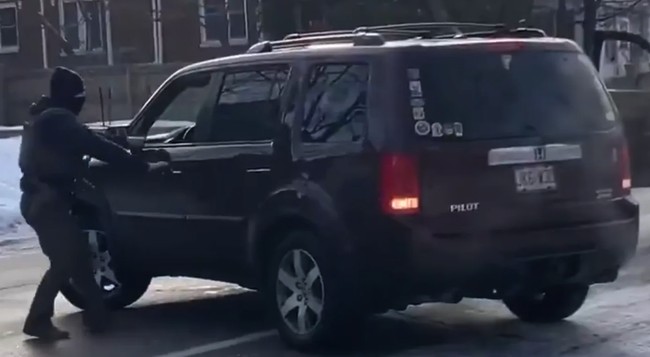
One ICE Officer is approaching her car and giving her lawful commands through her open driver’s side window. The car is in “Reverse” and her wheels are cut to the left. There is no ICE Officer to her front.
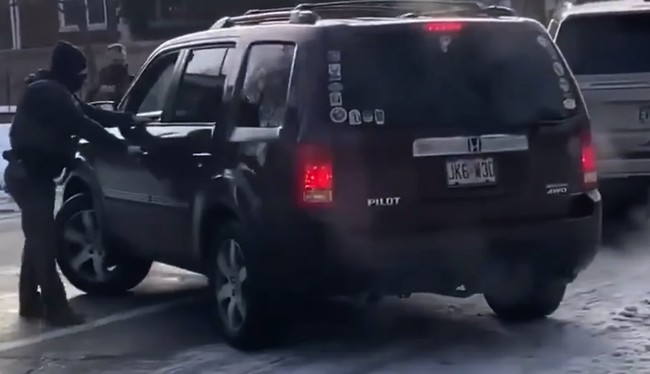
Here she has moved approximately 3 feet back as you can see from the relationship of her tires to the white line in both images. The ICE Officer to her front is still visible. In this image her “Reverse” white tail lights are off — she has shifted into drive. Her front tires are still cut to the left, and her front end has reoriented more towards the Officer now in the center of her front end.
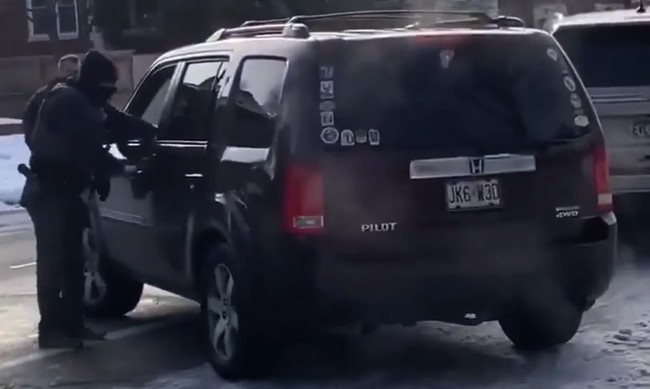
This is as far backwards as she travels. Her brake lights are now off — she’s in “Drive” and her foot is no longer on the brake. The ICE Officer is now in front of her driver’s side headlight, and her wheels are facing straight ahead. At this moment her front wheels break traction as she attempts to accelerate forward. Had the tires not spun on the ice she would have made immediate and forceful contact.
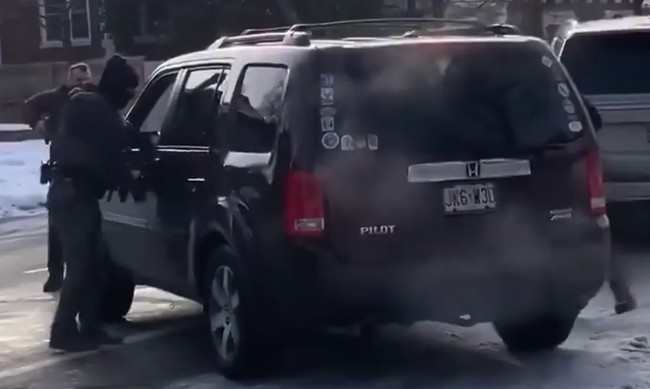
Just a fraction of a second later you see the ICE Officer drawing his firearm — her wheels are still straight. That’s the moment he decided to use deadly force — he recognized at that moment the fact that she was about to run him over. He resorted to deadly force in self-defense and defense of others.
That’s it.
As a federal prosecutor, if tasked to evaluate the lawfulness of his decision to use deadly force, I would have cleared him based on these four images and the video source alone. No other video produced so far does anything to call that conclusion into question.
What the driver’s intentions might have been are irrelevant. The one thing she clearly did not intend to do was to comply with the lawful orders she was given. As a result, she opened herself up to the consequences of the reasonable decision by the ICE Officer to eliminate the threat she posed to him as well as others.