Following his brilliant 2026 State of the Union address, it has become evermore apparent that we have an extraordinary individual in the White House. Although Donald Trump is less than 16 weeks from age 80, he works more hours than the typical career professional, small business entrepreneur, corporate executive, or head of a major organization.
Not Typical at All
Consider this: the average career professional who holds a nine-to-five job works 250 weekdays, out of 365 total days in a year, with about 10 days of vacation. Eight hours per day, for 250 days, yields a work year of 2,000 hours. Those who are career climbers often work much more than 40 hours a week, perhaps 50 hours or more. Individuals operating their own business often will work 60 to 70 hours per week or more.
President Trump does not average 60 to 70 hours a week. He is likely at 100 hours and then some. He's on the job seven days a week, averaging at least 15 hours, which sums to at least 105 hours. Reportedly, it’s even more, often 18 hours a day. For whatever reason, Donald Trump has the natural gift of operating effectively on very little sleep. The fakestream press/Google offers endless links to Trump dozing off, but who cares? He has more than earned it with the countless hours he devotes to the USA.
In assessing any highly energetic 30, 40, and 50-year-olds whom you might know, ask yourself if they could keep up with Donald Trump. On numerous occasions, during international flights, especially on the return to the U.S., while the entire press pool is exhausted, Trump is still awake, alert, and working. He did this on the trip to Asia, stopping in Qatar, Malaysia, Japan, South Korea, and China.
Two for the Price of One
As press secretary Karoline Leavitt has said, reporters who fly with the White House senior staff are often embarrassed that they cannot keep up with Donald Trump. While they’re deep in slumber, the President is still workingaway — addressing staff, handling phone conversations from around the world, and tending to other matters.
In essence, we've elected somebody who puts in double the hours that he is paid to do. We're getting two presidents for the salary of one: someone so dedicated to the job and on top of the issues, that in this second four-year term, he is offering us at least eight years' worth of leadership. And he donates his salary!
If you're a Democrat or are otherwise on the left, you dread this capability. After all, you seek to bring down the nation as quickly as possible. Everything that Donald Trump is achieving for America is to your utter disdain. If you're a Republican or are otherwise on the right, you are delighted that one of the most highly productive individuals in U.S. history leads our nation.
Redux with Gusto
While Donald Trump displayed much of the same energy during his first term, today, nearly a decade after November 2016, he is providing even greater output. It defies logic and perhaps even medical science, but the reality is that the man outworks virtually everyone.
If you don't like him, can't stand them, or wish him ill, with any semblance of rationality left in your brain, you’d still have to concede that few people can match him. From the standpoint of personal productivity, hours worked, and output, few individuals in America or, for that matter, anywhere on Earth have this level of work-related energy.
President Trump’s accessibility to staff, elected officials, heads of state, the hostile fakestream press, military leaders, and so many others is, in a word, astounding. He will speak unscripted to the press more times in a few weeks than Joe Biden did in four years.
An Exceedingly Tough Act to Follow
With the cameras rolling, President Trump conducts high-level meetings, as well as entertaining world leaders, with a large contingency of cabinetsecretaries, domestic and international journalists, and personal aids and assistants in attendance.
Whoever succeeds Donald Trump as president of the U.S. is not likely to possess the capability to work the number of hours that he has consistently put in. Week after week, month after month, and year after year, in both terms one and two, the leader of the free world continues on.
Let us thank our lucky stars now, in the present, while we have him for another three years. There might not be another like Donald Trump in our lifetimes, or that of our children or grandchildren.
WASHINGTON — President Donald Trump confirmed late Saturday on Truth Social that Iran’s Supreme Leader Ali Khamenei is dead, shortly after the Israeli government announced it believed Khamenei had been killed in recent strikes on Iranian leadership targets.
In a Truth Social post, the president wrote that reports of the Iranian leader’s death were accurate, aligning U.S. statements with Israel’s public assertion. The post followed public remarks from Israeli officials earlier in the day stating there were “growing signs” that Khamenei had been killed in an airstrike targeting top Iranian leadership and command facilities.
That assessment was widely reported by BBC News as part of its live international coverage of the escalating conflict. According to BBC reporting, Israeli leaders said intelligence indicated Khamenei’s compound was struck and that several senior Iranian officials were killed, though the broadcaster stressed that independent verification was not available at the time of its reporting.
During a phone interview with NBC News earlier Saturday, Trump said he and his advisers “feel that reporting that [Khamenei] is dead is a correct story,” adding that a substantial portion of Iran’s senior leadership had reportedly been taken out. NBC quoted Trump as saying he did not mean “two people” were killed, but that “most” of Iran’s senior leadership is gone, while stopping short of presenting independent evidence confirming the Supreme Leader’s status.
Iranian state media and official spokespeople have not independently confirmed Khamenei’s death. In earlier reports, Iranian authorities denied death rumors and described them as enemy propaganda. As of this writing, there has been no official statement from the Iranian government formally confirming the Supreme Leader’s death.
The Israeli announcement and Trump’s Truth Social post come amid the sharpest escalation between Iran and Israel in years, involving coordinated strikes on Iranian military sites and exchanges of missiles and drones. Global markets reacted swiftly, with oil prices rising on concerns of broader instability in the Middle East. International leaders, including officials at the United Nations, have urged immediate de-escalation as the situation remains volatile, and multiple nations have closed airspace or heightened military readiness following the Israeli announcement.
At a recent Grammy Awards ceremony, Billie Eilish stated publicly that “no one is illegal on stolen land.” This statement implies that the United States was unlawfully created and, therefore, any national laws regarding the illegal entrance of aliens into the country are invalid. This is a very big issue. If the United States was unlawfully created (different from unfortunately created), a case could be made that the land that now comprises its sovereign borders should revert to the indigenous people then living within those boundaries, or in the alternative, be allowed to be claimed by majorities pouring into its undefended borders—a type of siege.
Was the United States lawfully created?
It was lawfully created if one accepts the premises of Western Civilization, Christianity, and the notion of advances in civilization. It is thought that indigenous American tribes existed in the continental United States for thousands of years. Some scholars put that number at 23,000 years. This occupancy consisted of hundreds of tribes with spheres of influence over certain lands, but not individual ownership of parcels of land. These tribes mostly existed at a subsistence level, with advanced skills in survival crops and surface-level metallurgy—especially gold and copper.
Western Civilization grew out of Greek and Roman thought and practices, combined with the introduction and acceptance of Christianity, and incorporated the notion of advancement over subsistence, including the development of the person morally and intellectually. Christianity encouraged the curious, the industrious, and the innovative as discoverers of God’s creation.
The Biblical notion of man’s fallen nature shrouds Western thinking, a constant swimming upstream as advances are developed and then debauched. The word “lawful” includes this moral component. What may be legal must also be lawful in the Christian belief system.
How can what is the continental United States be legally “discovered” if peoples are already living on the land?
The “Age of Discovery” (1400 AD–1600 AD) grew out of the disruption Muslims caused to European and Asian trade routes across Europe, the Mediterranean, the Middle East, and into China. These routes brought paper, gunpowder, and spices to Europe in return for wool, wine, and other commodities from Europe. When these routes became too dangerous or too highly taxed, other water and land routes were sought.
Spain and Portugal led the way as they searched for another land/water route to China. And so, in rapid succession, we get Columbus, da Gama, Magellan, and others—brave explorers trying to find new trade routes and instant wealth. The Old World eventually “discovers” the New. Perhaps, it was thought, this was even more significant than the routes themselves.
This, then, is the initial story. Foundational philosophy, administration, and law from pagan Greeks and Romans; the Roman acceptance of Christianity; the rise of the Roman Catholic Church in governance and inquiry; the clash of Muslim/Christian cultures; the genius of Chinese innovation and its seepage into the West; and the insatiable nature of man to discover more and improve the already found.
Pope Alexander VI, in 1493 AD, declared it lawful to “discover” inhabited lands and declared an International Doctrine of Discovery for any Christian prince to ownership, with occupancy rights granted to the indigenous. This Catholic international law was validated by our Supreme Court in 1823, but was rescinded by Pope Francis in 2023.
And now, the rest of the story.
The rest of the story is part factual history and part mystery. Different societies handle experiential knowledge differently. Scholars theorize why this is so, but a definitive answer as to “why?” is not possible. How did the Chinese come up with the earliest technology in the smelting process that moved societies from the Bronze Age to the Iron Age? What compelled Monks in the 800s AD to the backbreaking reclamation of arable land from the wetlands of England and Belgium? What compels one group of people to curiosity and innovation and another to subsistence?
Experiential knowledge is lived, understood, passed along, and improved over time. It took 1,000 years for the blast furnace technology of China to reach Sweden. By the time colonists reached American shores in Jamestown in 1607 and in Plymouth in 1620, colonists had working guns, pistols, fowlers, and tools that were traded to indigenous tribes for land and assistance. How the nearly-starving colonists in Virginia found bog ore and built the first iron works at Falling Waters in 1619 is a wonder.
What the early Christian communes brought to tribal lands in America was not just advanced tools. They brought the notion of individual ownership and responsibility. Land was traded, purchased, and ceded by treaty, and the records of these transactions were recorded and housed. Descent and conveyance, as evidenced by wills, go back to the ancient Egyptians and were codified in England by Henry VIII in 1540. The idea of owning property and leaving that property to heirs to be improved meant that generation after generation, rather than sameness, there was the chance for advancement.
If what Miss Eilish is saying at the Grammys can be translated as a reflection of man’s fallen nature regarding the treatment of the indigenous, she has a point. America includes some conquered and some confiscated land. The whole notion of nation-states grew out of the religious wars of the 17th century in Europe. Native Americans did not have these notions. In addition, America’s overarching foundational philosophy is the development of the person, not the development of the group.
And yet, as part of the mystery, in spite of some past practices, there is a sweetness of intention in the language in Article 3 of the Northwest Ordinance, passed by Congress under the Articles of Confederation in July 1787:
The utmost good faith shall always be observed towards the Indians; their lands and property shall never be taken from them without their consent; and, in their property, rights, and liberty, they shall never be invaded or disturbed, unless in just and lawful wars authorized by Congress; but laws founded in justice and humanity, shall from time to time be made for preventing wrongs being done to them, and for preserving peace and friendship with them.
Miss Eilish deserves a response: the words “stolen land” are not accurate. The concept that what is legal must also be lawful (moral), however, is the basis of American civilization.
Citizenship is not a technicality. It is not a loophole. It is not a prize slipped across a hospital bassinet because geography happened to cooperate. Citizenship is the highest legal bond between an individual and a sovereign nation.
If that bond means anything, it must mean allegiance. That is the principle at the center of President Donald J. Trump’s Executive Order 14160, signed on Jan. 20, 2025, titled Protecting the Meaning and Value of American Citizenship.
The order directs federal agencies not to recognize automatic citizenship for certain children born in the United States after Feb. 19, 2025. When the mother was unlawfully present, or present only temporarily, and the father was neither a citizen nor a lawful permanent resident, the child becomes ineligible for citizenship.
Its rationale is straightforward. The Fourteenth Amendment grants citizenship to those born in the U.S. and “subject to the jurisdiction thereof.” That final clause is not ornamental language. It is a constitutional requirement.
Opponents moved quickly. Lawsuits were filed almost immediately.
Federal district courts issued preliminary injunctions, including a nationwide block from a Maryland judge on Feb. 5, halting enforcement before the policy could take effect. For a time, it appeared that the familiar pattern would repeat itself, executive action frozen by sweeping lower court orders.
Then the Supreme Court intervened in a critical procedural dispute.
On June 27, in Trump v. CASA, the Court ruled 6 to 3 to limit the use of universal injunctions by lower courts, finding no broad historical basis for them in most cases. The justices did not resolve the merits of the birthright citizenship order, but they did something profoundly important. They reaffirmed that nationwide policy questions belong before the Supreme Court itself, not in the hands of a single district judge.
That set the stage for the main event.
On Dec. 5, the Supreme Court granted certiorari in Trump v. Barbara, agreeing to hear the constitutional challenge to Executive Order 14160 during its ongoing term, with oral arguments scheduled for April 1, 2026.
The Court deserves enormous credit for taking the case. The country cannot function indefinitely on assumptions about citizenship that were never fully tested against the constitutional text.
The most powerful defense of the order appears in an amicus brief filed Jan. 27, 2026, in support of the petitioners in Supreme Court case No. 25-365. That brief does not rely on rhetoric. It relies on history, statutory development, Supreme Court precedent, and the framers’ own explanations.
Its core argument is simple, yet powerful.
The phrase “subject to the jurisdiction thereof” has always meant complete political allegiance, not mere physical presence. English common law shaped that understanding. In Calvin’s Case in 1608, Lord Coke explained that subject status depended on ligeantia, meaning allegiance and obedience to the sovereign, not simply being born within territorial boundaries. Allegiance was reciprocal. Protection flowed from loyalty.
That concept carried into American law.
The Civil Rights Act of 1866 declared citizens to be those born in the U.S. and not subject to any foreign power. Sen. Jacob Howard later explained that the Fourteenth Amendment’s jurisdiction language would exclude foreigners, aliens, and the families of ambassadors. Sen. Lyman Trumbull defined jurisdiction as complete jurisdiction, meaning not owing allegiance to anybody else.
These statements were not casual observations. They were explanations of what the Amendment was designed to accomplish.
The post ratification record reinforces the same principle. In the Slaughter House Cases in 1872, the Supreme Court observed that the jurisdiction clause excludes children of ministers and citizens of foreign states born within the U.S. In Elk v. Wilkins in 1884, the Court held that birth within the U.S. was not enough where complete allegiance was lacking.
Citizenship required full political subjection, not partial or divided loyalty.
Opponents point to United States v. Wong Kim Ark in 1898. But that case involved parents who were lawful permanent residents domiciled in the U.S. with the government’s consent. The Court emphasized lawful residence and the sovereign’s permission. It did not address children born to parents present in violation of federal law.
Extending Wong Kim Ark to that context assumes what must be proven.
Modern courts have readWong Kim Ark carefully. In Tuaua v. United States, the D.C. Circuit stressed the importance of complete political jurisdiction and direct allegiance. The amicus brief argues that collapsing the distinction between lawful, consent based presence and unlawful presence erases the constitutional requirement of allegiance.
The practical stakes are real.
Jennifer Pak reported that official Chinese estimates placed annual birth tourism numbers in the U.S. at approximately 50,000. Salvatore Babones has estimated figures as high as 100,000 per year. Peter Schweizer has argued that over a decade the number of children born through such practices could range between 750,000 and 1.5 million. China Daily has openly advertised automatic citizenship under the Fourteenth Amendment as an incentive for expectant mothers.
These numbers underscore a hard truth. If citizenship attaches automatically without regard to allegiance or lawful status, the incentive structure changes. The Constitution becomes a magnet rather than a covenant. The amicus brief contends that the framers anticipated this danger and wrote the jurisdiction clause to prevent it.
Textual analysis strengthens that case.
The Fourteenth Amendment speaks of being “subject to the jurisdiction thereof,” not merely “within the jurisdiction.” That distinction appears elsewhere in the amendment. The difference in phrasing suggests a difference in scope. Total political allegiance is not the same as temporary subjection to local laws.
The brief synthesizes English common law, the drafting history of 1866, early Supreme Court decisions, and modern precedent. It concludes that children born to those who remain under the political allegiance of another sovereign and who entered or stayed unlawfully are not fully subject to the jurisdiction of the U.S. in the constitutional sense.
That conclusion is not radical. It is anchored in text and history. It respects Congress’s role in naturalization. It restores meaning to words too long treated as surplus.
If the Supreme Court upholds Executive Order 14160, thereby clarifying the Fourteenth Amendment, the decision will resonate far beyond immigration policy. It will affirm that citizenship is defined by constitutional principle, not by gaming the system. It will elevate the value of American citizenship by tying it unmistakably to allegiance and consent. It will limit the ability of foreign interests and unlawful entrants to manufacture status through geography alone.
Most importantly, it will return control over America herself to the proper American people and their Constitution. In an era when sovereignty is often treated as an inconvenience, such a ruling would declare that the bond of citizenship still matters, still carries weight, and still demands loyalty.
That is not exclusion. That is self-government.
If citizenship can be claimed without allegiance, then sovereignty becomes a suggestion and the Constitution a relic. This case forces a choice between sentiment and structure, between drift and definition. The amicus brief proves that the Fourteenth Amendment demands loyalty, not opportunism.
Should the Court affirm that truth, it will not merely decide a policy dispute. It will decide whether U.S. citizenship is sacredly reserved for Americans themselves, or formalized as a valuable commodity for alien birth tourists.
I’m surprised that a liberal publication did this, but it has happened before, even in more left-leaning outlets, which I will mention shortly. USA Today featured a brief article by Joni Werner, a Democrat from Texas. She watched Trump’s State of the Union address and aligned with nearly everything he said.
Uh, Joni, are you certain you’re a Democrat? Werner believed the president’s message and agenda were correct for the nation and vital for restoring the economy. She was also disgusted that Democrats did not support the heroes present and failed to give Mr. Trump equal opportunity to govern:
I watched President Donald Trump's entire 2026 State of the Union speech. And I loved it! Watching it made me more likely to vote in the midterm elections.
This was the first time I wasn't bored and actually agreed with everything he had to say. I appreciate his businessman's approach to the economy and tariffs. I loved that he celebrated the people directly affected by his policy changes and celebrated the economy wins by putting America first.
I am disappointed in all the elected leaders who refused to celebrate the people who have been sacrificed because of the policies brought about by the Biden administration.
The speech improved my opinion of Trump, and I believe he has only the best interests of the United States at the core of all his decisions. I do believe the changes he has made are working, and I wish the Democratic Party would give him the same courtesy they gave the Obama administration with illegal aliens.
It does not need to be this difficult. I believe Trump is trying to make government more transparent and follow the rules.
Government needs to actually represent the people, not politicians' self interests and agenda. I am actually a registered Democrat, and I was ashamed of how congressional Democrats were acting at the State of the Union ‒ not giving Trump the common courtesy and respect the office of the president deserves.
Amen, Joni. Also, feel free to change parties anytime. We’d love to have you.
The president is the avatar of disruptive forces that transcend him.
City Journal Magazine - March Issue
Donald Trump is everywhere; that’s true for his country and for the world. At home, Trump is engaged in an astonishing number of high-visibility battles with institutions once controlled by the progressive Left: the lower courts, the prestige universities, corporate media old and new, cultural gatekeepers like the Smithsonian Institution and Washington’s Kennedy Center, the governors and mayors of Democratic-run jurisdictions, and more. Beyond these shores, we find him bunker-bombing Iran, orchestrating peace between Israel and Hamas, inaugurating a shooting war on Mexican and Venezuelan drug cartels, forcing NATO allies to jack up their defense spending, and ripping apart the globalized economy.
It’s a lot of drama, and it’s all personalized. A Democratic governor like Illinois’ J. B. Pritzker isn’t fighting the federal government when it comes to the deportation of illegal aliens in his state; he’s fighting Trump. Similarly, nobody speaks of a generic American plan to end the conflict in Gaza—it’s the Trump plan. Both Trump and his antagonists, for different reasons, like it personal, and there’s some justification for this approach. Trump is an attention vortex and probably a world-historical personality.
But when a towering figure dominates a group portrait, critical information will be obscured. Look behind the monumental image, and you will find media structures, social conflicts, and demographic trends that Trump has navigated to the heights and that could, just as unpredictably, bring him back down to earth. Even now, at the zenith of power, when he appears as a prime mover—the wheel that spins the whole machine—Trump is less cause than effect.
This brings me to a proposition. Suppose we treated the president as a visual obstruction and, by a cheap analyst’s trick, extracted him from the scene. What would the picture of the U.S. and the world look like?
Once out of Trump’s shadow, a different world comes into view—one teeming with humanity on the move. Impoverished and disordered nations across Africa, Asia, and Latin America are sending their populations outward in search of better lives. Ours is an age of vast, wandering migrations, a modern Völkerwanderung that recalls Europe at the end of the Roman Empire: unruly masses pushing toward the benefits of civilization, even as their advance threatens to undermine the very goods that they seek.
The numbers tell the story. At least 8 million migrants entered the U.S. between 2020 and 2024 alone; the true total could be much higher. Approximately 10 million of Britain’s 68 million inhabitants are foreign-born; 40 percent of the population of London is of nonnative stock. In Germany, the foreign-born amount to nearly 17 million; for Canada, the total comes close to 10 million, or 23 percent of the population, which, on current trends, will rise to 34 percent by 2041. Even Japan, that bastion of racial and cultural insularity, now hosts a record 3.5 million immigrants.
Many of these new arrivals inhabit a twilight zone between legality and illegality. Many come from ethnic and religious communities whose traditions sit uneasily with the norms of the host country. They seek the benefits of the welfare state, while often holding fast to the inherited prejudices and rigid hierarchies of their homelands.
Criminality is often confused with revolt. Paris is surrounded by a ring of immigrant-origin ghettos, the banlieus, that periodically erupt into orgies of destruction and pitched battles with the police, fought to the sound of hip-hop music. Placid Sweden has been shaken by hundreds of bombings and shootings tied to immigrant gangs. Expressions of resentment have increasingly taken an overtly political turn. Rage over something called “Palestine” can summon violent crowds. Recent anti-Semitic attacks in Britain and the stabbing of children in a German park were likewise expressions of imported hatreds.
The wanderers’ destination—the affluent nations, the great democracies of the West—exist in a state of profound institutional decadence. This is easy to see with Trump in the frame, but just as evident without him. Seduced during the Covid-19 pandemic into imitating China’s harsh quarantine measures, the people in charge earned widespread public contempt and distrust. Governments at every level have lost their sense of purpose. Their current policy ambitions, such as “decarbonization,” have fallen flat. The ruling classes keep borrowing to fund entitlements, but now the bills are coming due: the coffers are empty, economies are wavering, and a reckoning seems close at hand.
The institutions meant to deliver meaning, beauty, and truth have been corrupted to produce the opposite. A Beethoven sonata or a film like Some Like It Hot, though part of our heritage, can today feel foreign and inscrutable, as if bestowed on us by a race of compassionate space aliens. In such a metaphysical vacuum, a shared higher purpose, or even a clear sense of the national interest, becomes impossible.
At the bottom of the social pyramid, this produces a seething sense of grievance and anxiety, quick to explode into rage. At the top, the elites cosplay Franklin Roosevelt and Charles de Gaulle to each other’s applause. The ruthless grip on reality needed to build into the future has been displaced by fever dreams of climate destruction and “degrowth.”
Social relations as they actually exist, and democratic politics as they are actually practiced, are repudiated. Everyone is against, but few can say what they stand for. The radical Left, which wields substantial influence within major institutions, loathes nearly every aspect of Western civilization—its history, its economic system, its racial and sexual norms—and would happily demolish the entire edifice. The populist Right is eager to smash whatever regions or organizations that the Left controls, with little regard for the consequences. And the institutional elites, who might be expected to defend the status quo, now feel compelled to strike insurgent poses and denounce the very structures that they oversee.
The crush of the migrant multitudes has intensified these internal contradictions, to the verge of a breakdown: capitalist liberal democracy, a world-conquering system, could perish from the trauma. For the Left, the intruders are natural allies in the project to uproot Western society; even fundamentalist Islam, as distant as one can imagine from the Left’s revolutionary ideals, can help batter the established order. The ruling elites, for their part, view the newcomers as an inexhaustible stream of dependents on state largesse, justifying ever larger budgets and ever more intrusive measures of control in the name of protecting the marginalized. This compact between radicals and elites over immigration now sets the moral tone for politics across the democratic world.
But it is the populist Right that has been most transformed by the issue. Once an invertebrate movement defined by anger at globalist elites, populism has gained urgency and coherence in defending national cultures against the perceived invading hordes. From the populist perspective, liberal governments have betrayed their countries in pursuit of political advantage. In a landscape dominated by establishment norms and voices, populist politicians have stood alone in condemning the migrant tide. Because mass immigration happens to be deeply unpopular with voters, populist parties have surged.
Reform in Britain and Alternative für Deutschland (AfD) in Germany, recently formed to oppose immigration, now challenge and often surpass the traditional parties in popularity. Older populist parties burdened with sketchier pasts, like Marine Le Pen’s National Rally, have ridden anti-immigrant rhetoric to the threshold of power. In El Salvador, Hungary, Austria, Poland, and the Czech Republic, that threshold has been crossed, and populists now command the machinery of government. Giorgia Meloni recently proposed tighter restrictions on Islamic face coverings in Italy; her popularity remains undimmed. Javier Milei, destroyer of Argentina’s “Deep State,” issued a decree in May 2025 curbing immigration and won October’s midterm elections by a large margin.
Local conditions have largely driven these developments, with few, if any, links to the distant presence of Trump.
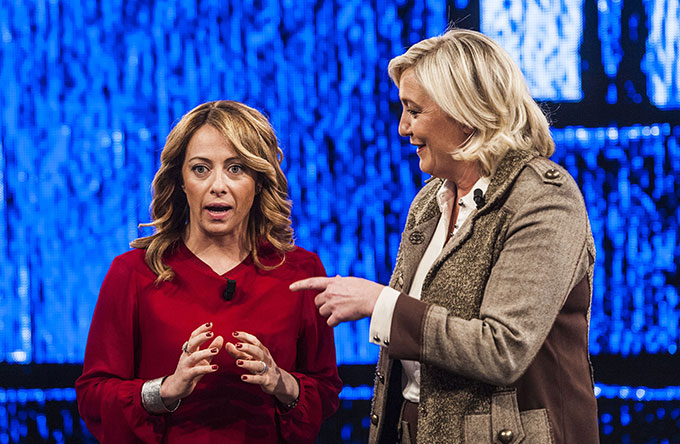
Like Trump, European leaders like Italian prime minister Giorgia Meloni and Marine Le Pen, head of France’s National Rally, have tapped rising populist sentiments. (Alessandro Serrano/AGF/SIPA/AP Photo)
While the populists advance, the traditional parties seem to be staggering toward oblivion. That monstrous machine, the state, no longer functions as intended; the levers are stuck, and all that comes out is sound and fury. Those running the institutions, including the old parties, face a sociopolitical Rubik’s cube: how to rule effectively over fractured societies from a shrinking minority position.
Ideologically exhausted, the elites have leaned heavily on the utopian projects of the radical Left. Mass immigration, anti-Zionism, decarbonization, racial equity, transgenderism—such contemporary pieties only intensify public alienation. Establishment leaders appear bred to be pale, weak, and lacking in media dazzle. Many are in free fall: approval rates stand at 13 percent for Britain’s Keir Starmer and 14 percent for France’s Emmanuel Macron. Both are historical lows.
In a paradox born of self-preservation, the Western establishment has come to repudiate the system that it has controlled for over a century. Defeat has taught the elites this lesson: if the status quo is to be saved, everything must change. Liberal democracy must be deconstructed into “our democracy.”
Since voters are unpredictable, the anti-populist counteroffensive has relied on institutions insulated from electoral control: the courts and the bureaucracy, with transnational bodies like the European Union also playing a role. Populist parties have been tagged “far right” and even as incipiently genocidal. With an obedient legacy media endlessly repeating these epithets, mainstream politicians feel justified in shunning the evildoers and excluding them from coalition governments. Russia and Vladimir Putin likewise loom large in establishment demonology. Populists are routinely portrayed as puppets of a foreign tyrant and thus unworthy of elected office.
Using institutional muscle to throttle the electorate isn’t a finely tuned strategy, though sometimes it works. Under EU pressure, Romania’s Constitutional Court, an unelected body, annulled the first round of the 2024 presidential election and disqualified the populist winner, Călin Georgescu. The justification given was Russian disinformation on TikTok, but little evidence was produced, and no attempt was made to explain how TikTok posts could mesmerize so many Romanian voters.
Three months after the anti-immigration AfD became the largest opposition party in Germany, that country’s equivalent of the FBI classified it as a “confirmed right-wing extremist” organization. The “extremist” label opens the door to police surveillance and potential banning. Remarkably, the evidence for this judgment, which holds profound implications for German democracy, remains secret. Yet the intent isn’t exactly a mystery: “The AfD is no longer a democratic party. It is the duty of our constitutional state to prevent it from acting,” explained the cochair of the Social Democratic Party. Translation: “our democracy” must disenfranchise the millions who keep voting the wrong way.
None of these maneuvers has revived a decaying regime. Class entitlement, it turns out, isn’t enough to earn the mandate of heaven, and old-fashioned abuses of power lose their force on the darkling plain of the information wars.
The present century has been shaped by its chaotic information environment. New communication technologies predated Trump and made his rise possible. The same technologies beckoned the immigrant masses out of their failing nations and guided them along the way. The web search, the algorithmic social media, the smartphone with its camera, artificial intelligence—with overwhelming speed, darkness turned to blinding light, the hidden was revealed, and the solemn murmur of the ruling class was drowned out by a roar of plebeian voices. The cognitive and social frameworks of the industrial age fell under these blows. Nothing has replaced them.
Those most battered were the last to grasp what was happening. It took the shock of Brexit and Trump’s 2016 victory for the people running the system to awaken to their predicament. By then, the barbarians were already inside the walls. The conflict now turns on belief structures, and the strategic terrain where victory will be decided is less political than definitional. The pandemic and the Black Lives Matter riots of 2020 clarified the stakes for the elites: the game will be won by whoever conquers the truth.
How, for instance, are we to characterize the millions of strangers who have poured into the democracies? For the establishment and the Left, they are innocent victims who will replenish aging native populations. For the populists and much of the public, they are foreign invaders who will destroy traditional ways of life. Other issues—climate change, transgenderism, the Palestinian cause—are equally unsettled. Add the discordant perceptions on both sides, and we end up hallucinating two mutually exclusive worlds.
In the conquest of truth, being empirically correct matters little. What matters is who gets to decide. The grand hierarchies of the industrial age anointed accredited experts as the arbiters of reality; outside of cranks and flat-earthers, no dissent was possible. The digital dispensation has shattered that arrangement. Much like the breakup of the Catholic Church following the Reformation, we now have multiple “establishments,” each claiming the right to determine the truth. We have crossed into a disordered post-truth moment, in which authenticity is a battleground, the facts are crowd-sourced—voted up or down with our likes and attention—and, as media theorist Andrey Mir has noted, “the universal gives way to the multiversal.”
Populism is a political by-product of the post-truth condition. Once presidents and TikTokers stand on the same plane of plausibility, with only the unruly public to choose between them, the temple of establishment authority is destined to tumble like the walls of Jericho. Sensing this, elites have succumbed to a reactionary panic—they want their twentieth century back. The first article of faith in “our democracy” is that the public must be pushed out of the commanding heights of the information sphere and that the power to construct a single, universal reality should return to those deemed properly trained for the task: the expert, the scientist, the politician, the journalist, the bureaucrat.
Barack Obama is the American apostle of epistemic reaction. “Part of what we’re going to have to do,” he said recently, “is to start experimenting with new forms of journalism, and how do we use social media in ways that reaffirm facts, separate facts from opinion. We want diversity of opinion; we don’t want diversity of facts.” But as every attorney knows, most meaningful disputes turn on the facts of the case. Obama isn’t really interested in diversity; his aim is narrative control. The facts will be supplied. The only question is: By whom? His answer is “government regulatory constraints” on digital platforms. Truth, like meatpacking, will be placed in the hands of bureaucratic inspectors, protecting the public by shutting down tainted voices. Implicit is the criminal prosecution of transgressors.
The Obama approach to truth—essentially a version of the Chinese Communist Party model—is already in place in many democratic nations. The EU’s Digital Services Act mandates inspectors, known as “trusted flaggers,” to scour platforms to ensure a “safe online environment”; fines for noncompliance can run to billions. In Brazil, Elon Musk’s social-media platform, X, was first shut down and then forced to censor populist content after a judge threatened to imprison the company’s local representatives. Pavel Durov, founder and CEO of Telegram, was arrested on arrival at Le Bourget Airport, Paris, on a flimsy pretext relating to his encrypted platform’s content.
While the tech firms feel squeezed and their platforms remain under constant surveillance, ordinary citizens find themselves bullied into submission. The British government has arrested more than 12,000 people for posting messages that cause “annoyance” or “anxiety”—by one measure, a larger number than China’s. In Germany, it’s now a crime to insult politicians online, and hundreds of police raids on private homes have been conducted to enforce this law. In Brazil, the same judge who shut down X has imprisoned countrymen whose political views inclined toward populism.
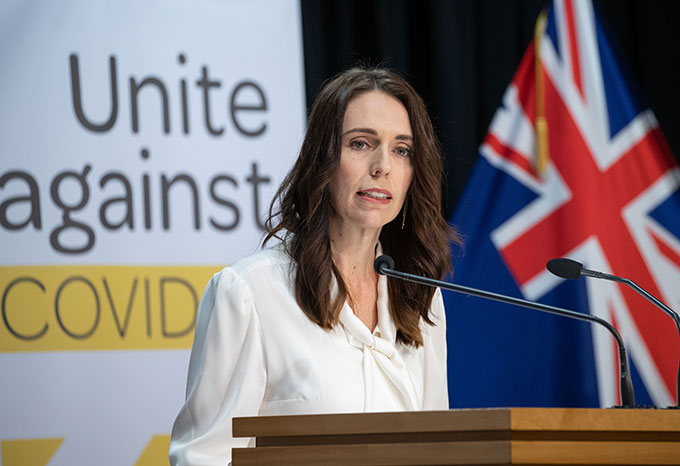
During the pandemic, Jacinda Ardern, then prime minister of New Zealand, provided an unusually explicit version of the elite objective. “We will continue to be your single source of truth,” she told the public. “Unless you hear it from us, it is not the truth.” It was a brave but futile boast. By January 2023, weighed down by unpopularity, Ardern had to resign. A few months later, her Labour Party found itself swept from office in a landslide. The truth may indeed be one, but the day is long gone when governments could claim a monopoly over it.
“Unless you hear it from us, it is not the truth,” said then–Prime Minister Jacinda Ardern of New Zealand in 2020. (Mark Mitchell/Xinhua/eyevine/Redux)
Even without Trump, then, the world remains a place turned upside-down. The old rules and categories have vanished, even if we still mutter the same familiar words in our civic rituals. Democracy now means perpetual conflict. Information now means a war over the truth.
If the populists prevail, the very form of modern institutions will be thrown into doubt, and a convulsive casting out of unwanted migrants will unsettle relations among nations in ways impossible to predict. Yet if the establishment somehow regains control and imposes the program of the Left, the repressive impulses of “our democracy” will make a mockery of liberalism, even as large numbers of unassimilated newcomers strain the system and threaten the very institutions that the elites seek to preserve.
On the margins, the authoritarian powers—China and Russia—await their turn. Neither can defeat the democracies in a direct confrontation, but both are content to aid in their unraveling.
The historical meaning of Trump becomes clear once we reinsert him into the picture. He is the avatar of the spirit of the age, a mighty whirlwind of change and disruption standing at the intersection of multiple, competing pressures, who, in success or failure, may hold the key to an unfathomable future.
Trump is the decider in this war of worlds. Should he self-detonate into nihilistic chaos, the old regime will triumph by default, and the window on an era riven by revolts from below may close. But should he achieve his objectives and pass the baton to a successor, the transformation of the system will accelerate to warp speed. The times would be defined by an immense horizon of possibilities, including, for example, a reconfiguration of government along lines shaped by the capabilities of artificial intelligence. Whether, at the end of this process, anything resembling our current dreams and ideals will remain may be the most consequential question we can ask—and one for which there is, at present, no answer.
Martin Gurri is a former CIA analyst and the author of The Revolt of the Public and the Crisis of Authority in the New Millennium.
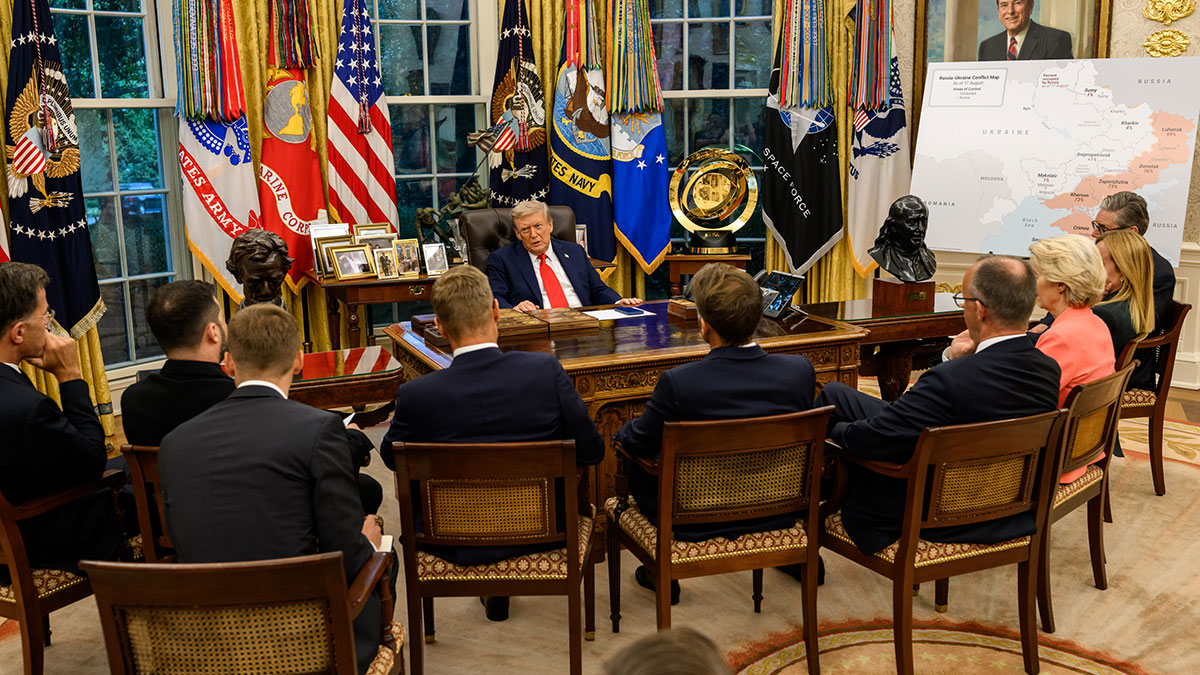
Top Photo: President Trump surrounded by European leaders in the Oval Office, August 2025 (Daniel Torok/White House/Newscom)