One of the most heartening developments of 2025 is that the relentless pursuit on the part of adults, who have been advocating to drastically alter the bodies of young children, has been exposed for the recklessness that it represents.
What’s Good for the Goose…
The Left remains on a relentless hunt for anyone in history who has ever committed an infraction that they deem to be reprehensible. What today's wokesters don't understand is that in the future they're going to be deservedly judged with at least equal vehemence to how they have been judging those on the Right. Not ironically, those on the Right have the best interests of children in mind.
The transgender mania that has been sweeping through our schools, particularly grade schools, has involved students as young as eight years old. Happily, the phenomenon tapered off significantly even before Donald Trump’s second inauguration. Nevertheless, in 2026, some teachers, school administrators, principals, as well as counselors and coaches, will continue to encourage young students to explore changing their gender. What’s more, many of these adults think that it is their solemn duty to profoundly indoctrinate children in one way or another.
In contrast, those on the Right feel that children should not be subjected to such indoctrination. At no time should a drag queen story hour, for example, be sponsored by any public school. What is the point? To expose young children to emotionally challenged men who feel the strong urge to dress up and parade around as if they are women? Is there social value in that? If so, carefully explain the value and cite legitimate references.
Proceed Cautiously
When young children who have been unduly influenced reach the age of 20, 30, or 40, and are in positions of power or influence themselves, watch out for a significant revolt among that population. The revolt will be directed towards those who induced them to irrevocable life changes.
It is not a large leap to imagine potential lawsuits, books, articles, theatrical productions, inflammatory documentaries, and all manner of information dissemination crying out about the injustices that such individuals experienced decades earlier, as impressionable youths. In time, it’s likely that those individuals today who are indoctrination advocates, let alone those who have encouraged or actually performed sexual mutilation and other horrendous medical procedures, will be deemed the villains of tomorrow.
If you believe it is your right to indoctrinate those whom you have no business indoctrinating, proceed with caution. You are among the dregs of the earth, and you will be cited as such, hopefully, while you're still here to face the utter shame of it all.
Gender Dysphoria is a Phase
Here’s news for the wokester advocates: Increasing evidence shows that gender dysphoria often is a situation that eventually passes. Most children grow out of it. Among those who do have such inclinations, many are simply gay. They are not candidates for changing their gender so that they'll somehow have a better life. Those in positions of authority, certainly within our educational institutions, have exceeded the bounds of prudence, caution, and science.
As more and more evidence emerges that sex change operations and the lifestyles that such victims must endure don't pan out, how will today's advocates of such changes be judged in the future? In a word: harshly.
Emerging studies reveal that most of those who undergo sex reassignment procedures do not achieve the inner peace and satisfaction that they had sought. Instead, they learn the exceedingly hard way that the procedures done to them are permanent, far less than satisfying, and, in many cases, doom them to an existence that they could not have previously imagined.
Deeds Revealed
In the coming decades, those who were advocates of this mania and unduly influenced children and teens based on a Leftist agenda, and not based on what was good for the individual, will be seen for what they are.
Those who made money off of such medical procedures, in particular, will be judged for what they did. Those who have corrupted the hearts and minds of the children they were entrusted to protect will be held in low esteem.
The term “gender-affirming care” will fall out of favor and will be regarded as despicable pseudoscience perpetrated by Leftist zealots, who continue to believe that they are correct on all issues related to gender, sexuality, and everything in between.
Binge-watching is a habit that’s usually good to avoid, especially when watching on your own. However, during the week after Christmas and before New Year’s — in which so many families find themselves sandwiched between big gatherings or parties and maybe even forgetting what day it is — spending a little extra time together in front of the silver screen with popcorn and in pajamas is to be expected, and can even prove restful.
The key to curating the perfect post-Christmas movie marathon experience, however, is knowing how to avoid all the streaming service slop so many platforms push on kids and parents this time of year. Whether you’re just watching one episode, hosting a double feature, or looking for new marathon material that isn’t watching The Lord of the Rings or Star Wars again, here is your ultimate guide to the best old-school films and T.V. series to watch with your family this holiday week.
Old Movies
Christmas movies like Home Alone or Elf — while delightful and sure to remain classics for generations to come — are often selected by families during the holiday season to the neglect of equally as delightful and arguably more timeless movies from the golden age (or thereabouts) of film. And yes, this era has far more to offer than Irving Berlin’s White Christmas or the ever-endearing It’s A Wonderful Life. This week is the perfect time to explore these holiday-adjacent movies you may have never heard of and develop a deeper appreciation for eras gone by — in which conservative values and familial sacrifice so often won the day.
Black-and-White
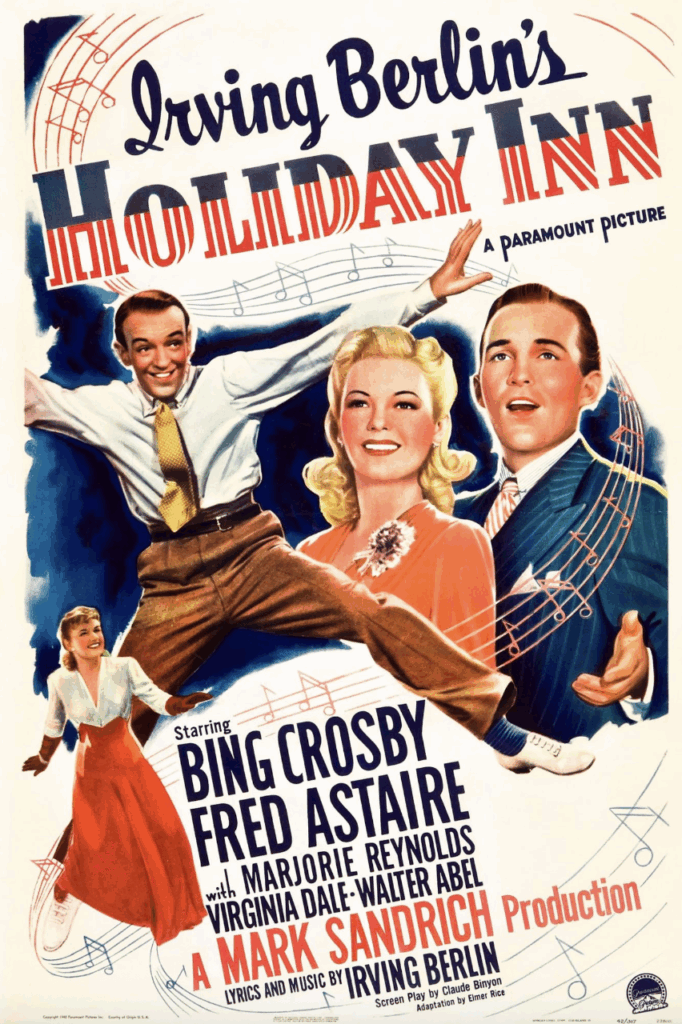
My siblings and I used to protest when our mom put on black-and-white movies, but I’m so glad she helped us appreciate the classics in spite of ourselves. My first recommendation is one of my all-time favorites, Holiday Inn (1942), starring Bing Crosby, Fred Astaire, and Virginia Dale. This movie about a hotel that’s only open on holidays has it all: humor, a love triangle, and iconic song and dance numbers — including Astaire’s famous Independence Day firecracker tap routine. (Parent disclaimer: this movie has come under fire for featuring a blackface scene. However, the song performed is in celebration of Abraham Lincoln’s Emancipation Proclamation, and, while you may decide to skip this part, resist the leftist urge to fully cancel classics just because certain scenes run against modern-day “political correctness.”)
Perhaps one of the earliest movies to follow the now Hallmark-dominated “corporate girl in a small town” storyline, Christmas in Connecticut (1945) tells the story of a “food writer who has lied about being the perfect housewife” and “must try to cover her deception when her boss and a returning war hero invite themselves to her home for a traditional family Christmas.” In a desperate stunt to preserve her reputation, the single New Yorker with no real homemaking skills of her own is forced to curate a clumsy housewife facade, only to end up finding true love.
The Bishop’s Wife (1947) is a heartwarming — and tearjerking — story of an Episcopalian Bishop, Henry, who is struggling at Christmas. While dealing with a manipulative church donor and efforts to build a new cathedral, “He is losing sight of his family and of why he became a churchman in the first place,” as one commenter on IMDb put it. After Henry prays for guidance, an angel named Dudley — played by movie star Cary Grant — is sent to intercede and becomes very involved in caring for Henry’s wife and daughter. The bishop becomes increasingly jealous and eventually realizes his family means more to him than anything — but this reordering of priorities was why Dudley was sent in the first place.
Another one of my absolute favorite old movies is titled Since You Went Away (1944). It follows a family during World War II after the father leaves to serve in the military, leaving the mother and her two daughters to take care of themselves while he is gone. Like many WWII movies produced at the time, the film movingly captures the grit and loyalty of families serving on the home front. (I found this high-quality version of the movie for free on YouTube.)
Starring a young Jimmy Stewart and Margaret Sullivan, The Shop Around the Corner(1940) tells the story of two rival shop workers who don’t know they are each other’s anonymous pen pal significant other. This classic story has inspired multiple remakes, including In the Good Old Summertime (1949) with Van Johnson and Judy Garland, and the more recent You’ve Got Mail (1998) with Meg Ryan and Tom Hanks.
In Glorious Technicolor
Speaking of Judy Garland, fans of her acting and singing voice can’t miss Meet Me In St. Louis (1944), a musical set in 1903 ahead of the Louisiana Purchase World’s Fair in St. Louis, Missouri. Garland plays Esther Smith, a young girl from a big family who falls in love with the boy next door. After her father announces that he plans to move the long-time Missouri-residing family all the way to New York, they prepare to follow his lead, only for all of them to discover they truly have it all right where they are.
And speaking of the boy next door, in the delightful and underrated early Doris Day film, On Moonlight Bay (1951), a tomboy eldest daughter, Marjorie, gives up baseball after catching the eye of the dashing, high and mighty scholar across the street (Gordon McRae). He claims he does not believe in marriage, but after falling in love with Marjorie, both he — and Marjorie’s father — eventually warm up to the idea. If you end up loving this movie as much as I do, be sure to follow it with the sequel, By the Light of the Silvery Moon.
In An Affair to Remember (1957), with Cary Grant and Deborah Kerr, an American celebrity and a nightclub singer — both unmarried but stuck in loveless relationships — meet on a cruise ship. At the end of the cruise, they agree to break off their current relationships and reunite the next year at the top of the Empire State building. But the plan fails when a tragic accident keeps one of them from making the rendezvous.
Although not explicitly holiday-related, for those looking for less feel-good and more suspense, I can’t recommend Alfred Hitchcock’s wonderfully directed mystery and thriller films enough. Rear Window, The Birds, Rope, The Man Who Knew Too Much, Vertigo, Psycho (black-and-white), and North by Northwest (another Cary Grant feature!) all showcase Hitchcock’s wonderful eye for intriguing camera angles, light, and character. They are sure to keep you on the edge of your seat — while of course maintaining that Golden Age glow.
For The Girls
There’s nothing like a good chick flick for mother-daughter bonding time. But if you’re tired of the same repeated Hallmark plots, give these a try instead.
While You Were Sleeping with Sandra Bullock and Sleepless in Seattle with Tom Hanks and Meg Ryan are two holiday-related ’90s rom coms that are great for watching back to back on a lazy day — if for no other reason than both titles mention sleeping. Sleepless in Seattle follows a widowed father struggling to open up his heart again after his wife’s death. In While You Were Sleeping, Lucy Moderatz, a single woman living in Chicago with no close relatives, is welcomed into a loving family when they mistakenly believe her to be engaged to their comatose son. (Tip: See if you can catch all the Affair to Remember references in Sleepless in Seattle.)
In The Family Man (2000), Nicholas Cage plays Jack Campbell, a rich New York investment broker who ultimately gave up his college girlfriend for an internship in London and a career on Wall Street. Years later, on Christmas Eve, he is given a “glimpse” of what life could have been if he instead settled down and started a family — only to realize he would rather have the love-filled chaos of single-family suburbia than the corner office.
The Preacher’s Wife (1996) is a modern-day remake of the aforementioned Bishop’s Wife. Rather than an Episcopalian cathedral, this rendition starring Whitney Houston and Denzel Washington centers on the family of the lead pastor at a black gospel church in Harlem.
Golden Age T.V.
Back before streaming services monopolized movie-watching, my family always tuned into the SyFy channel on New Year’s Eve and New Year’s Day to watch the channel’s 48-hour Twilight Zone marathon. (Don’t worry, we did not watch all 48-hours, just tuned in at different points over both days. The marathon also happens on the Fourth of July, too!) At this point, I think I have seen every episode of the series written by — and starring — Rod Serling that ran from 1959 to 1964. The episodes explore culturally relevant and then-newly emerging themes like space, aliens, the mechanization of society, the Cold War arms race, and more. However, the series does not merely touch on these motifs for their own sake, but, overall, uses them to highlight why society must preserve human dignity, individuality, critical thought, and truth in an era of modernization. If you don’t have cable or access to the SyFy channel, The Twilight Zone is available to stream on Paramount+ or Tubi.
In addition to directing numerous films, the witty, dry-humored Alfred Hitchcock is also famous for hosting the television series Alfred Hitchcock Presents (1955-1962). Each episode centers on a murder or some sort of mystery to be solved in under half an hour. Like The Twilight Zone, every installment features different slates of actors and often concludes in a twist ending. This series is available on Peacock.
Looking for some my-ribs-hurt-from-laughing level humor? One New Year’s Eve, while waiting for the midnight countdown, my family and I watched multiple episodes of The Carol Burnett Show, which ran on CBS from 1967-1978. Hosted by actress and comedian Carol Burnett, the show was filmed in front of a live studio audience and featured unforgettable guest stars, hilarious original sketches, and the unbelievable physical comedy of Tim Conway. (Watching this show with my parents was also how I came to learn that my dad met Burnett while working as a valet at a fancy Cincinnati restaurant in the ’90s.)
The Muppet Show, which also ran throughout the ’70s, is another, more kid-friendly classic featuring performances from the beloved characters alongside a plethora of guest stars. Access to this show is one of the few reasons why Disney+ is still worth it.
I would like to conclude with the obligatory disclaimer that, while these suggestions are overall family-friendly (especially the old movies and T.V.), be sure to check ratings and parent advisories, as some situations in the more modern or thriller options may be distressing or too mature for young children. But otherwise, pop some popcorn, cue up some forgotten classics (share any I may have missed in the comments), and happy movie-watching!
One of the big myths that drives leftism is that America has an almost unholy amount of poverty, which is totally at odds with the false consciousness that America is a wealthy country in which people thrive. However, lending credence to the saying “lies, damn lies, and statistics,” it appears that much of America’s so-called “poverty” is a bookkeeping designation, with welfare keeping many people afloat on a sea of unrecognized wealth.
Thus, a Wall Street Journal article from last week completely upends the idea that we have many poor people in this country. Yes, I know that the idea is preposterous, yet it appears to be true. Did you know that welfare programs are not counted as income?
In the essay, Phil Gramm & John Early write that federal welfare spending now totals $1.4 trillion. If divided evenly among the 19.8 million families the government classifies as poor, each would receive more than $70,000 a year—yet none of these benefits are counted as income for eligibility or poverty measurement.
Even accounting for the “skim” (the money the government and NGOs rake in off the top), it’s a staggering number. It is impossible to reconcile the $1.4 trillion with what Democrats and the media maintain is a system that “neglects” the poor.
What this suggests is that everything we’re being told about the poor is a lie, or at least being called poor and not having money are separate things. How can we reconcile such foundational issues as “one in seven children go to bed hungry” with the reality that suggests strongly that there is little to no correlation between being poor and hungry and an unjust economic system? In fact, the contrary appears to be true.
Democrat and socialist politics depend on making Americans feel guilty. What if we all woke up one day and realized that the greatest scam of all was the underlying lie that not ‘paying your fair share’ meant you were not paying sufficient graft? In other words, our poverty complex isn’t about helping poor people. It’s about helping criminals (obviously aided by bureaucrats) enrich themselves with taxpayer funds by pretending to help poor people.
Here are two more examples that I believe make my case:
First, Joe Thompson is leading the federal investigation into fraud across 14 Minnesota-run Medicaid and human-services programs. According to reports, his investigations reveal that Minnesota has paid $18 billion to these programs since 2018, with Thompson stating that “half or more” of that may be fraudulent. This implies losses of up to $9 billion.
Given that 82 of 92 defendants named in the currently existing fraud cases are Somali, it is ridiculous not to connect one with the other. The other side wants you to believe that we must separate and sanitize the crime, not tie it to any ethnic group. Hundreds, perhaps thousands of Somalis participated in the fraud for their “cut” of the theft.
Second, we have an identical situation with the Haitians, who were let in with little screening. Credible reporting concerns two Haitian men charged in Massachusetts with $7 million in SNAP (food stamp) fraud. I can promise you that this is the tip of the iceberg. It’s becoming common to shy away from accusing anyone from the immigrant minority community for fear of being tarred with the racism brush. This, in turn, leads to the lie that immigrants are more law-abiding than native-born.
As a nation, we need to grapple with whether it ever a good idea to allow anyone in on whatever visa de jour one could get for people who are not “natural fits” for our country, based on cultural values, education, and propensity to assimilate? The answer should logically be a resounding “No.”
That, however, is a different conversation. The conversation here and now is that poverty is a big business for corrupt government and corrupt people. In light of this fact, it’s impossible to know what America’s poverty rate actually is, and what choices people are making that drive poverty: Are these people who are genuinely down on their luck (what Alfred E. Doolittle called the deserving poor) or are they people addicted to a corrupt system that makes poverty functional (Doolittle’s undeserving poor) and, for the grifters, profitable?
Hundreds of thousands of people, politicians, NGOs, religious institutions, and others have treated the government as their own personal ATM. Once codified into law or practice, what should be deemed illegal practices at the outset become nothing more than baited fields for the unscrupulous and profiteers alike. All the fake concern they have for their meal tickets is just that, fake. It is grifting on a scale never before seen in this world, and the normal people in America are forced to pay for their own undoing.
There is a set of principles that undergird any society that wants to thrive and survive. They are:
1. Shared Prosperity
2. Shared Norms
3. Universal safety
4. Educated Individuals
5. A disdain for malingers.
Without these five principles at the base of every decision tree, we are lost. Inconsistent principles and poor execution have led to our Balkanization. National standards can only be set by Congress and seconded by our legal system. President Trump cannot sign an Executive Order requiring sanity in our governmental practices; it’s wishful thinking to believe otherwise.
We must have rational national standards for immigration and assimilation, or no immigration at all. Separate but equal went out a long time ago. We need rigid incentives for education and morality, the affirmation of families, and a way for young people to own a home they can afford that creates a sense of belonging, the beginnings of their own generational wealth, and a desire for children.
Every good essay should remind readers that it is up to us to put thought into action. If we seek more joyous holidays in the future, we must undertake the necessary corrections to ensure such. We should come away with the belief that every generation is just caretakers for the next. It is our duty and our privilege to leave this place better than we found it. Luck is not an accident; it’s when duty, logic, and truth collide.
The erosion of the philosophical and institutional/constitutional structure of America has intensified during a period exceeding one hundred years beginning with Woodrow Wilson.
President Donald Trump early in his second term renamed the Department of Defense the Department of War. This was the original name given to our federal military in 1789 and it had been in effect until it was eliminated by . In William Shakespeare’s great play Romeo and Juliet, Juliet utters the immortal line, “What’s in a name? A rose by any other name would smell as sweet.” This name change by Trump is not to change the department’s smell, but to signify a change in tone, focus, and commitment.
This name change has been only one of many actions taken by our present President to push back the decades-long movement from progressivism through the New Deal through multiculturalism and the historical revisionism of the Obama years. The erosion of the philosophical and institutional/constitutional structure of America has intensified during a period exceeding one hundred years beginning with Woodrow Wilson.
Although Wilson soundly defeated the socialist candidate Eugene V. Debs for the presidency in 1912, he was committed to dramatically altering the institutional and cultural landscape of the USA in ways that enlarged the power of national policy at the expense of local and state mores and institutions.
Wilson actively supported the creation of the Federal Reserve, an institution intended to stabilize the economy which, owing to banking greed and instability, had faced various collapses over the decades. The Federal Reserve’s were “to promote effectively the goals of maximum employment, stable prices, and moderate long-term interest rates.” However, as all students of history know, the banking collapse of U.S. history began less than twenty years after the creation of the Fed, i.e., the Great Depression beginning in 1929.
The Clayton Antitrust Act was also passed and signed into law by Wilson. Among other matters it prevented labor organizations and farmers’ associations from being sued under antitrust legislation. It also prevented price fixing and interlocking directorates. However, we still see oligopoly power being applied in various sectors. For example, Internet companies have collaborated in setting up divisions in major urban areas, so that even if a cheaper service is available in your city, it may not be available in your zip code.
Further, the big unions cling to their Democrat Party allegiance because their power cannot be challenged by the government in support of dissident groups within the unions that are blocked from growth by the dominant insider union leadership. Listen to the aggressive and uncompromising left-wing rhetoric of various big unions, especially the teachers’ unions in our major cities, and the American Federation of Teachers Randi Weingarten. They cannot be rejected or unseated by their own membership -- such is their tight grip on power.
Although the federal income tax was passed into law as a constitutional amendment under Pres. William Howard Taft, it became law under Wilson and he set up the Internal Revenue Service. Imagine, there was no income tax in the USA until 1913! This writer had a brief correspondence with Phyllis Schlafly, founder of the conservative organization Eagle Forum, a couple of years before she passed. I sent her the tax rates from the early years of the income tax, and she was surprised at how high they already were. In 1917 the top tax bracket was already being taxed 67%. If you think that is because of WWI, it should be stated that in 1921, the top bracket tax was even higher at 73%. The top bracket when Pres. Reagan took office was 70%, and during his term it dropped to 28%.
This marked statism of Progressivism morphed into increasing the size and scope of the federal government under the hegemonic leadership of FDR. The New Deal kept increasing the size of the federal government with its many alphabet agencies (WPA, AAA, CCC, NLRB, etc.). Layer after layer of increased powers accrued to the federal government with high federal income tax. Social Security came into existence to help the elderly survive and have a better quality of life, but at the same time, inflation lowered the value of the dollar so that more dollars were required to meet basic needs.
With every drop of increased government influence over income, outcomes, employment, and industry came a sharp decline in individual initiative, individual spirituality dependent upon a loving God, and increase and entrenched dependence upon the power brokers who were going to make it happen for the people. Government increasingly was shaping the lives of our citizens rather than facilitating those lives. The federal government began establishing outcomes rather than providing justice for citizens in the context of individuals and states being responsible for outcomes.
Ideals of independence and freedom were being diluted to an extreme. Then we faced WW II. While we were ourselves on the brink of full-blown socialism, we condemned the movements of Germany and Russia with their undo government control at the central level combined with their disgusting racism (Germany) and anti-family/anti-private ownership (Russia) rhetoric. But we had to move forward against those extremes despite carrying our own burdens of Wilsonian and Rooseveltian statism.
Meanwhile, in the 1980s, Deng Xiaoping had the brilliant idea of turning his wacky, impoverished post-Mao PRC into a semi-capitalist haven with “empowerment zones.” These would be areas where capitalists could come in, set up their companies, and manufacture goods (with appropriate bribes paid, of course). This incentive attracted exporters as well as manufacturers (including many American corporations) to set up plants in China using cheaper Chinese labor to manufacture goods and ship them to the U.S. as well as other countries. Even with the cost of shipping, profits were greater than manufacturing in the USA or Western Europe.
Then, towards the end of the Clinton presidency (yes, another Democrat quisling), Bill Clinton pushed through allowing duty-free imports to the USA for China under the World Trade Organization Agreement, and this really put manufacturing into full blown exodus. That’s when the world of economics started referring to the USA as a service economy rather than a manufacturing economy.
Coming back to the opening statement of this article, the name change to Department. of War is a change with great symbolic significance. It’s not only about the military. The name change is a reminder that we have been on the wrong side of the historical curve for a long time. We must find our way back to a more historically true sense of identity as a country, as a people. All the foundation assumptions must be rethought. There have to be readjustments as we seek to recover the love for freedom, hope in the individual and in the states, and literally a more peaceful vision of our identity as freedom lovers within a pluralistic institutional context.
On Friday, FBI Director Kash Patel took to X to announce the official shuttering of the J. Edgar Hoover FBI Headquarters building. Patel first made this announcement in May during an interview on Fox News' Sunday Morning Futures program with Maria Bartiromo. Since Congress holds the power of the purse to designate what happens with federal buildings, Patel cleared the proper channels in order to finally execute his plan.
December 26: Shutting down the Hoover Building.
After more than 20 years of failed attempts, we finalized a plan to permanently close the FBI’s Hoover headquarters and move the workforce into a safe, modern facility. Working directly with President Trump and Congress, we accomplished what no one else could.
When we arrived, taxpayers were about to be on the hook for nearly $5 billion for a new headquarters that wouldn’t open until 2035. We scrapped that plan. Instead, we selected the already-existing Reagan Building, saving billions and allowing the transition to begin immediately with required safety and infrastructure upgrades already underway. Once complete, most of the HQ FBI workforce will move in, and the rest are continuing in our ongoing push to put more manpower in the field, where they will remain.
This decision puts resources where they belong: defending the homeland, crushing violent crime, and protecting national security. It delivers better tools for today’s FBI workforce at a fraction of the cost.
The Hoover Building will be shut down permanently.
The Hoover Building has been a money-suck since its inception. Original construction was planned to be set in 1963 for an estimated $60 million. The construction wasn't completed until over 10 years later, to the tune of $126 million. The closure of this headquarters fulfills Patel's promise of a new FBI that would be transparent, accountable, and focus on letting cops be cops. With a more streamlined D.C. workforce, this means that along with agents being launched back into field work, state and regional headquarters will now be more fully staffed. The benefit of this has become evident with the trafficking arrests, narcotics busts, and thwarting of mass casualty terror plots in Michigan and California.
My colleague streiff wrote after Patel's confirmation as FBI Director.
During his confirmation hearing, he reiterated his goal of getting agents and analysts out of DC and into field offices.
During his confirmation hearing last month, Patel was asked about his previous comments suggesting he wanted the FBI’s headquarters emptied out and shuttered. His responses did not directly address whether he would actually shut the building down or seek to transform it into a museum, but suggested that he believes the FBI’s workforce in Washington should go out into the country.
“A third of the workforce for the FBI works in Washington, D.C.,” Patel said. “I am fully committed to having that workforce go out into the interior of the country, where I live west of the Mississippi, and work with sheriff’s departments and local officers.”
Some of those agents are on temporary duty to DC and will return to their home offices. You can also bet that a non-trivial number of those ordered out of the building will retire rather than move.
Good riddance. In May, Patel also signaled plans to increase personnel to Redstone Arsenal in Huntsville, AL. In a Senate oversight hearing, Patel committed to Alabama Sen. Katie Britt (R) that these plans were already being implemented.
WATCH:
In mid-December, the FBI's Deputy Assistant Director for IT Infrastructure, Kevin Jones, updated elected leaders and personnel at Redstone Arsenal. Jones said there are 2,200 FBI personnel already stationed at the facility — 500 of that number are agents who were moved from D.C. to the South. The FBI plans to expand that number to 4,000 by 2030.
Jones said the Huntsville facility will create one of the largest concentrated footprints of any FBI division in the United States. Personnel will work at the Richard Shelby Center for Innovation and Advanced Technology, the new name for the FBI’s official campus on Redstone Arsenal.
Workers will initially be stationed at the North Campus of the FBI building. That building houses the FBI’s technology, cyber, analytics and instructional environments.
These actions represent the return of the bureau back to enforcing laws, fighting crime, and making communities in the nation safer. Here's hoping under Patel's continued leadership of the FBI that we see a vastly different agency in the coming years.