Friday, December 26, 2025

The Death of Beauty: Urban Aesthetics and the Rupture of Modernism


In the great arc of human civilization, cities have always been more than just habitats. They are the material embodiment of a people’s values, dreams, and collective memory. For centuries, urban architecture was a celebration of order, proportion, and harmony—a mirror of cosmic ideals brought down to earth. From the grand colonnades of Athens to the domes of Florence, beauty in the urban fabric was not an aesthetic afterthought; it was a moral imperative.

However, with the upheavals of the twentieth century, a profound rupture occurred. Architecture abandoned its humanist and classical lineage, and in its place emerged a series of modernist styles (e.g., Bauhaus, International Style, Brutalism) that prized efficiency, novelty or ideological purity over beauty. In this turn, urban aesthetics began to die.

To speak of “beauty” nowadays is virtually taboo in architectural discourse. The word has become suspect, associated with nostalgia, reactionary sentiment or superficiality. However, this suspicion belies a deeper cultural sickness: we have forgotten that beauty is not mere ornamentation. It is a source of meaning, a civilizing force, and an expression of the metaphysical longing of human beings for order and transcendence. By sacrificing beauty on the altar of progress, we have more than disfigured our cities—we have wounded the soul of civic life itself.

The modernist rupture did not occur in a vacuum. The industrial revolution, the mechanization of life, and two catastrophic world wars created a climate ripe for radical rethinking. The classical idiom, once seen as the eternal language of architecture, came to be viewed as outdated or politically compromised. A new generation of architects, inspired by the machine, the factory, and the ideal of the tabula rasa, sought to reinvent the city from scratch. 

At the forefront of this movement was the mantra of functionalism—the belief that “form should follow function”. Ornament was denounced as “crime”, as Adolf Loos famously put it. The architect became an “engineer of social efficiency”, not a “poet of space”. In theory, this shift aimed to strip away the excesses of past architecture in favor of honesty and clarity. In practice, however, it gave birth to a sterilized, dehumanized aesthetic. Buildings lost their symbolic vocabulary; they ceased to speak to the citizens that they housed.

Indebted to the Bauhaus School of Walter Gropius, the International Style reduced architecture to abstract, rectilinear forms, devoid of local identity or cultural memory. Cities across the globe began to look indistinguishable, their skylines a collage of anonymous glass towers. The guiding aesthetic became sameness masquerading as modernity. Place-making gave way to placelessness; tradition was erased by ideology.

This drift continued and intensified in the rise of Brutalism, which emerged in the postwar era. Its massive concrete structures were justified as expressions of raw honesty and egalitarian spirit, especially in social housing. Yet the reality was one of alienation. Brutalist buildings, with their fortress-like facades and monolithic scale, inspired not awe but despair. In their pursuit of “truth through material”, they forgot the emotional needs of the people who would live among them.

As the twentieth century wore on, architecture succumbed increasingly to the cult of novelty and provocation. Where modernism once claimed moral seriousness, its postmodern and contemporary successors embraced a more playful—or cynical—aesthetic. However, the rupture with the past remained intact. Classical motifs were now quoted ironically, and buildings became exercises in self-referentiality or visual shock. The goal was no longer to uplift or dignify human life, but to produce a statement, a brand, a spectacle.

Today, many modern cities resemble “children’s rooms filled with clumsy toys”—towers twisted into pretzels, museums shaped like shards of glass, public spaces adorned with sculptures devoid of meaning or context. There is a pervasive sense of chaos—not a creative chaos, but one born of disregard for continuity, harmony or coherence. The urban environment has become a space of aesthetic noise, where each building, whether defined as “deconstructivist” or “high-tech” in style, screams for attention, yet no symphony emerges.

Underlying this phenomenon is a philosophical nihilism—the idea that the past has nothing to teach us, that tradition is oppressive, and that meaning itself is suspect. However, when the built environment reflects this belief, it transmits a dangerous message to those who inhabit it: that we are rootless, isolated individuals living in a landscape without memory or purpose.

The loss of beauty in our cities is not merely a question of taste. It is a moral and cultural crisis. Human beings are not machines. We do not thrive in environments designed solely for utility or efficiency. We need symbols, stories, rhythm, and harmony. We need a sense of belonging—not just socially, but aesthetically. Architecture is more than shelter; it is pedagogy. It teaches us how to live, what to value, and what we are part of.

English philosopher Roger Scruton wrote that beauty “is not just a subjective thing but a universal need of human beings”. It is not optional. It civilizes our gaze, ennobles our experience, and gives dignity to the spaces where life unfolds. The classical tradition understood this deeply. Its columns and courtyards, arches and domes, were not arbitrary decorations but embodiments of proportion, grace, and meaning.

When we walk through a traditional European piazza or along a colonnaded avenue, we feel a sense of repose. These spaces were designed with the human scale in mind. They invite community, contemplation, and joy. They do not scream for attention; they whisper truths. They endure. By contrast, many modern urban spaces repel human presence. They are anti-social, anti-human, and, ultimately, anti-civilization.

All is not lost. Amid the ruins of modernism’s promises, a quiet renaissance is emerging. Across the world, a small but growing number of architects and urbanists are rediscovering the principles of traditional architecture. Movements such as New Urbanism, New Classical Architecture, and human-scale urbanism are challenging the hegemony of the glass box and the concrete slab.

These movements recognize that beauty is not incompatible with modern life. Rather, it is its deepest necessity. They advocate for buildings that respect local traditions, that respond to climate and culture, and that place the pedestrian—not the automobile or the abstract concept—at the center. In doing so, they affirm that cities should not be experiments, but homes.

Examples abound: in Poundbury, England, a model town built under the direction of Luxembourgish architect and planner Léon Krier, traditional architecture has been fused with modern needs. In places like Seaside, Florida, or Val d’Europe outside Paris, urban planners have proven that harmony and beauty can be economically viable and socially enriching. Even in major cities like Washington D.C. or Paris, classical civic buildings still command respect and admiration, reminding us that the public yearns for dignity in design.

What is needed now is not a return to the past in a literal sense, but a recovery of its principles—proportion, unity, symbolism, and reverence for the human spirit. Architecture must once again become an ethical and cultural endeavor, not merely a technological or economic one.

The twentieth century may have killed urban beauty, but it did not destroy the human longing for it. This longing remains—buried perhaps, but alive—in every traveler who feels peace in an old square, in every child who marvels at a cathedral, in every citizen who looks at their city and asks, “Why must it be so ugly?”

Posterity will judge us harshly. The choice is not between “innovation and tradition”, but between “rupture and continuity”, “alienation and belonging”, “despair and dignity”. Beauty is not a luxury of the past; it is the scaffolding upon which a humane future should be built.

To restore beauty is not reactionary. It is reconciliatory—in the truest sense of the word: a turning back to foundational truths, not to flee the present, but to rebuild it with purpose.

If cities are to become homes again—and not just zones of production and consumption—they must be shaped by more than utility. They must be shaped by care, memory, and meaning. The death of beauty was not inevitable. Its resurrection is our task.


Entertainment thread for Dec 26


Hope you're not too hung over from yesterday.

Islam And The West: Time For A Divorce


Islam is simply incompatible with Western civilization, and that couldn’t be more evident considering the 2025 Christmas and Hanukkah season. We get it rubbed in our faces, time and time again, with one massacre after another. These aren’t just lone gunmen who go nuts. These are organized terrorism cells. Bondi Beach, a massacre allegedly committed by two Muslims (father and son), is only the latest example.

San Bernardino, California was the scene of a similar massacre by two Muslims (husband and wife). Nineteen Muslims, backed up by the wealth of other Muslims, gave us 9/11.

Only Islam commands its followers to “kill the infidels.” As a result, we constantly see two (or a lot more) Muslims banding together to kill the infidels. That’s us.

The gay nightclub shooting in Orlando was by one Muslim security guard, who targeted homosexuals — it was, presumably, driven by the Koran’s commandto kill homosexuals. He killed 49 people and wounded 53.

There are literally hundreds of other examples from all over the world, such as the Charlie Hebdo massacre in Paris. I could publish an encyclopedia full of nothing but massacres of non-Muslims by Muslims, in the 20th and 21st centuries alone.

How To Stop the Violence

This has got to stop. Nobody is going to stop it, except Western governments. And there’s only one way to do it: ban Islamic immigration, revoke their refugee or temporary protected status, and deport those who are here illegally, for the same reason Germany banned the Nazi Party.

The Constitution forbids discrimination on the basis of religion, but this isn’t just a religion. And the Constitution isn’t a suicide pact.

Islam is a brutally misogynistic, brutally homophobic, brutally xenophobic, supremacist political ideology, pretending to be a religion. And it needs to be viewed that way by Western civilization. No matter how peaceful most Muslims seem, eventually a charismatic leader will come along who will radicalize them, for his own aggrandizement. That’s what’s going on right now in Iran.

Adolf Hitler had a Muslim infantry division in the Waffen SS for very good reasons. Islamists love killing Jews, which was permitted by a charismatic leader in Germany. If Islamists aren’t killing Jews, they’re killing Christians; or any other religion, nationality, or ethnic group.

Lebanon used to be a Christian nation. Afghanistan used to be a Buddhist nation. Pakistan used to be a Hindu nation. Now all three are Muslim nations. Does anyone notice a pattern?

The “Aliens” and “Green Apples” Analogies

Here’s a Facebook reel from Nathan Fang, using an “aliens from outer space” analogy. If aliens landed on Earth and began to harm us, Fang is convinced that “alien’s rights activists” would crop up shortly, advocating for the aliens and their right to remain.

There’s also a conservative gentleman in the UK who’s of Russian descent (I think, judging from his name) who did a Facebook reel on the following analogy: We have green apples, red apples, and yellow apples, just as we have Muslims, Christians, and Jews. But what if a tiny percentage of green apples were extremely toxic, and will kill whomever eats them. Would we have people insisting that green apples deserve to stay on the grocery shelf, for the sake of diversity?

Would we have scientists monitoring all the green apples carefully, developing some sort of hideously expensive system that detects which ones are toxic, at incredible expense (think of an America bristling with security cameras and traffic cams, like the quills on a porcupine — costing us not only tax dollars, but much of our privacy)?

No, we wouldn’t. We’d have the FDA banning green apples from our grocery stores.

The  “Neighbor” Analogy

The relationship between Islam and the West has been very much like that of a woman with a new, male neighbor. The following analogy will be condemned as collective punishment, as certainly, there are good Muslims in the world. But they have roughly 50 countries of their own, and they should stay there and make the best of what they have there.

In this analogy, when the lady’s new neighbor appeared, there was a lot of feuding: the Islamic invasion of western Europe in the 7th Century, followed by the Crusades, followed by two Turkish invasions that were stopped at the gates of Vienna in the 16th and 17th centuries.

Gradually, they established relative boundaries—but then the male neighbor developed a lucrative new career: oil. Eventually, the woman begins a relationship with him, because he’s got something she wants, and they marry.

Regardless of his professed good intentions, every now and then he beats her up — an analogy for all these massacres. Regardless of his wealth, every now and then he steals a piece of her heirloom jewelry, and sells it to support his drug habit — an analogy for the roughly $9 billion in fraud schemes we now see in Minnesota, almost entirely by Somali Muslims, also justified by the Koran (Surah Al-Anfal, Chapter 8; Surah Al-Hashr, Chapter 59; Surah Al-Baqarah, Chapter 2, Verse 190-194).

Any woman with any sense, and a husband who is really nice to her 99.99% of the time, but beats her up and steals from her 0.01% of the time, is going to start thinking about divorce. So she takes a look at his iPhone.

Every now and then, in his confidential texts to his pals, he openly admits that he wants to kill her — an analogy for all the “death to America” and “death to Israel” campaigns in Muslim nations.

Is there any doubt that such a woman wouldn’t be hiring a divorce lawyer in a New York second?

Why An Immigration Ban Must Be Enforced

I realize that we’re not talking about aliens, or apples, or even one woman and her husband. We’re talking about billions of human beings: a clash of Western civilization with Islamic civilization. Each individual has a unique set of values and behaviors.

Muslims such as Ayaan Hirsi Ali have adopted Western values, but generally, we’re not compatible. The minority of Muslims who endorse or commit the killing of non-Muslims is too substantial. We should live in separate spaces. It’s time for a divorce.

The existing 50+ Muslim-majority nations can continue to be laboratories for the development of Islamic civilization. And I truly do wish them all the best. They have plenty of oil and other resources. If they’re moving in the right direction with free and fair elections, fair wages, personal liberty, honesty in government and a reduction in violence, we could even help with a little foreign aid where needed.

But not so much mingling. Not until Islamic cultures mature out of their current, violent phase. Unfortunately, our own relatives, neighbors and friends — Western progressives — argue against divorce. “Muslims enrich us with their diversity,” they say. “And you’re living on stolen land anyway.”

When is the West going to stop listening to them, and do what is necessary for self-preservation?


Australian Federal Police Commish Claims Muslim Terrorist Attack “Not Motivated by Religion”

 That must have been why they shouted "Allahu Akbar"

 by 


Islamic terrorism, as everyone knows, has nothing to do with Islam. Not a thing. Apart from the name, the motivation and the entire purpose of the exercise. Still our governments and ‘leading experts’ insist that the two are completely unrelated.

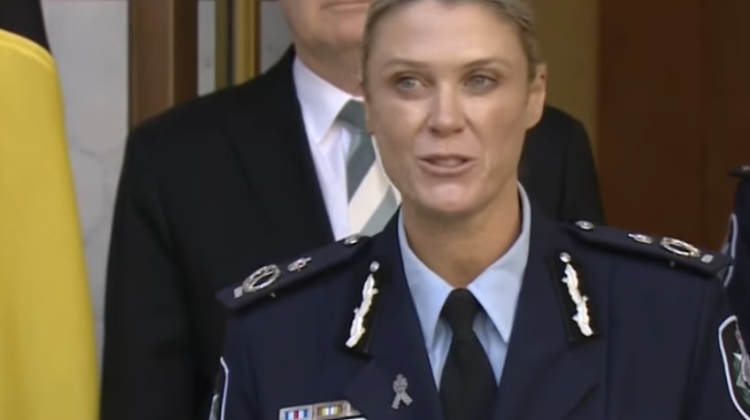
Australian Federal Police Commissioner Krissy Barrett (above) has faced criticism for saying the Bondi Beach terrorist attack was “not motivated by religion”.

Commissioner Barrett had stated in the aftermath of the December 14 attack that the alleged terrorists were “inspired by Islamic State”.

“These are the alleged actions of those have aligned themselves to a terrorist organisation – not a religion,” she said.

The ‘terrorist organization’ being the Islamic State whose purpose is to make a state completely ruled by Islam. Hence the name.

Terrorism is a tactic. It’s not an identity. Saying that Muslim terrorists are terrorists not Muslims makes no sense. People don’t go ahead and gun down a 10-year-old girl on a beach or any of the other things Muslim terrorists do because they have no actual ideological motives. They kill people in the name of something. And that thing that Australian Federal Police Commissioner Krissy Barrett refuses to name isn’t terrorism. It’s Allah, Islam, the Koran and all that tremendously murderous stuff.

Saying that Islamic terrorists are terrorists not Muslims is like saying that Japanese soldiers are soldiers, not Japanese. Or that Marxist terrorists aren’t really Marxists. Or that the folks who quote the Koran and shout “Allahu Akbar” before killing a bunch of people aren’t really acting in the name of those religious principles because white liberals are convinced that’s not real Islam. Real Islam, like the true Scotsman, doesn’t actually exist anywhere except in the platonic ideals of the people who don’t practice it or for that matter any actual religion beyond occasionally going to hear a minister/rabbi in a rainbow scarf explain that everything you need to know about religion can be found in Das Kapital. That’s what they think Islam is.

But Muslims actually take their religion seriously. Seriously enough to keep on killing us. We’re the ones refusing to take it seriously.

https://www.frontpagemag.com/australian-federal-police-commish-claims-muslim-terrorist-attack-not-motivated-by-religion/

From FBI Whistleblowers to Defunding Planned Parenthood—and Everything in Between: A Year of Victories


As we close out 2025, we want to look back on what was a landmark year for defending life, religious liberty, parental rights, and free speech at the ACLJ.

Our legal team’s workload ramped up significantly this year, and this was only possible because of supporters like you.

  •  220 pro-life legal contacts and cases, including defunding abortion and defending pro-life advocates
  • 306 free speech matters
  • 104 international matters, including defending persecuted Christians and Israel
  • 276 school contacts and cases protecting the rights of students, parents, and teachers
  • 192 government matters battling corruption and the Deep State

Below is a wrap-up of some of our biggest cases in 2025. Each case reflects decisive legal action that made a difference by protecting life, religious liberty, and constitutional rights.

Support the work of the ACLJ. Have your Tax-Deductible donation tripled in our Year-End Freedom Drive.

ACLJ Helps Secure Ruling Upholding Law To Defund Planned Parenthood

This was a devastating setback for abortion giant Planned Parenthood – and a landmark victory for the sanctity of life. The First Circuit Court of Appeals has affirmed that Congress has the constitutional authority to redirect Medicaid funding away from the nation’s largest abortion provider and its affiliates. The ACLJ filed four pivotal amicus briefs in this case, advancing our relentless legal fight to stop taxpayer dollars from propping up the abortion industry.

We have filed a total of seven amicus briefs to defund the abortion industry from taxpayer funding in a robust legal undertaking to save the lives of babies. As these cases continue on appeal, we will continue to defend life.

Complete Vindication: FBI Whistleblower Garret O’Boyle Wins Major Settlement

It was a major victory for constitutional rights and government whistleblowers. The ACLJ secured a complete vindication for FBI Special Agent Garret O’Boyle, who was fully restored through a comprehensive settlement with the DOJ. After years of battling the Biden FBI and DOJ, justice was finally served for this brave hero. The agreement provides back pay, benefits, damages, and full reinstatement – including his security clearance – ending years of persecution under the Biden Administration.

Pentagon, Secretary Hegseth, Apologizes to ACLJ Client Over “Terrorist Group” Label

After Army training under President Biden at Fort Bragg falsely labeled pro-life Americans – and ACLJ client Operation Rescue – as “terrorist groups,” the ACLJ took action. Following months of advocacy, President Trump’s new military leadership condemned the training, acknowledged the harm, issued an apology, and assured it will not be repeated, correcting what the Biden Administration refused to address.

Hawaii Drops Punishment of Teacher After ACLJ Action

A Hawaii teacher was disciplined for allowing a Constitution Day discussion involving political figures – such as Charlie Kirk and President Trump. The ACLJ intervened, explaining that such punishment violated core free speech principles. The Hawaii Department of Education fully rescinded the disciplinary action and cleared the teacher’s record. This case reinforced the importance of open discussion in classrooms and protection for lawful speech.

Surviving Israeli Hostages – Including Two More ACLJ Clients – Released by Hamas

After more than two brutal years in captivity – marked by sustained abuse and assault – the last surviving Israeli hostages violently seized during the October 7 terror attack have finally been brought home. Among those rescued were ACLJ clients Gali and Ziv Berman, whose return is a testament to perseverance in the face of unspeakable cruelty.

Related: Jewish Parent Wins Free Speech Battle.

ACLJ Defends Employee’s Right To Keep Bible at Work

A New York county attempted to force a public employee to remove his Bible from his desk, claiming it violated workplace policy. After ACLJ intervention, the county reversed course and acknowledged the employee’s First Amendment rights. This victory reaffirmed that public employees do not surrender their religious freedoms simply because they work for the government. The case sends a clear message that government hostility toward faith has no place in public workplaces.

Related: LA County Reverses Unconstitutional Beach Worship Policy.

Supreme Court Victory in Mahmoud v. Taylor

In a landmark Supreme Court ruling, parental rights received a major boost when the Court held that government schools cannot burden families by imposing ideological instruction that conflicts with religious beliefs. The ACLJ filed an amicus brief defending parental authority and Free Exercise rights. This decision strengthened constitutional protections for parents nationwide and set an important precedent limiting government overreach in education.

School District Reverses “Pay To Pray” Scheme

A public school district unlawfully required a student Christian group to pay fees to meet and pray. After the ACLJ sent a demand letter citing violations of the Equal Access Act and the First Amendment, the district reversed its policy. Students were granted equal access to facilities without charge. This victory reaffirmed that schools may not single out religious activity for discriminatory treatment.

Related: School Reverses Course After Illegally Banning Student-Led Jesus Club

ACLJ Defends Pro-Life Advocates Attacked at Supreme Court

Following a major Supreme Court decision, peaceful pro-life advocates were assaulted and wrongfully detained while celebrating outside the Court. The ACLJ intervened immediately, securing releases and getting the charges dropped. This case highlights the growing hostility toward pro-life speech and the importance of rapid legal defense to protect constitutional rights.

Related: Charges Dropped for Pro-Lifer Unconstitutionally Charged.

Looking ahead, 2026 already promises monumental battles. In January alone, we face a Missouri trial challenging Planned Parenthood’s attacks on pro-life laws, oral arguments in federal appeals defending a teacher’s right to pray, and oral arguments protecting pro-life centers from Massachusetts’ state-sponsored attacks. On top of that, we have filings in two cases at the U.S. Supreme Court – and this is just the start.

But no matter what the coming year brings, we will not flinch. We will face every challenge head-on – clear-eyed, prepared, and resolute – because the principles at stake are too important to abandon and the cost of silence is too high.


🎭 𝐖𝟑𝐏 𝓓𝓐𝓘𝓛𝓨 𝓗𝓾𝓶𝓸𝓻, 𝓜𝓾𝓼𝓲𝓬, 𝓐𝓻𝓽, 𝓞𝓟𝓔𝓝 𝓣𝓗𝓡𝓔𝓐𝓓


Welcome to 

The 𝐖𝟑𝐏 𝓓𝓐𝓘𝓛𝓨 𝓗𝓾𝓶𝓸𝓻, 𝓜𝓾𝓼𝓲𝓬, 𝓐𝓻𝓽, 𝓞𝓟𝓔𝓝 𝓣𝓗𝓡𝓔𝓐𝓓 

Here’s a place to share cartoons, jokes, music, art, nature, 
man-made wonders, and whatever else you can think of. 

No politics or divisive posts on this thread. 

This feature will appear every day at 1pm mountain time. 


A Remarkable Year Filled with Wins


It’s easy to think about the things we have yet to achieve.  However, author and friend of the Treehouse Jack Cashill documents a great deal of success and presents a year in review that deserves attention. [SEE HERE]

In his substack article, Cashill runs through some of the big wins that were achieved by President Trump and the MAGA network in 2025.  And the year ain’t over yet!

[READ The “Celebrating” HERE]


Promethean Action: Britain’s Secret Plot


Lyndon LaRouche (1922-2019) was a rather eclectic communist in the world of American politics for several generations. A few of his perspectives were sound and nationalistic. However, many of his perspectives were completely communist and slipped into the realm of geopolitical conspiracy theory finding British Imperialism under every rock and blaming Queen Elizabeth II for assassination attempts against him.

Susan Kokinda and Barbara Boyd of Promethean Action continue the LaRouche tradition while smoothing out some of the more outlandish elements and removing the overt communism the originating political movement was known for.

Barbara Boyd is the spokesperson and treasurer of the LaRouche Youth Movement. Boyd’s partner, Susan Kokinda, maintains a belief that eliminating British Imperialism is the objective of President Trump’s America-First policy agenda.  This is where I disagree.

While the outcome of President Trump’s policy does factually lead to the result LaRouche advocated, I strongly doubt “eliminating British imperialism” is the prism through which Donald Trump’s thought process flows.  That said, in the overall picture of American politics, the Kokinda and Boyd analysis of Trump’s international opposition is generally accurate, but their perspective on the domestic opposition is entirely shallow.

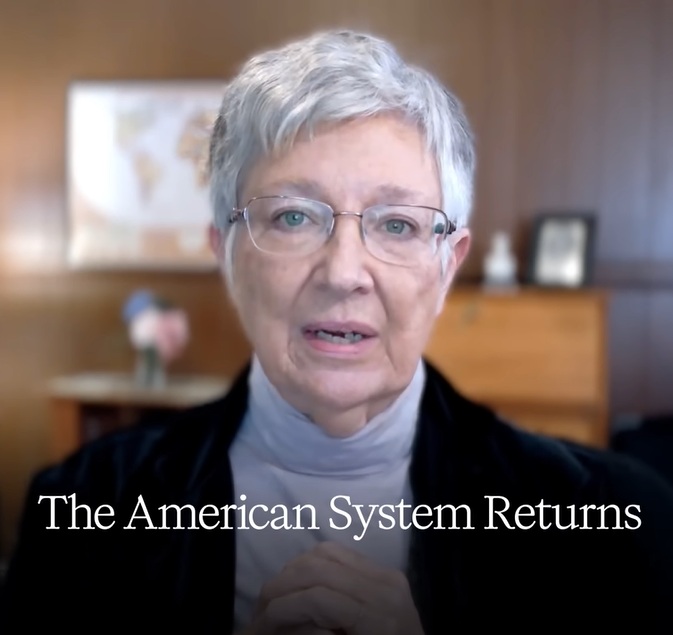
In their recent update, “Britains Secret Plot”, Susan Kokinda discusses how Marco Rubio is confronting the EU censorship program, and how President Trump’s national security strategy marks a significant departure from over a century of British-influenced American foreign policy.  Her review delves into the geopolitical friction between the U.S. and the UK, particularly regarding their strategies toward Russia and Ukraine.

Mrs. Kokinda underscores the broader clash of worldviews between America-First sovereignty and British-led internationalism. This episode also examines the opposition Trump faces from within the U.S. political establishment and British geopolitical strategists and emphasizes the importance of maintaining political support to ensure the success of Trump’s transformative policies.  WATCH:


The divergence between the worldview of the European Union and President Trump is accurately presented as above.  The Ukraine/Russia war serves as a case study in how the two worldviews conflict.  The core of U.K policy and national security strategy continues to view Russia as the biggest threat; the national security outlook by President Trump does not.

On the domestic side of the issue, there are several American elements in direct opposition to the geopolitical policy structure of President Trump. Understanding the domestic opposition to President Trump is where Kokinda/Boyd are shallow, while seeing British control behind every shadow.

In reality the domestic opposition to President Trump is the ideological left in combination with the Wall Street right.  Currently the EU/U.K opposition to President Trump is in alignment with goals and objectives of the Sea Island group and the professionally republican.

Just as the Biden/Obama agenda included the targeting of President Trump for removal (Transition Integrity Project – originating group) in early January 2017, so too did another UniParty stop Trump operation begin in January 2025.  We saw the latest iteration surface in the odd (at the time), narrative surrounding Qatar -vs- Israel.

The ideologically similar GOPe elements within the Sea Island network, tech and traditional Republican party, are all aligned due to opposition to Trump policy. They continue their efforts to divide elements from the larger MAGA network.

The use of the Qatar vs Israel wedge is clear within the billionaire tech/political group, and essentially distillates to 2028 positioning, JD Vance -vs- Ron DeSantis.

The battle was clear last week at TPUSA with the alligator emojis leveraging all the pressure they could toward the organization.  The Ellison, Weiss, Shapiro goal was to steer Turning Point to support DeSantis.  However, Erika Kirk endorsed JD Vance.

Now the alligator emojis, blind orcs for the Ellison agenda, hate TPUSA.


Memos of Conversations Between George W. Bush and President Vladimir Putin Are Released


Following a series of FOIA lawsuits, memos from conversations between Russian Federation President Vladimir Putin and former US President George W. Bush have been released online by the National Security Archive. [Original Source Here]

I know it’s Christmas, but bookmark or review as time allows, because the content is very interesting and very important. As early as 2001 and 2008, President Putin clearly told President Bush of his opposition to Ukraine’s accession to NATO, along with other key positions.

Despite what popular media might say, these are NOT full transcripts. Rather, they are memos containing quotes from both leaders as they discuss geopolitical relations between the U.S. and Russia. [SOURCE HERE]

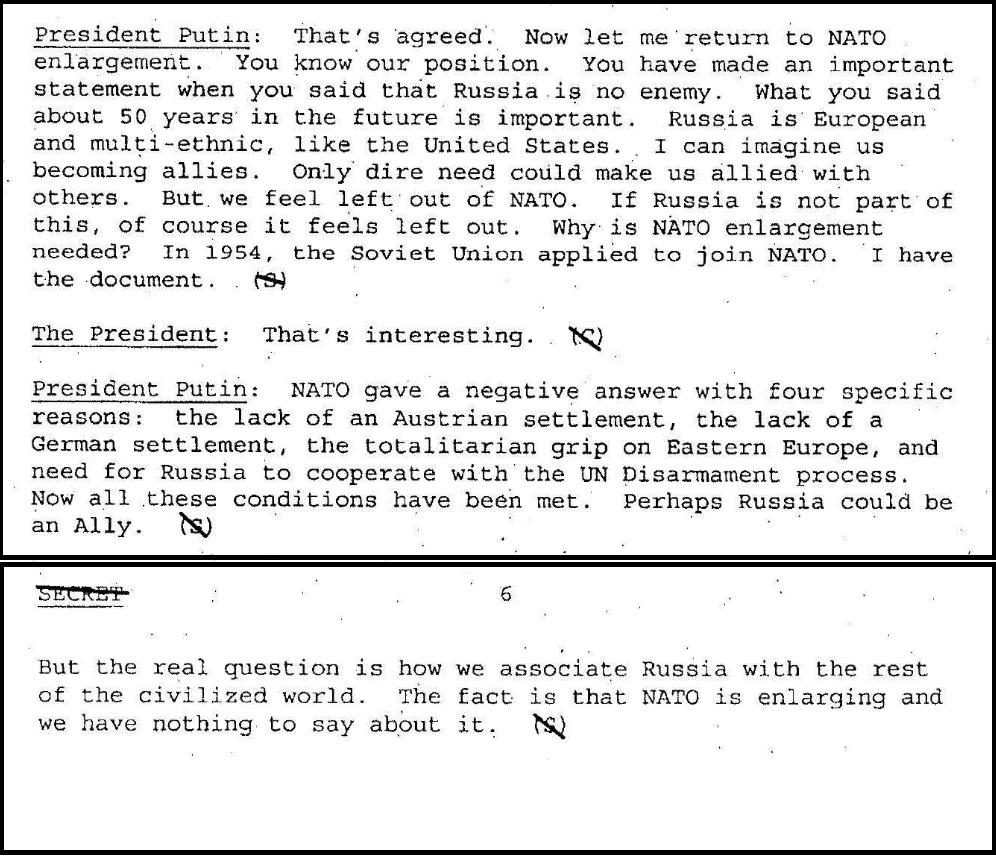
♦ June 16, 2001 – Memorandum of Conversation. Subject: Restricted Meeting with Russian President Vladimir Putin. [LINK HERE] In this first personal meeting at the Brno Castle in Slovenia Vladimir Putin and George W. Bush express respect for each other and desire to establish a close relationship. Putin tells Bush about his religious beliefs and the story of his cross that survived a fire at his dacha. In a short one-on-one meeting they cover all the most important issues of U.S.-Russian relations such as strategic stability, ABM treaty, nonproliferation, Iran, North Korea and NATO expansion. Bush tells his Russian counterpart that he believes Russia is part of the West and not an enemy, but raises a question about Putin’s treatment of a free press and military actions in Chechnya. Putin raises a question of Russian NATO membership and says Russia feels “left out.” [READ MEMO HERE]

♦ September 16, 2005: Document 2 – Memorandum of Conversation. Subject: Vladimir Putin, President of the Russian Federation: [LINK HERE] Putin meets the U.S. President in the Oval Office for a plenary that covers mainly issues of nonproliferation and U.S.-Russian cooperation on Iran and North Korea. The conversation shows impressively close positions on Iran and North Korea, with Putin presenting himself as an eager and supportive partner. Bush tells Putin “we don’t need a lot of religious nuts with nuclear weapons” referring to Iran. Putin said that Ukraine’s accession to NATO would, in the long term, create a field of conflict between Russia and the United States, adding that internal divisions within Ukraine could lead to its fragmentation. [READ MEMO HERE]

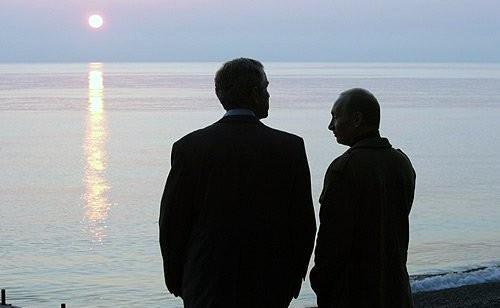
♦ April 6, 2008 – Document 3: Memorandum of Conversation. Subject: Meeting with President of Russia [LINK HERE] This is the last meeting between Putin and Bush, taking place at Putin’s residence in Bocharov Ruchei in Sochi on the Black Sea. The tone is strikingly different from the early conversations, where both presidents pledged cooperation on all issues and expressed commitment to strong personal relationship. This meeting takes place right after the NATO summit in Bucharest where tensions flared about the U.S. campaign for an invitation to Georgia and Ukraine to join NATO. Turning to conversations in Bucharest, Putin states his strong opposition to NATO membership for Ukraine and Georgia and says that Russia would be relying on anti-NATO forces in Ukraine and “creating problems” in Ukraine “all the time,” because it is concerned about “threat of military bases and new military systems being deployed in the proximity of Russia.” Surprisingly, in response, Bush expresses his admiration for the Russian president’s ability to present his case: “One of the things I admire about you is you weren’t afraid to say it to NATO. That’s very admirable. People listened carefully and had no doubt about your position. It was a good performance.” [READ MEMO HERE]

2001 –  Putin raises a question of Russian NATO membership and says Russia feels “left out.”

As noted by The Islander (Via Twitter) –  “The 2001 Memo That Should Have Ended the Cold War 2.0 and Instead Helped Write the Preface to Ukraine. There are documents that don’t merely record history, they expose it. This is one of them.

June 2001. A “restricted meeting” between President George W. Bush and President Vladimir Putin. Not a podium performance, not a television soundbite, not a speech crafted for domestic applause. A private conversation, the place where empires are supposed to speak plainly, where leaders test ideas that could reroute decades.

And what does the memo show?

Putin raises the idea that Russia could eventually join NATO. He says Russia feels “left out” by NATO enlargement. He points to an older fact most Western publics were never meant to internalize: the Soviet Union applied to join NATO in 1954. He argues the reasons for rejection no longer apply. He suggests, almost clinically, that perhaps Russia could be an ally — “European and multi-ethnic,” comparable in character to the United States.

Read that again slowly.

Because the propaganda version you’ve been fed for years requires amnesia: it requires you to believe Russia woke up one morning and decided to be “a threat,” as if geopolitics is a mood swing and security architecture is irrelevant.

But here is the declassified record: Russia was probing for an exit ramp. A pathway into a shared system. A new security architecture. A post–Cold War settlement that could have turned the 1990s from a hollow victory lap into a durable peace.

And it didn’t happen.

Not because it was impossible. Not because Russia “never wanted it.” Not because “the West tried everything.”

It didn’t happen because NATO, as an institution, does not know how to live without a frontier. It does not know how to justify itself without an adversary. It does not know how to maintain internal cohesion without a map that points east and says: there.

The 1954 Ghost: the offer the West never wanted to remember

The most important part of this memo is not the 2001 line, but the 1954 reference.

Because it collapses the morality play.

If the Soviet Union, a state the West defined as the existential enemy, floated the notion of joining NATO in 1954, that means something profound: the idea of Russia being inside the European security architecture is not a “Putin-era trick.” It is a recurring historical proposal, returning whenever Moscow believes there may be a rational way to avoid permanent confrontation.

And what happened then? It was refused.

Which is exactly the point: NATO was never simply a “defensive alliance.” Even in 1954, It was a structure. A protection racket. A way to organize Europe under an American strategic roof and to keep it there. If Russia enters that roof as an equal, the architecture changes. Budgets decrease, with less money for the MIC. Threat perceptions change. The entire postwar hierarchy changes.

So the West did what empires do when presented with a peace that would reduce their leverage:

It smiled, took notes, and kept moving.

“Join NATO” was never a plea, it was a test.

Some people still misunderstand the early Putin posture. They interpret it as naivete, or worse, submission.

Wrong.

This was not Russia begging to be absorbed. The consistent theme in contemporaneous accounts is conditionality, that Russia could consider joining if treated as an equal partner, but not as a defeated province invited into the emperor’s club after proving it can submit.

That distinction matters.

Because it reveals the real incompatibility:
•Russia wanted a security system where it is a partner of European security, not an object to be managed.
•The Atlantic system wanted Russia as a managed periphery, permanently “integrating,” permanently reforming, permanently conceding, never truly sovereign in security decisions.

You can’t fuse those visions. One side must yield.

So the Atlantic system chose the only thing it has ever really chosen, expansion.”

A quarter century has passed since that original outreach by Russian Federation President Vladimir Putin in 2001.  It was rejected by President George W Bush and all presidents thereafter.  In 2025, we are in the phase of consequence.

This public release just happened on December 23, 2025.

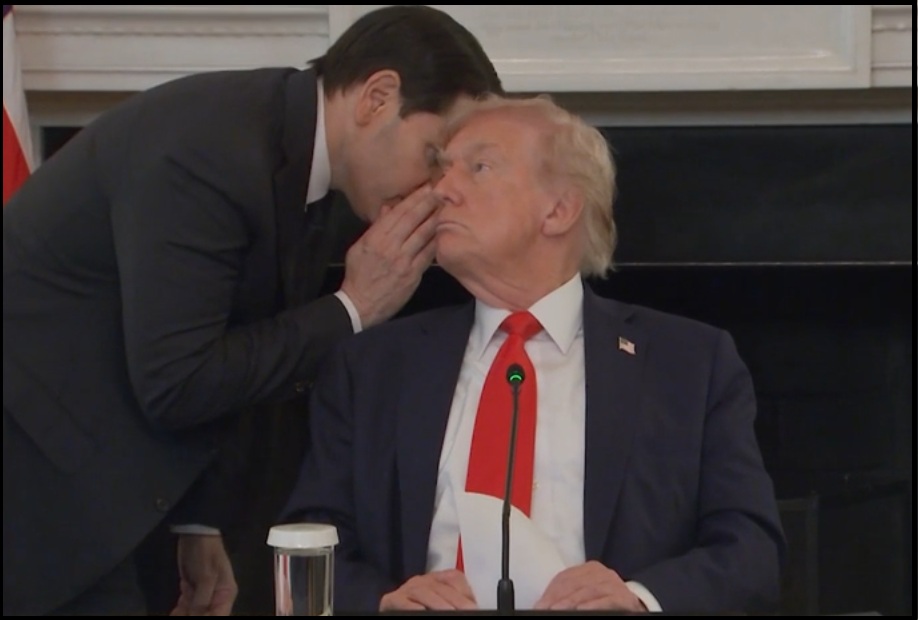
Perhaps, just perhaps, this release can change the conversation in the United States.  Perhaps, just perhaps, President Trump, Secretary Rubio and Emissary Witkoff can reverse the course, and change the arc of history toward peace and a strategic alliance.

The timing of the release inspires hope, but the opposition to peace is extreme.