Friday, December 19, 2025

‘Goodbye to Berlin’


In the annals of urban history, few cities embody the tragic interplay of aesthetic aspiration, ideological fanaticism, and moral decay as fully as Berlin. Hailed as the pulsating heart of European cosmopolitanism in the 1920s—a metropolis where artists, intellectuals, and bohemians converged in a symphony of experimentation—it now awaits the course of history, evidently broken. Its trajectory through the twentieth century reads as a somber elegy for lost grandeur. Gone is the magic. The echo of the interwar Berlin that Christopher Isherwood (author of the 1939 novel Goodbye to Berlin) conveyed so elegantly has long since fallen silent.

Berlin’s accumulated destruction under Nazism, Allied bombings, and Soviet communism has eradicated the physical reflections of a rich Judeo-Christian heritage and paved the way for an era of historical amnesia and cultural dissolution. Far from a phoenix rising from ashes, modern Berlin stands as a hollow simulacrum, a patchwork of architectural facades—or “stage backdrops” as in the case of the Berlin Palace—masking profound grief.

Arguably, Berlin’s “reconstruction” represents the denial of an irreversible loss, compounded by a nihilistic present that severs ties to lineage and invites cultural conquest. Like people in the 1930s, modern-day Berliners live in a time marked by ideological confrontation, intimidated by violent revolutionaries who collaborate to dismantle the supporting institutions of civilization and harass the Jews.

Understanding the depth of Berlin’s tragedy requires insight into its prelapsarian splendor. In the 1920s, during the Weimar Republic, Berlin was Europe’s unrivaled cultural capital, a vortex of creativity surpassing both Paris and Vienna. Cabarets throbbed with jazz and satire, theaters premiered Brecht’s revolutionary dramas, and the Bauhaus movement redefined modernism in architecture and design. This era, often romanticized as the “Golden Twenties”, fostered a cosmopolitan ethos where Jewish academics, later to be persecuted, mingled with avant-garde artists, and the city’s streets buzzed with intellectual ferment. Yet, this vibrancy was fragile, rooted in a precarious democracy that masked underlying social fractures.

The ascent of the Nazis in 1933 heralded the vengeful destruction of Berlin. Adolf Hitler’s regime, with its virulent antisemitism and imperial delusions, targeted the city’s cosmopolitan soul as anathema to Aryan purity. As a show of force, Nazis set fire to the Reichstag in 1933, synagogues were razed during Kristallnacht in 1938, and Jewish cultural institutions were dissolved. Berlin’s built environment, once a tapestry of eclectic styles from neoclassical to art nouveau, began to warp under Nazi aesthetics. Megalomaniac projects like Albert Speer’s Germania envisioned a monolithic capital of the Thousand-Year Reich. However, these were but preludes to destruction.

Like unruly warlords, the Nazis invaded the sophisticated, Judeo-Cristian metropolis of Berlin, purging its freethinkers and setting the stage for wartime apocalypse. Whether Nazism is interpreted as a socialist-revolutionary aberration or the logical culmination of nationalist-authoritarian impulses, it stained forever the city’s lineage and rendered any return to innocence impossible.

WWII unleashed hell upon Berlin, transforming it from a cultural beacon into a rubble-strewn graveyard. Allied bombings, commencing in earnest from 1940, reduced vast swathes of the city to smoldering ruins. By 1945, over 70% of Berlin’s buildings lay in pieces, with iconic landmarks like the Brandenburg Gate scarred by artillery. The human toll was staggering: hundreds of thousands perished, their lives extinguished in the inferno of total war. As opposed to “collateral damage”, the bombardment looked like a deliberate erasure, as if the victors sought to exorcise the Nazi specter through fire.

Postwar cleanup commenced amid the ashes, but victory birthed new divisions. The Potsdam Conference of 1945 divided Berlin into four sectors—American, British, French, and Soviet—mirroring the broader Cold War schism. In the Soviet zone, communists supplanted Nazis, installing the German Democratic Republic in 1949. Rather than liberation, the communist regime signaled substitution of one tyranny for another. Stalinist puppets like Walter Ulbricht imposed a Marxist-Leninist orthodoxy, nationalizing industries and suppressing dissent. 

Berlin’s political division culminated in the erection of the Wall in 1961, cynically dubbed the “anti-fascist protective wall” by communist propagandists. In reality, this concrete barrier, fortified with watchtowers, barbed wire, and minefields, functioned as a prison enclosure, trapping East Germans within the Soviet empire as perpetual state captives. Over 140 persons died attempting escape, their blood staining the Wall as a testament to communist barbarism.

The Wall, which separated freedom from totalitarianism, prosperity and dynamism from poverty and stagnation, had great symbolic value until 1989, the object of cult worship. In fact, however, the postwar era completed a tragedy: where Hitler demolished cosmopolitanism, the communists entombed its remnants in ideological concrete. The fall of the Wall in 1989, precipitated by Gorbachev’s perestroika and mass protests, ostensibly ended the lingering shadow of WWII in the Soviet sphere. Yet, this “final end” was pyrrhic; the euphoria of reunification masked the profundity of what had been irrevocably lost.

The post-1989 reconstruction of Berlin aimed to suture its wounds, transforming the former death strip into a vibrant core. Projects like the Potsdamer Platz redevelopment, with its gleaming skyscrapers by architects like Renzo Piano, symbolized “capitalist triumph”. The Reichstag’s glass dome, designed by Norman Foster, evoked “transparency and democracy”. A capital with numerous construction sites, Berlin presents the aesthetic conflict between old and new, where remnants of Prussian grandeur coexist with brutalist bunkers and postmodern pranks. This amalgamation ostensibly fosters a sense of freedom—street art in Kreuzberg, techno raves in abandoned bunkers—yet it is a freedom steeped in grief.

The lives destroyed are incalculable: Holocaust victims, bombing casualties, Wall escapees—all haunt Berlin like spectral accusations. Likewise, the lost beauty of the built environment is lamentable; the bygone elegance of ornate facades and boulevards has yielded to functionalist sterility. Obviously, the Berlin of the Weimar Republic will never be restored. The explanation is partly the extent of physical destruction and partly a spiritual rupture. Contemporary inhabitants, raised in an era of “secularism, nihilism, and anti-Westernism”, exhibit scant loyalty to lineage. Postmodern education prioritizes deconstruction over heritage, fostering a generational disconnect. In this void, Berlin’s historical spirit evaporates, replaced by transient consumerism and digital distraction. 

As interpreted by cultural pessimists, nihilism invites a more insidious transformation: Germany’s, and Western Europe’s, inexorable death march towards ideological submission. Demographic shifts, driven by low native birthrates and mass immigration from Muslim-majority countries, portend a societal collapse. Since the 1960s Gastarbeiter program (and accelerated by Angela Merkel’s 2015 refugee policy), millions have arrived, altering urban demographics. In Berlin neighborhoods like Neukölln, Arabic signage proliferates, and sharia-influenced norms challenge secular traditions. Far beyond harmonious multiculturalism, as critics like Thilo Sarrazin argue, this is a “demographic conquest” eroding Judeo-Christian foundations.

Berlin’s reconstructed facade conceals this erosion. The city’s “freedom” becomes ironic: amid memorials to Nazi and communist atrocities, imported ideologies gain ground, advocating religious absolutism and anti-Semitism. Honor killings, no-go zones, and Islamist radicalization—evidenced in incidents like the 2016 Christmas market attack—signal a brewing storm. Western Europe’s aging populations, coupled with migrants’ higher fertility, spells “civilizational erasure”, not through military conquest but Islamist entryism. By mid-century, projections suggest that Muslims could comprise 20–30% of Germany’s populace, tipping cultural balances. Berlin, once a bulwark of Enlightenment, risks becoming an outpost in a global ummah, its history diluted into irrelevance.

This transformation is abetted by elite complacency, conceitedly viewing heritage as insignificant. Nihilism begets surrender; without loyalty to lineage, societies forfeit their souls. Berlin exemplifies this: its haphazard mix of old and new is not renewal but requiem, a prelude to oblivion.

Berlin’s odyssey from cultural zenith to bombed husk, divided prison, and reconstructed simulacrum underscores a pessimistic truth: destruction is irreversible, reconstruction illusory. Nazism initiated the ruin, war amplified it, communism consummated it, and contemporary nihilism seals it. The city’s grief-laden freedom—better characterized as “detachment”—masks a premonition of dystopian labor before the birth of the caliphate. Unfortunately, this is no alarmist fantasy but a substantiated trajectory, rooted in historical patterns of ideological overreach and cultural suicide.

Berlin teaches that civilizations, once fractured, seldom mend; they morph into shadows of former selves, awaiting the next eclipse. In this light, the city’s story is one of melancholic resignation—a cautionary lesson for a West teetering on the brink.


Secretary of War Pete Hegseth

 Earlier today, U.S. forces commenced OPERATION HAWKEYE STRIKE in Syria to eliminate ISIS fighters, infrastructure, and weapons sites in direct response to the attack on U.S. forces that occurred on December 13th in Palmyra, Syria. This is not the beginning of a war — it is a declaration of vengeance. The United States of America, under President Trump’s leadership, will never hesitate and never relent to defend our people. As we said directly following the savage attack, if you target Americans — anywhere in the world — you will spend the rest of your brief, anxious life knowing the United States will hunt you, find you, and ruthlessly kill you. Today, we hunted and we killed our enemies. Lots of them. And we will continue.

Entertainment thread for Dec 19


If the world would just stop being so crazy for just long enough for us to enjoy Christmas, that would be nice.

Will Socialism Sweep the Midterms?


In recent years, the Democrat party has steadily shifted left, embracing ideas once considered fringe, including open borders, transgenderism, and the Green New Deal.

In abandoning the political center to Trump and his MAGA base, Democrats effectively cost themselves the House in 2022 — and the presidency and Senate in 2024.

With the 2026 midterms and 2028 presidential race approaching, analysts expected a centrist correction.  Instead, Democrats have doubled down, integrating a Marxist-oriented doctrine labeled “democratic socialism” into their public identity.

To traditional observers, this defies political logic.  Historically, parties seeking national victory have moderated to appeal to the center, the so-called “broad middle.”

After three straight landslide presidential losses in the 1980s, Democrats did exactly that.  Sensing that voters perceived Democrats as big-government liberals detached from middle America, Arkansas governor Bill Clinton and the Democratic Leadership Council (DLC), an organization composed of moderates like Al Gore and Al From, pushed the party to reject high spending and divisive culture wars in favor of pragmatic centrism aimed at middle-class and swing voters.

As DLC chairman in 1990, Clinton branded himself a “New Democrat,” advocating welfare reform, free trade, and fiscal responsibility.  His centrist strategy rebuilt the Democrat coalition and returned the party to the White House in 1992.

That Democrat party no longer exists.  Rather than recalibrating in anticipation of the looming 2026 midterms and 2028 presidential race, today’s Democrats have accelerated their embrace of far-left ideology, blending with socialist movements — particularly the Democratic Socialists of America (DSA).

Founded in 1982, the DSA has grown from fringe movement to Democrat party power broker.  Its formula for pushing its socialist agenda deep into the party mainstream is quite simple: Run DSA-supported socialist-leaning candidates in Democrat party primaries and appeal to Democrat primary voters by having those candidates “champion” Democrat pet progressive issues, such as affordability, government-run health care, and climate change.

Once these candidates achieve positions of real power, with the support of the DSA, they then begin to pursue measures to achieve the DSA’s central mission to “dismantle and move beyond capitalism” through a “wholesale socialist transformation of our economy.”  The organization envisions a society where “the people” own the means of production — either through nationalization of key industries or indirect control via regulation, taxation, and boardroom influence.  The result is the same: government dominance over what Americans produce, earn, and keep.

The DSA’s Marxist Caucus calls for the state to take over industries such as finance, energy, and banking.  Its militant wing, Reform and Revolution, seeks to build a “mass socialist party” to “overthrow the capitalist state — democratically.”  It promotes public ownership of the energy, auto, and defense sectors and state control of broadband, utilities, and even technology firms.

A turning point for socialism’s march through the Democrat party came with Bernie Sanders’s 2016 and 2020 presidential campaigns.  Sanders championed DSA-style proposals — “Medicare for All,” tuition-free college, and the Green New Deal.  His campaigns inspired new socialist-leaning politicians such as representatives Alexandria Ocasio-Cortez, Rashida Tlaib, and Jamaal Bowman, all backed by the DSA.

Over the last decade, the DSA has helped elect candidates nationwide.  In Massachusetts, its endorsements flipped city council seats in Somerville, Cambridge, and Medford.  In Minneapolis, Saint Paul, and Los Angeles, DSA-backed officials now hold city and school board positions.  Similar victories have occurred in Milwaukee, Detroit, Colorado Springs, and Jersey City.  DSA legislators serve in New York,  Michigan, and Wisconsin.

This is no longer protest politics — it’s a strategy to transform the Democrat party from within, and eventually control the presidency, House, and Senate.  The shock 2025 elections of Democrats Zohran Mamdani, a DSA member and self-avowed socialist, as mayor of New York City and Katie Wilson as Seattle’s mayor were watershed moments in that transformation.

The DSA’s influence in the party will only grow as it endorses socialist-oriented candidates in the 2026 primaries and midterms to challenge centrist Democrat incumbents.  The DSA is promoting various candidates for the city council in Seattle, Illinois’s 9th Congressional District, the Michigan and Maine senates, and the Georgia and Wisconsin governorships.

Mamdani, a DSA member, will govern America’s largest city and financial capital.  To fund his campaign promises — city-run grocery stores, free public transit, and taxpayer-funded “gender transitions” — Mamdani has already mobilized his allies throughout New York to pressure a reluctant Governor Hochul to support legislation imposing a 2% “surcharge” on “millionaires” in the state.  Such a bill could include provisions to tax Wall Street transactions or impose wealth taxes on hedge funds.  And if millionaires and billionaires flee, expect Mamdani to turn to middle-class earners and small businesses to fund his costly plans.

The DSA also supports expanding sanctuary policies and granting illegal aliens local citizenship — measures critics say are designed to secure Democrats permanent electoral majorities.

The recent vote on a House resolution condemning socialism highlights the growing influence of socialist ideas within the Democrat party.  Whereas all Republicans supported the resolution, only a minority of Democrats joined them.  A majority of House Democrats refused to condemn socialism, suggesting either sympathy toward socialist policies or concern about provoking the party’s rising socialist wing.  Their reluctance to back the resolution underscores the movement’s expanding power.

A Patient and Strategic Movement

One of the DSA’s greatest strengths is patience.  Rather than forming a separate party, it strategically penetrated the Democrat party, letting the party label carry its candidates to victory.  This approach is succeeding because the DSA’s ideology, though Marxist, overlaps with elements of Democrat policy that expands government control over economic life, such as Social Security, Medicare, Medicaid, the Green New Deal, and soon a universal basic income program to address the “affordability crisis.”

The DSA’s long-term strategy is clear.  Make sure that the next time the Democrat party takes over the House, Senate, and White House, it will be a party led by true believers like Representatives Ocasio-Cortez and Tlaib, Senators Sanders and Warren, and Mayor Mamdani.  That new Democrat party can then impose from above socialist policies that will radically transform our social and political institutions.

The DSA, of course, must first gain control of the party, and it will seize any opportunity to do so.  Trump’s DOJ is threatening subpoenas for dozens — perhaps hundreds — of establishment Democrats and allies allegedly tied to the “Crossfire Hurricane” and “Arctic Frost” efforts to block Trump’s 2016 victory, undermine his presidency, and later prosecute him after 2020.

Normally, Democrats would rally as one to defend Obama- and Biden-era officials.  But this time, it would not be surprising for the party’s socialist wing — figures like Alexandria Ocasio-Cortez and Rashida Tlaib — to offer only lukewarm support for their beleaguered “colleagues.”  They view establishment Democrats as obstacles to a socialist takeover and might secretly welcome their purge.  Many DSA leaders have been captured on video openly stating that they “hate” the Democrat party, which they see as a neoliberal tool of the capitalist class.  Socialists play hardball.

Conservatives Must Respond to the  Socialist Threat

A recent Wall Street Journal op-ed warned that although America “needs a sane and centrist Democratic Party” to counter this movement, a Mamdani victory will likely accelerate the leftward shift as more progressives win primaries and pull the party further left.

After the November 2025 election, Senator Bernie Sanders told a national audience that a national movement is being formed and will use primaries and upcoming midterm House and Senate races to further extend the socialists’ power.

If conservatives, centrists, and traditional liberals hope to halt socialism’s advance, they must educate the public on its economic consequences — not merely debate cultural issues like gender-neutral bathrooms or cashless bail.

They must clarify that socialism entails government confiscation of private profits, wages, and property — redistributed according to state priorities.  Such a system, critics argue, erodes personal freedom, private enterprise, and the foundations of a market-based democracy.

The Mamdani victory offers conservatives an opening: to label future Democratic tax and regulatory initiatives not merely liberal, but socialist and Marxist, forcing Democrats on the political defensive.

Socialist office-holders offer Republicans real-time examples of socialism in action to showcase to the American public, such as Mamdani’s plans to seize properties from landlords who neglect repairs and transfer them to government ownership.  Newly elected Seattle mayor Katie Wilson said she would force grocery chains to make food affordable and voiced her support for a government-run grocery store system.  She even stated that she will not permit “giant grocery chains to close stores that will leave behind food deserts.” That’s socialism in action.

The Democrat party’s ideological transition from center-left to socialist demands that major news outlets begin to interview new party leaders like Bernie Sanders, Alexandria Ocasio-Cortez, and Mamdani, rather than  Chuck Shumer and Hakeem Jeffries, when trying to take the pulse of the Democrat party on issues such as affordability and immigration.

The stakes could not be higher.  If the socialist faction within the Democrat party prevails, the nation’s transformation will be not merely political, but structural, profoundly threatening to the American way of life.


Can the Dark Ages Return? ~ VDH


Western civilization arose in the 8th century B.C. Greece. Some 1,500 city-states emerged from a murky, illiterate 400-year-old Dark Age. That chaos followed the utter collapse of the palatial culture of Mycenaean Greece.

But what reemerged were constitutional government, rationalism, liberty, freedom of expression, self-critique, and free markets—what we know now as the foundation of a unique Western civilization.

The Roman Republic inherited and enhanced the Greek model.

For a millennium, the Republic and subsequent Empire spread Western culture, eventually to be inseparable from Christianity.

From the Atlantic to the Persian Gulf and from the Rhine and Danube to the Sahara, there were a million square miles of safety, prosperity, progress, and science—until the collapse of the Western Roman Empire in the 5th century AD.

What followed was a second European Dark Age, roughly from 500 to 1000 AD.

Populations declined. Cities eroded. Roman roads, aqueducts, and laws crumbled.

In place of the old Roman provinces arose tribal chieftains and fiefdoms.

Whereas once Roman law had protected even rural people in remote areas, during the Dark Ages, walls and stone were the only means of keeping safe.

Finally, at the end of the 11th century, the old values and know-how of the complex world of Graeco-Roman civilization gradually reemerged.

The slow rebirth was later energized by the humanists and scientists of the Renaissance, Reformation, and eventually the 200-year European Enlightenment of the 17th and 18th centuries.

Contemporary Americans do not believe that our current civilization could self-destruct a third time in the West, followed by an impoverished and brutal Dark Age.

But what caused these prior returns to tribalism and loss of science, technology, and the rule of law?

Historians cite several causes of societal collapse—and today they are hauntingly familiar.

Like people, societies age. Complacency sets in.

The hard work and sacrifice that built the West also creates wealth and leisure. Such affluence is taken for granted by later generations. What created success is eventually ignored—or even mocked.

Expenditures and consumption outpace income, production, and investment.

Child-rearing, traditional values, strong defense, love of country, religiosity, meritocracy, and empirical education fade away.

The middle class of autonomous citizens disappear. Society bifurcates between a few lords and many peasants.

Tribalism—the pre-civilizational bonds based on race, religion, or shared appearance—remerge.

National government fragments into regional and ethnic enclaves.

Borders disappear. Mass migrations are unchecked. The age-old bane of anti-Semitism reappears.

The currency inflates, losing its value and confidence. General crassness in behavior, speech, dress, and ethics replaces prior norms.

Transportation, communications, and infrastructure all decline.

The end is near when the necessary medicine is seen as worse than the disease.

Such was life around 450 AD in Western Europe.

The contemporary West might raise similar red flags.

Fertility has dived well below 2.0 in almost every Western country.

Public debt is nearing unsustainable levels. The dollar and euro have lost much of their purchasing power.

It is more common in universities to damn than honor the gifts of the Western intellectual past.

Yet, the reading and analytical skills of average Westerners, and Americans in particular, steadily decline.

Can the general population even operate or comprehend the ever-more sophisticated machines and infrastructure that an elite group of engineers and scientists creates?

The citizen loses confidence in an often corrupt elite, who neither will protect their nations’ borders nor spend sufficient money on collective defense.

The cures are scorned.

Do we dare address spiraling deficits, unsustainable debt, and corrupt bureaucracies and entitlements?

Even mention of reform is smeared as “greedy,” “racist,” “cruel,” or even “fascist” and “Nazi.”

In our times, relativism replaces absolute values in the eerie replay of the latter Roman Empire.

Critical legal theory claims crimes are not really crimes.

Critical race theory postulates that all of society is guilty of insidious bias, demanding reparations in cash and preferences in admission and hiring.

Salad-bowl tribalism replaces assimilation, acculturation, and integration of the old melting pot.

Despite a far wealthier, far more leisured, and far more scientific contemporary America, was it safer to walk in New York or take the subway in 1960 than now?

Are high school students better at math now or 70 years ago?

Are movies and television more entertaining and ennobling in 1940 or now?

Are nuclear, two-parent families the norm currently or in 1955?

We are blessed to live longer and healthier lives than ever—even as the larger society around us seems to teeter.

Yet, the West historically is uniquely self-introspective and self-critical.

Reform and Renaissance historically are more common than descents back into the Dark Ages.

But the medicine for decline requires unity, honesty, courage, and action—virtues now in short supply on social media, amid popular culture, and among the political class.


🎭 𝐖𝟑𝐏 𝓓𝓐𝓘𝓛𝓨 𝓗𝓾𝓶𝓸𝓻, 𝓜𝓾𝓼𝓲𝓬, 𝓐𝓻𝓽, 𝓞𝓟𝓔𝓝 𝓣𝓗𝓡𝓔𝓐𝓓


Welcome to 

The 𝐖𝟑𝐏 𝓓𝓐𝓘𝓛𝓨 𝓗𝓾𝓶𝓸𝓻, 𝓜𝓾𝓼𝓲𝓬, 𝓐𝓻𝓽, 𝓞𝓟𝓔𝓝 𝓣𝓗𝓡𝓔𝓐𝓓 

Here’s a place to share cartoons, jokes, music, art, nature, 
man-made wonders, and whatever else you can think of. 

No politics or divisive posts on this thread. 

This feature will appear every day at 1pm mountain time. 


Vivek Ramaswamy Is Wrong About American Identity And Wrong About America


A disembodied notion of American identity means that America is really nothing at all, and no one is really an American.


You might have noticed there is a heated debate underway on the American right over the question of American identity. What makes someone an American? Is it based on lineage or is it propositional? Is America a nation and a people, or is it an idea based on universal principles?

After World War Two, these questions were largely swept under the rug. The dominant narrative, pushed by nearly every mainstream institution and both political parties, was that America was a credal, propositional country. Anyone, from any part of the world, professing any religion or worldview, could become an American. To suggest otherwise was racist and xenophobic, and frankly un-American. By the 1980s, the notion that America is a “nation of immigrants” had taken root in public discourse. America, we were told, was not a particular people but an ideal to which every human being on earth could aspire. It was for everyone.

In an op-ed for The New York Times this week, Vivek Ramaswamy defends this view, arguing that being an American really means nothing more than assenting to a set of intellectual propositions and swearing allegiance to the United States. Agree to a few key principles about good governance and human rights, sign some documents, and voila! you become an American.

“Americanness isn’t a scalar quality that varies based on your ancestry,” writes Ramaswamy. “It’s binary: Either you’re an American or you’re not. You are an American if you believe in the rule of law, in freedom of conscience and freedom of expression, in colorblind meritocracy, in the U.S. Constitution, in the American dream, and if you are a citizen who swears exclusive allegiance to our nation.”

In Ramaswamy’s telling, Americanness is based on a set of beliefs. He posits this over and against what he describes as a blood-and-soil version of American identity that’s supposedly growing on the right, one based on lineage and “the creation of a white-centric identity.” Those who push this view are self-described “heritage Americans,” whose ancestors might have crossed the Atlantic in the 17th century or fought in the Civil War, but are no more American than a first-generation Somali migrant who successfully navigates the immigration bureaucracy and gets his papers.

There are two related things to note about Ramaswamy’s argument. First, he is misrepresenting (intentionally or not) the position of those of us on the right who insist that America is a nation and a people, not merely a creed or a set of principles. Ramaswamy presents a false binary: either you agree with American propositionalism or you are a racist.

But actually it’s possible, and in fact necessary, to insist on a synthesis of America as an idea, a proposition, and America as a people and a nation with a particular history and culture. That culture, because it is at its core English and Christian, requires an affirmation of a very specific set of intellectual propositions that are unique to England and the Christian faith that shaped the English.

The propositions themselves, however, are not enough. They are necessary but not sufficient, because they rely for their coherence on a set of cultural folkways and attitudes that are particular to a people and a place, and which emerged from a specific historical context—distinctly Christian and English. The source of our liberty, for example, is not our Founding documents (great as they are) but our folkways. The former emerged from the latter, not the other way around.

Hence, the ideas articulated in those documents are not as universal as we have been led to believe. “You are an American if you believe in the rule of law,” says Ramaswamy. But many cultures and nations believe in the rule of law. What matters of course is how the law is made, how it is enforced, and whether it meets the demands of justice. You are an American if you believe in “meritocracy,” he says. But many Asian countries embrace meritocracy more fully than the United States does. Singapore has the rule of law and meritocracy. And yet Singapore is not America — or American in any meaningful sense.

The point here is that the universal ideals Ramaswamy claims are at the heart of American identity only make sense in light of English common law, constitutionalism, and Christianity — all of which belong to a particular people from a particular place. Without that context, they become meaningless. Generations of certain people, descendants mostly of the English, brought forth a nation that reflected and codified their particular religious beliefs, morality, language, customs, and folkways. They were not making a proposition for a universalist political project. Indeed, the Founders told us who America is for: ourselves and our posterity. John Jay famously described America as “one united people; a people descended from the same ancestors, speaking the same language, professing the same religion, attached to the same principles of government, very similar in their manners and customs.”

Secondly, Ramaswamy is offering instead what amounts to a form of intellectual Gnosticism about American identity that can never really take concrete form. If Americanness is based merely on a set of professed beliefs about government and individual rights, and not on the solidity of cultural customs and practices, then American identity becomes something insubstantial and impossible to define. Even a person whose own cultural practices are totally alien to American life and society — cousin marriage, women in burkas, animal sacrifice — could be considered just as American as anyone else. American identity is thus reduced to basically nothing, a contentless void.

As Nate Hochman memorably put it on X, obviously commenting on Ramaswamy’s piece, “America is great because it does not exist. That’s what makes us exceptional: We are the absence of form. Without essence, beyond comprehension. A black hole, a void outside space and time. Nobody knows who we are or how we got here. Anyways, that’s why I love this country.”

According to Ramaswamy’s theory of American identity, then, we could import millions of people from the Ganges Delta or the African littoral, and as long as they say they agree with the Constitution, they are Americans.

And in fact, that is what Ramaswamy, along with a certain swath of Romney-era Republicans, actually think. They have no problem, for example, with large corporations that don’t promote American values or interests, or that will gladly ship American jobs overseas. They share the basic worldview of corporate elites, who see the American people as nothing more than labor inputs, replaceable cogs that can be swapped out for cheaper ones in Asia or Africa, as need arises.

This is actually the logical endpoint of Ramaswamy’s credal view of Americanness. If anyone can be an American, then no one really is an American, and nothing in particular is owed to the American people by their leaders. If millions of workers in India or Pakistan want to come here to make more money, and they will do the job for a lower wage than native-born Americans, on what grounds should we deny them entry?

Ramaswamy has no answer to that question. His anemic view of American identity prevents him from acknowledging that some peoples, from some cultures, will never become Americans — no matter how much they might embrace the abstract propositions Ramaswamy mistakenly thinks are at the heart of our nation.


Gov't Makes Stunning Admission Regarding Blame for Deadly Black Hawk-Jet Mid-Air Collision That Killed 67


RedState 

It's been nearly a year since a U.S. Army UH-60 Black Hawk helicopter collided with a passenger jet on approach to Ronald Reagan Washington National Airport, which resulted in both aircraft plummeting into the icy Potomac River below. The January 29, 2025, crash killed 67 people – 64 on the American Airlines flight and three Army personnel on the Black Hawk – and the first lawsuit related to the disaster is making its way through the courts.

Rachel Crafton, the widow of American Airlines flight 5342 (AE5342) passenger Casey Crafton, is suing the airline and the U.S. government over her husband's "senseless and tragic" death. In a Wednesday filing, the government admitted it failed in its "duty of care" to the commercial passengers, writing that the Army helicopter pilots had failed "to maintain vigilance so as to see and avoid AE5342."

From the filing: 

... the United States admits that the [Black Hawk] and AE5342 pilots failed to maintain vigilance so as to see and avoid each other; the DCA local controller did not comply with ¶ 7-2-1(a)(2)(d) of FAA Order JO 7110.65AA, chg. 3, Air Traffic Control (Sept. 5, 2024); and because of the [Black Hawk] pilots’ failure to maintain vigilance so as to see and avoid AE5342, the United States is liable to a Plaintiff who is legally eligible to recover certain monetary damages, as permitted by the Federal Tort Claims Act (FTCA), 28 U.S.C. §§ 1346(b), 2671–80, in an amount yet to be determined and apportioned among other tortfeasors.

As RedState has previously reported, the Army Black Hawk helicopter was on a training mission out of Fort Belvoir, Virginia, and was on a flight path that took it north up the Potomac River. It was returning from its mission when, according to preliminary reports, it failed to maintain the proper altitude as it neared the airport, putting it on a collision course with the passenger jet coming in from Wichita, Kansas.

Jennifer Homendy, chairman of the National Transportation and Safety Board (NTSB), said at a briefing earlier this year that investigators are paying particular attention to the altitudes of both aircraft at the time of the crash. From our reporting:

The altitudes of the two aircraft as they continued on the collision course were confirmed by Homendy. As it made its final descent into Reagan National, the passenger jet was at 313 feet, two seconds prior to the crash, and the Black Hawk was at 278 feet at the time of the collision. 

The big issue, besides lingering questions about the female Black Hawk pilot's flying history, seems to be the altitude at which the helicopter was flying when the collision occurred. It was required to be flying no higher than 200 feet as it approached the airport, but, according to the NTSB's preliminary findings, was 78 feet above that cap. Putting it perilously close to the American Airlines flight.

Although the NTSB has yet to reveal its ultimate conclusion on who was at fault, it's clear the U.S. government thinks there's enough evidence that the Army crew failed in their duty to be vigilant on their flight. Rachel Crafton's legal team welcomed the admission.

“In a very carefully drafted and lengthy legal filing, the United States admits the Army’s responsibility for the needless loss of life in the crash of an Army helicopter and American Airlines Flight 5342 at Reagan National Airport, as well as the FAA’s failure to follow air traffic control procedure,” Robert A. Clifford, Crafton’s attorney, said in a statement to The Hill.  

The final report from the NTSB is expected in early 2026.


Trump Declares Space Supremacy Push, With a U.S. Moon Base by 2030


RedState 

The United States remains the only nation to have ever sent men to the moon and brought them home, but we haven't done that since Apollo 17, in December of 1972; that's 53 years ago last month. I was 11 years old when that happened, and boy, howdy, a quick look at my profile photo will tell you I'm no spring chicken. But President Trump is determined that the United States is going to put men back on the moon, and fast. On Thursday, President Trump signed an executive order pointing us in that direction. There's a lot in that order, but here's the part about the moon:

Sec. 2.  Policy.  My Administration will focus its space policy on achieving the following priorities:

(a)  Leading the world in space exploration and expanding human reach and American presence in space by:

(i)    returning Americans to the Moon by 2028 through the Artemis Program, to assert American leadership in space, lay the foundations for lunar economic development, prepare for the journey to Mars, and inspire the next generation of American explorers;

(ii)   establishing initial elements of a permanent lunar outpost by 2030 to ensure a sustained American presence in space and enable the next steps in Mars exploration; and

(iii)  enhancing sustainability and cost-effectiveness of launch and exploration architectures, including enabling commercial launch services and prioritizing lunar exploration;

Just getting people to the moon is doable; we did it in the '60s and '70s, after all, and there have been a technological advancement or two in the last half-century. Imagine going into space in the spacecraft equivalent of a 1972 Ford Pinto, or even a 1972 Lincoln Continental if you prefer, and you'll have a pretty good grasp on that. 

Of course, the trick isn't getting people to the moon. It's keeping them there. The Apollo missions were on the lunar surface for a matter of hours. But a colony? Humans on the moon for any length of time would have to contend with lunar gravity, which is about 1/6th that of Earth. A prolonged stay in that entails loss of muscle and bone mass; stay long enough, and you're never going home. Also, the moon's lack of an atmosphere would require some pretty serious radiation shielding, so that the lunar population doesn't start to glow in the dark.

We might remember, though, the words of President Kennedy, who aimed us at the moon in the first place; we do these things not because they are easy, but because they are hard. 

The private sector, also, is making serious inroads into space travel. When humans do spread off-planet to stay, it's likely going to be the private sector that takes them there. There are enormous mineral resources out there, no farther away than the asteroid belt, which presents even greater technological challenges. Remember, though: We solve today's problems with tomorrow's technology.

First step will be one more giant leap for mankind, onto the lunar surface, and this time, mankind will be setting up installations - and probably having a lot of robotic help, which in and of itself solves some of those technical challenges. Interesting times, indeed.


Do Not Look Away on This One


The ramifications are enormous here, not just to Brown University, Providence Rhode Island or local/state officials.  The ramifications here extend into every facet of the leftist operation to disrupt law and order in the United States.

Do not look away from the story of the targeted assassination on the campus of Brown University, or the coverup surrounding why information is not available.  Brown University was attempting to create the ultimate leftist locale where every leftist idea and outlook was affirmed, and all leftist policies were implemented. The implications here are extremely important.  Do not look away.  WATCH:


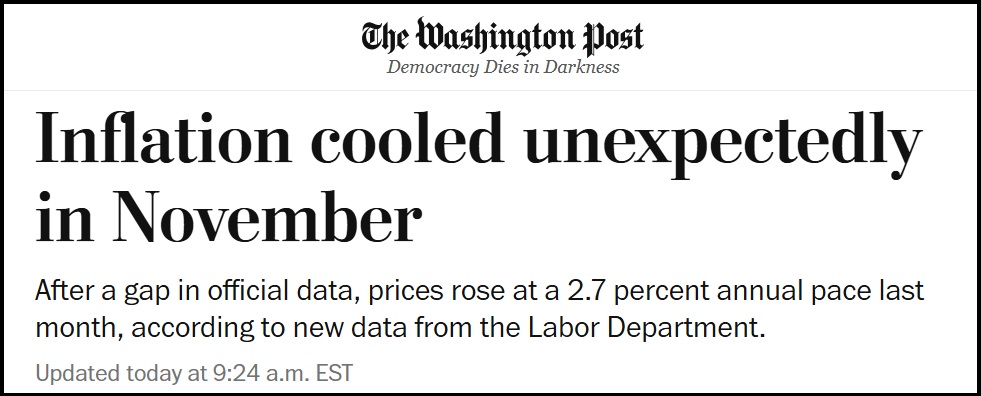
No, Inflation Did Not “Cool Unexpectedly”, It Slowed Because Trump Policies are Working


The Bureau of Labor and Statistics (BLS) has released the November Consumer Price Index (CPI) [DATA HERE] showing the rate of inflation has dropped to 2.7% overall, with core inflation at 2.6%.  This is a significant drop from expectations by financial pundits and pontificating economic media.

While the media proclaim, “inflation cooled unexpectedly,” the reality is that it’s not unexpected.  The results of a slowing of price increase are not accidental; they are the result of Trump’s domestic economic policies working.

[Non-Paywall Source and Media Spin]

President Trump has been cutting waste, fraud and abuse in runaway government spending; slashing costly regulations across all sectors of the economy and ending Green New Scam energy policy in favor of drill, baby, drill.  As noted by NEC Chairman Kevin Hasset, Trump has reduced deficit spending overall.

There’s still a long way to go, but significant MAGAnomic progress is being made.  Oh, and that skyrocketing “tariff inflation” the same shocked pundits proclaimed was sure to happen this time, well, that has not surfaced either.  Just like it didn’t surface in 2018 or 2019 when the tariffs were applied the first time.

NEW YORK – US inflation unexpectedly cooled in November – slowing its pace in the first report since September after a government shutdown disrupted data gathering.

The Consumer Price Index rose 2.7% in November over the past 12 months, down from 3% in September and below expectations of a 3.1% rise, the Bureau of Labor Statistics said Thursday.

Core CPI – which excludes volatile food and energy prices – rose 2.6% over the same period, far below estimates of a 3% jump.

[…] “This report is clear: prices are steady and wages are beating inflation,” the White House Council of Economic Advisers said in a social media post, nodding to lower inflation rates on airfares and hotels. (read more)