Friday, November 7, 2025

Don't Call Mamdani a Commie or Jihadi?


Zohran Mamdani surged to an easy victory as the "democratic socialist" mayor of New York City, complete with media enthusiasm that carried echoes of silly Obama love songs. The badly named "mainstream media" earnestly promoted the most extreme candidate.

Andrew Cuomo must have felt so betrayed. In 2020, he was the media's pandemic prince. His press conferences on COVID were carried live nationwide. That November, the Emmy Awards people decided to give him a special prize for his "masterful use of television" during the pandemic. Now he's been cast aside like month-old milk.

After Mamdani won, New York Times media reporter Michael Grynbaum warned about the opposition of reprehensible right-wing media outlets. The New York Post puckishly called New York "The Red Apple," with the subhead "On your Marx, get set, Zo! Socialist Mamdani wins race for mayor."

Grynbaum summarized: "As is often the case in these matters, the screaming front page of The New York Post, the city's mischievous tabloid that like Fox News is controlled by Rupert Murdoch, summed up the conservative id."

It's the "conservative id," is it? Would Grynbaum be able to locate a "leftist id" at his own newspaper? For example, on the front page of the Times on Jan. 10, 2021, they compared Donald Trump to Adolf Hitler and Joseph Stalin. These slanderous citations are repetitively spewed in the leftist press.

Grynbaum added this warning: "Some of the harsher right-wing attacks on Mr. Mamdani have been marked by Islamophobia. Steve Bannon, the right-wing podcaster and provocateur, has called Mr. Mamdani a 'neo-Marxist jihadist.'"

At the end of his article, he noted Small Business Administration leader Kelly Loeffler referred to Mamdani "talking about seizing the means of production." At a February 2021 meeting of the Democratic Socialists of America, Mamdani proclaimed: "But then there are also other issues that we firmly believe in, whether it's BDS (Boycott, Divestment and Sanctions of Israel), right, or whether it's the end goal of seizing the means of production."

The Left energetically claims it means nothing. When Trump called Mamdani a commie in June, PolitiFact typically went expert-shopping to move the goalposts: "Multiple political scientists and communism experts told us Mamdani's mayoral race positions did not amount to communism." They doubled down on this in July. Their funniest expert was Geoffrey Kurtz: "I had the impression that Mamdani intended that phrase as lighthearted hyperbole."

In 2020, Mamdani tweeted, "What kind of mayor does NYC need right now?" and hailed "Comrade Arya Rajendran," a Communist Party mayor in India!

What about jihad? At a December 2023 DSA meeting, Mamdani talked up the loathing of Israel: "For anyone to care about these issues, we have to make them hyper-local," he said. "We have to make clear that when the boot of the NYPD is on your neck, it's been laced by the IDF." PolitiFact won't be evaluating that metaphor. They haven't "fact-checked" a single Mamdani statement.

Mamdani's associations suggest a comfort with Hamas backers. His radical political mentor Linda Sarsour boasted that the Hamas-linked Council on American-Islamic Relations was the "largest institutional donor to the pro-Zohran PAC."

In October, he praised Imam Siraj Wahhaj -- an unindicted co-conspirator in the 1993 World Trade Center bombing -- as a "pillar of the Bed-Stuy community." In January, he visited the Islamic Society of Bay Ridge, whose imam Muhammad Al-Barr made a fiery speech months before that visit, praising the effectiveness of the Hamas "mujahideen" in Gaza and calling on Allah to "annihilate" Israel. Isn't that ... Judeophobia?

The leftist media that dismiss the "conservative id" aren't coming to grips with Mamdani's actual public record.


Entertainment thread for Nov 7


Don't have much to say, other then 'Good evening'.

How International Institutions Are Undermining American Independence


Every day, Americans are feeling the pinch of globalist policies — from skyrocketing energy prices driven by international climate mandates to the crushing weight of inflation, all while the wealthiest corporations and international interests tighten their grip on our economy.

But as these policies take hold, one question remains: Is this the future we want for America?

The world is increasingly being shaped by powerful global institutions whose influence extends into nearly every facet of our daily lives. From climate policyto economic structures, the United Nations (U.N.), the World Economic Forum (WEF), and other international bodies are spearheading initiatives that present themselves as solutions to the world's problems.

However, a deeper analysis reveals that their true agendas may not align with the interests of ordinary people, but rather serve the financial elites, multinational corporations, and unelected global bureaucrats.

The Deceptive Nature of “Sustainability” and the UN’s Role in the Globalist Agenda

One of the most deceptive terms that has entered global discourse is “sustainability.” Initially, sustainability was intended to protect the environment.

Today, however, it has been hijacked by the U.N.’s Agenda 2030 and the World Economic Forum’s Great Reset, redefining it as a tool for social engineering, population control, and the promotion of a globalist order.

While the agenda’s 17 Sustainable Development Goals (SDGs) sound noble — ending poverty, ensuring access to clean water, and promoting gender equality — there is a darker undercurrent.

The real agenda behind these goals is not about environmental protection or human rights; it is about centralizing power and resources under global governance.

The UN SDGs can be a bit tricky to decode, certainly with all the weaponized buzzwords they use. Many of these goals may be unattainable, but for the global elite, the point isn’t to improve the world, the point is to control it, and control you.

Centralization and Control: The New “Sustainable” World Order

For decades, the so-called "green economy" promoted by the U.N. has served as a faΓ§ade for a much larger political and economic scheme. Rather than focusing on real environmental protection, the U.N.’s policies prioritize global control over natural resources, population control, central planning, global governance, and education to indoctrinate your children into a new set of beliefs.

Initiatives like carbon taxes, international trade regulations, and "sustainable" agricultural practices have been sold to the public as necessary steps to fight climate change.

Yet, the globalists are actually using these 'lofty' goals to further their own political and economic interests. These initiatives often benefit multinational corporations, which can exploit "green" policies to increase profits, while smaller, local businesses are squeezed out of the market.

The reality is that these policies are designed to create a new economic order — one where power is consolidated in the hands of a few global elites, while ordinary citizens face higher costs of living, fewer freedoms, and greater dependence on government oversight.

America has always been a beacon of self-determination, and the push for globalism threatens this core principle. Take the push for electric vehicles (EVs), heavily supported by both the Biden administration and global entities like the WEF, which aim to make EVs the cornerstone of America’s future. While electric cars are framed as part of a cleaner, more sustainable future, they come with a cost: skyrocketing government regulations, the destruction of local industries, and increased reliance on foreign batteries and rare earth metals controlled by global giants like China.

This prioritization of climate dogma over practical energy solutions is what drives these policies, which ultimately undermine real sustainability. This is not sustainability—it’s control.

The Financial Elites and the Hidden Agenda

A central part of this globalist agenda is the financialization of the global economy, which has been built on the back of debt and banking manipulation.

The UN’s Agenda 2030 is not just about sustainability; it is a mechanism for global control that ensures the continued flow of wealth from the masses to the elite. With policies aimed at debt reduction, financial inclusion, and "fair trade," the reality is that these programs often entrench the power of global financial institutions, including the IMF and World Bank, while perpetuating debt slavery in developing nations; as well as in Western developed nations.

The idea of "debt relief" touted by the UN is often a smokescreen, obscuring the fact that these global institutions continue to extract vast sums from governments around the world in the form of interest payments, further entrenching their control over national economies.

A New Global Order: The Rise of Smart Cities and Surveillance States

One of the most concerning aspects of the globalist agenda is the push for smart cities and surveillance-based governance. The UN's Agenda 2030envisions a world where individuals are increasingly confined to densely populated urban areas, where they will be tracked, monitored, and controlled through digital surveillance systems.

Smart cities, promoted as solutions to overpopulation and climate change, are actually designed to give the global elite unprecedented power over the lives of citizens.

Through the integration of AI, 5G networks, and surveillance technologies, these cities will create a digital dictatorship, where individual freedoms are subordinated to the demands of the state.

The Rise of Technocratic Tyranny

The ultimate aim of these globalist agendas is to usher in a technocratic order where decisions are made by unelected experts, backed by international mega-corporations, who claim to know what is best for the planet and its people.

These institutions push for universal digital IDs, social credit systems, and policies that force conformity to a centrally planned vision of society. The public’s needs and desires are irrelevant in this new world order; only compliance with the dictates of international bodies is required.

Do we want to follow the Chinese model of technocratic control, where every aspect of life is monitored and dictated by the state, or do we want to preserve the freedoms that have made America a beacon of self-determination and individual rights?

What’s at Stake: A Call for Real Sustainability and Real Self-Determination

While the U.N. and other global institutions continue to push their vision of a "sustainable" future, it is crucial to recognize that true sustainability involves decentralization, self-sufficiency, and the preservation of personal freedoms.

The U.N.’s 'global partnership' (Goal 17) is often disguised as a noble effort to promote peace and cooperation. In reality, it's a Trojan horse for policies that undermine American sovereignty, allowing unelected international bodies to influence everything from trade deals to domestic law enforcement. We must ask ourselves: did we elect these global leaders, and why should their dictates supersede the will of the people?"

Real environmentalism is about protecting local ecosystems, supporting sustainable agriculture, and respecting the autonomy of nations and communities. Instead of relying on globalist institutions to dictate our future, we can advocate for a world where individuals have the freedom to choose how they live, without the heavy hand of international governance.

Why should unelected global bodies have the power to shape our future? It makes more sense to chart our own course and protect local economies and personal freedoms.

Breaking Free from the Globalist Grip

The globalist agenda is not just about solving global problems—it’s about controlling them. By understanding the true nature of the U.N.’s SDGs and other international initiatives, we can begin to reclaim our autonomy.

The fight for freedom and true sustainability is just beginning, and it’s up to us to ensure that the future is one we create— not one dictated by unelected global elites. To secure a future where Americans control their lives, economy, and environment, we must reject globalist policies and restore true economic and environmental sustainability, prioritizing local sovereignty and individual freedom over international mandates.


Time to Scrap the Filibuster


President Trump is in a bind right now. Voters are going Democrat in no small part because Democrats have shut down the government, not even allowing continuing resolutions to ensure that welfare recipients on SNAP benefits get their payment cards filled. To them, free health care for illegal aliens is more important. 

Now the airports are shutting down, and flights are being delayed. Many voters are blaming President Trump againn for assorted small plane crashes around the country as well as monster delays at airports. The phony claims of Democrats stoke those fears.

The military has no money to pay troops and local news reports say that military families are lining up at food banks.

While the fault here is the Democrats, Trump is taking the fire. So not surprisingly, he's changing tactics in the face of this wall of obstruction, asking GOP Senators to scrap the filibuster, to lower the threshhold for passage of some kind of budgetary bill to keep the government running.

According to The Hill:

Senate Republican support for eliminating the filibuster is picking up momentum after President Trump invited members of the Senate GOP conference to the White House for a breakfast meeting Wednesday to demand they reform the Senate’s rules in order to reopen the government.

Changing the Senate’s rules with a simple majority vote to eliminate the 60-vote threshold for advancing most legislation would be very controversial — so controversial that it’s called the “nuclear option” — but a growing number of Senate Republicans are calling for a review of the matter.

Ostensibly, Trump's argument is that Democrats are already planning to scrap it once they regain power, so might as well strike first to delay the possibility that they will retake power.

But instead of seeing "what time it is," as New York Post columnist Miranda Devine put it, the Senate RINO contingent is saying 'no.'

According to Politico:

“I’ve said before there are not the votes there,” said Majority Leader John Thune (R-S.D.), adding that Trump “could have some sway with members, but I just know where the math is on this issue in the Senate.”

Privately Republicans acknowledge they aren’t anywhere close to having the votes to change the rules. Sen. John Barrasso (R-Wyo.) pointed to the number of GOP senators who have recently backed the filibuster, adding that Trump is “very attuned to the political realities.”

Several GOP senators also reiterated Wednesday they would not support a change. Opposition from just four of the 53 Senate Republicans could stop Trump’s demand cold.

“I’d never vote to nuke the filibuster,” Sen. Thom Tillis (R-N.C.) told reporters.

Sen. Mike Crapo (R-Idaho) similarly said in an interview, “I have long said I don’t support nuking the filibuster.” And Sen. James Lankford (R-Okla.), a member of Senate GOP leadership, called the filibuster an “important aspect of how the Senate operates.”

It's the stupidest, most George-Bushian, thank-you-may-I-have-another response that can be imagined.

It's why the Republicans secure weak majorities and constantly get thrown out of power.

Fact is, Democrats have already changed the rules of the political game by lunging for tyranny of the majority which is what ending the filibuster would do, too.

Gov. Gavin Newsom got the voters to approve his Proposition 50 measure in a naked bid to disenfranchise Republican voters, who amount to 45% of the state into virtually no representation, by gerrymandering the state as if it were Illinois in order to increase Democrat representation in Congress at the expense of California's few Republican representatives.

As a consequence, the rice farmers and lumberjacks of Northern California will have their representation in Congress decided by the hot-tub flakes of Marin County.

The Asian-American refugees from communism in Orange County will have their representatives decided by the woke white academics of Irvine.

The back-county desert ranchers of East San Diego County will get Ammar Campa-Najjar, the grandson of a Black September terrorist (whom he calls 'a legend') and whom they rejected earlier, as their representative in Congress, because the Democrats have decided.

Proposition 50, passed Tuesday, creates just that tyranny of the majority.

So what difference does it make if Republicans scrap the filibuster, it's the same thing, and the RINO resistance is just that failure to recognize what's in the wind now, and what Democrats are already miles ahead in this political game.

Why they would let their majority slide, and why they would allow President Trump's agenda to falter as the shutdown grinds on can only be some kind of lunacy known only to them. 

Democrats know very well that the shutdown is translating to political trouble for President Trump, which explains why they are now digging in their heels.

That Thune and company don't see any reason to change and any reason to end the shutdown can only suggest that they are way out of touch with the voters, or don't mind voting for a healthcare-for-illegals budget, caving in entirely to the leftist minority party.

That stinks in the extreme and points to the critical need to get these buffoons out of office for goodd.


Mamdani Moves Mayor's Office Under Children's Hospital


Mamdani Moves Mayor's Office Under Children's Hospital

Politics·Nov 6, 2025 · BabylonBee.com
Image for article: Mamdani Moves Mayor's Office Under Children's Hospital

NEW YORK, NY — In his first official act as mayor-elect, Zohran Mamdani moved the mayor's office under a children's hospital.

The mayor's office had been located at New York City Hall since 1812, but Mamdani was determined to relocate it when he learned it wasn't strategically positioned behind human shields. "This place doesn't meet our needs for a headquarters," he said, seemingly unaware that it was not American practice to line the walls with sick children.

Voters were reportedly shocked to learn Mamdani had moved his office beneath a children's hospital, but were assured this was "perfectly normal" and "nothing to worry about."

"This is standard procedure," Mamdani said, visibly surprised by everyone's concern. "You always put your hideout underneath a place where no one would dare attack. It's a brilliant strategy that has proven to be effective."

Mamdani is originally from Uganda, where a foreign terrorist organization known as the Allied Democratic Forces (ADF) operates. They avoid detection by blending into the community, a strategy Mamdani said has served him well in life. "Children are my future," he said, detailing his strategy. "As long as I'm surrounded by children, no one can touch me."

"The sicker the better," he added with a wink. "People feel too sorry for them to cause any trouble."

At publishing time, Zohran Mamdani had replaced his security detail with small handicapped children.

🎭 π–πŸ‘π π““π“π“˜π“›π“¨ 𝓗𝓾𝓢𝓸𝓻, π“œπ“Ύπ“Όπ“²π“¬, 𝓐𝓻𝓽, π“žπ“Ÿπ“”π“ 𝓣𝓗𝓑𝓔𝓐𝓓


Welcome to 

The π–πŸ‘π π““π“π“˜π“›π“¨ 𝓗𝓾𝓢𝓸𝓻, π“œπ“Ύπ“Όπ“²π“¬, 𝓐𝓻𝓽, π“žπ“Ÿπ“”π“ 𝓣𝓗𝓑𝓔𝓐𝓓 

Here’s a place to share cartoons, jokes, music, art, nature, 
man-made wonders, and whatever else you can think of. 

No politics or divisive posts on this thread. 

This feature will appear every day at 1pm mountain time. 


Here Are 7 Key Moments From Justice Barrett’s Latest Sit-Down Interview


‘You can’t criticize one branch for being outside of its lane by veering outside of your lane to take it down.’


The U.S. Supreme Court may be busy juggling cases from its ongoing term, but that hasn’t stopped Associate Justice Amy Coney Barrett from making time to speak directly to the American people.

On Oct. 31, the Trump appointee participated in a sit-down interview with the Hoover Institution’s Peter Robinson. Released on Wednesday, the more than hour-long exchange covered Barrett’s recently released book and a myriad of issues relevant to the Supreme Court and America’s ongoing political discourse.

From the origins of originalist jurisprudence to the limited power of lower courts, here are some of the most compelling remarks from one of SCOTUS’s most junior justices.

Originalism

Before delving into more modern issues, Robinson began his conversation with Barrett by discussing originalism, the judicial philosophy of interpreting the Constitution as originally written at the time it was adopted.

After playing a clip of Associate Justice Samuel Alito’s analysis of originalism’s origins during his interview with Robinson several months ago, the Hoover policy fellow described how originalism “had to fight to establish itself” when its early pioneers like former Associate Justice Antonin Scalia — for whom Barrett clerked — first joined the Supreme Court. He further noted that Barrett and her fellow Trump appointees are “of a different generation” where originalism “is already, in some way, established.”

While agreeing with Alito’s assessment that “originalism became prominent as a theory, and it became self-conscious as a theory, at the time that Justice Scalia and some of the early pioneers of originalism … began writing about it,” Barrett added that “when you look back at the 19th century, originalism is what the court was doing in most cases.”

“It had never had to defend itself,” Robinson said, to which Barrett replied, “Exactly.”

“The story of originalism is really that in the Warren Court years, and the more the court veered from more traditional tools of constitutional interpretation and became more creative, and the living constitution became the interpretive theory du jour, then originalists had to pause,” Barrett said. “And if they were gonna criticize what had become dominant in the Warren and Burger Courts as this more living constitutionalism [took root], they had to articulate, ‘Well, what had been going on before? What was the old way and why is it the right way?’”

Judicial Activism and the Amendment Process

When mentioning criticisms of originalism, Robinson asked Barrett to respond to a recent Atlantic article by Harvard Law School Professor Jill Lepore, who wrote in part, “Originalism took hold from the failure of conservatives to change the Constitution by democratic means — by means of amendment.” The Trump appointee noted the apparent correlation between the rise of living constitutionalism with the “drop off” in amendments being ratified to the Constitution, and how such judicial activism discouraged the need for amending the document through traditional means.

“I think amendments dropped off just as living constitutionalism was taking hold, and … that when you look at the pattern of constitutional amendment, what you see is a shift towards, ‘Well, why do we need to amend the Constitution, because we can go to the Supreme Court to functionally get the amendment we want through case law?’” Barrett said. “I think the conventional view is that … the main reason that amendments kind of died out was that the court was doing the work of amendment.”

Reexamining Precedent

The conversation later shifted to differing originalist views on stare decisis, the doctrine that courts will abide by past precedent when deciding cases.

Robinson noted the opposing views of Scalia and Associate Justice Clarence Thomas, and how the former was much more reluctant to reexamine precedent than the latter. The Hoover fellow referenced remarks Thomas reportedly gave in a recent interview with him, in which the justice said, “The Supreme Court is the end of the line. If something is obviously wrong, we should question it and not just go along.”

When asked which of the justices’ philosophies on stare decisis she more closely aligns with, Barrett said, “Closer to Justice Scalia.”

“Justice Thomas’ point, and I agree with it, is that the ratified text of the Constitution always has to trump. That is the law. But I think the way that you instantiate that can be different,” Barrett said. “I think one area in which he really differs from Justice Scalia — in which I would align more with Justice Scalia — is [that] Justice Thomas would affirmatively, in a case, as he says in the quote that you read, question precedents.”

She continued, “If the question is called, that’s one thing. Then it’s front and center in front of the court and the court has to decide: Should we overrule this case or not? That’s a different thing than if precedents lie in the background or if they’re part of the reasoning, and the court just, on its own, decides we should examine that. I don’t want to decide the case in front of me if there are cases in the background or that are relevant along the way that people might not have challenged in this case, but that might be wrong. I think you let those sleeping dogs lie.”

“Whereas Justice Thomas might be more willing to dig into the background a little bit?” asked Robinson, to which Barrett replied, “Yes.”

Dobbs and Democracy

The discussion on stare decisis drifted into the Supreme Court’s 2022 Dobbs v. Jackson Women’s Health Organization decision, which overturned longstanding precedent first established in Roe v. Wade (1973) regarding an imaginary “constitutional right” to abortion.

At one point in the exchange, Robinson referenced critics of the court’s Dobbs ruling who argue that the decision “somehow represented an assault on democracy.” He then asked Barrett, “But in fact, it expanded what we could decide democratically, didn’t it?”

“Yes, that was part of the point, because when the court … says that something is constitutionally protected, it inhibits the lawmaking process. And then legislatures are then hemmed in, so that they can’t legislate on that topic. They can’t regulate,” Barrett said. “So, what Dobbs did is say, ‘This is not a pro-life or a pro-choice decision. We’re not taking a position on whether abortion is … a social good or a social ill. We’re just throwing it to the democratic process.’ And we’ve seen that play out across the states, many of whom have amended their constitutions to address abortion.”

Nationwide Injunctions

Robinson later probed Barrett on the issue of nationwide injunctions and separation of powers. He noted how, “On one hand, it cannot be the case that any president of the United States gets to rule by executive order, unchallenged executive order.” He then added, “On the other hand, we have over 670 district court judges, and it cannot be the case that each of those judges gets to issue a national injunction.”

“So, how do we think about … that weighting problem?” Robinson asked.

In her response, Barrett discussed the Supreme Court’s recent Trump v. CASA decision, which limited lower courts’ use of nationwide injunctions to halt the enactment of certain policies for the entire country. She specifically alluded to Associate Justice Ketanji Brown Jackson’s solo dissent, and how the arguments put forward by the Biden appointee regarding the power of the judiciary to issue sweeping universal injunctions don’t comport with how the constitutional system works.

“Even if you assume that the [president’s] executive order was unlawful … fighting fire with fire isn’t the way to approach it because courts need to stay in their lane too,” Barrett said. “So, the whole system will just crumble if you take a ‘we’re gonna fight fire with fire’ approach. You can’t criticize one branch for being outside of its lane by veering outside of your lane to take it down.”

Ineffective Congress

The role of Congress also became a significant part of Robinson’s discussion with Barrett. The Hoover fellow noted how the lawmaking body has often demonstrated an inability and unwillingness to fully embrace its constitutional role, prompting him to ask the justice, “If Congress doesn’t do its job, what position does that put you in?”

While declining to criticize a separate branch of government, Barrett harkened back to their earlier discussion about how past Supreme Courts’ adoption of living constitutionalist theory seemingly hindered the amendment process. She emphasized that “all of the branches have to be doing their job for the right equilibrium to be there,” and that one branch — including the judiciary — cannot exceed its powers simply because another won’t fulfill its role.

“I think my view, and I said this with respect to CASA, is that if one of the other branches is either not doing what they should be or exceeding their powers, the answer to that counterweight can’t be that we exceed ours,” Barrett said.

An ‘Engaged Citizenry’

In concluding his interview with Barrett, Robinson asked the justice to explain a quote from her book, which reads, “We cannot legislate a culture of respect for law into existence. Our constitutional project can only succeed if Americans invest in it.”

The Trump appointee reasoned that “the Supreme Court and the courts cannot do everything,” and that it is incumbent upon the American people to be engaged in the body politic in order for the country to thrive.

“We can decide the cases in front of us, and we can uphold the Constitution. So, that oath that I took, I can discharge that. But the people have to want that,” Barrett said. “You were asking before about constitutional amendments. If people … don’t like the status quo, if they don’t like it the way everything is operating, we should have an engaged citizenry that has a movement to amend the Constitution. I think that the rule of law, commitment to the Constitution, a lot of it is done by norms. A lot of it is done by what the American people want. A lot of it is done by patriotism.”


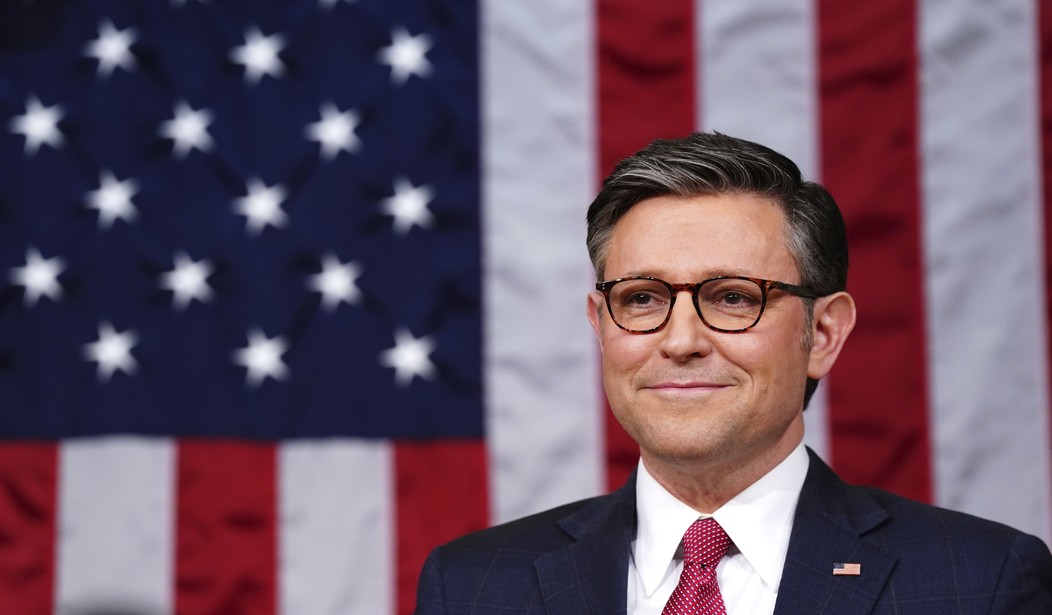
Based Mike Johnson Strikes Again After House Democrat Stages Shutdown Stunt Outside His Office


RedState 

There's just something about conservative dudes from Louisiana.

I mean, we've got Sen. John Kennedy, who most, if not all of us, would agree is an absolute national treasure with his words of wisdom, razor-sharp wit, and flair for cutting right to the point (him periodically urging his Dem colleagues to file "Hurt Feelings Reports" is classic).

There's also RedState's esteemed senior editor, Joe Cunningham, whose myriad qualities would have to be broken down into a series of in-depth write-ups.

Last but not least, there has been House Speaker Mike Johnson (LA-04), who, as we've noted, who has been a machine during the Schumer Shutdown, taking wrecking balls to Democrat talking points nearly every day since it started, pointing out each time that the reason we are in the situation we are in today is because Democrats are beholden to their far-left base, which is now led by radical NYC mayor-elect Zohran Mamdani.

Because Democrats are a thoroughly predictable lot, there have been many staged stunts outside of Speaker Johnson's office, including one from mid-October where Democrat Rep. Nanette BarragΓ‘n (CA-44) falsely accused a Capitol Police officer of "forcibly grabbing" her as she ripped down signs and tried to storm the speaker's office. 

The most recent one involves Democrat Rep. Yassamin Ansari (AZ-03), who on Thursday set up a "change my mind" table just feet from the speaker's office door. 

She accused him of "starving" millions and "gutting healthcare," while insinuating that he's refusing to seat Rep.-Elect Adelita Grijalva (AZ-07) on grounds that he's trying to engage in an Epstein Files cover-up:

Hilariously, Johnson's office responded by turning up the TV that has been situated in front of his office for weeks, and which plays clips that include Democrat Minority Whip Katherine Clark's (MA-05) infamous "leverage" quote on loop:

Sadly for Ansari, the table had to be moved out by people who were likely unpaid staffers (Ansari, meanwhile, is still collecting her congressional paychecks), which left her standing there holding the sign:

Johnson's office took advantage of that as well, using Sen. Minority Leader Chuck Schumer's (D-NY) "every day gets better for us" statement against her:

Further, there was also this inconvenient fact:

It would appear that Rep. Ansari is a couple of fries short of a Happy Meal. Change my mind.