Thursday, June 5, 2025

The Maturing of Defense Secretary Hegseth


On May 31, Secretary of Defense Pete Hegseth spoke at the annual Shangri-La Dialogue in Singapore. This is the world’s highest profile international meeting of national security officials; and certainly the most watched, because it was the debut appearance of a key cabinet member of President Donald Trump’s second term. Hegseth’s appointment was controversial. He is a decorated combat veteran who stressed the “warrior ethos” against various “woke” notions that degraded the military profession. But as a Fox news anchor, he had expressed naΓ―ve strategic views that tended toward isolationism. His message in Singapore calmed these fears.

His primary focus was on threats from China. “It has to be clear to all that Beijing is credibly preparing to potentially use military force to alter the balance of power in the Indo-Pacific. We know. It's public that Xi has ordered his military to be capable of invading Taiwan by 2027,” he warned. Then he pledged “Again, to be clear: any attempt by Communist China to conquer Taiwan by force would result in devastating consequences for the Indo-Pacific and the world. There's no reason to sugarcoat it. The threat China poses is real.” Hegseth also pointed out that Beijing has ambitions across the region, from the Philippines to Japan.

America is responding by increasing the forward deployment of forces in the region, not just the Navy which President Trump started to expand in his first term and is accelerating in his second with a trillion-dollar defense budget, but also with units from all the services. The Marines just deployed a new anti-ship missile battery in Luzon that not only protects the Philippines but would also reach a Chinese Taiwan invasion force. “We must ensure that China cannot dominate us -- or our allies and partners. Maintaining the status quo requires strength. That's just a rational, common-sense goal that all should be able to live with” declared Hegseth. 

A major theme that addressed many concerns was that America First does not mean America alone. Indeed, early in his remarks Hegseth stated “And under President Trump's leadership, the United States is committed to achieving peace through strength. That starts with deterring aggression around the world and here in the Indo-Pacific, here in our priority theater, here with you -- our allies and our partners.” Strategists can still look at how operations in different theaters might play out, but Great Power rivalry drives politics worldwide. Alliances and alignments span the globe, as do the ambitions of the major players. And the preparations for security in a turbulent world must run deep.

It should be noted that on May 24, a British carrier strike group, which includes warships from Canada, Norway, and Spain to give it a NATO flavor, entered the Red Sea conflict zone on its way to the Indo-Pacific where it will hold joint exercises with a variety of local navies to demonstrate that the West has friends on a global scale that Beijing can only dream about.

Economics is the material foundation of power. The “trade war” between the U.S. and China is fundamentally different from the commercial disputes that have brought forth President Trump’s broad use of tariffs. China has used its “gains from trade” (capital and tech transfers, expanded industrial capacity supported by trade surpluses) to build a peer geopolitical challenger that threatens not a trade war, but a real war to achieve its regional ambitions. There has been a broad bipartisan consensus in both the Trump and Biden administrations to rebuild strategic industries in America while denying China the means to compete in the development of new technology. As Hegseth stated, “Economic dependence on China only deepens their malign influence and complicates our defense decision space during times of tension. “

This is about industrial policy, not trade policy. We will build what we need. As Hegseth said, “We're reviving our defense industrial base and investing in our shipyards. We're rapidly fielding emerging technologies that will help us remain the world leader for generations to come.” He also talked about integrating economic capabilities with allies, especially India and Australia, which with the U.S. and Japan form “The Quad” of nations responding to China’s increased capabilities. The Trump administration has also talked with South Korea and Japan about industrial cooperation, especially in shipbuilding. Decades of neglect has eroded American shipyards while China has created the largest shipbuilding industry in the world.

Addressing China as our “primary” threat was correct, but Hegseth could not ignore threats outside the Indo-Pacific because Beijing is involved in support of aggression across the world, in particular that of Russia and Iran. Hegseth said little about Ukraine except to blame President Biden for failing to deter Russia’s invasion and to declare that President Trump is seeking “durable peace.” But he did say “It's important for this room to hear today, and all the world -- America First certainly does not mean America alone. Especially alongside so many of our allies, model allies like Poland, Israel, and the Gulf States, the Baltic States. And it does not mean ignoring the world.” The named allies stand in the front line against Russia and Iran. Poland and the Baltic States are vocal in their calls for more aid for Ukraine in its valiant defense against Russia.

Hegseth echoed the Trump view that Europe should take the lead in facing down a much weaker Russia, which is logical and certainly doable given NATO’s much greater economic potential. And while NATO has pledged to increase defense spending to 5% of GDP to match the U.S., it will take time after so many years of neglect based on the false hope of perpetual peace dashed by Vladimir Putin. To bring peace through strength right now will require the application of American power to force Putin to conclude peace is his only viable option.

Again, the Russia-Chinese alignment cannot be ignored. In 2022, just before Russia invaded Ukraine, Moscow and Beijing declared they were “friends without limit.” Last month, the leaders of both dictatorships declared a “friendship of steel” using the same words Hitler’s Germany and Mussolini’s Italy had used on the eve of World War II.

The two anti-western revisionist and revanchist powers have held numerous joint military exercises. Most recently, strategic bombers of Russia and China conducted a joint operation over the Sea of Japan on November 29, a threat to both Japan and South Korea (not to mention U.S. bases in both countries). On July 24 last year, they conducted the same kind of operation off the coast of Alaska. They held a joint naval exercise with Iran in the Gulf of Oman just after President Trump threatened Tehran if it did not dismantle its nuclear program.

In the new June issue of the U.S. Naval Institute’s Proceedings journal, Dr. William Bunn, a retired naval intelligence officer now a professor at the Joint Forces College, warns that Russia could join China in a war over Taiwan. Putin has been modernizing his Pacific Fleet. While it has always been assumed that an Indo-China conflict would tempt Moscow into fresh aggression in Europe, Bunn believes “U.S. forces must include a combined Russian-Chinese force in future Pacific wargames.” More proof that to deter China, Russia must be defeated in Ukraine to give credence to a “peace through strength” American policy and posture. Actions not only speak louder than words, they are usually the only things adversaries understand.


X22, And we Know, and more- June 5


If today has felt like the craziest game of chess ever, well...

You wouldn't be far off. Not even Hetty could come up with something like this, and she's a chess master!

D-DAY SPECIAL JUNE 6, 2025

 Catherinette suggested and I concurred...

A blog posting where we all of us can comment and post personal photos that spark remembrance 

.


Are People Getting Dumber?


I’ll be the first to admit that I am not the ideal customer. Actually, no, I am the ideal customer in that I want to get whatever transaction I am engaging in finished as quickly as possible. I pay, I go. Along the way, I say just enough to facilitate the completion of the transaction. While I am not unique, but I believe my approach is the best. Unfortunately, people are getting dumber and making this symbiotic relationship a freaking mess.

Can I just ask a basic question: Who the hell are these people who go to Costco or the grocery store to make friends with the cashiers? No offence to cashiers, I’ve been one, but they’re not that interesting. Yet, we have these people who, no matter how long the line is behind them, strike up a conversation with them, slowing everything down to a crawl. Then, in what makes me come close to breaking, they seem surprised, even shocked, that the transaction requires them to pay at the end of it. 

As if that weren’t bad enough, when they fumble through their purse or pockets to find their card, they look at the swipe machine as if it was the first time they’ve ever seen one. They don’t know how to swipe or insert it, they pull it out too early and have to repeat everything, and the concept of a PIN is treated like a delicate boobytrap disarming that would confuse Indiana Jones. How do these people dress themselves?

Of course, much worse than all of that is the 2 percent of people who still insist on writing checks. Nothing against check writing, but you should not be surprised by it being an important part of the closing of your retail transaction. 

My mother was a check-writer, always. But she knew how it worked and, while she was always a talker too, could chat with the cashier (who she’d usually known for a long time) while filling out everything on the check except the amount. As soon as the “total” button was hit, my mom was ready, pen in hand, to finish the transaction so everyone could get on with their lives.

Now, check-writers don’t have a pen half the time, never know the date and completely forget they’re going to pay that way until everything is bagged and back in their cart. It’s like being caught off-guard by your reflection in the mirror. 

On a recent trip to Delaware, the family and I were looking for a place to eat. It was late for dinner, and many places were transitioning from restaurant to mostly bar, ready for people to come in and start drinking. I don’t blame them for not wanting to seat a couple with 2 young kids, as we could delay that transition. Still, they need to come up with a better lie than “We don’t have any tables.”

Then we get to a place that is just a restaurant, my hopes rose. I asked hostess if they had a table for four and she replied, “Inside or out?” Immediately, I thought we were in business. “Any,” I answered, ready to get everyone’s hopes up. “We don’t have any tables,” she responded.

I looked at the vapid face – possibly the dumbest person I’ve ever met in real life – and marveled at what had just happened. Half laughing, half shocked, I said, “Then why the f*ck did you ask me that question?” 

She had no idea, completely oblivious to the moment. “What do you mean?”

Laughing, I replied, “Was there an answer I could have given that would’ve freed up a table? Is there a code word I don’t know or is there a plane of existence between inside and out where tables are free, but you have to specifically ask for them?”

Her face reflected the fact that her inner monologue is “duh.” I kept laughing and walked out, impressed in the way only unaware incompetence can. 

I don’t know, maybe we’re getting dumber or maybe we’ve always been this dumb and I’ve only started noticing. But I do not remember being that dumb. Of all the stupid things I’ve done, and lord knows that list is long, I was always aware of the fact that what I was doing was stupid. That, in some ways, makes what I was doing dumber. But it also makes what I’m seeing now worse, because it means these people aren’t aware of how stupid what they’re doing is. 

Either way, it does not bode well for the future of our species.


The Courts Are Courting Disaster by Alienating Conservatives


The problem with the courts is the same as the problem with many of our other institutions. Called the Skinsuit Phenomenon, after the great @Iowahawk’s famous tweet that perfectly sums up the leftist approach to marching through our society: “1. Identify a respected institution. 2. Kill it. 3. Gut it. 4. Wear its carcass as a skinsuit, while demanding respect. #lefties.” The courts are supposed to have respect because they’re supposed to do their job, but, as is so common these days, they’re not doing the job, yet they still expect the respect. That’s just not in the cards. Things are going to change. It’s just a matter of how they change. They could change back to when the courts acted like courts, or they could change to where the courts get kicked to the curb.

The courts fulfill several functions. Courts resolve disputes between individuals and entities – we call that “civil law,” which I did for about 30 years. Courts also resolve criminal disputes, where the government charges that someone committed a crime and the accused denies it. These are the most common things that courts do, the routine work that allows society to function. However, there is another role that courts play. Courts determine limitations on government power, and that’s where we have problems. In the first two roles, courts certainly screw up on a regular basis, but it’s not a systematic problem. With some exceptions – hello, family law in general, insane plaintiffs’ verdicts, and government persecutions like the J6 pogrom – the courts generally function adequately. You can be fairly certain you will be heard and fairly certain that the courts will apply something that is at least somewhat similar to the law to your case.

But then you get to political cases, and everything goes crazy. Take it from a lawyer – the kind of antics that go on in political cases have nothing to do with the normal law that goes on day-to-day in other courts. Procedurally, you don’t have crazy things like ex parte motions to certify a class filed at 3 a.m. on a Saturday morning and granted within 15 minutes without allowing opposition. This doesn’t happen. And substantively, you don’t have courts ruling on matters where their jurisdiction has been expressly removed by legislation or otherwise ignoring the clear text of the Constitution and the applicable statutes. In normal cases, judges hate to be reversed by the courts of appeal. In political cases, lower court judges seem to wear reversal like a medal and run hog wild.

The courts have stopped doing what the courts are supposed to do as an institution. The courts are now doing what the employees of those institutions want to do, following their own (leftist) political agenda instead of the law. It’s the Skinsuit Phenomenon. They’re not doing their job, but we’re supposed to keep respecting them, and respecting them, I mean, allowing them to exercise power.

Where should the courts get their power? From doing their job. They don’t have any other power. They have no police to send out to arrest anybody, nor any Army to go conquer the defiant. They have the power we give them, and they’re supposed to earn it by performing their function adequately. Remember, these folks are not elected. In the federal system, they serve for life, so they’re not accountable to the voters. But even though they’re not doing the job they were appointed to do – apply the law neutrally – they still expect to have the power they would have if they were actually doing the job they were appointed to do and applying the law neutrally. 

But that doesn’t work. What they’ve done is convert the courts from a branch that is not political into one that is, without adding the critical characteristic of accountability. In other words, we can’t vote them out of office like we can other politicians. Congress is a political branch. If you don’t like what your current representative or senator is doing, you can vote for someone else – and you should in 2026. And if you don’t like what our current president is doing – in which case, you’re a dork – you can vote for whichever communist weirdo the Democrats nominate in 2028. 

But you don’t get to vote on federal judges even when they act like politicians. If a branch is going to be political, it has to be accountable. Today, we have courts that want to be political but not accountable like politicians are. What use are the courts for resolving disputes over government power if they are just going to act like politicians but not have the limitations put on politicians in the form of having to face the voters?

What’s the moral argument for compelling obedience to a bunch of people who you will never get to vote for or against in the future? Why do we even need a third political branch? I keep hearing about how important “Our Democracy” is, so how does that work when the people who are making the decisions are outside of our democratic processes? Well, it doesn’t. It’s just a power grab. It’s a skin suit. Why must we obey the courts as if they’re neutral arbiters who only care about the law even when they are manifestly not neutral arbiters and do not care only about the law?

The left killed the courts, gutted them, and is wearing the resulting skin suit around town demanding respect. That might’ve worked for a while, but that’s not going to happen anymore. We’re hip to the scam, and we’re getting more and more angry. The current configuration of the courts just isn’t working for us. We’re getting tired of the status quo.

Just look at what happened earlier this week. The Supreme Court had the chance to take on two Second Amendment cases, one where a bunch of communists imposed magazine capacity limitations and another where the pinkos tried to ban AR-15s. The argument for doing the latter was, seriously, that the most common rifle in America does not fall within the category of “arms,” as in the right to keep and bear the same. The Supreme Court decided not to hear the case, with Brett Kavanaugh saying that the Court might get around to hearing the matter in a year or two. Hey, what’s the hurry? It’s only a key enumerated right under the Constitution?

Sure glad we had Kegger’s back, huh?

But when a bunch of illegal alien Third World gang members might get shipped back to where they belong, suddenly the Court has got to act right now, right away, no time to wait, immediately, to protect the fair rights of those scumbags. Normal Americans having their actual rights violated? No biggie. Maybe we’ll find time to take care of that in a couple of years. Maybe.

The left has spent years trying to undermine the authority of the Supreme Court to stop the lower courts from their skin-suiting. John Roberts thinks he can play footsie with these people, while they will gut him and wear his pelt like his skin suit the second they get the chance. His problem is he thinks he can cleverly play off the left and the right and preserve his institution and that he can do it by making political rulings. But that’s not so. The only way for the Court to restore its reputation for neutral application of the law is by neutrally applying the law. No, that’s too easy. No, John Roberts has to be clever. And in doing so, he’s alienated the only faction in American politics that might have supported him.

You have probably heard of the Federalist Society. That is a group of law nerds that was generally associated with the right because it wasn’t actively leftist. It believes in originalism, the idea that you should apply the original understanding of the Constitution and the laws instead of filling in legal Mad Libs like the living Constitution leftists. Basically, it was an argument between what the law was meant to say, associated with conservatives, and what the law needed to say to reach a policy goal, associated with liberals. 

Trump famously appointed Federalist Society judges in his first term. We ended up with Kavanaugh, Gorsuch, and Coney Barrett. None of them are reliably conservative. That’s what we want: reliable conservative votes. Why? Because the judiciary has become a political branch, and you can’t shut your eyes real tight and try real hard as you continue to apply your arcane legal theory while the other side’s judges are doing whatever they need to do to get the result they want. It doesn’t work.

As usual, the Fredocons are out in force, telling us to ignore reality and pretend that the norms are still in effect. That’s not a skin suit – that’s a real pelt! But we’re not playing that anymore. We’ve accepted that the judiciary has become a political branch, and we’re going to deal with it on those terms. This means no more Federalist Society judges who, through a faulty application of their academic ideology, might end up supporting the left. Since it’s now a political branch, we want judges who were going to get us our preferred political result. Hey, prospective judge, I don’t want to hear about your ideology. I want you to vote my way every time because that’s what the courts do now.

Of course, this raises the question of why we need courts at all to resolve questions about government powers. If it’s going to be just another political branch, that’s superfluous when we already have a legislature and an executive. What function does having a third branch, consisting of unelected people in funny clothes pretending to read legal briefs, provide? None. There’s no reason for it, and it deserves no moral deference. It’s just another set of politicians, and we ought to consider getting rid of the courts’ participation in such issues if we are not going to return it to its proper role. But in the meantime, we should accept things as they are. That means no more Federalist Society sissies, only hard-core conservatives. If the courts are just another political arena, I say we go full Maximus and fight to win.


Harvard and the Birth of Lawfare


By Matthew G. Andersson  |  June 4, 2025  |  Minding the Campus

The concept of “lawfare” is in the news constantly. The term describes a program, run mostly by political parties, that uses the courts to attack and tie up opponents—or to use the judicial system as its own government. It seems like a new practice in present-day politics, but its design goes back decades to one of our flagship universities and its law school.

When Harvard Law was first established in the 19th century, it was a trade school focused almost entirely on applied business. But something happened along the way: Harvard Law discovered social engineering. That is, law school could grow in prominence, influence, and wealth if its object became not just corporate clients with needs involving contracts, bills, insurance, and property, but the entire domain of human affairs. Lawyers could be the new engineers of societies.

Such ambition, or conceit, naturally finds itself pursuing, or cooperating with, political power and control, which relies on a warfare model of political conduct, which draws on the law school practice of adversarialism. The law school gradually became the “base camp” of a new political warfare model, and the development of legal methods, and especially a legal culture, was necessary to pursue lawfare in ways that could appear to be a regular use of the legal system.

[RELATED: How the Modern Law School Promotes Political Division and ‘Lawfare’]

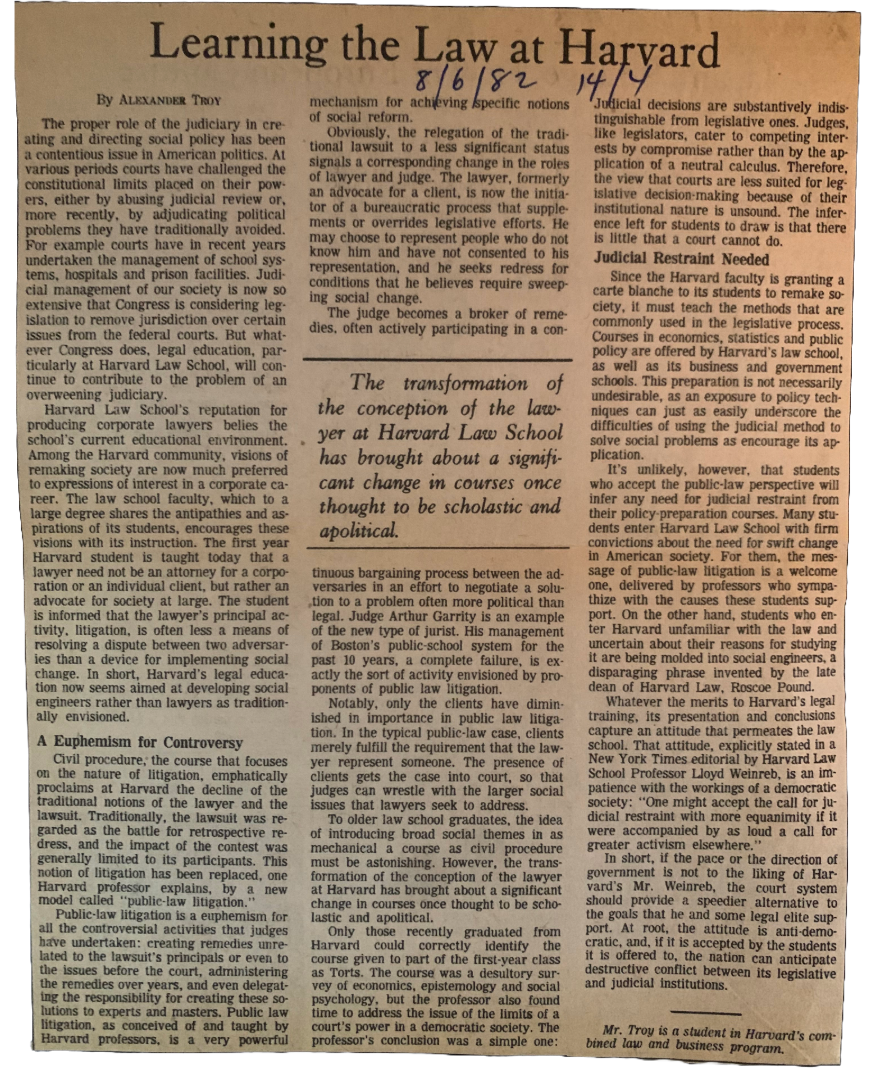
Numerous books and papers have been written about various aspects of this problem. Most interesting of all, however, may come from an actual Harvard Law student, in his bellwether Wall Street Journal op-ed from August 6th, 1982, “Learning the Law at Harvard.” (See the image of the essay I captured below). In a succinct essay, Mr. Alexander Troy chronicled how Harvard Law evolved from a law school to a school of political activism and social ideology, a transformation that has continued to the present day, with its influence extending all the way up to the Supreme Court, and its enduring concentration of Harvard Law alumnae. Perhaps some of his unique insight came from his dual concentration in business.

Troy, Learning the Law at Harvard, Wall St. J., Aug. 6, 1982,

He especially focused on how a transformation of American law teaching standards occurred within Harvard’s curriculum, where its core focus shifted to litigation. Moreover, litigation was recast from a method of resolving disputes in the representation of a client to an enlarged role of representing “society” and using courts as a form of legislation. With this change, the entire doctrinal complex of separation, neutrality, consent, and restraint was reformulated into subversion, interests, authority, and license.

Harvard Law’s preoccupation with public-law litigation is exactly what lawfare isthe use of law to override the consensual processes of a democratic society. As Troy insightfully stated over 40 years ago, “At root, the attitude is anti-democratic, and if it is accepted by the students it is offered to, the nation can anticipate destructive conflict between its legislative and judicial institutions.”

As the public discovers nearly every week, another court ruling is made by appointed judges who assume they are in a contest with elected representatives over who is running the country. This goes beyond mere judicial excess or theories of judicial review or restraint; it represents a breakdown in our understanding of government.

The judiciary may not always be fully aware of the ramifications of their actions—judges aren’t generally so perceptive. However, they are smart enough to ingratiate themselves with politicians, believing that they are serving justice by aiding those political interests that they assume represent a higher social objective, which justifies enactment by judicial diktat. Economists sometimes refer to this as the “Nirvana Fallacy.”

Congress has the power to rein in such judges and courts. But its responsibility extends further and includes potentially impeaching judges who operate outside their oath-bound duties. Moreover, as judicial immunity may be revoked or lost through impeachment, additional charges may be brought against judges who knowingly participate in a coordinated undermining of a functional government.

That, unfortunately, is also the essence of almost all modern law school jurisprudence that seeks to emulate Harvard as a model: it rests not just on advocacy and adversarialism, but through a carelessness in thought, combined with a rejection of maturity and restraint, it has created a self-image of “revolutionology” as jurisprudence. Throughout history, such a worldview first requires an enemy created by ideological division and class envy, ultimately leading to lawlessness.

[RELATED: Yale, Harvard, UChicago: The Leftist Legal Trust Shredding the Constitution]

That may be the legacy of the Harvard Law School model of law as a vehicle for social justice. Indeed, it is the ironic basis of the entire “elite” law school category: law as a centralized, top-down judgment of private preferences, rather than a bottom-up, distributed power based on public consent.

The good news is that the elite category of law schools is unnecessary, except perhaps to the elite law schools themselves. Students will find the power of law instead in their own communities, families, businesses, and local governments, all across the country. Each of their own local community colleges and state schools already has the best credentials for learning what law is. And it isn’t that much: a basic set of private law principles for private citizens in control of a limited public government bound to a ratified Constitution.

Done right, much of the law as we know it today disappears, and the “elite” law school largely with it. That is where a true legal “revolution” may begin, by correcting a systematic mistake that has occurred in university law training, and by extension, its corrupting influence on our ability to manage self-governing societies and their states.


Image: “Langdell Hall, Harvard Law School” by Kenneth C. Zirkel on Wikimedia Commons

https://www.mindingthecampus.org/2025/06/04/harvard-and-the-birth-of-lawfare/

🎭 π–πŸ‘π π““π“π“˜π“›π“¨ 𝓗𝓾𝓢𝓸𝓻, π“œπ“Ύπ“Όπ“²π“¬, 𝓐𝓻𝓽, π“žπ“Ÿπ“”π“ 𝓣𝓗𝓑𝓔𝓐𝓓


Welcome to 

The π–πŸ‘π π““π“π“˜π“›π“¨ 𝓗𝓾𝓢𝓸𝓻, π“œπ“Ύπ“Όπ“²π“¬, 𝓐𝓻𝓽, π“žπ“Ÿπ“”π“ 𝓣𝓗𝓑𝓔𝓐𝓓 

Here’s a place to share cartoons, jokes, music, art, nature, 
man-made wonders, and whatever else you can think of. 

No politics or divisive posts on this thread. 

This feature will appear every day at 1pm mountain time. 


Tucker Carlson Interviews Former CIA Operations Officer John Kiriakou


An interesting interview between Tucker Carlson and Former CIA Counterintelligence Operations Officer John Kiriakou about being targeted by the CIA and FBI after telling the truth about CIA torture ops.

Kiriakou outlines how no U.S. President ever controls the CIA, and why politicians are seemingly afraid of holding them accountable. WATCH:


Chapters:

0:00 Introduction
1:41 Speaking Out Against the CIA’s Torture Program
7:20 Why the CIA Loved Obama
19:05 Why John Brennan Hated Kiriakou
23:23 The CIA’s Torture Techniques
32:01 How the FBI Tried to Bait Kiriakou Into Committing Espionage

42:48 The FBI’s Absurd Years-Long Investigation Into Kiriakou’s Life
59:13 The CIA Set Up to Get Kiriakou Thrown in Jail
1:04:34 The Major Issue With the Espionage Act
1:15:20 Kiriakou’s Experience in Prison
1:27:55 Did Any Elected Officials Defend Kiriakou?
1:32:38 The Dangerous Legal Precedent Set in Kiriakou’s Case Used Against Trump
1:34:10 The Clinton Judge Responsible for the Sentencing of Kiriakou & Assange
1:39:29 Kiriakou’s Attempt to Get a Pardon From Joe Biden
1:42:00 Obama’s Drone Strikes Against American Citizens
1:43:38 Do CIA Employees Think They’re Doing Good?
1:47:10 Kiriakou’s Thoughts on the JFK and RFK Assassinations
1:53:12 The CIA’s MKUltra Program
1:57:59 Can the CIA Infect People With Cancer?
1:58:33 How 9-11 Turned the CIA Into a Paramilitary Group
2:08:03 Ronald Reagan Was Right About Government
2:09:57 The Waco Massacre
2:12:37 How CIA Employees Get So Rich
2:14:20 FBI Agent Apologizes to Kiriakou
2:16:51 How to Forgive Your Enemies


Republican Rep Asks Dem Witness if She’s a ‘Covert White Supremacist’ – Her Answer Leaves Him Dumbfounded


Rusty Weiss reporting for RedState 

Representative Brandon Gill (R-TX) tied a witness for the Democrats at a congressional hearing today in absolute knots, as she repeatedly refused to deny being a "covert white supremacist."

Diane Yentel, President & Chief Executive Officer of the National Council of Nonprofits, was testifying in support of NGOs (Non-governmental organizations) at a DOGE Subcommittee hearing titled "Public Funds, Private Agendas: NGOs Gone Wild."

Gill began his questioning by noting Yentel has "written a lot about anti-racism and white fragility" in the past, and offered her an opportunity to state whether or not she believes President Trump is a racist.

Yentel pivoted, unwilling to make such a declaration on the record. Undaunted, the Texas congressman pointed out that she has said on social media that the President is a "vile, despicable racist."

He also asked the witness if she found Trump's housing policies to be racist. Again, that's something she tweeted, and again, it was something she was unwilling to say at the hearing.

Here's where Gill's grilling turns into an absolute work of art. He reveals that one of her affiliate charities has expressed that "denial of racism"—something she just denied multiple times—"constitutes covert white supremacy."

"Are you a covert white supremacist?" he asked flat out.

Yentel time and time again refused to say no, leaving Gill by his own admission "dumbfounded."

"Are you a covert white supremacist?" Gill continued.

Yentel replies, "Can I talk about the work that nonprofits do?"

"No. I'm asking you if you're a covert white supremacist, which, according to one of your own organizations - again, denial of racism constitutes covert white supremacy," the congressman pressed. "Would you like to answer the question?"

The Democrats' star witness was left a sputtering mess.

After asking again, Gill stated, "I am utterly dumbfounded - you will - you are on record right now, and you will not say that you are not a covert white supremacist?"

It's at this point that Yentel takes the Ketanji Brown Jackson route, saying she does not know the definition of a "covert white supremacist" and thus, can not answer.

Gill finds her non-responses "astounding."

The entire exchange can be seen below.


Gill, as my esteemed RedState colleague Sister Toldjah has pointed out, has been making a name for himself since being sworn into Congress in January. Eviscerating a Democrat witness is just the latest example.

Last month, he steamrolled USA Fencing Chairman Damien Lehfeldt during a Congressional hearing for smearing parents who don't want biological males to compete in their daughters' sports.

Now he's masterfully dismantled an expert witness Democrat lawmakers thought would defend NGOs, instead exposing her history of partisan and radical leftist posts on social media. 

Well done, Mr. Gill.


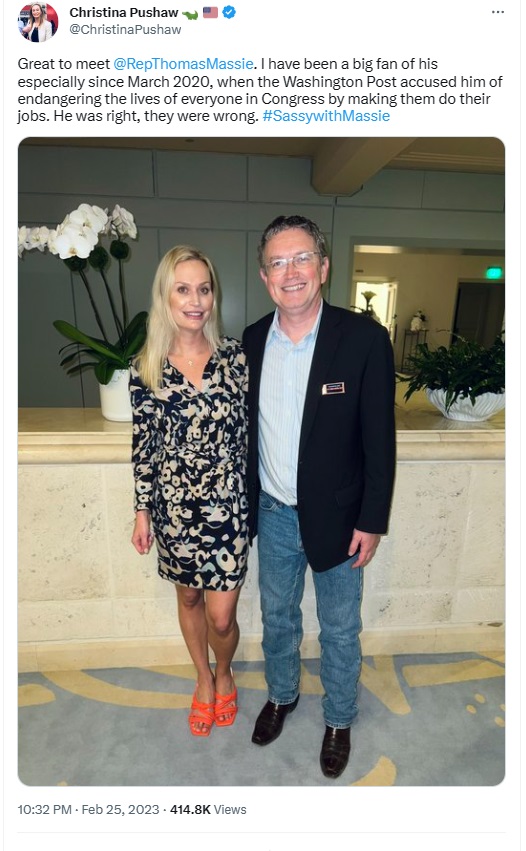
Thomas Massie Wants Elon Musk to Fund Primary Challengers to Trump Supporters in Congress


If you have walked the deep political weeds with us, you will likely remember the warnings.  Thomas Massie, Chip Roy, Rand Paul and other fellow republican travelers will join with Elon Musk and the alligator emoji network to oppose President Trump as soon as they can get back into the minority.

There is an intention behind this alignment of interests, which includes the Tech Bros (and Sea Island), that ends with a Vance-DeSantis promoted effort in 2028.  The only thing standing in their way is MAGA.  As a result, MAGA must be fractured.

The money center behind the strategy is working on a learning curve.  Having failed with prior launches of similar approaches (ref. DeSantis ’23/’24), they are now doing much more proactive seeding.

Yeah, I know, I know; some will say I’m crazy.  I’m not. I’ve watched this exact group’s constructs for over 14 years now.  All the data indicates this approach; the only unknown variables are the names of the political representatives who will participate.  Today, Thomas Massie is asking Elon Musk to fund primary challengers against the House republicans who support Donald Trump.

WASHINGTON DC – Rep. Thomas Massie, R-Ky., said Elon Musk should fund primary challenges against almost every Republican who voted for President Donald Trump‘s “big, beautiful bill” last week.  “I don’t primary my colleagues, but I feel pretty good about him doing it,” Massie told Fox News Digital on Wednesday.

“There’s a few others that should be spared,” when asked to clarify if he meant all 215 House Republicans who supported the legislation. “But people want term limits, right? Elon can bring term limits.”

Musk came out against the massive Trump agenda bill that House Republicans passed last week. “I’m sorry, but I just can’t stand it anymore. This massive, outrageous, pork-filled congressional spending bill is a disgusting abomination. Shame on those who voted for it: you know you did wrong. You know it,” Musk first posted.

It was followed by several posts on the national debt, and one that read, “In November next year, we fire all politicians who betrayed the American people.”

Massie said on Wednesday, “I just think he made one mistake when misstatement – he said take them out in November. I would take them out in primaries if I were Elon Musk.” (more)

Massie wants to give control of the House to Democrats.  With Democrats in control President Trump is then isolated, ridiculed, marginalized and targeted again.  This approach, the Massie strategists believe, diminishes President Trump, and weakens his endorsement power in the lead up to the ’28 contest.

Both Massie and Musk supported Ron DeSantis until Trump finished crushing him in 2024.  This is simply a replay.

The Sea Island GOPe are nothing if not predictable.

Team Cruz in ’16, became Team DeSantis in ’24, will be Team Vance in ’28.

Watch.