Change is underway—at the border, in our federal government, and abroad. But several forces threaten to undermine success.
The Trumpian
agenda to “Make America Great Again” emerged during the 2015–16 campaign and
ensured Donald Trump’s nomination and eventual victory over Hillary Clinton.
This counterrevolutionary movement reflected the public’s displeasure with both
the Obama administration’s hard swing to the left and the doctrinaire, anemic
Republican reaction to it.
Although
only partially implemented during Trump’s first term, MAGA policies
nevertheless marked a break from many past Republican orthodoxies, especially
in their signature skepticism concerning the goal of nation-building abroad and
the so-called endless wars, such as those in Iraq and Afghanistan, that tended
to follow. But like all counterrevolutions, there were intrinsic challenges in
the transition from simply opposing the status quo to actually ending it.
There was a
promising start during Trump’s first administration. Corporate interest in a
porous border to ensure inexpensive labor was ignored; immigration was deterred
or restricted to legal channels, and the border was largely secured.
Deregulation and tax cuts, rather than deficit reduction, were prioritized.
Selective tariffs were no longer deemed apostasies from the free market, but
acceptable and indeed useful levers to enforce reciprocity in foreign trade.
Costly middle-class entitlements were pronounced sacrosanct. Social Security
and Medicare were declared immune from cost-cutting and privatization.
This “action
plan to Make America Great Again” went hand in hand with an effort to transform
the Republican Party. What had once been routinely caricatured as a wealthy
club of elites was reinvented by Trump as a working-class populist movement.
Racial chauvinism and tribalism were rejected. Race was to be seen as
incidental to shared class concerns—notably, reining in the excesses of a
progressive, identity politics–obsessed bicoastal elite. Athletes who in 2020
had bent a knee to express outrage at “systemic” racism were in 2024
celebrating their scores by emulating Trump’s signature dance moves.
Despite
intense resistance from the media, the Democratic Party, and the cultural left,
the first Trump term enjoyed success in implementing many of these agendas.
After losing the 2020 election—in which nearly 70 percent of voters in key
swing states voted by mail-in ballot—Trump left office without a major war on
his watch. He had overseen a period with 1.9 percent annualized inflation, low
interest rates, steady economic growth and, finally, after constant battles and
controversy, a secure border with little illegal immigration.
Yet during
the succeeding four-year Biden interregnum, the world became far more chaotic
and dangerous, both at home and abroad. Biden’s general agenda was to reverse
by executive order almost every policy that Trump had implemented. And while
Trump was successfully reelected in 2024 after reminding voters that they had
been far better off under the MAGA agenda than during Biden’s subsequent
shambolic tenure, the changed conditions in 2024 will also make implementing
that agenda even more difficult than after Trump’s first victory.
Trump has
now inherited an almost bankrupt country. The ratio of debt to annual GDP has
reached a record high of nearly 125 percent—exceeding the worst years of World
War II. The nation remains sharply divided over the southern border. Trump’s
own base demands that he address an estimated 12 million additional unvetted
illegal aliens; diversity, equity, and inclusion mandates and racial quotas;
and an array of enemies abroad who are no longer deterred by or content with
the global status quo. The eight-year Obama revolution, in retrospect, did not
change American institutions and policies nearly as much as the more radical
four-year Biden tenure. And so often, when drastic remedies are proposed, their
implementation may appear to the inured public—at least initially—as a cure
worse than the disease.

Take the
example of illegal immigration. Since Trump left office in January 2021, two
major and unexpected developments followed during the Biden years. First, the
border did not just become porous but virtually disappeared. Indeed, Biden in
his first hours of governance stopped further construction of the Trump wall,
restored catch-and-release policies, and allowed illegal immigrants to cross
the border without first applying for refugee status.
Given the
magnitude of what followed—as many as 12 million illegal aliens crossed the
border during Biden’s tenure—the remedy of deportation would now necessitate a
massive, indeed unprecedented, effort. The public has been increasingly
hectored by the left to fear the supposedly authoritarian measures Trump had in
mind when he called for “massive deportations.” Left unsaid was that such
deportations would only be a response to the prior four years of lawless and
equally “massive” importations of foreign nationals. And yet, while the 12
million illegal entrances over four years were an insidious process, the
expulsion of most of those entrants will be seen as abrupt, dramatic, and
harsh. In addition, it was much easier for felons and criminals to blend in to
the daily influx of thousands than it will be to find them now amid a
population of 335 million.
Second, in
the 2024 election, Trump won a record number of Hispanic voters (somewhere
between 40 and 50 percent, depending on how the term Hispanic is
defined) in one of the most dramatic political defections from the Democratic
Party in history. While voters’ switch to Trump can be largely attributed to
the deleterious effects of the Biden-Harris open border on Hispanic
communities, schools, and social services, no one knows what, if any, might be
the paradoxical political effects of the mass deportation of many within these
same Hispanic communities.
Will
Hispanic voters continue to resent the ecumenical nature of illegal immigration
across the southern border, which now draws millions from outside Latin
America? Will they wish to focus primarily on violent criminals while exempting
on a case-by-case basis Mexican nationals, many of whom have kinship ties to
Hispanic U.S. citizens? In sum, no one yet knows the political consequences of
deporting all—or even five to 10 percent—of the Biden-era illegal aliens, given
their unprecedented numbers. Even if polls tell us that 52 percent of Americans
support “massive” deportations, will that number still hold true if they
eventually include friends and relatives or entail five or six million
deportations?

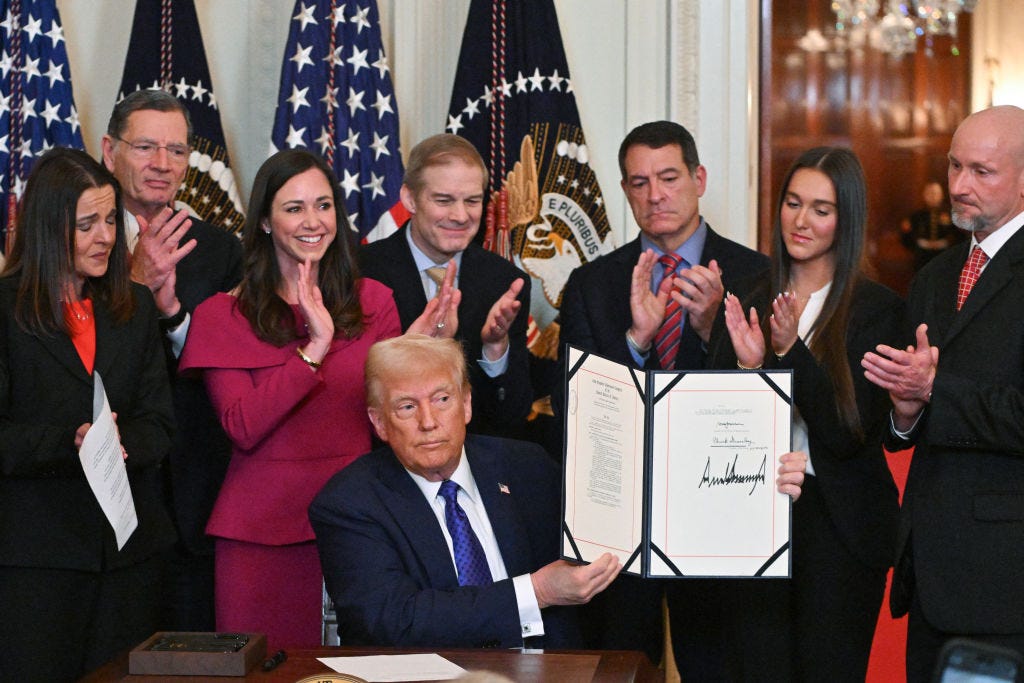
Trump looks
on after signing the Laken Riley Act in Washington, D.C., January 29, 2025.
(Roberto Schmidt via Getty Images)
Trump’s
fiscal policies pose similar known unknowns. During the 2024 campaign, Trump
promised a number of large tax cuts to various groups. For example, eliminating
taxes on service workers’ tips might cost the Treasury in excess of $10 billion
a year. Trump’s call to make tax-free the incomes of police officers,
firefighters, veterans, and active-duty military personnel would translate into
at minimum a shortfall of $200 billion a year in federal tax revenue. Another
$200 billion in annual revenue would be lost if, as promised, Trump once again
allowed state and local taxes to be deducted from federal income taxes. Some
$300 billion per annum would also vanish under Trump’s proposals to cease
taxing hourly overtime pay. Other promises to eliminate taxes on Social
Security income, cut corporate taxes to 15 percent, or re-extend his 2017 tax
cuts could reach $1 trillion in lost federal revenue per year.
The 2024
yearly deficit was projected at about $1.83 trillion. So how would Trump reach
his goal of moving toward a balanced budget if all the promised tax reductions
were realized, with a yearly loss of at least $1 trillion in revenue added to
the nearly $2 trillion currently borrowed each year? No one knows the precise
increase in annual revenues that will accrue from greater productivity and
economic growth due to Trump’s deregulatory and tax-reduction agendas.
Furthermore, how much income can be expected from proposed reciprocal tariffs
on foreign imports? And how much will realistically be gained in savings from
Elon Musk’s new Department of Government Efficiency and its promise to cut $2
trillion from the annual federal budget?
So far,
Trump’s proposed radical tax cuts are quite popular, mostly transparent, and
often detailed, while the commensurate massive reductions in federal spending
are as yet none of the above. The political success of Trump’s tax and spending
reductions will hinge on the degree to which he can eliminate massive unpopular
waste, slash useless programs, increase federal revenue from targeted foreign
tariffs, and through incentives, grow the size and incomes of the taxpaying
public and corporations—without touching sacrosanct big-ticket items like
defense, Social Security, and Medicare. It bears noting that no prior
administration has been able to cut the annual deficit while also massively
reducing federal income taxes.
Trump has
also promised a radically new and different cohort to run his cabinet posts and
large agencies. In his first term, Trump’s agenda was stymied by both his own
political appointees and the high-ranking officials of the administrative
state. Starting in 2017, they saw their new jobs as either warping MAGA
directives into their own preferred policies or colluding to block a supposedly
unqualified and indeed “dangerous” Trump. Almost monthly, his cabinet heads or
agency directors—John Bolton, James Comey, John Kelly, James Mattis, Rex
Tillerson, Christopher Wray—were at odds with their politically inexperienced
president.
Anonymous
lower-ranking officials routinely claimed to the media that they were
internally frustrating Trump initiatives and leaked embarrassing (and possibly
fabricated) anecdotes about their president. One supposedly high-ranking Trump
official known as “Anonymous”—later revealed to be a rather low-ranking
bureaucrat named Miles Taylor—began a New York Times hit
piece, “I Am Part of the Resistance Inside the Trump Administration.” He
further boasted of how appointees deliberately tried to sabotage Trump policies
and executive orders.
But
paradoxes also arise from Trump’s 2024 remedies for this earlier internal
obstruction. Given this past experience, only genuine outsiders appear immune
to the compromises and careerism endemic among veterans of the administrative
state. And yet such would-be reformers often lack the insider knowledge,
expertise, and familiarity with the government blob needed to reduce or
eliminate it.
The radical
growth in the federal government, the surge in entitlements, the increases in
regulations and taxes, and the soaring deficit and national debt were overseen
by so-called experts in the bureaucracy as well as by traditional politicians
on both sides of the aisle. In response, would-be reformers have talked grandly
about the dangers of unsustainable national debt, the interest payments that
now exceed $1 trillion per year, and the need to rein in nearly $2 trillion in
annual budget deficits. But few, especially in Congress, may be willing to
cancel the sacred-cow programs that have enriched their constituents, provided
jobs for millions of Americans, and offered high-paying, revolving-door billets
for retired politicians and their staffers.
For example,
the general public, liberal and conservative alike, acknowledges vast waste and
wrongheaded procurement at the Pentagon. Auditors quietly grant that massive
subsidies and corporate welfare to pharmaceutical companies, agribusiness, and
crony-capitalist wind- and solar-energy companies are near scandalous. An
increasing number of voters now believes that the government needs to get out
of the business of guaranteeing student loans that are nonperforming, stop
funding boondoggles like high-speed rail, and dismantle the vast DEI commissar
system at government agencies.
Yet those
most familiar with these programs are their beneficiaries. And those who could
most effectively discontinue them are precisely those who perhaps could least
be trusted to do so. Therefore, outsiders are needed, even or especially those
without the degrees and résumés customarily required to run these huge
government entities.
Trump’s
cabinet nominee Pete Hegseth, for example, a decorated combat veteran who wrote
a book on the Pentagon’s pathologies, is by conventional standards unqualified
to be the defense secretary. He is not a four-star officer, former Fortune 500
CEO, or prior cabinet official. Unlike his two predecessors, however, he would
not revolve into the office from a post at a defense corporation with huge
Pentagon contracts.
The FBI
director nominee Kash Patel has a lengthy record of government service in
Congress, the executive branch, and legal circles. But he also is a fierce
critic of the FBI and was once himself a target of agency monitoring. Indeed,
Patel wrote a book about FBI misadventures, incompetence, and political
weaponization. He promises to move the agency outside of Washington, D.C., and
to end its political contamination—which has earned him fierce opposition from
within the bureau and its congressional and media supporters.
In rejection
of the Republican establishment that obstructed him in his first
administration, Trump has often opted for anti–big government picks who were
once Democrats or who otherwise emphatically reflect the populist nature of the
new Republican Party, such as Tulsi Gabbard (Director of National
Intelligence), Robert F. Kennedy Jr. (Secretary of Health and Human Services),
Dr. Marty Makary (head of the Food and Drug Administration), Dr. Jay
Bhattacharya (Director of the National Institutes of Health), or Lori
Chavez-DeRemer (Secretary of Labor).
In sum,
while it is not impossible for reformers to emerge from the status quo, it is
precisely those “unqualified,” “firebrand,” or “dangerous” outsiders without
“proper” experience in government, without prestigious degrees and credentials,
and without sober and judicious reputations within the bureaucracies (indeed,
they are sometimes the very targets of the agencies that they are tasked to
reform or end) who are most immune to being compromised by those bureaucracies.
But it is
abroad where the implementation of the MAGA agenda will be most severely
stress-tested, particularly regarding China, Russia, Ukraine, and the Middle
East. Trump’s first term was neither isolationist nor interventionist. He
loathed nation-building, but he also ridiculed the appeasement strategies of
prior administrations. Recalling the Roman military commentator Vegetius’s
famous aphorism si vis pacem, para bellum (if you desire
peace, prepare for war), Trump’s strategy in building up the nation’s defenses
and reforming the Pentagon was not to fight elective ground wars or to
democratize foreign nations, but to avoid future conflicts through demonstrable
deterrence.

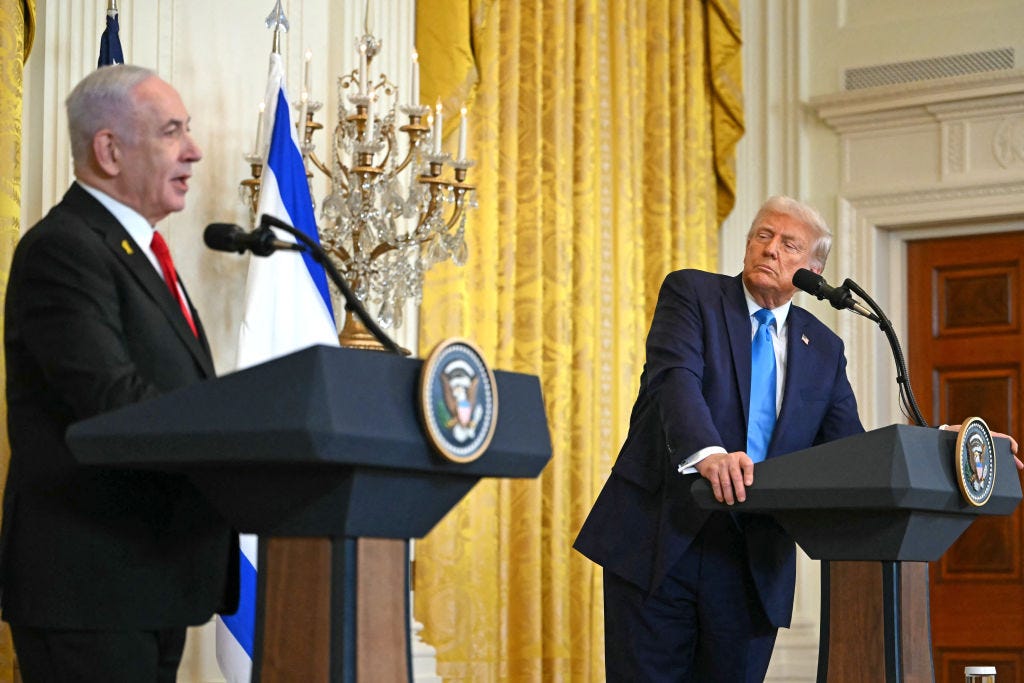
Trump
listens to Israel’s prime minister Benjamin Netanyahu speak during a press
conference in Washington, D.C., on February 4, 2025. (Andrew Caballero-Reynolds
via Getty Images)
A good
example is his first-term experience with radical Islamists in the Middle East.
On January 3, 2020, the Trump administration killed by drone the Iranian major
general Qasem Soleimani near the Baghdad airport. Soleimani had a long record
of waging surrogate wars against Americans, especially during the Iraq conflict
and its aftermath. After the Trump cancellation of the Iran deal, followed by
U.S. sanctions, Soleimani reportedly stepped up violence against regional
American bases in Iraq and Syria—most of which, ironically, Trump himself
wished to remove.
A few days
after Soleimani’s death, Iran staged a performance-art retaliatory strike of
twelve missiles against two U.S. air bases in Iraq, assuming that Trump had no
desire for a wider Middle Eastern war. Tehran had supposedly warned the Trump
administration of the impending attacks, which killed no Americans. Later
reports, however, did suggest that some Americans suffered concussions and that
more damage was done to the bases than was initially disclosed. Nonetheless,
this Iranian interlude seemed to reflect Trump’s agenda of avoiding “endless
wars” in the Middle East, while restoring deterrence that prevented, rather
than prompted, full-scale conflicts.
Yet in a
second Trump administration, such threading of the deterrence needle may become
far more challenging. The world today is far more dangerous than it was when
Trump left office in 2021. The U.S. military is far weaker, suffering from
munitions shortages, massive recruitment shortfalls, DEI mandates, and
dwindling public confidence. The State Department is far less credible, and
America’s enemies have been long nursed on Biden-era appeasement. Four years
ago, for example, no one would have dreamed that hundreds of thousands of
Ukrainians and Russians would become casualties in a full-scale war on Europe’s
doorstep.
Indeed, an
inept Biden administration crippled U.S. deterrence abroad through both actual
and symbolic disasters. In March 2021, Chinese diplomats brazenly dressed down
newly appointed Biden administration diplomats in Anchorage without rebuke. The
debacle in Afghanistan in August 2021 marked the greatest abandonment of U.S.
arms and facilities in American military history. Six months later, an
observant Vladimir Putin correctly surmised that a Russian invasion of Ukraine
would likely face few countermeasures from a now humiliated and unsteady United
States.
In late
January 2023, the meandering and uninterrupted weeklong flight of a Chinese spy
balloon across the American homeland seemed to exemplify the general disdain
enemies now held for the Biden administration. Indeed, foreign foes assumed
that there would be few Western consequences for their aggression, at least
during a window of opportunity never before seen—nor likely to be repeated.
On October
7, 2023, Hamas terrorists, followed eagerly by a ragtag mob of Gazans, stormed
into Israel. They murdered, tortured, raped, or took hostage some 1,200 Israeli
victims, sparking a theater-wide war against Israel instigated by Iran and its
surrogates.
The serial
Houthi attacks on international shipping intensified to such a degree that the
Red Sea joined the Black Sea, the Strait of Hormuz, the South China Sea, and
the Eastern Mediterranean as virtual no-go zones for Western shipping, given
the absence of visible American and NATO deterrents. By autumn 2024, Iran had
launched 500 missiles, rockets, and drones at the Israeli homeland, with the
United States loudly enjoining de-escalation and restraint on our Israeli ally.
By year’s
end, tens of thousands of North Korean combat troops were fighting with
Russians on the Ukrainian border. And by late 2024, the combined Russian and
Ukrainian dead, wounded, and missing had passed one million, in the greatest
European charnel house since the World War II battle for Stalingrad.
All these
foreign wars and quagmires pose dilemmas for MAGA reformers. Again, Trump was
not elected to be a nation-builder, globalist, or neoconservative
interventionist. Conversely, he is no isolationist or appeaser, on whose watch
the world would continue to descend into the chaos of the past four years. Yet
Trump in 2024 is much more emphatic about the need to avoid such dead-end
overseas entanglements, or even the gratuitous use of force that can lead to
tit-for-tat entanglements. That caution may obscure his Jacksonian foreign
policy and wrongly convince opportunists to test his frequent braggadocio and
purported deterrence credentials.
In this
regard, Trump’s selection of J.D. Vance as vice president and Tulsi Gabbard as
director of national intelligence, along with Tucker Carlson and the
once-Democratic pacifist Robert F. Kennedy Jr. as close advisers—coupled with
his announcements that the hawkish former secretary of state Mike Pompeo and
the former UN ambassador Nikki Haley would not be in the administration—may be
misinterpreted by scheming foreign adversaries as proof of a new Trumpian
unilateral restraint.
The
Republican Party is now the party of peace, and Trump the most reluctant
president to spend American blood and treasure abroad in memory. Trump broke
with previous Republican interventionism largely because he damned past
American misadventures in Afghanistan and Iraq that cost thousands of lives and
trillions of dollars while they distracted from an unsustainable national debt,
a nonexistent southern border, and a floundering lower middle class. Similarly,
it is no wonder that the public often sees the use of force abroad as coming at
the zero-sum expense of unaddressed American needs at home. Moreover, a woke,
manpower-short military has disparaged and alienated the working-class recruits
who disproportionately sought out combat units and fought and died in far-off
Afghanistan and Iraq.
Recently,
however, even as President Trump’s inner circle emphasized a stop to endless
conflicts, Trump himself in November 2024 warned Vladimir Putin not to escalate
his attacks against Ukraine. Yet that warning was followed by massive Russian
air onslaughts against largely civilian Ukrainian targets—and further threats
of tactical nuclear weapons deployed against Ukraine. Trump also instructed
Hamas and Hezbollah to cease their wars against Israel, and advised the former
to release the hostages, Americans particularly—or else.
Vladimir
Putin no doubt took note, but he also may have wished to encourage America’s
enemies to test Trump’s Jacksonian rhetoric against his campaign’s domestic
promises to mind America’s own business at home. So, is there a way to square
the circle of neither appeasing nor unwisely intervening?
Trump will
have to speak softly yet clearly while carrying a club. For the first few
months of his tenure, his administration will be tested as never before to make
it clear to Iran and its terrorist surrogates, as well as China, North Korea,
and Russia, that aggression against U.S. interests will swiftly incur
disproportionate and overwhelming repercussions—in order to prevent wider wars
that eventually might require the use of much larger forces.
Ukraine is,
paradoxically, a case study of both the dangers of American intervention in
distant foreign wars and the consequences of being regarded as weak, timid, and
unable or unwilling to protect friends and deter enemies. The cauldron on the
Ukrainian border, as already noted, has likely already caused between 1 and 1.5
million Ukrainian and Russian casualties, soldiers and civilians alike. There
is no end in sight after three years of escalating violence. And there are
increasing worries that strategically logical and morally defensible—but
geopolitically dangerous—Ukrainian strikes on the Russian interior could
escalate and lead to wider wars among the world’s nuclear powers. Joe Biden’s
postelection decision to allow Ukraine to launch sophisticated American
missiles deep into the Russian homeland was met by further Russian warnings of
escalation to the use of nuclear weapons.
Many on the
right wish for Trump immediately to cut off all aid to Ukraine for what they
feel is an unwinnable war, even if that cessation would end any leverage to
force Putin to negotiate. They feel the conflict was egged on by a globalist
left, as a proxy conflict waged to ruin Russia to the last Ukrainian soldier.
These critics see the war as conducted by a now undemocratic Ukrainian
government, without elections, habeas corpus, a free press, or opposition
parties, led by an ungracious and corrupt Zelensky cadre that has intrigued
with the American left in an election year. Preferring negotiations that might
cede Ukrainian territories already occupied by Russia for guarantees of peace,
they point to polls revealing that less than half the Ukrainian people are
confident of a full military “victory” that would restore the country’s 1991
borders.

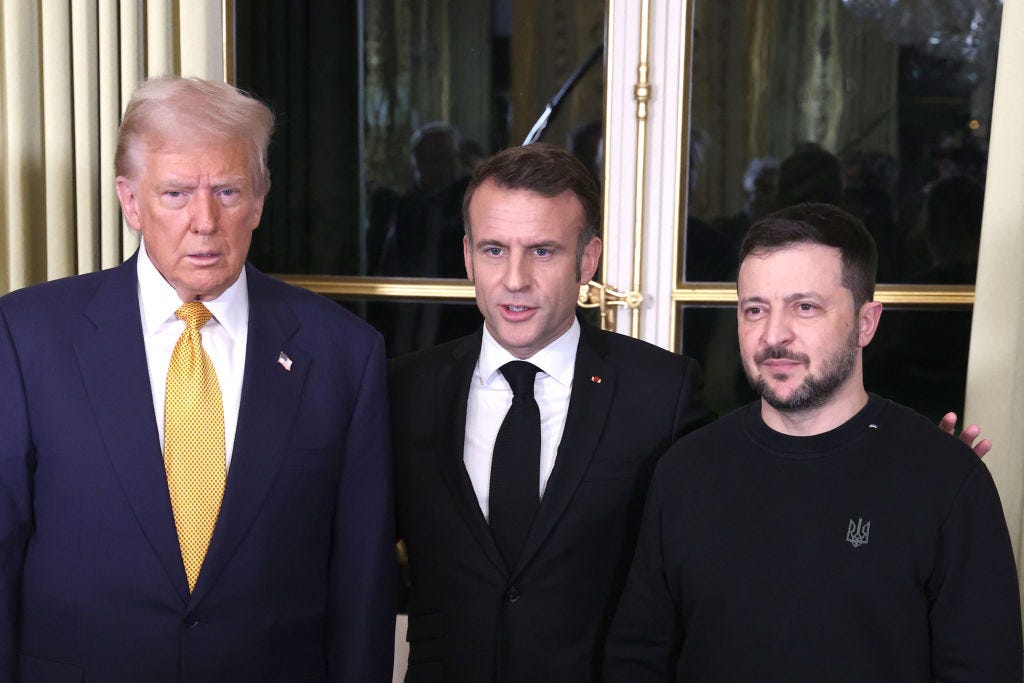
French
president Emmanuel Macron and Ukrainian president Vladimir Zelensky meet with
Trump on December 7, 2024, in Paris, France. (Oleg Nikishin via Getty Images)
In contrast,
many on the left see Putin’s invasion and the right’s weariness with the costs
of Ukraine as the long-awaited proof of the Trump-Russia “collusion” unicorn
and generally perfidious Trumpian Russophilia. They judge Putin, not China’s
imperialist juggernaut, as the real enemy. And they discount the dangers of a
new Russia-China-Iran-North Korea axis. To see Ukraine at last defeat Russia,
recover all of the Donbas and Crimea, and destroy the Putin dictatorship, they
are willing to feed the war with American cash and weapons—again, to the last
Ukrainian.
Trump vowed
to end the catastrophe within a day by doing what is now taboo—namely, calling
up Vladimir Putin and making a deal that would do the seemingly impossible and
entice Russia back inside its pre-invasion borders of February 24, 2022, thus
preserving a reduced but still autonomous, and even secure, Ukraine. How could
Trump pull this off?
Ostensibly,
Trump would be following the advice of a growing number of Western diplomats,
generals, scholars, and pundits who have reluctantly outlined a general plan to
stop the slaughter. But how would the dictator Putin face the Russian people
with anything short of an absolute annexation of Ukraine, after wasting a
million Russian casualties?
Perhaps,
after the deal, Putin could brag to Russians that he institutionalized forever
his 2014 annexations of the majority-Russian Donbas and Crimea; that he
prevented Ukraine from joining NATO on the doorstep of Mother Russia; and that
he achieved a strategic coup in uniting Russia, China, Iran, and North Korea in
a grand new alliance against the West and particularly the United States, with
the acquiescence, if not support, of the NATO member Turkey and an ever more
sympathetic India.
And what
would Ukraine and the West gain from such an example of the Trumpian “art of
the deal”? Kyiv might boast that, as the bulwark of Europe, Ukraine heroically
saved itself from Russian annexation, as was envisioned by Putin in the 2022
attempt to decapitate Kyiv and absorb the entire country. Ukraine was
subsequently armed by the West and fought effectively enough to stymie the
Russian juggernaut and humiliate and severely weaken the Russian military—to
the benefit of NATO and EU nations. Trump might then pull off the agreement if
he could further establish a demilitarized zone between the Russian and
Ukrainian borders and ensure EU economic help for a Ukraine fully armed to
deter an endlessly restless Russian neighbor.
What would
be the incentives for such a deal, and would they be contrary to the interests
of the American people or antithetical to the views of the new Republican
populist-nationalist coalition? First, consider that if Trump were to cut all
support for Ukraine, it would likely soon be absorbed by Russia. The MAGA right
would then be blamed for a humiliation comparable to the Kabul catastrophe.
Indeed, the fallout would likely be worse, since the situation in Ukraine,
unlike the Afghanistan mess, required only American arms, rather than lives. In
contrast, if the conflict grinds on and on, at some point the purportedly
humanitarian yet pro-war left will be permanently stamped as the callous party
of unending conflict, and seen as utterly indifferent to the Ukrainian youth
consumed to further its endless vendetta against a Russian people who also are
worn out by the war.
Both Russia
and Ukraine are running out of soldiers, with escalating casualties that will
haunt them for years. Russia yearns to be free of sanctions and to sell oil and
gas to Europe. The West, and the United States in particular, would like to
triangulate with Russia against China and vice versa, in Kissinger style, and
thus avoid any multi-power nuclear standoff.
Trump wants
global quiet in order to increase and stockpile American munitions with an
emboldened China on the horizon. He will inherit a U.S. military budget
dangerously exhausted by wasteful procurement of overpriced systems like the
F-22 aircraft and the littoral combat ship, by cuts in training for troops and
maintenance of ships, and by massive aid to Ukraine and Israel. Accordingly,
Trump prefers allies like Israel that can win with a few billion, rather than
those that continue to struggle after receiving $200 billion, as Ukraine has
done.

Last, Europe
is mentally worn out by the war, and increasingly reneging on its once-boastful
unqualified support for Ukraine, as it hopes the demonic Trump can both end the
hated war and be hated for ending it.
The same
challenge of forcefully dissuading bullies while avoiding exhausting wars will
confront Trump in the Middle East. To restore deterrence, Trump will have to
put the Houthis on notice that their attacks on international shipping in the
Red Sea will earn them something more deleterious than the Biden
administration’s passive deflections of shore-to-ship missile attacks. That
passivity has so far cost the United States about $2 billion in munitions
without achieving tangible results.
Iran, of
course, is at the nexus of Middle Eastern tensions. Both fear of Tehran’s
missiles and the Biden administration’s opposition paralyzed the Abraham
Accords. Iran supplies all the terrorist organizations—Hamas, Hezbollah, and
the Houthis—that have attacked Israel since Trump’s departure. Accordingly,
Trump will likely lift American restraints on Israel, supply the necessary
heavy-duty ordnance should it wish to retaliate against Iranian attacks by
taking out Iran’s nuclear program and oil-export facilities, and deter Russia
and China from intervening to help their client Iran.
In sum, to
ensure that there are no theater-wide conflicts in the Middle East as well as
in Eastern Europe and beyond, Trump will have to use disproportionate force to
dispel the image of the United States as indifferent to aggression due to fears
of costly intervention.
The MAGA
revolution that will now ensue in the four years of Trump’s second and last
presidential term promises to remake America in ways only haphazardly realized
four years ago. In Trump’s favor this time around are his past years of
governance and his knowledge of the sort of opposition he will now face—after
two impeachments, five weaponized civil and criminal court cases, repeated
efforts to remove his candidacy from state ballots, two assassination attempts,
and three brutal presidential campaigns.
The failed
Biden years—the entrance of 12 million illegal aliens through a deliberately
opened border, wars abroad, inflation, and soaring crime—helped propel the most
spectacular political resurrection in American political history. The backroom
Biden removal from the Democratic nomination, the subsequent listless Harris
campaign, and the ever more radical trajectory of the increasingly unpopular
Democratic Party have all put Trump in a far more powerful position than when
he entered the presidency in 2017 or when he left office in 2021.
Trump’s
success in resetting the United States will hinge not merely on outwitting the
desperation of his enemies, but also on navigating the paradoxes of
implementing his own MAGA agenda.
https://www.thefp.com/p/victor-davis-hanson-can-trump-reset?utm_source=substack&utm_medium=email